





Sharing research evidence with senior rather than junior staff significantly raises the chance it spreads through an organisation, but shifting peer beliefs about the evidence has no clear effect.
Many governments and policymakers rely on policy-advising organisations – international development banks, think tanks, ministries – to translate academic research into actionable recommendations. Yet better evidence does not automatically produce better policy. Even when high-quality research exists, it must travel through layers of hierarchy inside a policy-advising organisation, both upward and downward. A junior analyst may surface a finding that never reaches the decision-maker who could act on it. Equally, a senior leader’s review of the evidence may never filter down to the operational level. Each step in the chain is a potential bottleneck; accordingly, the evidence-to-policy pipeline increasingly impedes the use of rigorous research in practice (DellaVigna et al. 2024, Garcia-Hombrados et al. 2025, Bonargent 2024, Rao 2024).
A growing evidence base examines how policymakers engage with evidence (Vivalt and Coville 2023, Toma and Bell 2024), and how training can build capacity for evidence use (Crowley et al. 2021, Mehmood et al. 2024), but much less is known about what drives evidence diffusion within organisations. Who shares evidence with whom? Does it depend on where in the hierarchy evidence first lands? Do concerns about how peers might react shape whether sharing happens? These are the questions we set out to answer.
An experiment inside the World Bank
We designed a large-scale framed field experiment at the World Bank’s headquarters in Washington, DC, involving 1,319 permanent employees across 360 divisions (Shaukat, Stegmann, and Toma 2025). The World Bank provides an ideal setting, both producing and consuming rigorous research, and routinely translating evidence into policy advice for governments worldwide – making it a key node in the evidence-to-policy chain.
In each division, we randomly invited one employee – whom we refer to as the ‘seed’ – to complete a survey. In three-quarters of divisions, we shared scientific evidence on the workplace impacts of generative AI (like ChatGPT) as part of the survey. We focused on generative AI for two reasons: our experiment coincided with the early stages of its rollout in workplaces, making it a timely topic, and its broader relevance to organisations like the World Bank.
Generative AI shapes the production of policy advice and core knowledge-work tasks such as synthesis and analysis – and, as governments weigh its regulation and adoption, it has itself become an important policy topic. In the first round of the experiment (December 2023 to January 2024), seeds received findings from Noy and Zhang (2023) showing that ChatGPT access significantly improved task completion speed and output quality among skilled workers. In the second round (March to April 2024), seeds received findings from Doshi and Hauser (2024) showing that ChatGPT boosted the novelty and usefulness of creative writing.
We cross-randomised two main treatments. First, we varied whether the seed was a relatively senior or junior employee. Second, we randomly varied whether seeds received positive or negative information about how many colleagues were already using and endorsing ChatGPT. We then measured how far this evidence travelled through three outcomes: seeds’ stated intention to share the evidence, engagement with a shareable infographic tracked via link clicks, and – two to three weeks later – colleagues’ recall of specific study details in a separate survey.
Hierarchy determines who shares evidence
Figure 1 shows that the most striking finding concerns organisational rank. Seeding evidence with a senior employee substantially increased diffusion of scientific evidence, as measured by all three outcomes.
Senior seeds were 14 percentage points more likely than junior seeds to report being willing to share the evidence with colleagues. In divisions where a senior employee received the evidence, the infographic link was 16 percentage points more likely to be clicked multiple times – suggesting the materials were genuinely passed on, rather than just opened by the seed alone. And when we surveyed colleagues two to three weeks later, colleagues of senior seeds were 5 percentage points more likely to correctly recall at least one notable feature of the study.
Figure 1: Impact of evidence sharing, by seniority and positive information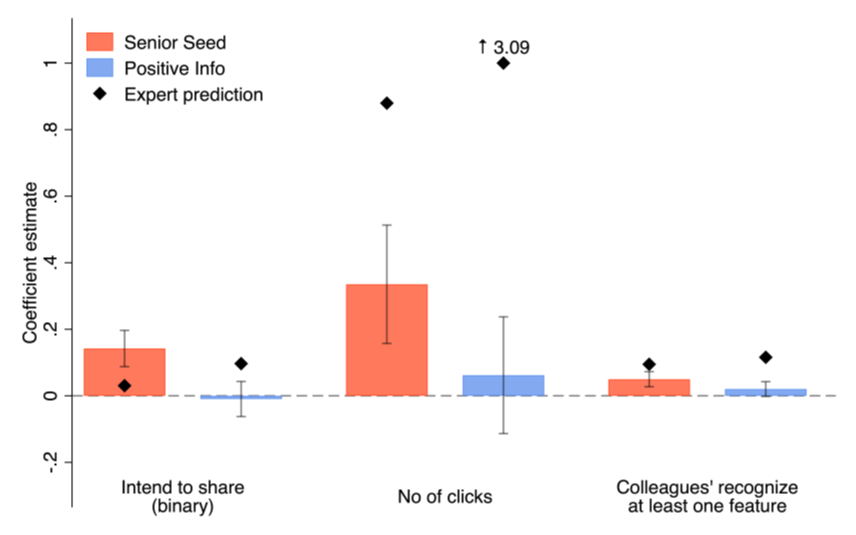
Notes: This figure shows the impact of our treatments on three outcomes relevant for evidence dissemination: (i) the likelihood that a seed self-reports intentions to share evidence as ‘likely’ or ‘very likely’; (ii) number of clicks on infographics summarising the evidence; and (iii) the likelihood that seeds’ colleagues recognise at least one feature of the evidence. The red bars report effects for seeding evidence with a senior seed, while the blue bars report effects for sharing positive information with seeds about their colleagues’ perceptions of the evidence. 95% confidence intervals are reported.
What explains this pattern? Senior seeds appear both more motivated to share evidence and less constrained by perceived barriers than junior seeds. On the motivation side, senior seeds were significantly more likely to cite the value of the evidence for their peers as a reason for sharing, and they also tended to view the evidence as more credible, interesting, and useful, although these differences are only suggestive and not precisely estimated. On the barrier side, senior seeds were significantly less likely to report concerns about generating conflict as a reason not to share. In other words, senior seeds may have been less worried about the reputational consequences of sharing evidence to which their colleagues may have mixed reactions compared to junior seeds. Part of this pattern may also reflect selection into senior roles: senior staff were, on average, more educated and more frequent users of ChatGPT. Despite this, the main results remain similar when we account for these observable differences.
Shifting beliefs about peers has no effect
The second treatment tells an equally instructive story. We gave seeds either a positive or a negative view of colleagues’ ChatGPT adoption: in the positive condition, seeds learned that 75% of a sample of their colleagues that we surveyed before our experiment use ChatGPT and 80% support its frequent use at the World Bank; in the negative condition, those figures were 20% and 18%, respectively.[1] This information effectively shifted seeds’ beliefs about their colleagues’ views, with seeds in the positive condition estimating their colleagues’ ChatGPT adoption to be 12 percentage points higher, and support for its use to be 22 percentage points higher.
Yet we observed no effect of this information on sharing behaviour. Seeds in the positive information condition were no more likely to share the evidence, the infographic was not clicked more often, and colleagues were no more likely to recall the studies. Despite clear and substantial belief updating about peers, the perceived social acceptability of sharing did not lead to an observable increase in evidence sharing.
Even informed observers expected a different result
Before releasing the results, we surveyed 72 researchers – World Bank economists and external social scientists – and asked them to predict the effects of the two treatments. The researchers correctly predicted that sharing evidence with senior World Bank employees would lead to more dissemination relative to sharing it with junior employees. However, they also (incorrectly) predicted that shifting employees’ beliefs about their colleagues’ perceptions of ChatGPT would have large effects. This suggests that even well-informed observers can misjudge how evidence actually travels within organisations.
What this means for the evidence-to-policy pipeline
These findings point to a practical tension in how policy-advising organisations treat evidence. Senior staff are more effective messengers: they are more likely to share evidence, get colleagues to engage, and ensure the message is heard and remembered. Yet evidence often enters organisations at junior levels, through the analysts and researchers who first encounter new studies and may be more open to experimenting with novel ideas and technologies than their senior colleagues. If evidence does not reliably travel upward from there, organisations may systematically underuse the research they nominally champion.
Overall diffusion remained limited: just 3% of colleagues in divisions with a seed who received evidence recalled any feature of the studies in the first round of the experiment, and essentially none in the second round. This is despite the majority of seeds reporting an intention to share and substantial engagement with the infographic. Whether 3% represents a meaningful reach or a ceiling depends on one’s baseline expectations – we do not have good comparisons for how far evidence typically spreads through large organisations. What the results do suggest is that even senior seeds’ enthusiasm is not sufficient on its own to drive widespread evidence diffusion through a large organisation.
While the quality of research evidence has long been a focal point for both research and policy communities, this work points to the routing of evidence inside organisations as another key predictor of effective evidence use. Identifying a senior champion for a new study may increase how widely findings are heard and acted upon. More broadly, efforts to strengthen the evidence-to-policy pipeline should take internal organisational structure seriously: how evidence travels within institutions may matter as much as how it is communicated from researchers to those institutions in the first place.
References
Bonargent, A (2024), "Can research with policymakers change the world?" Unpublished manuscript.
Crowley, D, e a (2021), "Lawmakers' use of scientific evidence can be improved," Proceedings of the National Academy of Sciences, 118(9): e2012955118.
DellaVigna, S, W Kim, and E Linos (2024), "Bottlenecks for evidence adoption," Journal of Political Economy, 132(8): 2748–278.
Doshi, A R, and O P Hauser (2024), "Generative AI enhances individual creativity but reduces the collective diversity of novel content," Science Advances, 10(28): eadn5290.
Garcia-Hombrados, J, M Jansen, A Martínez, B Ozcan, P Rey-Biel, and A Roldan-Mones (forthcoming), "Ideological alignment and evidence-based policy adoption," American Economic Review.
Mehmood, S, S Naseer, and D L Chen (2024), "Training policymakers in econometrics," Unpublished manuscript.
Noy, S, and W Zhang (2023), "Experimental evidence on the productivity effects of generative artificial intelligence," Science, 381(6654): 187–192.
Rao, M R (2024), "Program evaluations and policy spending," Unpublished manuscript.
Shaukat, M I, A Stegmann, and M Toma (2026), "How do organizations learn? The diffusion of scientific evidence on generative AI," Unpublished manuscript.
Toma, M, and E Bell (2024), "Understanding and increasing policymakers' sensitivity to program impact," Journal of Public Economics, 234: 105096.
Vivalt, E, and A Coville (2023), "How do policymakers update their beliefs?" Journal of Development Economics, 165: 103121.