




Formal military cooperation between neighbouring states can reduce jihadist violence in border regions, as shown by causal evidence from the G5 Sahel Joint Force, which allowed armies to conduct joint operations and share intelligence across borders. However, high levels of civilian victimisation put these gains into perspective. Military cooperation alone cannot resolve deep-rooted conflicts; any benefits are contingent on institutional stability – a lesson made urgent by the subsequent collapse of the G5 framework following coups in Mali, Burkina Faso, and Niger.
Borderlands are violent places. In 2023, nearly 19% of recorded violent events worldwide occurred within 50 kilometres of an international border, despite these areas accounting for only 6% of the world's population. This concentration of violence is particularly acute in West Africa's Sahel region, where jihadist insurgencies have killed tens of thousands since 2012. The tri-border area, where Mali, Niger, and Burkina Faso converge without physical demarcation, has become the epicentre of this crisis.
Geographic research over the past decade has documented this troubling trend. Quantitative spatial analysis of conflict patterns across North and West Africa has revealed that violence increasingly concentrated in borderlands between 1997 and 2019 (OECD/SWAC 2020, 2022, Radil et al. 2022). This work explored multiple explanations for this pattern, from state capacity failures to border permeability to local governance dynamics.
In a recently published article (Richard and Vanden Eynde 2026), we focus on one specific mechanism that can be addressed through policy intervention: armed groups exploit an asymmetry in cross-border mobility. They can attack in one country and retreat to another, while national armies face legal and practical constraints at international boundaries. Can formal military cooperation between neighbouring countries reduce this asymmetry and lower violence? We provide the first causal evidence on this question. By doing so, we add to recent work on the organisation of security forces in conflict zones (Dell and Querubin 2018, Blair 2025, Fetzer 2021, Fetzer 2026).
The G5 Sahel experiment
In 2017, five Sahel countries – Mali, Niger, Burkina Faso, Mauritania, and Chad – launched the G5 Sahel Joint Force. This 5,400-strong force had a specific mandate: operate within designated 50km zones along international borders to combat jihadist groups, trafficking networks, and trans-border crime. Critically, the Joint Force could conduct cross-border operations and coordinate intelligence-sharing between national armies – capabilities they had previously lacked.
The G5 Sahel addressed coordination failures in two ways. First, it provided a commitment mechanism for states to deploy troops effectively in border areas, overcoming free-riding problems. Second, it established communication channels between national armies, allowing them to share intelligence and conduct joint operations. Legal authorisation to cross borders within operation zones allowed the Joint Force to eliminate the sanctuary advantage that armed groups had long exploited.
France provided logistical support, but analysts emphasise that the initiative was driven by the participating states themselves. The UN mission in Mali (MINUSMA) offered limited operational support, constrained by its own overstretched capacities and restricted to Malian territory.
Figure 1: Foreign military operations before and during the G5 Sahel Joint Force
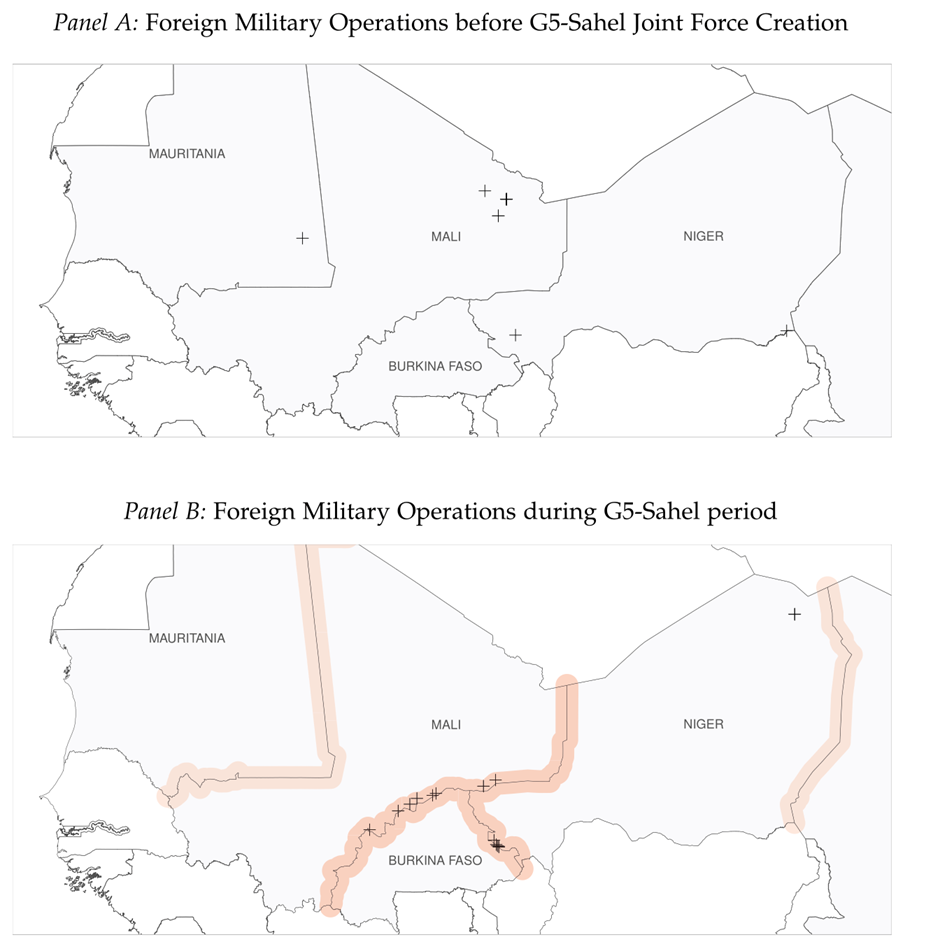
Notes: Panel A shows the sparse presence of foreign military operations before the creation of the G5 Joint Force. Panel B shows operations during the G5 period, with the shaded buffer zones (50km along international borders) marking the designated operation zones. The concentration of activity along border segments illustrates the geographic focus of the mission – and the sharp boundary we exploit for identification.
Measuring impact with spatial regression discontinuity design
To isolate the effect of military cooperation from broader conflict trends, we exploit the sharp geographic boundary of the G5 operation zone. Grid cells just inside the 50km buffer had G5 Joint Force presence; those just outside remained under sole national army control. This discontinuity allows us to compare otherwise similar locations exposed to different security arrangements.
Figure 2: Fatalities as a function of distance to the G5 operation zone boundary (50km from borders)
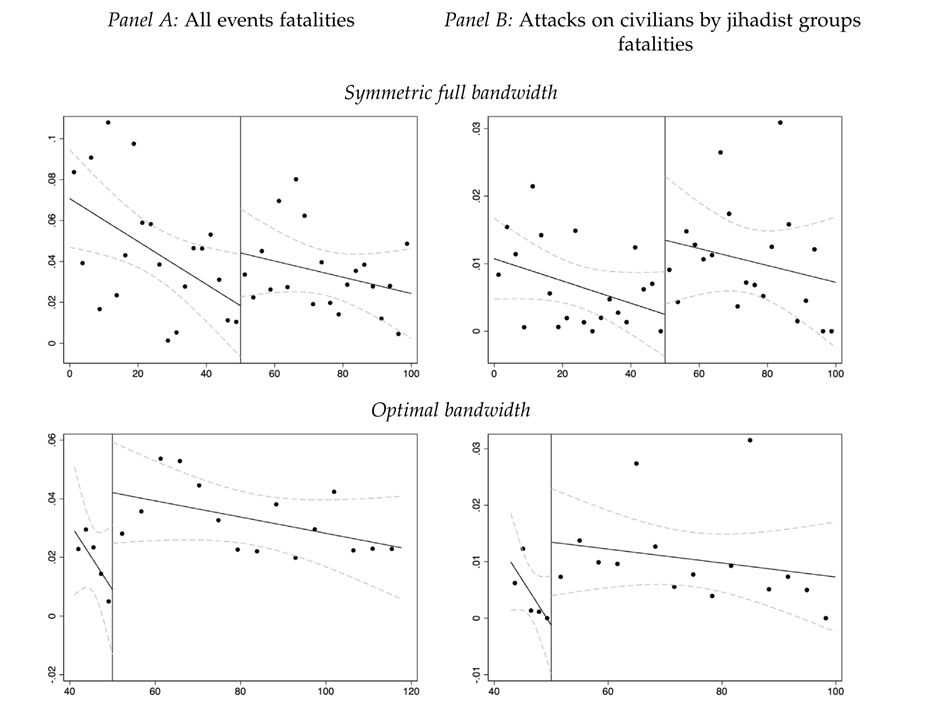
Notes: Each dot represents a binned average; the vertical line marks the boundary of the operation zone. Panel A shows all violent events; Panel B isolates attacks on civilians by jihadist groups. Fatalities drop sharply just inside the operation zone, with the discontinuity particularly pronounced for jihadist violence against civilians.
Using high-precision conflict data from ACLED between September 2017 and January 2020, we find clear evidence that the G5 mission reduced violence locally:
- Violence declined significantly within the operation zone. We observe fewer fatalities and violent events in areas where the G5 mission was active. The effect is statistically robust and economically meaningful in this specific context.
- The effect concentrated on jihadist violence. Attacks on civilians by jihadist groups – the primary mandate of the G5 mission – showed the sharpest decline. Security operations against ethnic militia also decreased, suggesting the mission operated within its stated objectives rather than targeting all armed groups indiscriminately.
- Porous borders saw larger reductions. We find varying effects across border segments. Violence declined most where borders were most permeable: in areas with above-median terrain ruggedness (which facilitates concealment) and where ethnic groups straddled both sides of the border (enabling cross-border support networks).
- Armed groups operating across borders were specifically affected. When we distinguish between groups operating in multiple countries versus those confined to one nation, we find the G5 mission reduced violence from transnational groups – exactly those exploiting cross-border mobility – while having no effect on purely domestic armed groups.
How it worked: Responsiveness to threats
To understand the mechanism behind these results, we examined how security forces responded to major French operations against jihadist groups (which we use as ‘trigger events’ that typically cause jihadist groups to relocate and intensify activity).
Our analysis reveals a clear pattern: without the G5 mission, security operations actually decreased in border areas following trigger events – suggesting national armies faced operational constraints near borders. However, when the G5 mission was active, this pattern reversed entirely. Security forces became significantly more responsive in border zones, conducting more operations in the weeks following a trigger event.
This finding provides direct evidence that the G5 mission facilitated security operations where they had previously been hampered. The improved responsiveness likely created a deterrent effect, explaining the overall reduction in jihadist violence we observe in our main results.
A natural concern is whether armed groups simply relocated just outside the operation zone. Our analysis finds no evidence of such displacement. Violence patterns just beyond the 50km boundary show no spike, and the graphical patterns in our data are inconsistent with symmetrical displacement. This doesn't mean broader regional displacement is impossible – violence could have moved to areas beyond our estimation bandwidth. However, our theoretical framework and empirical evidence show that armed groups derive substantial strategic value from operating near borders (access to smuggling routes, ability to evade pursuit, opportunities for expansion). Pushing them away from these areas reduces their capabilities, suggesting local reductions can represent genuine security improvements.
What this means for policy
Our findings carry several implications for security provision in conflict-affected border regions:
- Institutionalised cooperation works, but context matters. The G5 Sahel succeeded in reducing violence locally despite severe organisational challenges, including coordination problems between member states and limited resources. The mechanism was straightforward: joint operations and intelligence-sharing allowed armies to neutralise the cross-border sanctuary advantage that armed groups had exploited. However, effectiveness was greatest where geographic and ethnic factors made borders naturally porous – suggesting cooperation should prioritise the most permeable segments.
- Local effects can still be valuable if well targeted. Despite the local reductions we document, the Sahel security situation continued to deteriorate during and after our study period. Jihadist groups expanded operations, and violence spread to new areas. Our findings suggest that structured military cooperation can reduce borderland violence – at least locally and in the short term – but military cooperation alone cannot resolve deep-rooted conflicts driven by governance failures, economic marginalisation, and ethnic tensions. Yet local need not mean marginal. In related work, Richard (2026) shows that insecurity along migration routes in Mali significantly reduces post-harvest seasonal migration, a key risk-coping strategy for rural households, with measurable consequences for lean-season consumption. Coordinated border operations like those of the G5, if directed along key migration corridors and timed to protect seasonal mobility windows, could translate local violence reduction into tangible welfare gains for rural populations.
- The institutional landscape has since collapsed. Between 2020 and 2023, military coups in Mali, Burkina Faso, and Niger toppled civilian governments and fundamentally reshaped the region's security architecture. The three juntas formed the Alliance des États du Sahel (AES) in September 2023, withdrew from the G5 Sahel, and announced their departure from ECOWAS. While the AES formalises cooperation between the three regimes, it simultaneously severs cooperation with their other neighbours. This matters precisely because of what our research documents: the border security problem in the Sahel is not confined to the borders between Mali, Niger, and Burkina Faso. It plays out at all borders across the region, including those with Benin, Togo, Côte d'Ivoire, Ghana, and others. Armed groups do not respect the boundaries of any political alliance. By turning inward, the AES countries may be addressing one set of borders while leaving others dangerously exposed, with no institutional framework to coordinate with the ECOWAS states on their other flanks.
- Human rights concerns remain critical. While we document violence reduction under the G5, armies participating in the mission were regularly accused of human rights abuses against civilians (MINUSMA 2018, HRW 2021). Our data shows that security force violence against civilians increased in border areas when the G5 was active, mirroring the pattern of military operations more broadly. The current trajectory raises further concerns: the AES governments have increasingly turned to private military contractors, first Russia's Wagner Group – now rebranded as the Africa Corps – to supplement or replace national and multilateral forces. Reports of civilian massacres linked to these mercenary forces have emerged. Yet the absence of the oversight mechanisms that, however imperfectly, accompanied multilateral frameworks like the G5, means there is even less pressure for restraint.
References
Blair, C W (2025), "Border fortification and legibility: Evidence from Afghanistan," American Journal of Political Science, 69: 1559–1580.
Dell, M, and P Querubin (2018), "Nation building through foreign intervention: Evidence from discontinuities in military strategies," Quarterly Journal of Economics, 133(2): 701–764.
Fetzer, T, P C L Souza, O Vanden Eynde, and A L Wright (2021), "Security transitions," American Economic Review, 111(7): 2275–2308.
Fetzer, T, O Vanden Eynde, and A L Wright (2026), "Team production on the battlefield: Evidence from NATO in Afghanistan," Journal of Economic Behavior & Organization, 241: 107385.
Human Rights Watch (2021), "Sahel: End abuses in counterterrorism operations."
MINUSMA (2018), "La MINUSMA conclut son enquête sur les incidents de Boulkessy du 19 Mai 2018."
OECD/SWAC (2020), "The geography of conflict in North and West Africa."
OECD/SWAC (2022), "Borders and conflicts in North and West Africa."
Radil, S, I Irmischer, and O Walther (2022), "Contextualizing the relationship between borderlands and political violence: A dynamic space-time analysis in West and North Africa," Journal of Borderlands Studies, 37(2): 253–271.
Richard, M (2026), "The roads not taken: The economic cost of insecurity along migration routes in Mali," Unpublished manuscript.
Richard, M, and O Vanden Eynde (2026), "Cooperation between national armies: Evidence from the Sahel borders," Journal of Development Economics, 181: 103726.