





Evidence from Ecuador reveals that central transfers to subnational governments can meaningfully stimulate local economic activity – operating primarily through higher municipal spending on wages, procurement, and small-scale investment.
Editor's note: The authors have made slides available here.
Across Latin America, subnational governments rely heavily on transfers from central governments, which account for around 58% of their revenues on average (Alves et al. 2025). These funds sustain the provision of basic public goods and services through basic administrative functions (e.g. operating schools, maintaining local roads). Yet despite their central role, a fundamental question remains: do these transfers stimulate local economic activity?
Much of the existing evidence on this topic is based on the US and Europe (Jackson et al. 2016, Leduc and Wilson 2017), contexts where institutions, markets, and state capacity differ markedly from those in developing countries. As a result, the design of transfer rules for subnational governments in Latin America often relies on evidence that fails to reflect their realities – high informality, volatile fiscal revenues, and uneven (often limited) administrative capacity.
This matters because debates over these rules tend to focus narrowly on ‘territorial equity’, making them politically charged but analytically shallow. Transfers are often seen as redistributive tools but their potential to stimulate local demand, support firms, and drive short-run economic activity remains poorly understood and largely unconsidered. A reform in Ecuador provided exactly the opportunity to fill that knowledge void.
Ecuador’s 2017 transfer formula reform
Each year, the central government in Ecuador allocates a fixed share of national tax revenues and oil income to local governments using a formula, which assigns resources based on seven attributes of each subnational government measured the year before – population size, unmet basic needs, fiscal effort, along with two indicators of administrative performance – each with a predefined weight.
In 2017, Ecuador quietly changed that formula, altering the weights assigned to existing criteria; however, the underlying data, rules, and procedures remained the same. The new reform resulted in some municipalities receiving more money than expected (those in blue in Figure 1) while others received less (those in red). We assume these reforms exogenous to the municipalities, given that they had no influence on the reforms and the new weights were assigned uniformly. This created a rare opportunity to observe how local economies react when municipal budgets shift suddenly for reasons beyond local control.
Figure 1: Municipal winners and losers from the 2017 transfer formula reform
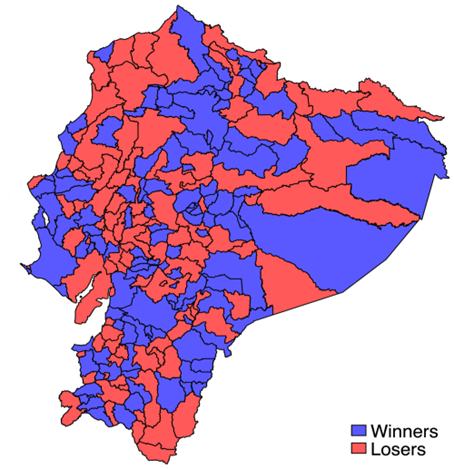
Source: Authors’ calculations based on estimates from Sánchez-Aragón et al. (forthcoming).
To identify the impact of these budget changes, our analysis (Sánchez-Aragón, Sánchez, and Zanoni forthcoming) relies on a design-based instrumental variables strategy, which treats the mechanical reweighting of the formula components as a source of exogenous variation once the underlying attributes of local governments are accounted for (Lee et al. 2022, Borusyak et al. 2025). This approach makes it possible to compare business activity in municipalities that gained or lost funding for reasons unrelated to their own local conditions, providing credible evidence on how transfers affect local economic activity.
What happened when transfers changed?
Using a longitudinal administrative database that linked budget transfer data from the Ministry of Finance to business balance-sheet information from tax records, we document substantial variation in the size of transfer shocks across municipalities. Municipalities receiving larger increases in central transfers experienced sharp and economically meaningful growth in business sales. For every 1% increase in transfers, total sales rose by 0.94% in 2018 and 1.05% in 2019. Non-VAT sales, often tied to exempt activities, grew even more (1.12% and 1.33%, respectively), while VAT-taxed sales increased by 0.87–0.92%. The 2019 transfer shock alone generated roughly US$646 million in additional non-VAT sales (≈0.6% of GDP). Small and medium enterprises (SMEs) saw the strongest responses, consistent with their dependence on local demand and liquidity. Figure 2 shows how the transfer shock affected municipalities, with impacts measured as elasticities. Some areas exhibit stronger responses than others, whether we focus on SME sales or on total sales across all firms.
Figure 2: Impact of the MET reform on local economies – Total sales and SME sales (2018)
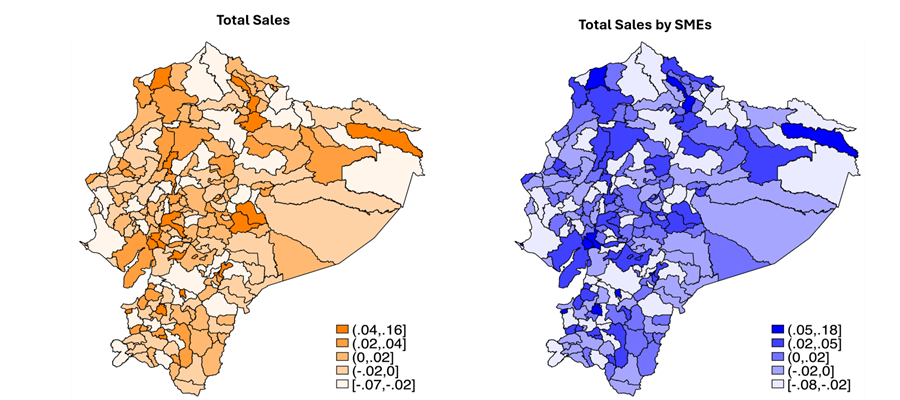
Source: Authors’ calculations based on estimates from Sánchez-Aragón et al. (forthcoming). Note: Legend values represent elasticities: a 1% increase in central transfers leads to the indicated percentage change in local business sales.
A key institutional feature helps interpret these effects as a genuine local stimulus. VAT is collected centrally in Ecuador, and municipalities neither set rates nor audit firms. This means the increases in reported sales are unlikely to reflect changes in enforcement or administrative pressure. Instead, they almost certainly represent real increases in economic activity.
Distributional effects of the transfer reform
Municipalities with high unmet needs, large territorial extension, or low population density tended to experience ‘gains’. This occurred mechanically, as the new weighting scheme placed relatively more emphasis on the characteristics they already possessed. Conversely, several dense, urban, or fiscally stronger municipalities experienced reductions in their expected transfers.
These differences in budget shocks interacted sharply with how municipalities spend. Expenditure data shows two dominant channels through which transfers translate into local economic activity. A 1% increase in transfers generates 1.05–1.25% growth in current spending, largely personnel and routine procurement, and 0.74–0.85% growth in capital spending, especially small-scale infrastructure. Municipalities that received larger-than-expected gains (typically rural, poorer, and lower-density) responded most strongly along both channels: wages boosted immediate consumption in local businesses, while procurement and investment injected liquidity into local supplier networks. Figure 3 shows how the transfer shock translated into changes in municipal spending, with impacts measured as elasticities. Responses differ across municipalities and vary by spending category – current, capital, and total spending.
Figure 3: Impact of the MET reform on municipal spending
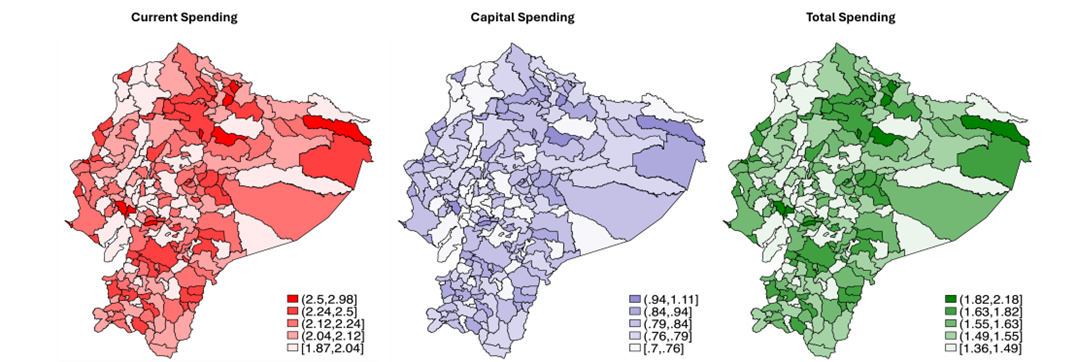
Source: Authors’ calculations based on estimates from Sánchez-Aragón et al. (forthcoming). Note: Legend values represent elasticities: a 1% increase in central transfers leads to the indicated percentage change in spending across municipalities.
Transfers are not only redistributive, but also provide local economic stimulus
Our findings matter for governments in Latin America as they show that intergovernmental transfers do far more than finance schools, roads, or administrative services – they meaningfully stimulate local economic activity. In a region where municipalities depend heavily on central transfers and where firms, especially SMEs, face chronic liquidity constraints, even modest increases in rules-based funding trigger sizeable increases in sales, production, and demand. Our results from Ecuador demonstrate that municipalities can act as effective stabilisers of local economies despite limited fiscal autonomy or uneven administrative capacity. This fills a long-standing gap in the evidence base. Debates over transfer formulas often rely on assumptions drawn from high-income countries, yet the institutional realities of Latin America – high informality, fiscal volatility, and capacity asymmetries – are fundamentally different.
Equally important, we show how transfers translate into economic gains. Municipalities channel additional resources primarily through recurrent spending and procurement, which rapidly inject liquidity into local supplier networks and household incomes. These channels matter for policy design: they imply that the effectiveness of transfers depends not only on how much money is sent, but on the speed and predictability with which municipalities can execute their budgets. Strengthening rules-driven allocation mechanisms and improving local procurement and execution capacity can significantly amplify the impact of central transfers, helping promote more inclusive and geographically balanced development. Governments across the region should take these findings into account when designing reforms to transfer systems or pursuing broader decentralisation agendas.
References
Alves, G, P Brassiolo, F Buccari, C Camacho, R Cifuentes, R Estrada, and G Fajardo (2025), “Nearby solutions: The role of regional and local governments in Latin America and the Caribbean,” Unpublished manuscript.
Borusyak, K, P Hull, and X Jaravel (2025), “Design-based identification with formula instruments: A review,” Econometrics Journal, 28: 83–108.
Jackson, C K, R C Johnson, and C Persico (2016), “The effects of school spending on educational and economic outcomes: Evidence from school finance reforms,” Quarterly Journal of Economics, 131: 57–218.
Leduc, S, and D Wilson (2017), “Are state governments roadblocks to federal stimulus? Evidence on the flypaper effect of highway grants in the 2009 Recovery Act,” American Economic Journal: Economic Policy, 9: 253–292.
Lee, D S, J McCrary, M J Moreira, and J Porter (2022), “Valid t-ratio inference for IV,” American Economic Review, 112: 3260–3290.
Sánchez-Aragón, L, G Sánchez, and W Zanoni (2026), “Stimulating local economies through central transfers: Evidence from Ecuador,” Journal of Development Economics, 179: 103664.