




The 1933 Soviet famine was not the inevitable result of poor harvests but of Stalin’s collectivisation and procurement policies, which disproportionately targeted Ukrainians and produced catastrophic, unequal mortality.
Editor’s note: An earlier version of this article was first published on Broadstreet.
The Soviet famine of 1933 claimed between 6 to 10 million lives. Another 60 million starved or witnessed starvation around them – surviving, but likely scarred for life. It was the second-deadliest famine of 20th century, surpassed only by the Great Chinese famine. However, in terms of deaths relative to the overall population, the two were tragically similar.
Though 1933 may seem distant now, this was the world of many of our grandparents and great-grandparents – people forced to live through unimaginable horrors: entire villages were emptied, families vanished, and acts of desperation – such as cannibalism – became grim realities.
The victims were disproportionately Ukrainians. Although the Soviet republic of Ukraine made up only 20% of the population, it accounted for at least 40% of famine deaths. Today, Ukraine considers the 1933 famine a genocide, while Russia denies this history – portraying Stalin as “an effective manager” (Kolesnikov 2019) and even destroying famine memorials in the occupied territories (Naylor 2023). The legacy of this suffering endures: the memory of the famine continues to shape politics and economic development to this day (Rozenas and Zhukov 2019, Yaremko 2022, Naumenko 2024b).
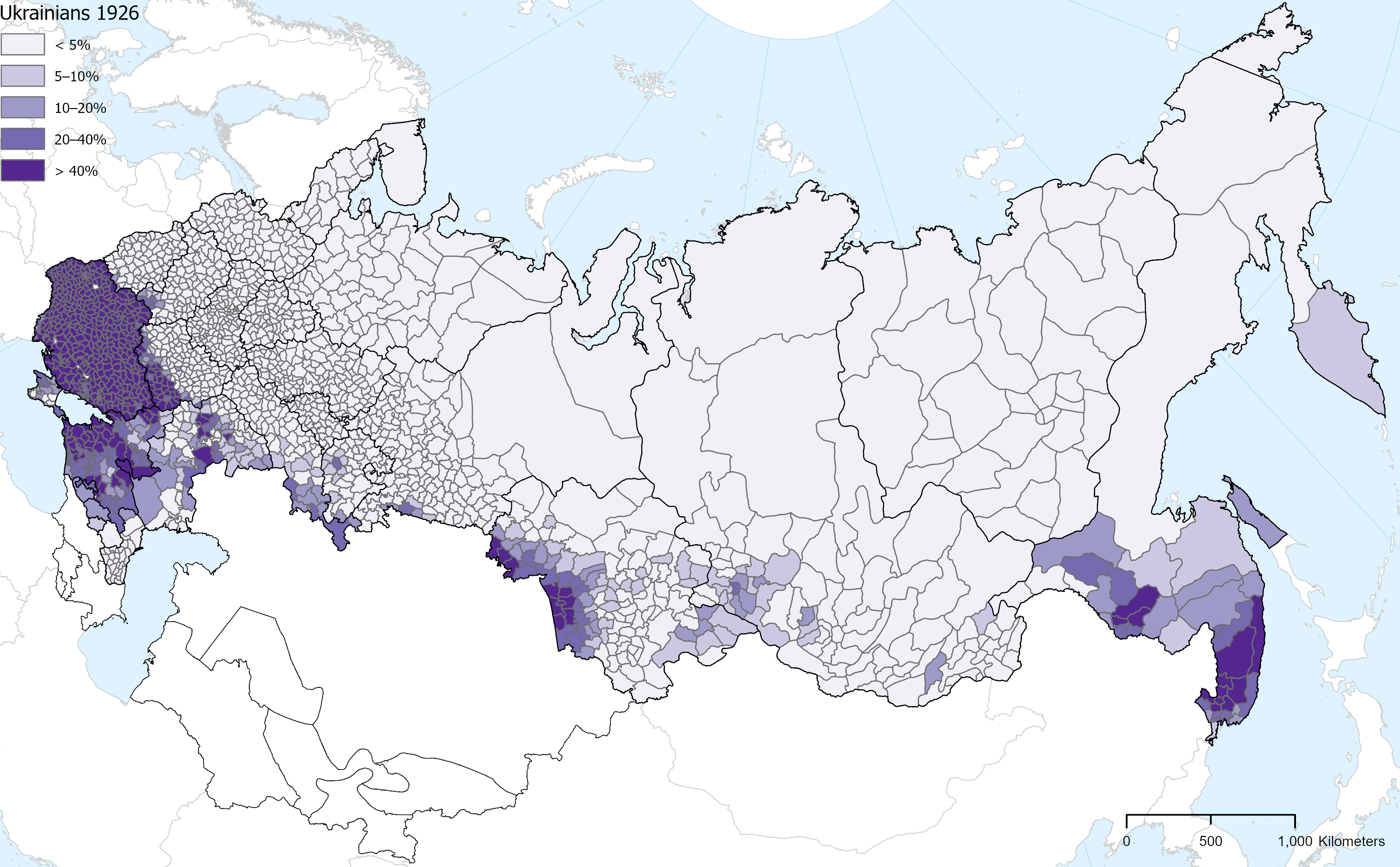
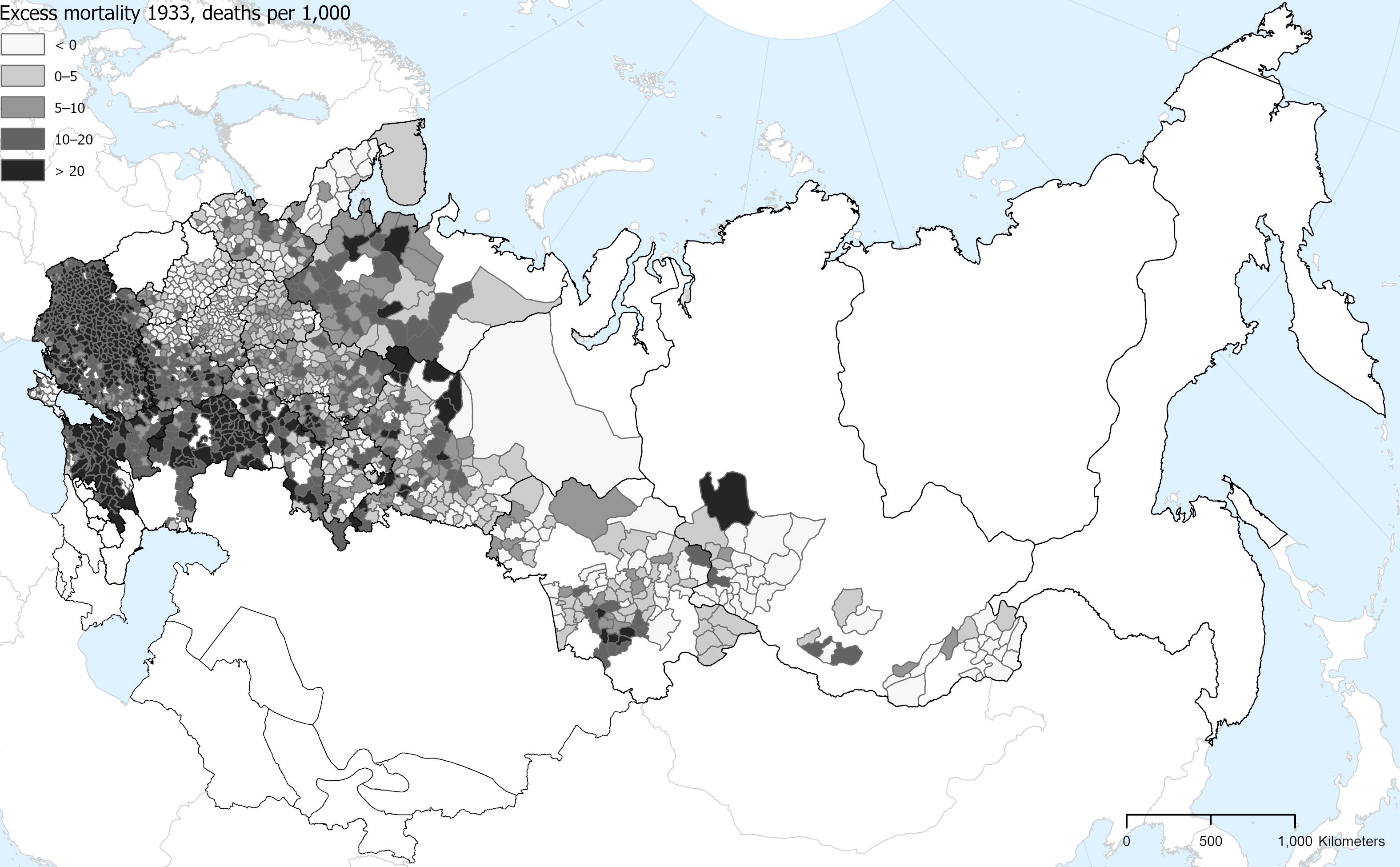
In recent work, we study the famine (Naumenko 2021, Markevich, Naumenko, and Qian 2025). The maps below compare the distribution of ethnic Ukrainians (Figure 1) with excess mortality in 1933 (Figure 2). They reveal a stark pattern: areas with more Ukrainians also suffered the highest mortality. Yet the interpretation of this remains contested: were ethnic Ukrainians deliberately targeted – perhaps through an artificially planned famine, as some argue? Or did mortality rise because Ukrainians largely inhabited the grain-producing regions of the Soviet Union, which were particularly vulnerable to weather shocks and bad government policies? To answer this question, we must take a step back and understand why this famine happened.
Figure 1: 1926 Ukrainian population share
Source: Markevich, Naumenko, and Qian (2025).
Figure 2: 1933 excess mortality
Source: Markevich, Naumenko, and Qian (2025).
Famines in Russian history
First, let’s put the 1933 famine into perspective. How normal – or how abnormal – was it? Russia (the Russian Empire before 1917, and the Soviet Union thereafter) was a largely agrarian economy: in 1926, 80% of the population were peasants, and agriculture accounted for roughly 50% of GDP (Cheremukhin et al. 2016). Compared with Europe and the US, agricultural productivity was lower (Allen 2003). Yet after the abolition of serfdom in 1861, yields rose steadily until 1913 (Markevich and Zhuravskaya 2018). World War I, the 1917 Revolution, and the subsequent Civil War disrupted this process; still, by 1928, the rural economy had more or less recovered to its 1913 level (Markevich and Harrison 2011). Before 1933, Russia had experienced two major rural famines in 1892 and 1922.
The 1892 famine was triggered by a severe drought in 1891 and exacerbated by a cholera epidemic – claiming nearly half a million lives (Wheatcroft 1992). Its epicentre was in the fertile but drought-prone Volga region of southern Russia.
Three decades later, famine struck again. The destruction of the Civil War, compounded by arbitrary grain requisitions under War Communism (1918–1921), reduced the area under cultivation by more than 30%. A severe drought in 1921, once more centred in the Volga region, further exacerbated the crisis. Though it is difficult to disentangle famine deaths from the broader toll of World War I and the Civil War, estimates suggest between 3 and 5 million people perished (Adamets 2003, Wheatcroft 2017).
Thus, the 1933 famine was unprecedented. Without war destruction, and with no worse agricultural technology than in 1891, it killed an order of magnitude more people. Its geographic epicentre also differed: this time, the highest mortality was not in drought-prone Volga region, but in Ukraine. Was the weather really ten times worse than in 1891, or did something else cause the famine?
Stalin’s collectivisation campaign
In late 1929, Stalin launched a sweeping collectivisation campaign. Official directives prioritised grain-producing regions in the South, while the less-productive North received less attention. Under collectivisation, peasants were forced to surrender their land, livestock, and tools and to work together on collective farms. Harvested grain was stored in collective farm granaries, from which the government first took its share. Only after seed stocks, fodder, and reserves were set aside was the remainder divided among farm members. The state sought to eliminate private plots and livestock, leaving households with little for subsistence. Trading of food was banned, and much of the procured grain was used to feed the urban population or exported abroad.
Collectivisation simplified grain extraction from the countryside: it was much easier to search one collective rather than a hundred individual households. In practice, this enabled the state to impose what amounted to a 100% tax on surplus grain (Qian 2021). Historians broadly agree that collectivisation also destroyed incentives to work: why produce more than subsistence when surplus would be confiscated? Consequently, harvests in 1931 – and especially in 1932 – fell far short of government expectations.
Pre-famine harvest levels
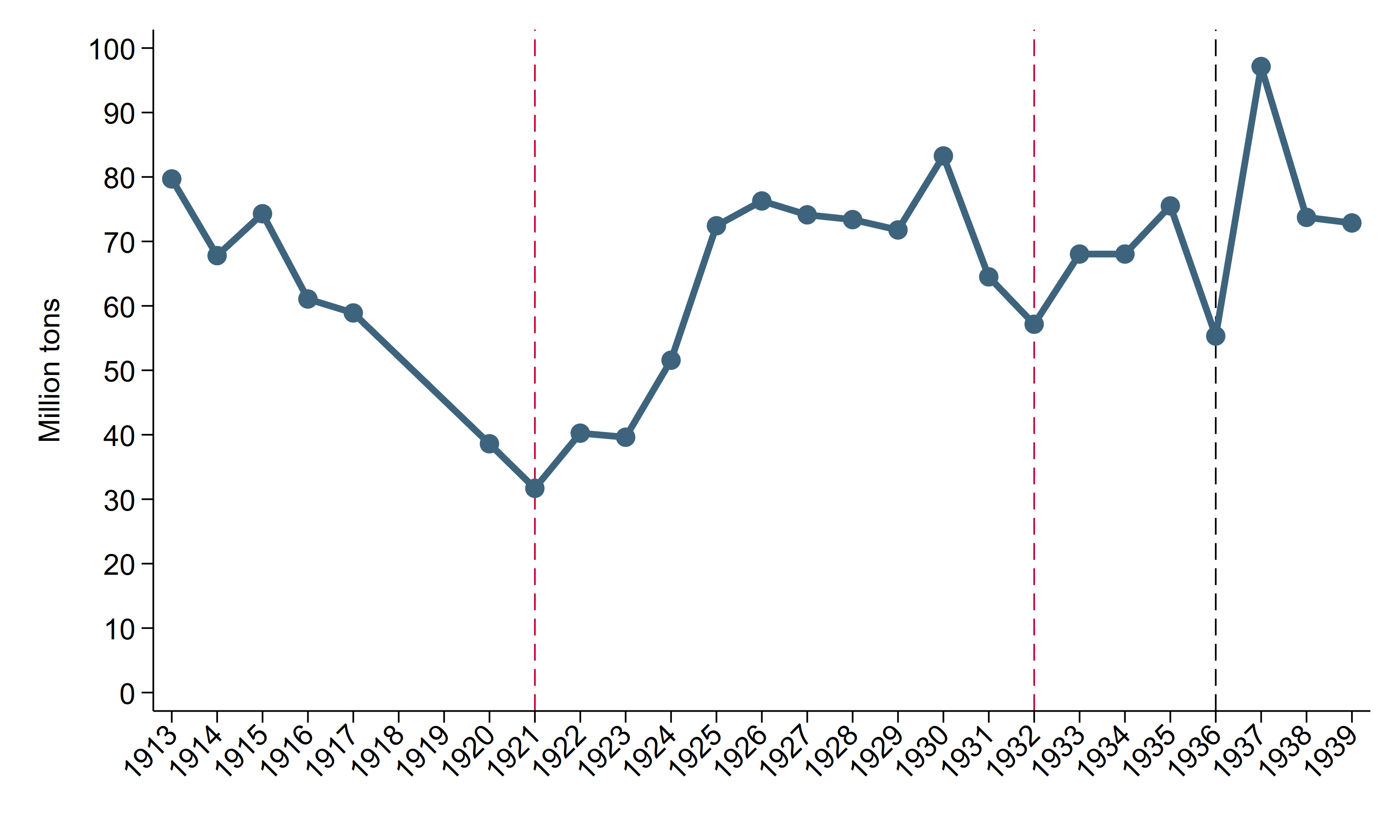
But was the 1932 harvest decline severe enough to kill millions? Figure 3 plots Soviet grain production from 1913 to 1939, measured within constant borders.
Figure 3: Grain production in the Soviet Union
Source: Naumenko (2024a)
Two observations stand out. First, the 1932 harvest was nearly twice as large as that of 1921 – yet the 1933 famine claimed far more lives. Second, the 1932 harvest was similar to the 1936 harvest, but there was no mass starvation in 1937. Thus, the argument that there was not enough grain in the country to prevent mass casualties is unsound. Even if we attribute part of the decline to weather – which itself is debatable – poor weather cannot account for the scale of the tragedy; the harvest decline was not catastrophically low. Instead, it was the system of collectivised agriculture, procurement, and distribution that transformed a modest shortfall into a disaster.
Of course, what matters is not only the total amount of grain but also how it was distributed across regions. One might argue that some areas produced too little and that the government, despite its efforts, failed to provide relief. Yet evidence points elsewhere. We show that Ukraine’s harvest in 1932 was below average, but still sufficient to avoid famine had the government not taken away more than 40% of it. Consistent with the harvest totals presented in Figure 3, grain extracted from Ukraine was not necessary to feed the rest of the Soviet Union.
Causes of the 1933 famine
Why then did millions die in 1933, both in Ukraine and outside?
First, collectivisation contributed to a decline in harvests, particularly in traditionally productive regions that were more intensely collectivised, such as Ukraine. Then, convinced that peasants were sabotaging the policy and concealing grain, Stalin pushed ahead with procurement – turning a bad harvest into a catastrophe. Grain procurement again targeted areas that had historically produced more grain, as officials struggled to recognise how little grain had actually been harvested in 1932, and because it was easier to seize grain from more collectivised areas.
Consistent with this explanation, Naumenko (2021) shows that, in Ukraine, the drop in harvest is not predicted by the weather – it must have therefore been caused by collectivisation. Naumenko (2021) also shows that within Ukraine, districts (relatively small administrative units) with a higher collectivisation rate (measured in 1930 or 1932) experienced higher famine mortality. That is, if you compare districts with similar agroclimatic conditions, past productivity, and 1932 weather, the more collectivised ones suffered more, on average, in 1933.
Also consistent with this explanation, using a sample of provinces (relatively large administrative units), we show that grain production in 1932 is either unrelated to famine mortality or positively correlated with it. Had there been a simple harvest failure that was not exacerbated by procurement, we should see a negative correlation: lower harvest would lead to more deaths. A zero or positive correlation occurred because the government over-procured from regions where harvests had declined relative to normal years but still produced more grain than the North.
The famine was created by government policies, but this does not mean that the famine was created intentionally. Rather, the ban on trade prevented regions with food to spare from selling it. Revealing that you had more than the government suspected – more than enough for subsistence – risked drawing harsher collectivisation measures and additional grain collections. The government, frantically trying to feed the urban population and not able to collect as much grain as it had planned from traditionally productive areas, left them without subsistence.
Already in 1932, it was obvious that the system was failing. After the famine, procurement quotas were tied to a farm’s assigned sown area, which made them more predictable. Collective farm members were also permitted and even encouraged to keep private livestock and gardens (although these were heavily taxed). After paying taxes and delivering assigned quotas, peasants could sell the remaining produce in markets at free prices. Over time, peasants received most of their income from private plots and livestock, working in collective farms primarily for the right to keep them (Belov 1956). Collectivisation thus continued but in a modified form: less rigid, more dependent on private incentives, and shaped by the lessons of the famine.
Was the famine ‘targeted’?
If the famine was driven by policies of collectivisation and procurement that targeted grain-productive regions, did Ukrainians suffer simply because they happened to live in these areas? The answer is no. Every policy we can measure was implemented with a systemic bias against ethnic Ukrainians – resulting in deeply unequal famine mortality.
First, using a sample of districts in Ukraine, Naumenko (2021) shows that from the start of the collectivisation campaign, ethnic Ukrainian areas were collectivised more intensely. That is, if you compare districts with similar agroclimatic conditions and past productivity, the ones with a higher share of ethnic Ukrainians were, on average, more collectivised in 1930.
Second, using a sample of provinces, we show that procurement in 1932 was more intense in areas with a higher share of ethnic Ukrainians. That is, if you compare provinces with similar harvests, on average, more grain was taken from the ones with more ethnic Ukrainians. This resulted in a bias in grain retention (production minus procurement): provinces with more ethnic Ukrainians were left with less food after the 1932 harvest.
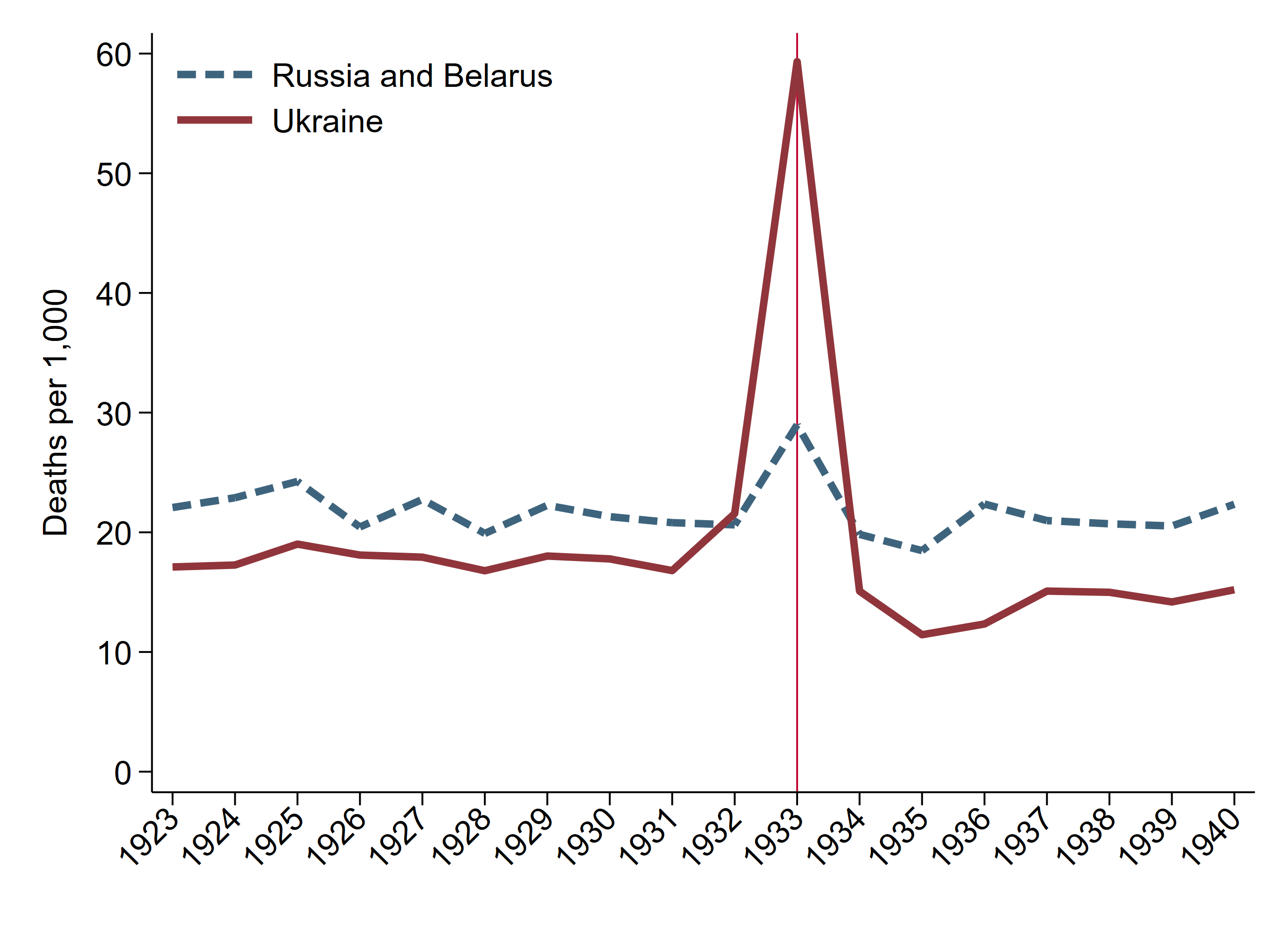
Consequently, using both a sample of provinces and districts within provinces, we show that famine mortality was biased against ethnic Ukrainians. That is, if you compare provinces with similar harvests, weather, and other characteristics, the ones with more Ukrainians had higher famine mortality on average. To illustrate this, Figure 4 plots average mortality from 1923 to 1940 in Ukraine, Russia, and Belarus – illustrating that Ukraine experienced a much larger spike in 1933.
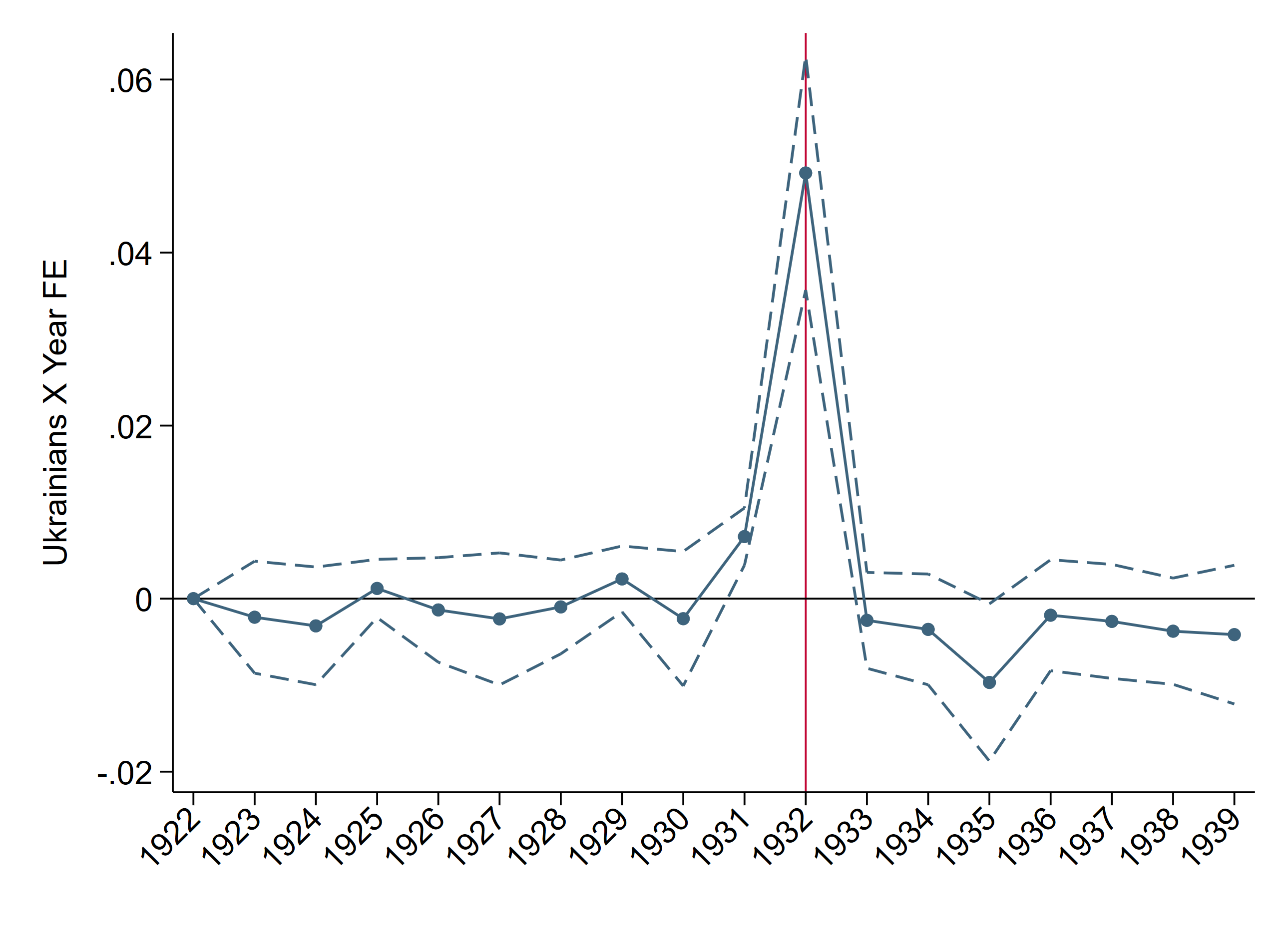
Figure 5 plots the estimated difference in mortality between Ukrainian and non-Ukrainian provinces after each harvest from 1922 to 1939. This difference remained stable until the harvest of 1931. Following the 1931 harvest, Ukrainian areas experienced higher mortality; this difference was even larger after the 1932 harvest. On average, if you move from a province with zero Ukrainians to a province with 100% Ukrainians, famine mortality increased by 50 per 1,000; this is huge given that non-famine mortality was around 20 per 1,000.
Figure 4: Mortality
Source: Markevich, Naumenko, and Qian (2025).
Figure 5: Coefficients of Ukrainian Share × year fixed effects on mortality
Source: Markevich, Naumenko, and Qian (2025).
We show that, similar to provinces, if you compare districts within the same province with similar soil quality and 1932 weather, the ones with more ethnic Ukrainians had higher famine mortality. Moreover, this is true even if we drop Ukraine from the sample and only consider Russia and Belarus – there appears to have been a pervasive bias against ethnic Ukrainians, not just against the Ukrainian Republic.
Finally, we show that, conditional on production, the First Five-Year Plan aimed to procure slightly more from ethnic Ukrainian territories. This does not mean that Stalin planned to create the famine or starve Ukrainians; rather, it made Ukrainians more vulnerable if the harvest was below the planned level.
Lessons from the 1933 famine
Statistical methods do not allow us to pinpoint the exact source of the bias. Whether it stemmed from local officials, Stalin and the Politburo, or some combination of the two, we cannot say with certainty. We do know that ethnicity was salient at the time: Ukraine had briefly attempted to declare independence in 1918, Stalin feared ‘losing Ukraine’, and Ukrainians were perceived as more resistant to collectivisation. We also know that procurement targets – and the severity with which they were enforced – were decided in Moscow. Yet no ‘smoking gun’ document exists in which Stalin explicitly orders famine to be used as a weapon against a particular ethnic group.
With or without this intention, the outcome remains the same: a devastating famine that killed millions and fell with particular severity on Ukrainians. Though nothing can bring back those who died, we hope this work contributes to a fuller understanding of their suffering and, in some measure, to historical justice.
References
Adamets, S (2003), “Guerre civile et famine en Russie.”
Allen, R C (2003), “Farm to factory: A reinterpretation of the Soviet industrial revolution,” Princeton University Press.
Belov, F (2013), “History of a Soviet collective farm,” Routledge.
Cheremukhin, A, M Golosov, S Guriev, and A Tsyvinski (2017), “The industrialization and economic development of Russia through the lens of a neoclassical growth model,” Review of Economic Studies 84(2): 613–649.
Kolesnikov, A (2019), “Why Russia is making Stalin great again,” Carnegie Endowment.
Markevich, A, and M Harrison (2011), “Great War, civil war, and recovery: Russia's national income, 1913 to 1928,” Journal of Economic History 71(3): 672–703.
Markevich, A, and E Zhuravskaya (2018), “The economic effects of the abolition of serfdom: Evidence from the Russian Empire,” American Economic Review 108(4–5): 1074–1117.
Markevich, A, N Naumenko, and N Qian (2025), “The causes of Ukrainian famine mortality, 1932–33,” Review of Economic Studies 92(5): 3276–3305.
Naumenko, N (2021), “The political economy of famine: The Ukrainian famine of 1933,” Journal of Economic History 81(1): 156–197.
Naumenko, N (2024a), “Collectivization, the industrialization debate, and the first Five-Year Plans.”
Naumenko, N (2024b), “Economic consequences of the 1933 Soviet famine,” GMU Working Paper.
Naylor, A (2023), “Kremlin’s war on history targets Holodomor remembrance,” Center for European Policy Analysis.
Qian, N (2021), “A tale of two famines,” Broadstreet.
Rozenas, A, and Y M Zhukov (2019), “Mass repression and political loyalty: Evidence from Stalin’s ‘terror by hunger’,” American Political Science Review 113(2): 569–583.
Wheatcroft, S G (1992), “The 1891–92 famine in Russia: Towards a more detailed analysis of its scale and demographic significance,” in Economy and society in Russia and the Soviet Union, 1860–1930: Essays for Olga Crisp, 44–64, Palgrave Macmillan UK.
Wheatcroft, S (2017), “10 Eastern Europe (Russia and the USSR),” Famine in European history, 212.
Yaremko, V (2022), “The long-term consequences of blacklisting: Evidence from the Ukrainian famine of 1932–33.”