




Unlike Western Europe, Russia entrenched serfdom as an extractive institution rooted in frontier defence. To secure its southern border, the state granted land to servicemen who leveraged their strategic role to restrict peasant mobility—hardwiring coercion into law and shaping Russia’s long-term institutional landscape.
Why did Russia tighten labour coercion just as Western Europe dismantled it? Classic explanations point to abundant land (Domar 1970) or Baltic grain exports (Blum 1957), yet neither account for the striking geography of serfdom: the deepest coercion lay in a slim, east-west belt roughly 200 km south of Moscow. This area was neither the most productive agricultural area, nor the best located to serve its production for domestic consumption or export; still, by the late 17th century, 40% of its population was bound to the soil, versus a national average of 14%.
Understanding why labour became immobile in this very specific corridor matters today for two reasons. First, serfdom’s legacy still shapes Russia’s economic and political landscape. Second, the mechanism at work—outsourcing routine border defence to local landowners—is a recurring theme across many historical and geographic settings. Russia’s frontier therefore offers a rare historical laboratory for studying how security policy can hard-wire extractive institutions into an economy.
Building a watchtower frontier
From the mid-1500s, the rulers of Muscovy (later Russia) confronted a strategic nightmare. Crimean-Tatar horsemen could ride unopposed across the open steppe, raiding deep into Muscovy for slaves and plunder. Its answer was the Tula defence line—a chain of timber forts, earthen berms, and felled-tree barricades stretched along the forest–steppe hinge. But a line of fortification is only as strong as its garrison, and Moscow had neither the fiscal nor the administrative capacity to afford a standing army large enough to patrol a thousand-kilometre border.
Instead of wages, the state paid watch-standers with land grants abutting the frontier. These were hereditary, but conditional on continued military service each year. Each mounted serviceman (sluzhily dvorianin) received just enough acreage to feed his household and provide himself with horses and equipment. Crucially, these plots were chosen for tactical value, not agricultural promise: some were certainly on good land, but where the defence line crossed areas with thin soils, few towns, and little free labour, the local soldiers/landholder could hardly afford to pay wages competitive with more prosperous areas. Since garrison duty precluded full-time farming, soldiers’ estates in such areas could not meet subsistence targets.
These soldiers were able to leverage their importance to the defence of the state to extract a number of concessions from Moscow, in particular imposing restrictions on the ability of their tenant farmers and hired labourers to relocate away from them. At first these restrictions were temporary. Then they were made permanent, and the term for finding runaway serfs progressively lengthened. Over roughly a century, a pile of local petitions evolved into a national policy; the 1649 Sobornoe Ulozhenie (Law Code) finally declared peasant mobility a criminal offence across the realm and the status of serf was made official and hereditary. What began as an ad-hoc frontier expedient thus became the legal foundation of Russian serfdom.
New evidence on where serfdom took root
To trace the evolution of serfdom, we (Matranga and Natkhov 2025) digitised Russia’s earliest full census: the 1678 household count, covering every taxable estate from the Arctic to the Pontic Steppe. We then geolocated all the locations of the Tula line, overlaying them on reconstructed 17th-century district (uezd) boundaries.
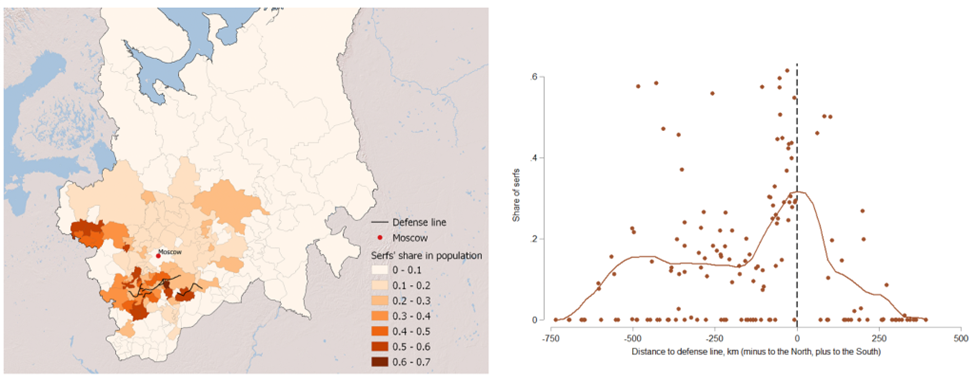
Figure 1 plots the share of serfs by district. A dramatic discontinuity appears: districts intersected by the defence line average around 40% serfs, whereas those just 50 km away average 14%. No comparable jump occurs along rivers leading to Baltic ports or in regions with the thinnest population density, casting doubt on land-labour ratio or grain export stories.
Figure 1: Share of serfs by district
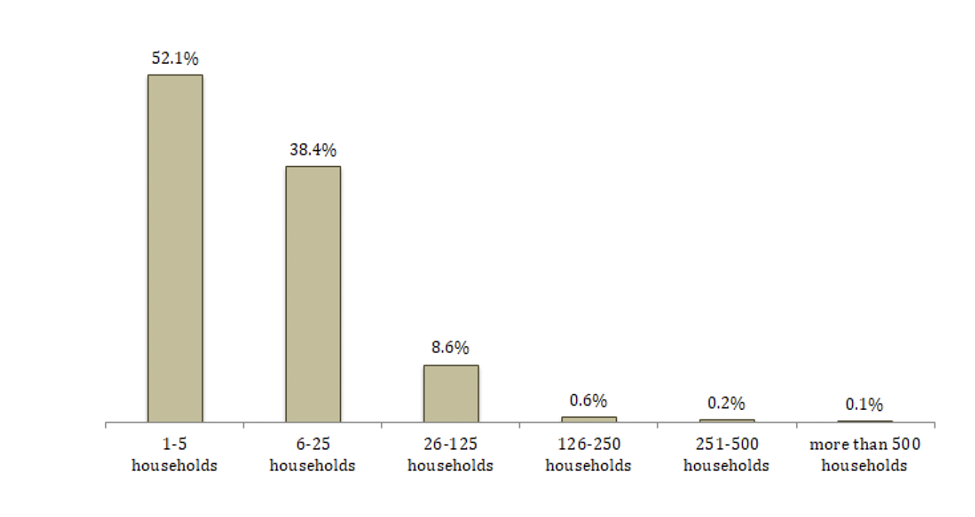
Estate-level data sharpen the picture. Figure 2 shows that more than four-fifths of holdings inside the frontier belt contain less than 25 serf households—just enough to feed and equip one cavalryman plus his remounts. Outside the belt, estates fan out toward much larger sizes, typical of landlord agriculture rather than garrison subsistence.
Figure 2: Number of serf households within holdings
Finally, we applied simple text mining to 96 surviving frontier petitions (written from 1608) and to the runaway-peasant clauses of the 1649 Law Code. The overlap is startling: phrases such as ‘runaway peasants’ and ‘frontier estates’ recur verbatim. This linguistic fingerprint links local military lobbying directly to country-wide legislation.
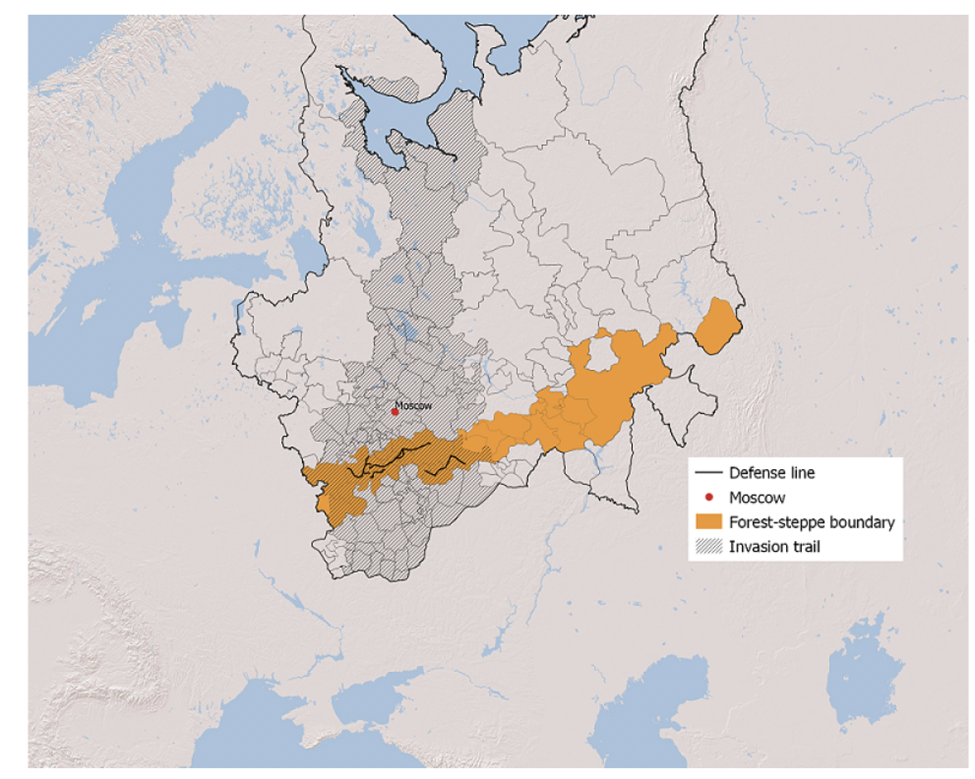
To establish causality, we exploit military geography. Using terrain and river-crossing costs, we algorithmically traced the cheapest cavalry invasion routes from Crimea toward Moscow. Districts lying on the modelled ‘optimal defence line’ exhibit a 25-percentage-point higher serf share even after controlling for soils, towns, and pre-existing labour norms—almost exactly mirroring the raw gap. Figure 3 overlays the simulated line on the actual fort network, showing an uncanny match.
Figure 3: Optimal defence line
Together, these three strands—map discontinuity, estate-size skew, and textual borrowing—pinpoint the watchtower frontier as the birthplace of Russian serfdom. With the empirical foundation laid, the next sections ask whether traditional economic factors can rival this military explanation and what long-term legacies the garrison system left behind.
Why classic economic stories of serfdom fall short
Conventional explanations for Eastern Europe’s turn to serfdom start with factor endowments. Domar’s (1970) land-to-labour logic predicts the deepest coercion where arable land was most abundant and population scarcest. Yet when we regress district serf shares on logged 1678 population density, soil quality, and growing-degree days, the coefficients either vanish or invert sign once a ‘Tula-line’ dummy is included. The black-earth belt south of Moscow was well peopled by Russian standards—hardly the empty frontier Domar envisioned. Conversely, much sparser northern districts kept their peasants free.
A second narrative credits Baltic grain exports: if landlords near the Dvina, Neva, or Narva rivers (which all flow into the Baltic Sea) could earn hard currency abroad, they supposedly had a stronger incentive to bind labour at home (Blum 1957). But in the 1600s the export corridor still ran mainly through Polish ports, and Russian shipments were tiny. Empirically, a district’s fluvial distance to Riga or Danzig explains under 3% of serf-share variation, and the interaction of river access with wheat suitability is indistinguishable from zero once military geography is controlled.
Urban demand likewise fails to account for the pattern. Town density, market fairs, and monastery estates do correlate with lower coercion, but the effects are modest: shifting from the 10th to the 90th percentile of pre-1700 town density reduces predicted serf share by barely five points. In short, soil, markets, and demography matter at the margin: the step-change created by the watchtower frontier dominates them all, pointing squarely to security policy—not economics—as the proximate cause of Russian serfdom.
The persistence and diffusion of coercion: Why serfdom spread
The watchtower frontier solved Moscow’s security crisis, but its labour regime long outlived the last Tatar raid. Districts behind the Tula line still topped the empire’s serf counts in the 1858 Revision List—two centuries after the forts lost military value and just three years before Tsar Alexander II’s emancipation decree. The logic that had yoked cavalry subsistence to peasant immobility proved stubbornly persistent: neighbouring landlords without military obligations copied the system to stabilise rents, while central officials gradually standardised the frontier rules into empire-wide practice. For example, in 1714 Peter I equalised military landholdings with hereditary estates, and in 1762, his grandson Peter III freed the landholders from the obligation to serve in the military as a necessary condition for owning land and serfs.
The reason the crown was willing to grant these privileges was that landholders provided state capacity at a local level. They oversaw tax collection, administered military conscription, and managed conflict resolution between peasants through estate courts (Dennison 2014). This mutually beneficial relationship between the crown and landholders was also the main reason behind the very late abolition reform and the very disadvantageous (for peasants) terms of the abolition. Even after 1861, peasants did not receive land property rights and were forced to buyout their plots under unfavourable conditions. This design was heavily influenced by the aristocratic opposition to the reform (Dennison 2020). Although the abolition reform spurred agricultural productivity and industrial growth in the former serfdom provinces (Markevich and Zhuravskaya 2018), the long-term effect of serfdom is still visible as areas with higher share of serfs in 1858 have lower levels of urbanisation and per capita consumption today (Buggle and Nafziger 2021).
Broader lessons for other frontiers and today’s policymakers
Russia’s experience echoes a wider pattern: outsourcing defence to local elites often bakes coercion into the economic fabric. Ottoman timars, Spanish encomiendas, and Qing bannerman lands all paired military service with labour-control rights, and in each case those rights survived long after the frontier shifted. The common denominator is an early fiscal and administrative constraint: states too poor to pay soldiers cash, and too unsophisticated to reliably contract and supply them. The lasting damage arises when these ‘temporary’ privileges ossify into general law.
The analogy matters today. From community militias in the Sahel to de facto warlord zones in parts of Afghanistan, governments still trade land or informal tax rights for security they cannot otherwise afford. History warns that such bargains are hard to unwind: once local strongmen internalise labour control as part of their income, reform threatens their very business model. Successful demobilisation therefore requires more than disarmament; it demands credible alternative livelihoods and legal reforms that limit the geographic spread of coercive practices. Russia’s watchtower belt is a reminder that the institutional costs of defending a border can linger long after the guns fall silent.
References
Domar, E.D. (1970), “The causes of slavery or serfdom: A hypothesis,” The Journal of Economic History, 30(1): 18–32.
Blum, J. (1957), “The rise of serfdom in Eastern Europe,” The American Historical Review, 62(4): 807–836.
Buggle, J. and S. Nafziger (2021), “The slow road from serfdom: Labor coercion and long-run development in the former Russian Empire,” Review of Economics and Statistics, 103(1): 1–17.
Dennison, T. (2014), “The institutional context of serfdom in England and Russia,” in Briggs, C., P.M. Kitson, and S.J. Thompson (eds), Population, welfare and economic change in Britain, 1290–1834: 249–268.
Dennison, T. (2020), “Overcoming institutional inertia: Serfdom, the state, and agrarian reform in Prussia and Russia,” in Broers, M., A.A. Caiani, and S. Bann (eds), A history of the European restorations: Culture, society, and religion: 385–472.
Markevich, A. and E. Zhuravskaya (2018), “The economic effects of the abolition of serfdom: Evidence from the Russian Empire,” American Economic Review, 108(4–5): 1074–1117.
Matranga, A. and T. Natkhov (2025), “All along the watchtower: Military landholders and serfdom consolidation in early modern Russia,” Review of Economic Studies, forthcoming.