




Repeated increases in the real minimum wage in early-2000s Argentina – implemented amid moderate inflation and an economic recovery – did not lead to higher job destruction as firms were able to absorb higher costs without resorting to terminations.
One of the most contested questions in economics concerns the employment effects of minimum wages. Some economists and policymakers view minimum wages as a key policy instrument for tackling income inequality, a particularly pressing issue in Latin America – the most unequal region in the world. Others, with equal conviction, argue that minimum wages simply raise the cost of labour, discouraging hiring and encouraging dismissals, thereby reducing employment among the least advantaged workers.
These conflicting predictions largely stem from disagreement about the underlying structure of a country’s labour market, and in particular about how competitive it is. Broadly speaking, those who see labour markets as highly competitive tend to expect job destruction from higher minimum wages, while those who emphasise frictions (such as monopsony power or search frictions) are more inclined to predict limited employment losses, or even employment gains, from minimum wage increases (Krueger 2015, Dube and Lindner 2024).
Since the 1990s, research on minimum wage has adopted a more ‘agnostic’ approach, utilising credible quasi-experimental methods to estimate the actual effects of these policies. This shift has transformed the field from a purely theoretical debate to one grounded in data. The impact of a minimum wage increase is now understood as an empirical question rather than a theoretical one.
In Abbate and Jiménez (forthcoming), we add to this evidence base by studying a series of country-wide real minimum wage hikes in early 21st-century Argentina, a context marked by moderate but persistent inflation, and quantify their impact on job losses using rich administrative data on registered employment. Our main finding is that, in this recovering economy with moderate inflation, minimum wage increases did not generate any detectable employment losses in formal jobs.
Inflation and minimum wages in Argentina
Our research focuses on Argentina in the early 2000s. Namely, we study the effects of eight minimum wage hikes between 2003 and 2011. We highlight three features of our context:
- Moderate but persistent inflation: Annual inflation rates fluctuated between 10% and 20% over this period, while average inflation in Latin America and the Caribbean remained in single digits.
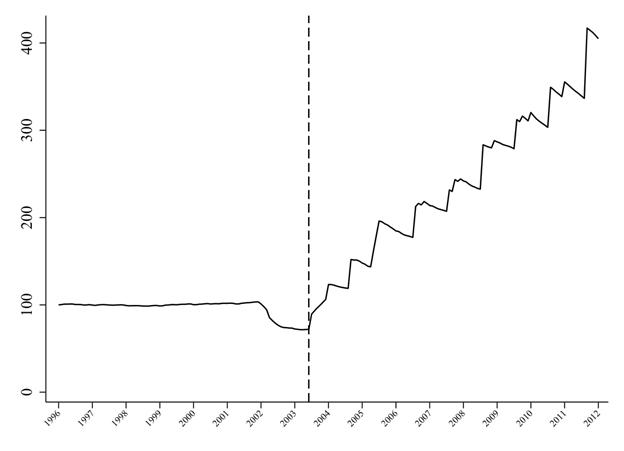
- Real – rather than purely nominal – minimum wage increases: The minimum wage hikes we study raised real wages, not just nominal values eroded by inflation. Figure 1 shows that between 1996 and 2012, the purchasing power of minimum wage workers increased by a factor of about four. This meant a rise from roughly US$200 in 1996 to just over $550 in 2012.[1]
Figure 1: Real minimum wage, 1996–2012
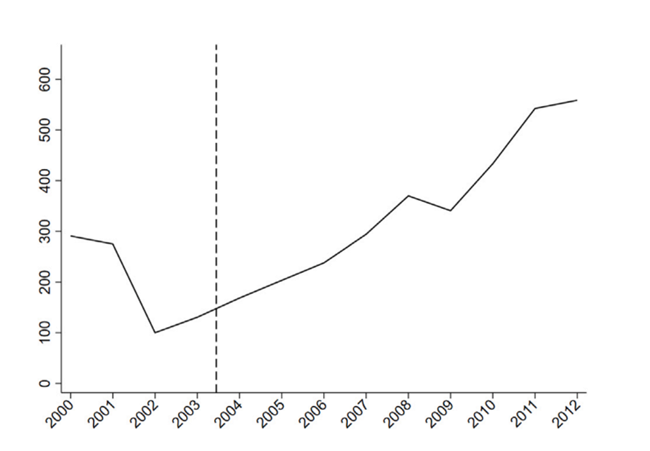
- A strong economic recovery: Our study period coincides with a robust recovery from the 2001–2002 Argentine crisis. Real GDP grew rapidly and was only mildly affected by the international subprime crisis of 2008 (Figure 2).
Figure 2: Real Gross Domestic Product, 1996–2012
Do minimum wages lead to employment destruction?
Our central question is whether minimum wage increases destroy existing jobs. We address this as follows. For each minimum wage hike, we:
- Identify a group of workers directly exposed to the reform – those earning between the old and the new minimum wage.
- Compare the evolution of their employment to a group of similar workers just above the new minimum, who are not directly affected.
For example, in 2003 the nominal wage floor rose from ARS 200 to 300. We compare workers whose pre-reform wages were between ARS 200 and 300 to those earning just above ARS 300. Once the hike is implemented, employers of the first group must either raise wages to the new minimum or dismiss workers, while employers of slightly higher-paid workers face no such sudden jump in labour costs. Comparing employment trends between these two groups provides a clean way to detect any job destruction caused by the policy.
Intuitively, if minimum wage increases destroy jobs, we should observe more job separations among workers whose pre-reform wages were below the new minimum than among similar workers just above it. Employers who cannot afford the higher wage would let those jobs go. Workers who already earned above the new minimum should be largely unaffected.
Figure 3 summarises our main result. It shows, by pre-hike wage level, the share of jobs that are destroyed within six months of a minimum wage increase, pooling the eight hikes between 2003 and 2012. Workers are grouped by five-peso intervals, and each marker shows the average job destruction rate in that interval. Solid markers correspond to workers directly exposed to the hike (between the old and new minimum), while hollow markers represent similar workers just above the new minimum.
Figure 3: Job separation rates after a minimum wage hike
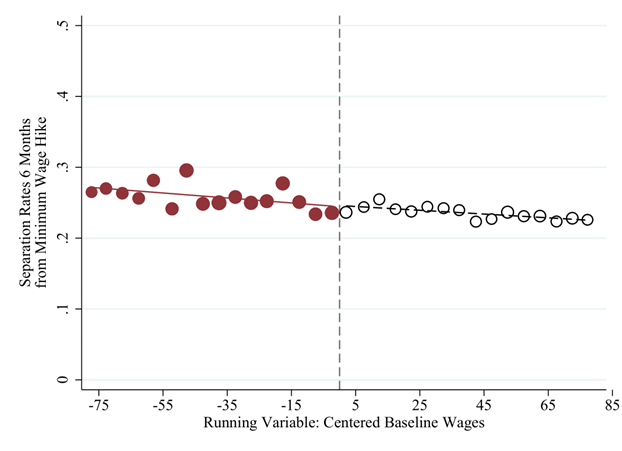
The main takeaway from this figure is that separation rates are virtually identical between workers who were and were not exposed to the minimum wage hikes. If minimum wage increases had destroyed jobs, we would expect a visible kink – a discontinuity – at the new minimum wage (shown as a dotted vertical line in the figure). We see no such pattern. In that sense, our answer to the question ‘do minimum wages lead to employment destruction?’ is, at least in this context, a sound no.
Separating disemployment effects from routine turnover
Several readers may wonder why we focus on such a narrow ‘just below’ versus ‘just above’ comparison, instead of comparing exposed workers to all higher-wage workers?
The key reason is that our data comprises administrative records for the entire universe of registered wage earners, from entry-level workers (e.g. shop assistants, junior clerical staff) to top executives (e.g. chief officers and other high-level managers). Turnover patterns differ systematically along this job ladder: even without any policy change, we expect low-wage jobs to be more unstable and high-wage jobs more stable.
Comparing job turnover patterns between these two types of workers would severely confound the employment effects of the policy with underlying differences in the very nature of their jobs. For instance, even in the absence of a minimum wage hike, one would expect the employment duration of a shop assistant and that of a chief executive officer to differ substantially.
We took that concern seriously and put it to the test across the whole job ladder in Figure 4. We compare job destruction rates between different income levels in three different scenarios. First, we compared workers before and after the actual minimum wage hikes. Second, we calculated six-month separation rates for all workers during the 1990s, a period with no minimum wage changes. Finally, we repeated the exercise for our study period around ‘placebo’ dates set six months before each actual reform.
Figure 4: Six-month job separation rates across the wage distribution (the job ladder)
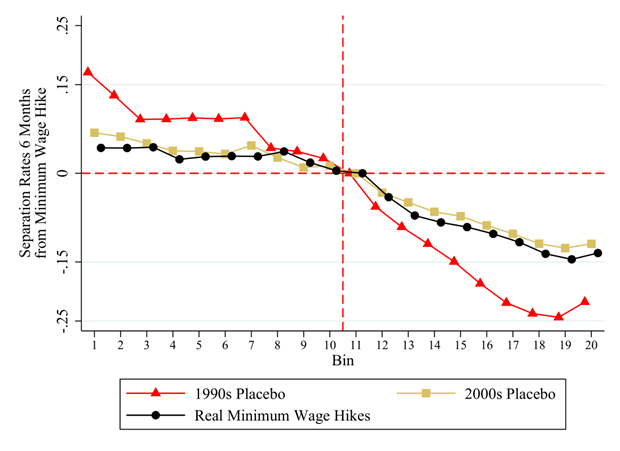
The line with circle markers shows separation rates in the six months following a minimum wage hike. As expected, separations are somewhat higher for workers at the lower end of the wage distribution and much lower for those at the very top.
If anything, when minimum wages increase, the gap in separation rates between low- and high-wage workers appears slightly smaller than in periods with no change. This reinforces our main point: raw differences in turnover between low- and high-wage workers cannot be interpreted as evidence that minimum wages destroy jobs. Careful empirical strategies are needed to separate genuine policy effects from pre-existing differences in employment dynamics.
Business cycle conditions
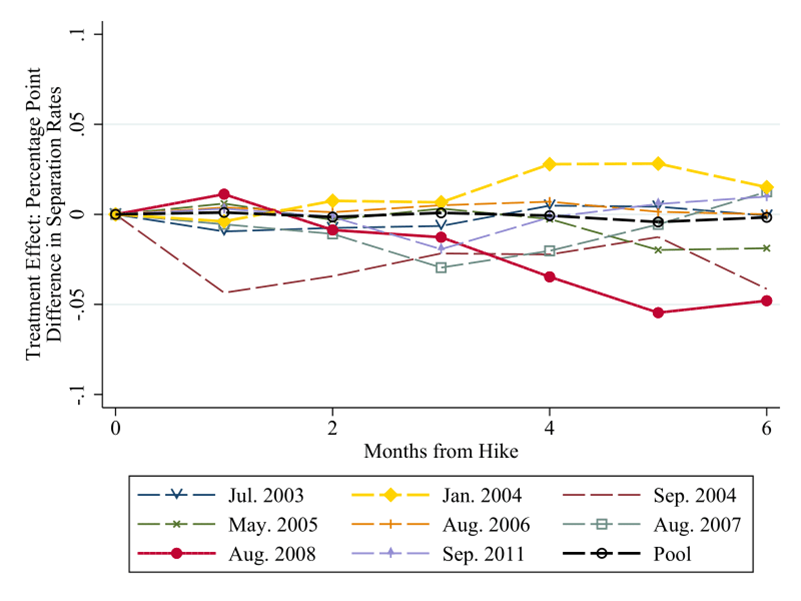
A careful reader may still wonder whether individual hikes had different effects. In other words, could our overall ‘zero effect’ simply reflect positive and negative impacts across reforms that cancel out?
Our results suggest this is not the case. Figure 5 shows that the estimated effects of each hike cluster tightly around zero. Moreover, the most favourable outcomes – interpreted normatively as less job destruction – occur when economic activity is recovering from the 2001–2002 crisis, rather than in weaker macroeconomic conditions.
Figure 5: Difference in job destruction between exposed and non-exposed workers around each minimum wage hike
Implications for labour policy during economic recovery
In institutional contexts with moderate inflation and an ongoing economic recovery, substantial real increases in the minimum wage do not trigger abnormal employment losses in the formal sector. Employers do not lay off workers en masse in response to these reforms.
In that sense, minimum wages can be a promising tool for preserving – and even improving – workers’ purchasing power in such environments. At the same time, as this discussion highlights, studying minimum wages – and designing good policy – is inherently difficult. For example, while our findings speak against employment destruction, they do not allow us to say much about possible effects on hiring. Moreover, even when minimum wages do increase job separations, it is far from straightforward to draw normative conclusions. Higher wages for those who remain employed and a higher value of job search can, in some cases, still generate positive welfare effects (Flinn 2011). This underscores the complexity of the trade-offs involved.
Our hope is that our work, by providing evidence from a real-world episode of substantial minimum wage increases, contributes to the broader effort to better understand these mechanisms and to inform the design of more effective minimum wage policies in the future.
References
Abbate, N, and B Jiménez (2026), “Do minimum wage hikes lead to employment destruction? Evidence from a regression discontinuity design in Argentina,” Journal of Development Economics, 178: 103558.
Dube, A, and A Lindner (2024), “Minimum wages in the 21st century,” in Handbook of Labor Economics, Vol. 5: 261–383, Elsevier.
Flinn, C J (2011), The minimum wage and labor market outcomes, MIT Press.
Krueger, A B (2015), “The history of economic thought on the minimum wage,” Industrial Relations, 54: 533–537.