





In Guinea, providing information about the risks of migration journeys corrects overly optimistic beliefs and significantly reduces irregular migration intentions and behaviour among young people, without discouraging regular migration.
Editor’s note: For a broader synthesis of themes covered in this article, check out our VoxDevLits on International Migration and Refugees and Other Forcibly Displaced Populations. The authors have made slides available here.
Every year, thousands of migrants embark on dangerous journeys towards Europe. Restrictive policies limit legal migration pathways, inducing many to take unsafe irregular routes, crossing the Sahara Desert, enduring violence and exploitation in transit countries, and risking drowning in the Mediterranean Sea. Despite these risks, irregular migration remains widespread. Are potential migrants informed about the risks of irregular migration? And does information induce them to revise their migration plans and decisions?
In a recent field experiment in Guinea, we examine whether providing accurate information about migration risks and outcomes can influence young people’s beliefs and migration choices. Our findings suggest that information, particularly about the risks of the journey, can reduce the intention to migrate and risky migration. Importantly, it does so by discouraging irregular migration, not migration overall (Battiston, Corno, and La Ferrara 2024).
Migration decisions under uncertainty
Legal pathways to migration are limited. Strict immigration policies in destination countries make regular migration difficult, pushing many towards irregular routes that are viable but far more dangerous. The risks of these journeys are severe. According to the International Organization for Migration, more than 34,000 migrants have died or gone missing while attempting to cross the Mediterranean since 2014 (IOM 2018). Many die while trying to cross the Sahara, and survivors experience violence, forced labour, or trafficking during their journey.
Obtaining reliable information on the potential consequences of irregular migration is not easy. Prospective migrants frequently rely on incomplete or distorted accounts from friends, relatives, and sometimes smugglers. Migrants have inaccurate perceptions about the risks of migration before leaving, as well as their rights in destination countries.[1] In this context, migration decisions are made under uncertainty. Young people must weigh the potential benefits of migration against the risks and costs that are hard to assess. Providing reliable information could help them make more informed choices.
Testing the effects of information provision: A field experiment
To test this idea, we conducted a randomised controlled trial involving more than 7,000 secondary school students across 160 schools in Conakry, Guinea’s capital. Guinea is an important origin country for migrants to Europe, and many migrants are young people with secondary education. In our sample, 38% have a classmate who migrated and 60% have contacts abroad.
Based on our survey, 57% of students reported that they believe their likelihood of being subjected to violence is low, while 76% stated that their likelihood of being exploited is low. These perceptions are over-optimistic relative to the prevalence rates reported in survey data collected by IOM (2018) and UNHCR (2017).
As part of our intervention, we randomly assigned schools to one of four groups:
- Risk information: Students received information about the dangers of the migration journey, including violence, trafficking, and mortality risks.
- Economic information: Students received information about employment prospects and economic outcomes in destination countries.
- Combined information: Students received both types of information.
- Control group: Students received no migration-related information.
We tracked students over time, measuring their beliefs, migration intentions, and actual migration behaviour.
The intervention used engaging and accessible formats, including video testimonials from migrants, illustrated stories, and official statistics. Our intervention, involving one-time sessions delivered in schools using videos and printed materials, was relatively inexpensive. However, it sparked students’ interest in the issue of migration, a very salient theme in the life of young Guineans.
Effects of our intervention on beliefs and migration
The intervention had immediate effects on students’ beliefs. Students who received risk information became significantly more aware of the dangers of migration one month after the information session: their perceived probability of being beaten, kidnapped, or dying during the journey increased by 7 to 10 percentage points. Students who received economic information revised their expectations downwards about finding jobs, obtaining legal status, or continuing education abroad. These results are consistent with many students holding overly optimistic priors about the journey and opportunities abroad.
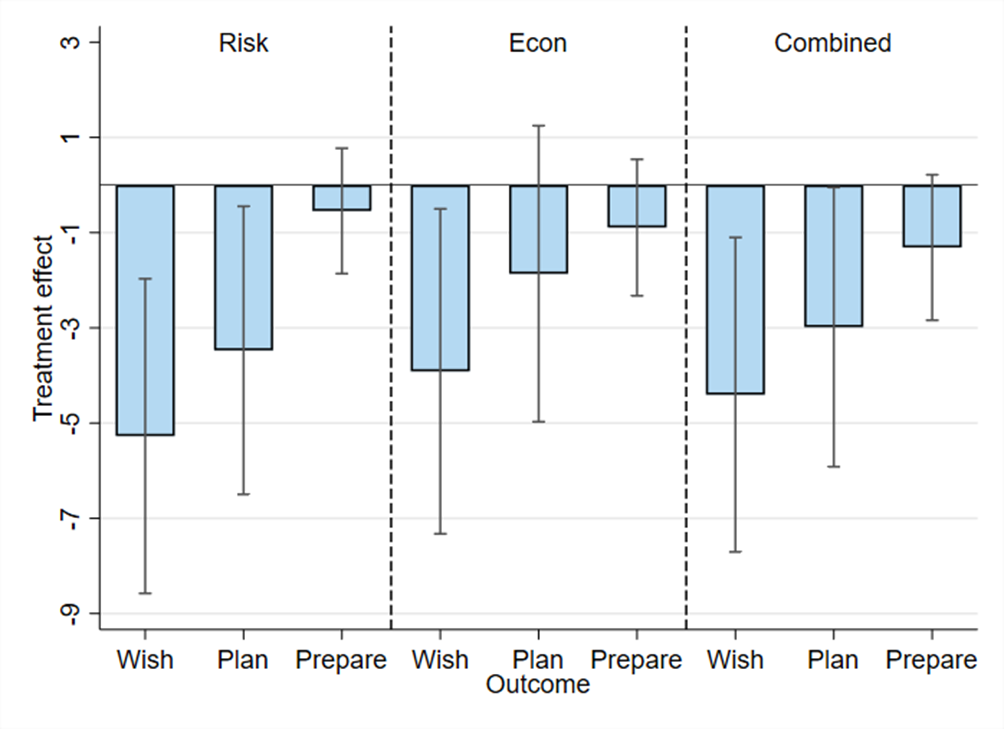
Changes in beliefs translated into changes in migration intentions (Figure 1). One month after the intervention, students who received information were significantly less likely to express a desire to migrate or declare that they were planning to migrate. The proportion of students saying they wished to migrate fell by about 4–5 percentage points, from a baseline of about 26%. Interestingly, information about risks had the strongest and most consistent effects. This suggests that underestimating journey risks is particularly important in shaping migration decisions. Indeed, our baseline survey data shows that students underestimate journey risks more than they overestimate economic benefits. Correcting risk perceptions therefore had a larger impact on their decisions. Alternatively, since the risks of the journey affect the perceived cost of the journey, this may be more immediate and salient for potential migrants than expected benefits at destination.
Figure 1: Changes in migration intentions
One year after the intervention, we find suggestive evidence that our intervention reduced actual migration abroad, only for the risk information treatment. The probability of migrating fell by about 0.8 percentage points, a nearly 50% reduction relative to the control group. Crucially, this reduction was entirely driven by a decline in migration without a visa. There was no evidence that information reduced ‘regular’ migration. This suggests that our intervention did not discourage migration altogether, but rather it helped students avoid the most dangerous forms of migration.
Policy implications
Our findings have important implications for migration policy. First, information can reduce risky irregular migration decisions. Irregular migrants hold misperceptions about journey outcomes at all stages of the migration process, potentially shaping their migration decisions. Providing accurate information can change expectations and behaviour. Second, information interventions should target perceptions of risk. Potential migrants hold optimistic beliefs about journey risks, and they revise these beliefs in response to information, affecting migration intentions and behaviour. Third, tailored information campaigns provide a scalable and effective way to reduce the human toll of irregular migration. Relatively cheap information materials can have profound consequences for young migrants at risk of trafficking or of facing the hardships of irregular migration journeys.
Lack of information can induce people to make dangerous irregular migration decisions. By correcting overly optimistic beliefs about dangerous journeys, information campaigns can reduce irregular migration and potentially save lives. Even modest reductions in irregular migration could generate large humanitarian benefits by preventing exposure to violence, trafficking, and death. At the same time, providing information leaves individuals free to choose, enabling them to make better-informed decisions.
Information alone cannot solve the complex challenges of migration. But as a low-cost, scalable policy tool, it can play an important role in protecting vulnerable young people from the dangers of irregular migration.
References
Battiston, G, L Corno, and E La Ferrara (2024), “Informing risky migration: Evidence from a field experiment in Guinea,” Unpublished manuscript.
Beber, B, and A Scacco (2022), “The myth of the misinformed migrant? Survey insights from Nigeria’s irregular migration epicenter,” Unpublished manuscript.
Eziakonwa, A et al. (2019), “Scaling fences: Voices of irregular African migrants to Europe,” United Nations Development Programme.
IOM (2018), “Flow monitoring surveys: The human trafficking and other exploitative practices indication survey.”
Mixed Migration Centre (2019), “MMC North Africa 4Mi snapshot: Access to information of refugees and migrants in Libya.”
Rozo, S V, and G Grossman (2025), “Refugees and other forcibly displaced populations,” VoxDevLit, 14(1).
Sanchez, G, R Hoxhaj, S Nardin, A Geddes, L Achilli, and S Kalantaryan (2018), “A study of the communication channels used by migrants and asylum seekers in Italy, with a particular focus on online and social media,” European Commission.
Tjaden, J (2020), “Assessing the impact of awareness-raising campaigns on potential migrants: What we have learned so far,” Migration in West and North Africa and across the Mediterranean, 426–434.
UNHCR (2017), “Harrowing journeys: Children and youth on the move across the Mediterranean, at risk of trafficking and exploitation.”
Yang, D, C Batista, G Khanna, D McKenzie, A M Mobarak, and C Theoharides (2026), “International migration,” VoxDevLit, 21(1).