





Local exposure to Venezuelan migrants does not necessarily lead to a rise in local xenophobia. In fact, evidence suggests that anti-migrant sentiment is a national-level phenomenon, driven by national narratives and divorced from local experiences with migrants.
The world has witnessed a drastic rise in refugee flows and anti-migrant sentiment in recent decades. This negative sentiment towards migrants and refugees can exacerbate social tensions, sway political outcomes, and ultimately influence national policy decisions in ways that affect newcomers’ access to essential resources and opportunities. Understanding how host societies perceive and respond to large influxes of migrants is thus crucial for fostering social cohesion and guiding effective integration policies.
The Venezuelan exodus is one of the largest displacement crises in recent history. Between 2016 and 2019, over 4.5 million Venezuelans - or almost 1 in 5 Venezuelans - emigrated due to severe economic collapse, political instability, and escalating violence. The speed and scale were staggering. Venezuelans settled across several countries in Latin America, most notably next-door neighbour Colombia, as well as Ecuador, Peru, and Chile. Despite a shared language, religion, and broad cultural heritage, anti-Venezuelan xenophobia spiked over this period, offering an opportunity to study the formation of migrant sentiment.
To investigate the relationship between migrant exposure and attitudes, we leverage multiple migrant sentiment outcomes, different levels of geographic variation across seven Latin American countries, and an instrumental variable strategy. We find that, despite worsening xenophobia in the countries that received the most Venezuelans, this did not occur in the districts within-country that received more migrants (Lebow et al. 2024). Many of the channels typically considered to be primary drivers of xenophobia - such as economic competition, public resources strain, or crime - are expected to be most relevant in migrant-receiving communities. Yet our results are consistent with anti-migrant sentiment being a national-level phenomenon, driven by national narratives and divorced from local experiences with migrants.
Migrant exposure and migrant sentiment at national and sub-national levels in Latin America
Gallup's Migrant Acceptance Index (MAI) measures feelings toward receiving immigrants in the country, immigrants as neighbours, and immigrants marrying into one’s family. The MAI was measured across Latin America in 2016 and 2019, before and after the majority of the Venezuelan exodus. Figure 1 shows the marked decline in the MAI from 2016 to 2019 in the countries with significant Venezuelan migrant populations, more specifically in Colombia, Peru, and Ecuador.
Figure 1: Migrant sentiments worsened between 2016 and 2019 in the countries that received the most Venezuelans
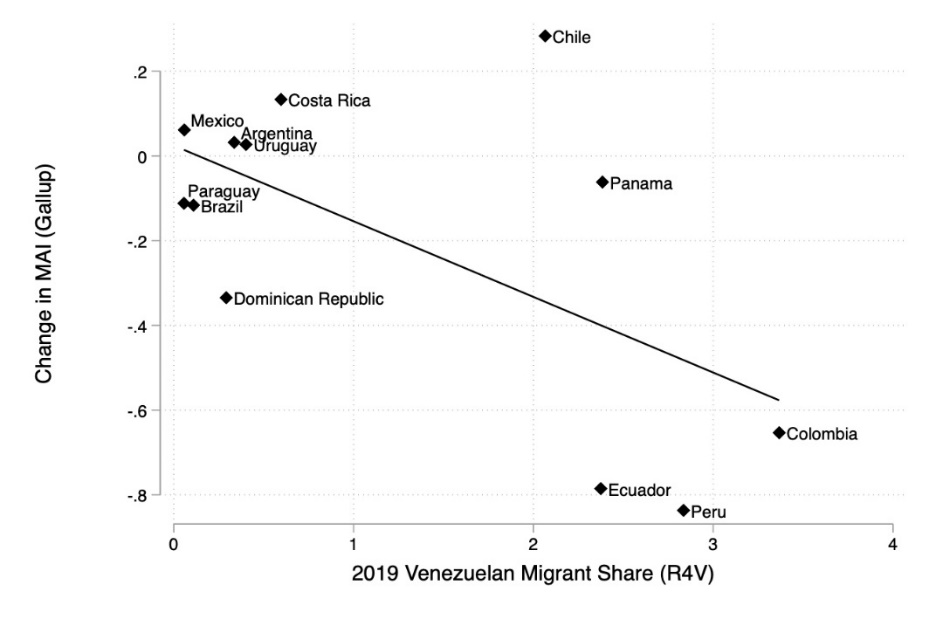
Note: Gallup’s migrant acceptance index (MAI) is a standardised index based on 3 questions about migrants. A larger value indicates more favorable attitudes toward migrants. Changes are measured between 2016 and 2019.
To study this effect at a sub-national level, we regress the Gallup MAI on the migrant share of the population at the department or province level across seven Latin American countries: Colombia, Ecuador, Peru, Panama, Chile, Argentina, and Uruguay. We control for department or province fixed effects - thus studying the relationship between changes in MAI and changes in migrant shares between 2016 and 2019 - as well as country-year fixed effects and respondent characteristics. We find no statistically significant effect of migrant share on migrant sentiment; a one percentage point increase in the migrant share improves migrant sentiment by an insignificant .02 standard deviations, with precise confidence intervals that rule out any meaningful negative effect.
A challenge with this approach is that migrants do not randomly choose where to locate. For example, Venezuelans may have intentionally migrated to regions with better migrant sentiments. To tackle this threat to causal inference, we employ an instrumental variable (IV) analysis based on the historical share of Venezuelans living in each region prior to the recent migration wave. Because there was historically little migration out of Venezuela, these shares are small and therefore less likely to directly affect long-term economic outcomes or preferences (Jaeger et al. 2018). Our pre-trends tests also support the validity of our IV. Additionally, there were strong network effects driving where Venezuelans settled within-country indicating there was a strong relationship between historical shares and current shares. Like the OLS analysis, the IV analysis finds precise null effects of migrant exposure on migrant attitudes.
Using anti-migrant tweets to measure migrant sentiment in Latin America
In addition to the Gallup MAI outcome, we study a more extreme, negative behavioural outcome: anti-migrant tweets. Tweets were restricted to those containing keywords about Venezuelans, geolocated to regions, and classified using sentiment analysis. Though this yields a restricted sample of regions with sufficient geolocated tweets, the results again show no evidence of a correlation or causal relationship between regional migration and the share of negative tweets about Venezuelans. If anything, there is a slight increase in positive sentiment in places with more migration.
Trust and segregation preferences across Colombian municipalities
To complement the multi-country analysis, we conduct a more localised study across 118 municipalities in Colombia – the country that received the largest share of migrants. We use data from a 2019 nationwide survey, the Encuesta de Cultura Política, having worked with the survey team to include questions on trust toward foreigners and preferences for having a foreigner as a neighbour. While this analysis has greater geographic precision, the caveat is that we do not have pre-period data. We compensate for this by controlling for a long list of pre-period municipal-level characteristics such as economic conditions, crime rates, and political preferences. Using a similar OLS and IV strategy, we again find no significant increase in anti-migrant sentiment in municipalities with higher levels of Venezuelan migration. In fact, sentiments again improve slightly, suggesting that migrant exposure may instead foster more acceptance.
Exploring the role of labour market competition, public resource strain, and crime
Next, we explore whether mechanisms such as labour market competition, public resource strain, and crime might affect the relationship between migration and attitudes toward migrants. There is some evidence that Venezuelans slightly depressed wages for low-wage informal workers in various countries, and there have been widespread concerns about public resource strain in low-income migrant-affected communities (Selee and Bolter 2020, Lebow 2022, Olivieri et al. 2022). Though there is little evidence that Venezuelans have increased crime anywhere in Latin America, communities may falsely associate Venezuelan inflows with local crime (Knight and Tribin 2023, Ajzenman et al. 2023).
We find no evidence that lower-income respondents or those in regions with higher poverty, worse public goods provision, or more crime, are more likely to turn migrant exposure into migrant resentment. In fact, Colombian municipalities demonstrate precisely the opposite: Venezuelan inflows generate greater backlash in municipalities with better, rather than worse, availability of services.
Inter-group contact may play a role in supporting migrant sentiment
In some areas, the lack of local backlash may be due to the genuine lack of negative consequences for migrant-hosting communities. In others, it may be because of the positive effects of intergroup contact (Paluck et al. 2019, Bursztyn et al. 2024, Steinmayr 2021). We find evidence that Colombian host municipalities experienced an increase in meaningful and repeated social contact between migrants and Colombian natives. This distinguishes this setting from settings where natives have only fleeting exposure to migrants and refugees, which may instead lead to feelings of intergroup threat (e.g. Hangartner et al. 2019).
How the Venezuelan exodus can inform migration policy
A growing literature shows that the effects of migration on social attitudes are complex and vary heavily across contexts (Alesina and Tabellini 2024). Migrant sentiment sometimes but not always aligns with political preferences – in fact, research shows that, across Colombian municipalities, Venezuelan migration moved voters to the right, but this was because the migration was used by politicians to highlight the dangers of socialism and had little to do with anti-migrant rhetoric (Rozo and Vargas 2021). As with many situations of forced displacement globally, we study a context in which migrants and natives speak the same language and have close cultural overlap, but where Venezuelan migrants have nonetheless been stigmatised, discriminated against, and placed into an out-group boundary. By showing that local exposure to migrants does not necessarily lead to a rise in local xenophobia, this research challenges the notion that migration inherently causes social conflict at the local level. Instead, it highlights the importance of addressing national-level narratives, which may include negative media portrayals, national fears of cultural threat, and misperceptions of the true effects of migration in migrant-hosting communities.
References
Ajzenman, N, P Dominguez, and R Undurraga (2023), “Immigration, crime, and crime (mis) perceptions,” American Economic Journal: Applied Economics, 15(4): 142–176.
Alesina, A, and M Tabellini (2024), “The political effects of immigration: Culture or economics?” Journal of Economic Literature, 62(1): 5–46.
Bursztyn, L, T Chaney, T A Hassan, and A Rao (2024), “The immigrant next door,” American Economic Review, 114(2): 348–384.
Hangartner, D, E Dinas, M Marbach, K Matakos, and D Xefteris (2019), “Does exposure to the refugee crisis make natives more hostile?” American Political Science Review, 113(2): 442–455.
Jaeger, D A, J Ruist, and J Stuhler (2018), “Shift-share instruments and the impact of immigration,” National Bureau of Economic Research, No. w24285.
Knight, B, and A Tribin (2023), “Immigration and violent crime: Evidence from the Colombia-Venezuela border,” Journal of Development Economics, 162: 103039.
Lebow, J, J Moreno-Medina, S Mousa, and H Coral (2024), “Migrant exposure and anti-migrant sentiment: The case of the Venezuelan exodus,” Journal of Public Economics, 236: 105169.
Lebow, J (2022), “The labor market effects of Venezuelan migration to Colombia: Reconciling conflicting results,” IZA Journal of Development and Migration, 13(1).
Olivieri, S, F Ortega, A Rivadeneira, and E Carranza (2022), “The labour market effects of Venezuelan migration in Ecuador,” The Journal of Development Studies, 58(4): 713–729.
Paluck, E L, S A Green, and D P Green (2019), “The contact hypothesis re-evaluated,” Behavioural Public Policy, 3(2): 129–158.
Rozo, S V, and J F Vargas (2021), “Brothers or invaders? How crisis-driven migrants shape voting behavior,” Journal of Development Economics, 150: 102636.
Selee, A, and J Bolter (2020), An Uneven Welcome: Latin American and Caribbean Responses to Venezuelan and Nicaraguan Migration, Migration Policy Institute, Washington, DC.
Steinmayr, A (2021), “Contact versus exposure: Refugee presence and voting for the far right,” Review of Economics and Statistics, 103(2): 310–327.