



Evidence from Brazil suggests that the crop-specific knowledge of domestic migrant farmers, during a period of large-scale migration, was a key driver of the recent transformation of the country’s export patterns – highlighting the importance of migrants’ knowledge in the expansion of specific sectors of the economy.
What determines a country’s trade patterns? Comparative advantage – differences in relative costs across sectors and countries – is a key determinant of specialisation, export patterns, and the welfare gains from trade (Eaton and Kortum 2002, Costinot and Rodriguez-Clare 2014). Recent research has documented that comparative advantage evolves over time and leads to substantial changes in a country’s trade patterns (Levchenko and Zhang 2016). Relatively less understood, however, are the factors driving that evolution and how policy can shape it.
Periods of large-scale internal migration are often accompanied by significant changes in the sectoral patterns of specialisation within affected countries. Consider, for instance, the westward expansion of the US and, more recently, the large-scale migration of Chinese workers to export-oriented regions. Across the world, rural-urban migration is a hallmark of development. In Pellegrina and Sotelo (2025), we study how a major episode of internal migration in Brazil – known as Brazil’s March to the West – shaped the country’s rise as a major player in global agricultural markets. We find that migrants’ knowledge played a key role in the expansion of the crops that came to dominate Brazil’s agricultural export basket.
Internal migration and the evolution of export patterns in Brazil
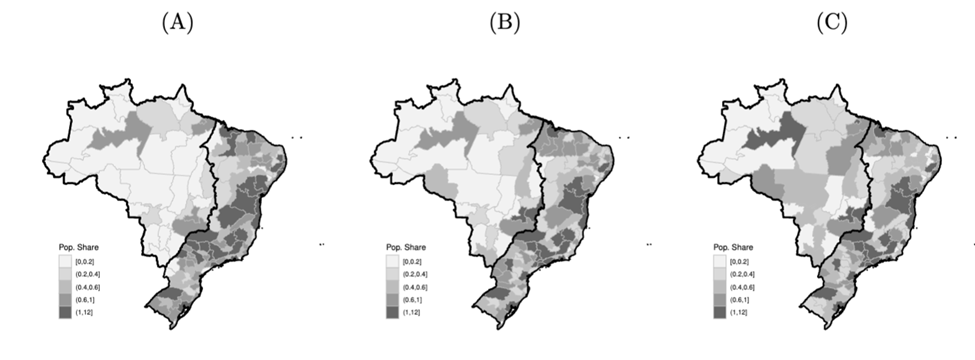
The West of Brazil is one of the world’s major agricultural powerhouses, whose agricultural exports are comparable in magnitude to those of large countries such as Mexico and India. This status, however, came rather recently: the 1950s marked an inflection point in the evolution of Brazil’s West (Figure 1). The share of Brazil’s population living there was around 7% before the 1950s, and has since doubled. These patterns are equally striking when we look at the share of agricultural value added and the share of agricultural land. Figure 2 illustrates how Brazil’s population shifted over time: while the West was sparsely populated in the 1950s compared to the East, this changed markedly by 2010.
Efforts to populate Brazil’s western regions began in the 1950s under President Getúlio Vargas and continued over the following two decades. A key milestone in the March occurred in 1964, when President Juscelino Kubitschek relocated the Brazilian capital from the coastal city of Rio de Janeiro to Brasília, a newly constructed city in the Central-West region. Complementing this political decision, the government constructed highways connecting Brasília with the rest of the country (Morten and Oliveira 2024, Bird and Straub 2020), and established a major agricultural research institution, Embrapa, whose main focus included studying the agroclimatic conditions of western Brazil (Akerman et al. 2025).
The March to the West accelerated during the 1970s, when the government embarked on a host of large-scale policies to increase food supply and expand the country’s agricultural frontier.
Figure 1: The evolution of economic activity in Brazil’s West
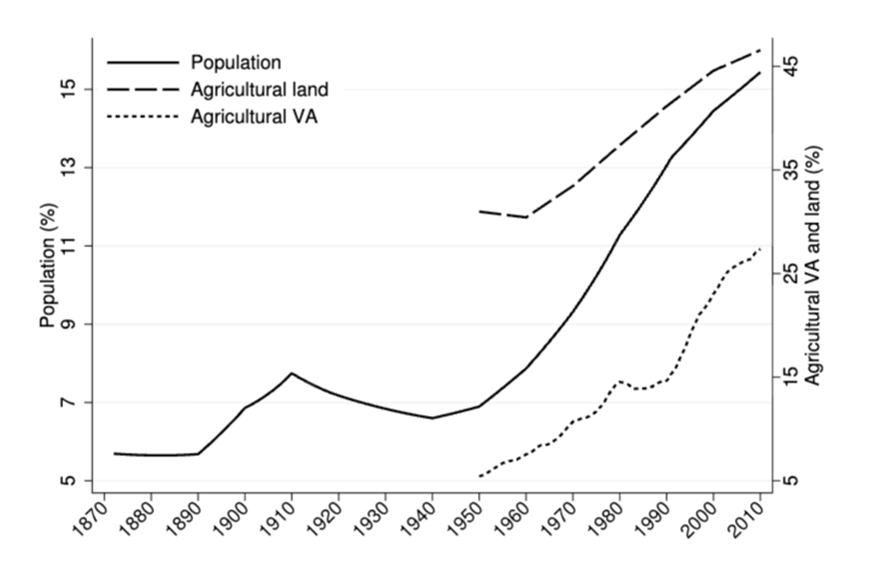
Figure 2: The spatial distribution of the population
As the West was being settled, Brazil underwent significant shifts in its patterns of trade specialisation. Between the 1970s and 2010s, the export participation of traditional comparative advantage goods – such as coffee, cacao, and banana – plummeted, giving way to new comparative advantage goods – soybeans, corn, and beef – whose export share rose to 40%.
The role of migrants in shaping export patterns
Exploiting rich microdata from Brazil, we provide new evidence on the role of migrants’ knowledge in shaping agricultural patterns of specialisation. First, we show that regions that receive more migrants from areas specialised in a particular crop tend to increase their own specialisation in that same crop. Second, when we compare two farmers producing the same crop within the same region (and therefore under the same institutional and agroclimatic conditions), those coming from regions that specialise in that crop earn substantially higher incomes than those from regions specialised in other crops.
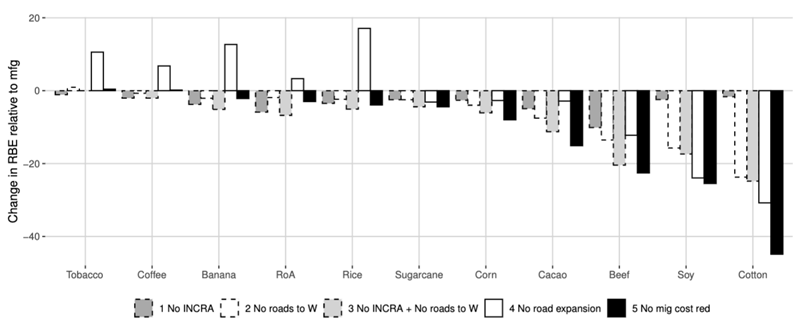
Based on these empirical facts, we develop and quantify a dynamic model of trade and migration in which workers differ in terms of their crop-specific knowledge. Using this model, we find that the portability of knowledge between regions played a pivotal role in the emergence of Brazil's new patterns of specialisation. Had migrants from the East been unable to bring their own knowledge and instead been forced to rely on the knowledge of the local population in the West, Brazil’s export specialisation in soy, livestock, and corn would have been 15%, 9%, and 4% lower, respectively. This estimate is based on our ‘Relative Bilateral Exports’ index, which measures the degree of export specialisation across sectors.
We also use the model to measure the reductions in migration costs that rationalise the patterns of migration we observe in the data between 1950 and 2010. Figure 3 shows how Brazil’s export specialisation in soy, livestock, and corn would have declined if migration costs had not fallen. Figure 3 also illustrates the estimated effects of specific government policies implemented to foster migration, such as land grants in the West and the expansion of road networks. Such policies account for a large share of the total impact of migration costs.
Figure 3: The effect of migration policies on Brazil's pattern of export specialisation
Policy implications: Migration and specialisation
Policies that foster the mobility of workers across domestic labour markets, such as expanding the road network or providing incentives to settle low-density areas, can have large impacts because they allow workers to use their knowledge to take advantage of new export opportunities.
References
Akerman, A, J Moscona, H S Pellegrina, and K Sastry (2025), “Public R&D meets economic development: Embrapa and Brazil’s agricultural revolution,” Unpublished manuscript.
Bird, J, and S Straub (2020), “The Brasilia experiment: The heterogeneous impact of road access on spatial development in Brazil,” World Development 127: 104739.
Costinot, A, and A Rodríguez-Clare (2014), “Trade theory with numbers: Quantifying the consequences of globalization,” in Handbook of International Economics 4: 197–261.
Eaton, J, and S Kortum (2002), “Technology, geography, and trade,” Econometrica 70(5): 1741–1779.
Levchenko, A A, and J Zhang (2016), “The evolution of comparative advantage: Measurement and welfare implications,” Journal of Monetary Economics 78: 96–111.
Morten, M, and J Oliveira (2024), “The effects of roads on trade and migration: Evidence from a planned capital city,” American Economic Journal: Applied Economics 16(2): 389–421.
Pellegrina, H, and S Sotelo (2025), “Migration, specialization, and trade: Evidence from Brazil’s March to the West,” Journal of Political Economy, forthcoming.