

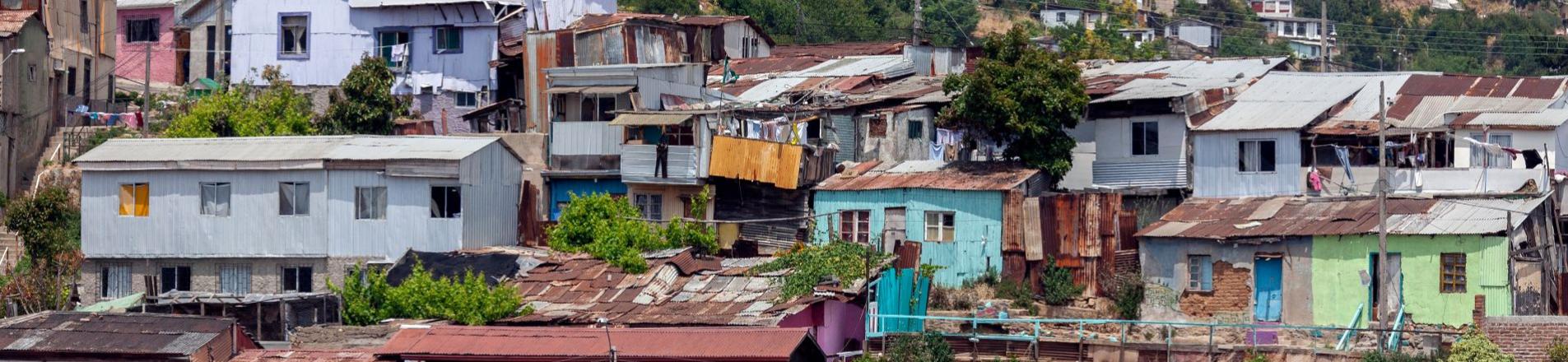




New evidence from Chile finds that in-situ slum upgrading – combining physical infrastructure improvements with the formalisation of land tenure within the slum – delivers larger gains in local economic development, both within treated slums and in surrounding neighbourhoods, at a lower cost than policies that relocate slum populations elsewhere.
Slums constitute a fundamental aspect of urban growth in developing countries. As rural-urban migration continues and the supply of formal housing fails to meet demand, informal settlements frequently serve as the initial entry point into cities for low-income households. Currently, more than one billion people worldwide live in slums; this figure is projected to increase as urban populations continue to grow (Our World in Data 2026).
A growing body of research highlights that slums are not merely a symptom of poverty but a structural component of urbanisation itself (Henderson et al. 2021). Informal settlements often develop at the peripheries of cities, where land acquisition costs are lower and regulation is weaker. Over time, some slums evolve into well-integrated neighbourhoods, whereas others remain trapped in poor conditions, leading to negative externalities for nearby neighbourhoods and limiting local economic development. Understanding this dynamic process is crucial for formulating effective urban policies.
Governments typically face a difficult choice. One alternative is in-situ upgrading, which improves housing and infrastructure within existing slum areas, protecting informal dwellers from clearance. The other option entails population relocation, which moves residents to new housing developments located away from the original site, and the vacated land is often repurposed for other urban uses, such as commercial development, public infrastructure, or green and recreational spaces. Both approaches are widely used, yet evidence on their impacts remains limited (Harari and Wong 2025, Rojas-Ampuero and Carrera 2023). Recent research has begun to rigorously evaluate these options, showing that design details and context are particularly important (Harari and Wong 2025, Henderson and Wong 2024).
Two approaches to slum renewal
In recent work (Gertler, Gonzalez-Navarro, Undurraga, and Urrego 2025), we study both slum renewal policies in the Chilean context, where in-situ upgrading and population relocation policies have been implemented nationally since 2011. We assemble a high-frequency panel of the universe of ever-slum areas that spans more than two decades. Using georeferenced polygons that were ever officially designated as slums at any point between 2011 and 2021 and Google Earth imagery, we track the evolution of land use within these polygons beginning in 2000 and following them up to 2021 (see Figure 1). In addition, the panel integrates census microdata, construction permits, administrative records, crime reports, and property tax data for slum polygons and for areas in formal neighbourhoods adjacent to slums.
Figure 1: La Iglesia slum in the municipality of Tome, selected years
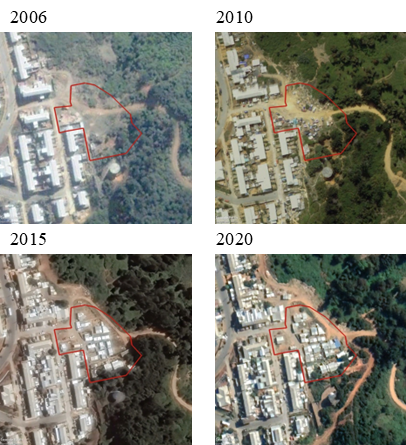
Source: Google Earth Pro.
Before turning to the evidence, we describe the two slum intervention policies and their objectives, emphasising that both aim to transform slum areas into non-slum neighbourhoods.
In-situ upgrading typically includes:
- Investments in local infrastructure, such as paved streets, water, and sanitation.
- Formalisation of land tenure or secure occupancy rights.
- Improvements to housing structures, if needed.
The goal is to improve housing and neighbourhood conditions while allowing slum households to remain in place, thereby preserving access to jobs, services, and social networks.
On the other hand, the population relocation policy typically includes:
- Provision of formal housing ownership with legal titles outside the slum area, allowing slum dwellers to voluntarily choose whether to access it.
Relocation is often motivated by safety concerns, environmental risk, or land redevelopment objectives. However, it can sever links to labour markets and weaken existing community ties.
While relocation may be the only option in hazard-prone areas such as flood zones, in most settings in-situ upgrading remains a viable alternative, giving urban planners meaningful discretion between the two approaches. This choice also has important fiscal implications: in Chile, in-situ upgrading costs roughly two-thirds as much per slum household as population relocation.
Direct impacts of slum interventions: Evidence from treated areas
To evaluate the effects of upgrading and relocation, we study impacts at the level of slum polygons using Synthetic Difference-in-Differences (SDiD) (Arkhangelsky et al. 2021). For each cohort of treated slums, SDiD constructs a weighted ‘synthetic’ comparison group from never-treated slums that closely matches pre-intervention outcome trends (Arkhangelsky et al. 2021).
Focusing on the direct effects of each policy on treated areas enables an assessment of whether each policy achieves its stated objectives. In-situ upgrading’s objective is to improve housing and neighbourhood conditions while allowing slum households to remain in place. The data is consistent with the goal being achieved. Upgraded slums experience clear improvements in housing quality and urban infrastructure. Within six years, upgraded slums exhibit significantly higher shares of paved streets, larger housing units that are more regularly oriented, and further spaced out. Importantly, these improvements occur without meaningful changes in total population levels.
Population relocation seeks to fully depopulate slums but, in practice, achieves only limited reductions in total population. We find that populations fall by an average of only 16% from pre-intervention means. Moreover, relocation does not lead to improvements in housing quality or infrastructure within slum polygons. This outcome is partly driven by the voluntary nature of the intervention, which leads to incomplete take-up. As a result, slum polygons are difficult to fully repurpose, creating scope for rapid repopulation.
Beyond the slum perimeter: Spatial spillovers of slum renewal policies
If slum upgrading or relocation alters neighbourhood desirability or investment incentives, its effects should not be confined to the slum perimeter. We therefore estimate impacts on nearby formal neighbourhoods within 200 meters of treated slums, applying the same SDiD approach.
Our results indicate that in-situ upgrading yields meaningful reductions in crime across multiple categories (violent crimes, property crimes, homicides) in neighbouring formal neighbourhoods, while simultaneously stimulating housing investment. Formal areas adjacent to upgraded slums experience significantly higher levels of new construction and renovation activity. These improvements in housing attracted higher-SES residents, particularly those with higher levels of education and employment. Together, these patterns suggest that in-situ upgrading improves local amenities, increasing the attractiveness of nearby neighbourhoods for residential investment and redevelopment.
In contrast, population relocation interventions do not generate comparable positive spillovers. Neighbourhoods adjacent to relocated slums do not experience significant reductions in crime, nor do they show similar increases in housing development or renovation activity.
What does this mean for slum policy?
In a voluntary take-up environment, in-situ upgrading dominates population relocation as a strategy for slum renewal. Relocation programmes largely fail to achieve their core objective of depopulating slum land: take-up is incomplete, slum perimeters persist or are rapidly repopulated, and living conditions inside treated areas do not improve relative to comparable untreated slums. As a result, relocation generates neither meaningful direct benefits for remaining residents nor positive spillovers to surrounding formal neighbourhoods, despite being substantially more expensive per household. By contrast, in-situ upgrading delivers durable improvements in housing quality and infrastructure, attracts higher-SES residents, and produces sizable positive externalities – higher formal housing investment and large crime reductions – in adjacent neighbourhoods. Crucially, these gains are realised at lower fiscal cost and without displacing residents.
For policymakers, the implication is clear: except in settings where physical constraints or hazard risk make on-site intervention infeasible, upgrading with secure tenure and coordinated infrastructure investment should be the preferred policy, while relocation should be reserved for narrowly defined cases and paired with strong enforcement to prevent repopulation if land repurposing is the goal.
References
Arkhangelsky, D, S Athey, D A Hirshberg, G W Imbens, and S Wager (2021), “Synthetic difference-in-differences,” American Economic Review, 111: 4088–4118.
Gertler, P, M Gonzalez-Navarro, R Undurraga, and J A Urrego (2025), “In-situ upgrading or population relocation? Direct impacts and spatial spillovers of slum renewal policies,” Unpublished manuscript.
Harari, M, and M Wong (2025), “Slum upgrading and long-run urban development: Evidence from Indonesia,” Review of Economic Studies, rdaf090.
Henderson, J V, T Regan, and A J Venables (2021), “Building the city: From slums to a modern metropolis,” Review of Economic Studies, 88: 1157–1192.
Henderson, V, and M Wong (2024), “Designing cities in developing countries: Land planning, slum upgrading and reconstruction programmes,” VoxDev.
Our World in Data (2026), “Data page: Number of people living in urban slum households,” Data adapted from United Nations Population Division, national statistical offices, and Eurostat, via World Bank.
Rojas-Ampuero, F, and F Carrera (2023), “Sent away: The long-term effects of slum clearance on children,” Unpublished manuscript.