






Mandatory disclosures in housing markets reduce market inefficiencies and improve access to information, as evidenced by disclosure laws in India.
Akerlof, in his seminal paper on the market for lemons, refers to dishonesty in business as an act by the seller to misrepresent the ‘quality’ of the good to buyers (Akerlof 1970). The housing market has potential for high levels of such dishonesty, leading to uncertainty and risks for buyers. In India, sellers may, for example, build on land without clear titles, misrepresent whether government approvals have been obtained, or disregard officially permitted building heights and floor space. These factors lead to higher probabilities of litigation against housing projects, which are not disclosed to buyers.
In Mumbai, India’s financial capital, around 30% of ongoing real estate projects are embroiled in litigation. Real estate projects take around 8.5 years from construction start to finish, and litigation adds, on average, 20% to project completion timelines (Gandhi et al. 2021). Since pre-sales (sales before the project is completed) are common, buyers must expend resources to determine whether or not a real estate project is facing litigation, in other words, whether a project is a lemon.
Studying the impact of mandatory disclosure laws in the Mumbai housing market
To bring about transparency in the real estate market, the government of India introduced the Real Estate Regulatory Act (RERA) in 2016. The Act directed state governments to create regulations that mandated developers to disclose certain information about their projects on a public website. This would reduce information asymmetry between buyers and sellers as the former could look up various details of a project before buying a house.
The disclosure policies introduced by state governments under the Real Estate Regulatory Act varied in nature. For example, only six states require developers to disclose litigation status, while sixteen others do not. The state of Maharashtra established the state real estate regulator and rules in May 2017. These rules not only mandated developers to disclose the litigation status of projects on the regulator’s website but also required them to provide case details.
By focusing on Mumbai, the capital city of Maharashtra, we address the following questions in Tandel, Gandhi, Nanda, and Agnihotri (2025): What is the impact of mandatory disclosure of house quality on market outcomes? Does this impact differ across income groups due to differences in buyers’ abilities to privately resolve information asymmetry?
The disclosure policy lowered prices and sales of litigated housing units
In our research, we collect data on litigations and other housing project details from the regulator’s website and match it to unit-level price and buyer data in a mortgage dataset acquired from a large Indian private bank. We also match projects to project-level sales data. This dataset includes transactions and sales both before and after the disclosure policy for the same projects.
Figure 1: Impact of disclosure policy on litigated projects
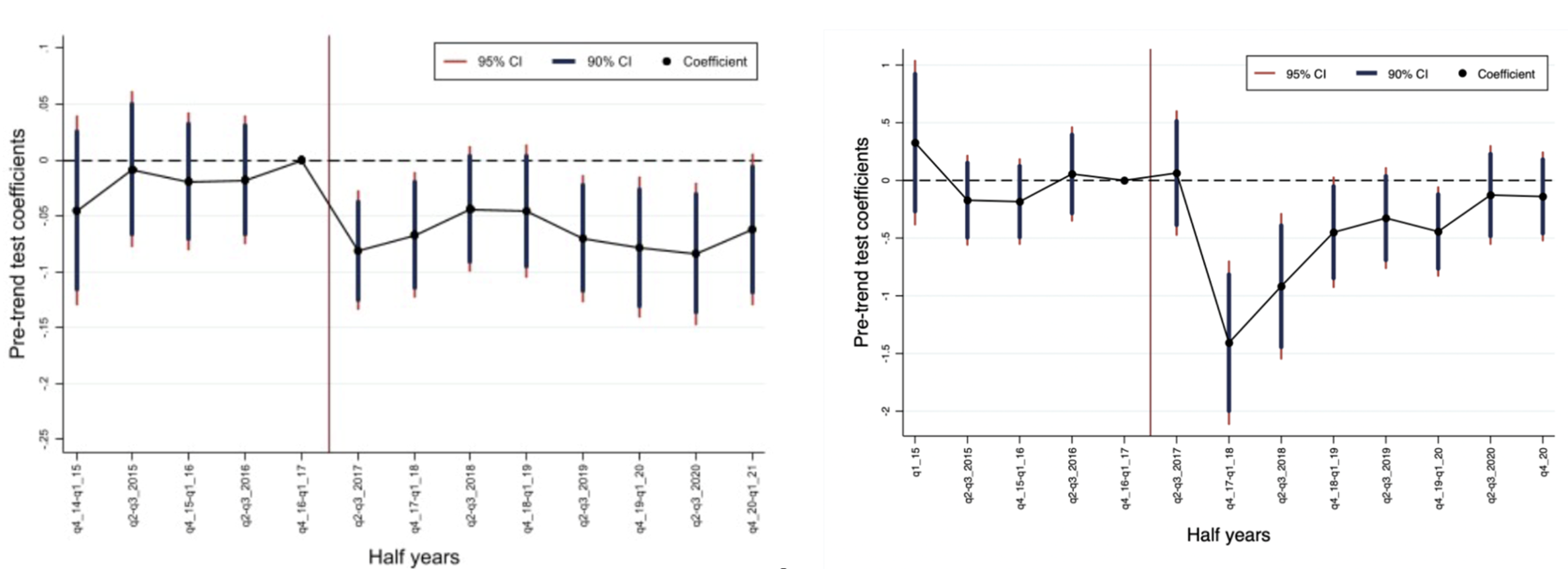
Notes: Effect of disclosure policy on property prices and sales bi-annually. The maroon vertical line represents the last pre-reform period before RERA.
Our results show that, prior to the reform, there was no difference in the prices of litigated and non-litigated units, indicating that buyers, on average, did not differentiate between litigated and non-litigated housing projects (Figure 1 Panel A). After the disclosure reform, we find that the mean per square foot price of litigated units was 4–6% lower than that of non-litigated units. We examine a possible channel for the fall in prices, namely sellers lowering prices of litigated project following a decline in sales as potential buyers switched to non-litigated projects. We find that sales in litigated housing projects declined immediately following the disclosure reform but recovered after a couple of years—perhaps in response to the price declines (Figure 1 Panel B).
In the period before the disclosure policy, some buyers were likely to privately resolve information asymmetry by hiring brokers, solicitors, or surveyors to gather information about projects. This behaviour was likely correlated with buyer income: buyers with higher incomes had the resources to hire such services, whereas lower-income buyers did not have access to similar information channels. As a result, higher-income buyers may have known the litigation status of housing projects—implying unequal access to information before the reform.
We therefore anticipate that the disclosure policy would have differential impact across income groups. Indeed, we find that the price decline was greatest for buyers in the lower-income category (quartile 1) and non-existent for buyers in the highest-income category (quartile 4). Thus, the disclosure policy reduced inequality in access to litigation information.
Figure 2: Effect of disclosure policy on prices by income quartile
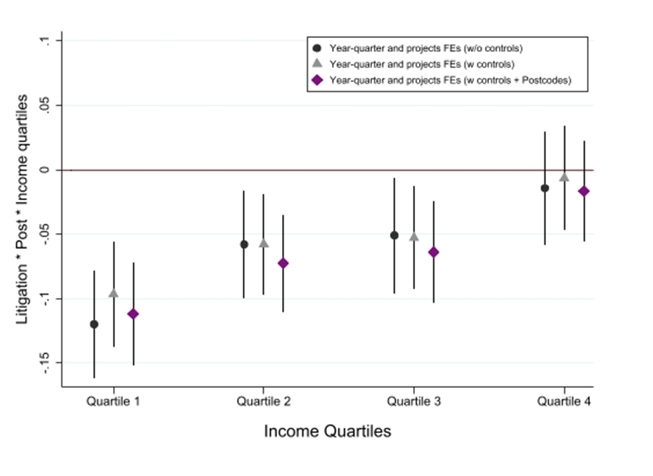
Notes: The figure shows the results of the introduction of RERA on price of litigated units for each income quartile of the homebuyer. Controls refer to unit controls, which are completion status and area in square feet, and buyer controls—which include occupation, gender, and loan to value for the transaction.
Implications for property rights in developing countries
Our results show that disclosure laws may have efficiency - and equity - enhancing effects in Mumbai’s housing market. Given the preponderance of litigation in the Indian housing market overall, we make a case for other states to introduce rules of mandatory disclosure of litigation.
Weak property rights in cities are an issue not only in India but also in many African cities (Lall et al. 2017). Our results also have implications for designing disclosure laws in housing markets across other developing countries with similarly weak property rights systems.
References
Akerlof GA (1970), “The market for ‘lemons’: Quality uncertainty and the market mechanism,” Quarterly Journal of Economics 84(3): 488–500.
Gandhi S, Tandel V, Tabarrok A & Ravi S (2021), “Too slow for the urban march: Litigations and the real estate market in Mumbai, India,” Journal of Urban Economics 123: 103330.
Lall SV, Henderson JV & Venables AJ (2017), “Africa’s cities: Opening doors to the world,” World Bank.
Tandel V, Gandhi S, Nanda A & Agnihotri N (2025), “Do mandatory disclosures squeeze the lemons? The case of housing markets in India,” Journal of Public Economics 247: 105395.