







In Nigeria, cash transfers to women increase their desire for agency but only when husbands can't see it – revealing the complex interplay between economic empowerment and social norms.
Women's empowerment remains a central development goal, with policymakers frequently using cash transfer programmes to improve women's status within households (Almås et al. 2018, Duflo 2012, Greco et al. 2025). But do these economic interventions actually change power dynamics, or do they merely shift material outcomes? Our study of married couples in rural Nigeria reveals a surprising answer: cash transfers increase women's desire for decision-making power, but this desire remains hidden.
Studying the role of cash transfers in couples’ decision-making
We conducted a lab-in-the-field experiment in Kebbi State, northwestern Nigeria, a region where patriarchal norms strongly shape household dynamics. The experiment was embedded within a larger randomised controlled trial of an unconditional cash transfer (UCT) programme that provided NGN 75,000 (~ USD 693 PPP 2015) over 18 months to ultra-poor women – roughly half their annual household consumption (Bakhtiar, Fafchamps, Goldstein, Leonard, and Papineni 2025).
The main impact evaluation by Papineni et al. (2024) found substantial economic effects from this programme. One year after the programme ended, beneficiary women had increased their enterprise ownership rate by 20 percentage points. There was also a documented shift away from husband-centred towards joint intrahousehold decision-making based on survey measures.
Our lab experiment complements these findings by providing a more nuanced understanding of the decision-making process itself. We conducted sessions with a subsample of 506 couples from the main evaluation sample, taking place approximately one year after the transfers ended. In our experimental marketplace, we set up three shopping stalls: one with women's items (jewellery, colourful fabrics), another with men's goods (caps, belts, shoes), and a third with household items (cleaning supplies, plates, mosquito coils).
Crucially, we introduced a ‘secret’ treatment where half the sessions allowed participants to make decisions their spouse would never know about. This design allows us to examine whether observability matters for women's willingness to exercise agency.
Equal outcomes, unequal process
Contrary to expectations, we find that both husbands and wives divided budgets relatively equally on average – a finding that echoes previous work suggesting spouses have social preferences for each other's consumption (Ashraf 2009, Jakiela and Ozier 2016). However, this apparent equity masks dramatic inequality in the decision-making process itself.
Women deferred budget allocation decisions to their husbands 67–68% of the time, while men deferred to their wives only 20–26% of the time. Women were also far more likely to consult their husbands (55–59% vs 20–23%) and accommodate their preferences when making decisions. Figure 1 illustrates this striking gender asymmetry.
Figure 1: Proportion of spouses deferring budget allocation decisions to their partner
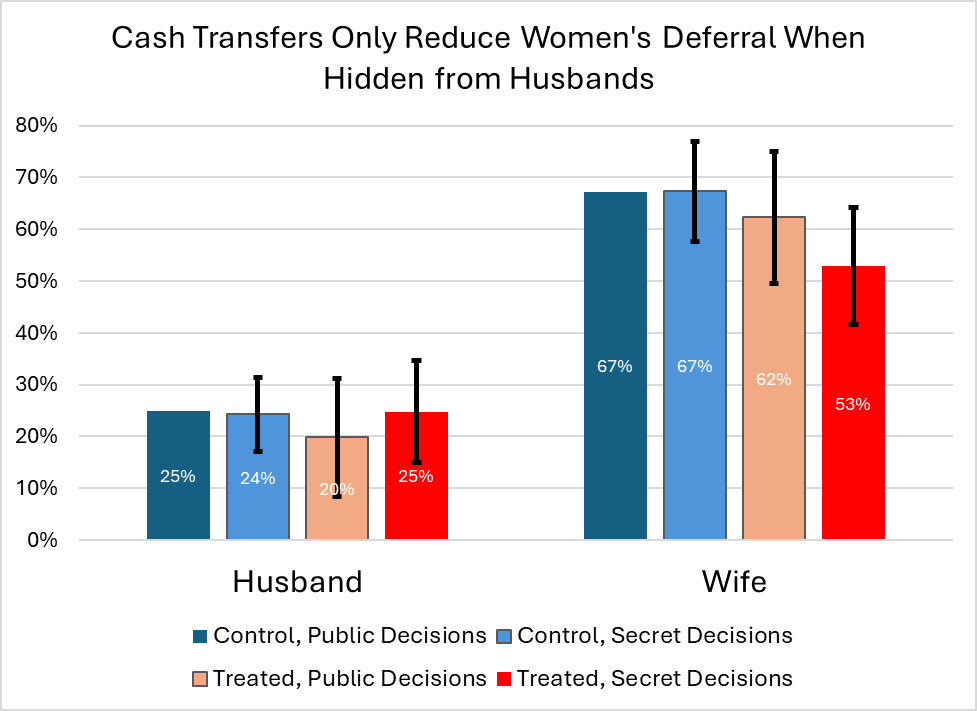
Notes: ‘Public Decisions’ are observable by the spouse; ‘Secret Decisions’ are hidden. Error bars represent 95% confidence intervals.
Most remarkably, this deferral was costly. Women chose to let their husbands decide even when it meant receiving less. When we gave participants cookies and juice to consume privately (during the lab session), 68% of women still let their husbands choose for them. Yet when spouses chose items for each other, these choices matched what their partner actually wanted only around 50% of the time – no better than chance.
The UCT effect: Pent-up demand for agency
The cash transfer intervention revealed something unexpected. UCT-treated women became significantly less willing to defer decisions to their husbands, but only when those decisions were secret (Figure 1). In observable conditions, treated women continued deferring at the same high rates as control women.
Specifically, in secret conditions, UCT recipients were 12–17 percentage points less likely to defer decisions across different allocation domains. They also allocated slightly more resources to themselves (around 5% more) and were 13–27 percentage points less likely to consult their husbands. However, these behavioural changes completely disappeared when husbands could observe their wives' choices.
This pattern suggests the UCT created what we call ‘pent-up demand’ for agency – a desire for control that women felt unable to express when their choices were observable to their husbands.
Policy implications: Economic empowerment and women’s agency
Our findings challenge the assumption that economic empowerment automatically translates into increased agency. While cash transfers successfully increase women's income and assets, they appear to create hidden tensions rather than transforming household power dynamics. Women develop greater aspirations for agency but cannot express them within existing social structures.
This suggests several important considerations for development programmes:
- Measurement matters: Evaluations focusing solely on consumption patterns or observable decisions may miss critical dimensions of empowerment. The secret condition revealed desires that standard surveys would never capture.
- Beyond material outcomes: The process by which decisions are made matters as much as the outcomes themselves. True empowerment requires attention to both dimensions.
- Complementary interventions may be needed: Economic support alone in this context appears insufficient to change observable decision-making patterns. Programmes may need to consider complementary approaches beyond economic transfers, potentially including community-level interventions or male engagement initiatives.
- Safe spaces for agency: Creating legitimate domains where women can exercise decision-making without threatening existing norms may provide a transitional path towards broader empowerment.
Our research on Northern Nigeria reflects a broader challenge: economic change often outpaces social change. Women who receive cash transfers find themselves caught between new economic possibilities and persistent social expectations. They adapt through maintaining public deference while harbouring private desires for agency.
Understanding these hidden dynamics is crucial for designing effective intervention. True empowerment appears to require more than simply putting resources in women's hands. Our findings suggest the contexts in which decisions are made matter crucially for whether economic interventions translate into genuine agency in household decision-making.
The persistence of these patterns one year after the cash transfers ended suggests that while economic shocks can shift aspirations, transforming entrenched power dynamics likely requires sustained, multi-faceted approaches beyond economic interventions alone.
References
Almås, I, A Armand, O Attanasio, and P Carneiro (2018), “Measuring and changing control: Women’s empowerment and targeted transfers,” Economic Journal, 128: F609–F639.
Ashraf, N (2009), “Spousal control and intra-household decision making: An experimental study in the Philippines,” American Economic Review, 99: 1245–1277.
Bakhtiar, M M, M Fafchamps, M Goldstein, K L Leonard, and S Papineni (2025), "To defer or to differ: Experimental evidence on the role of cash transfers in Nigerian couples’ decision-making," The Economic Journal, 135(669), 1536-1574.
Duflo, E (2012), “Women empowerment and economic development,” Journal of Economic Literature, 50: 1051–1079.
Jakiela, P, and O Ozier (2016), “Does Africa need a rotten kin theorem? Experimental evidence from village economies,” Review of Economic Studies, 83: 231–268.
Greco, G, S Gulesci, P Prabhakar, and M Sulaiman (2025), “Digital cash transfers, privacy and women’s empowerment: Evidence from Uganda,” Unpublished manuscript.
Papineni, S, P Gonzalez, M Goldstein, and J Friedman (2024), “Cash is queen: Local economy growth effects of cash transfers in West Africa,” Unpublished manuscript.