









Group coaching in multi-faceted poverty alleviation programmes delivers the same results as individual coaching – at much lower cost.
Governments and NGOs worldwide have increasingly adopted multi-faceted poverty alleviation (or ‘graduation’) programmes to address extreme poverty. These programmes are unique, as they simultaneously tackle multiple barriers to escaping poverty: support usually includes an asset transfer, consumption support, access to savings facilities, and regular coaching and mentoring. Rigorous evidence from multiple countries shows that these multi-faceted poverty alleviation programmes can boost consumption, asset holdings, food security, and subjective well-being (Bandiera et al. 2017), and that these benefits persist in the long term (Banerjee et al. 2021).
But scaling up remains a challenge (Banerjee et al. 2015, Abed 2025). One of the costliest components is coaching, in which field staff visit households regularly to provide training, advice, encouragement, and monitoring. Because coaching relies on scarce skilled human resources, these programmes are also particularly difficult to scale (List 2024). One way to reduce the cost of the graduation model is to shift coaching from a one-on-one basis to a group-based coaching approach, in which one coach meets with several households at once. Could shifting from individual- to group-based coaching achieve similar outcomes at a lower cost?
Why coaching modality may matter
The choice between group and individual coaching is not just about cost. Individual coaching may work better if different households face very different challenges, as coaches can offer tailored advice. If the benefits of coaching accrue through monitoring and compliance, then individual home visits may be more effective. On the other hand, group coaching may work better if peer effects, social learning, and strengthening networks are important for programme success.
Comparing group versus individual coaching
To rigorously compare the cost-effectiveness of group versus individual coaching, we conducted randomised controlled trials evaluating three graduation programmes implemented between 2015 and 2022 in three distinct contexts: Uganda, the Philippines, and Bangladesh (Beam et al. 2025). We measured impacts approximately two years after the initial asset transfer in Uganda and the Philippines, and six years later in Bangladesh.
Eligible households were randomly assigned to receive one of the following:
- A graduation package with only individual coaching (home visits).
- A graduation package with group coaching (peer group meetings in a central location).
- A control group (no programme).
In Bangladesh, we also tested a lighter-touch individual coaching model in a fourth arm, maintaining the individual coaching modality but halving its frequency.
Aside from experimental variation in coaching delivery, all households received the same country-specific package of support, including a large asset transfer, consumption support, and access to savings facilities.
Graduation works but coaching modality does not matter
Graduation programmes significantly improved household welfare compared to the control group in all three settings. Consumption increased by 9% in the Philippines, 28% in Uganda, and, depending on coaching modality, 8–17% in Bangladesh. Food security improved markedly in Uganda and the Philippines. Asset holdings were higher by approximately 100% in Bangladesh and Uganda, and 50% in the Philippines. Total household income increased by 27% in Bangladesh and 50% in Uganda. Subjective well-being improved across all three sites.
Yet we find no statistically significant differences when comparing the impacts of group coaching to individual coaching. Across consumption, food security, income, asset holdings, and well-being, the two approaches to delivering coaching within the graduation programme performed almost identically, as evidenced by the close point estimates and overlapping confidence intervals in Figure 1.
Figure 1: Standardised programme impacts on primary household outcomes
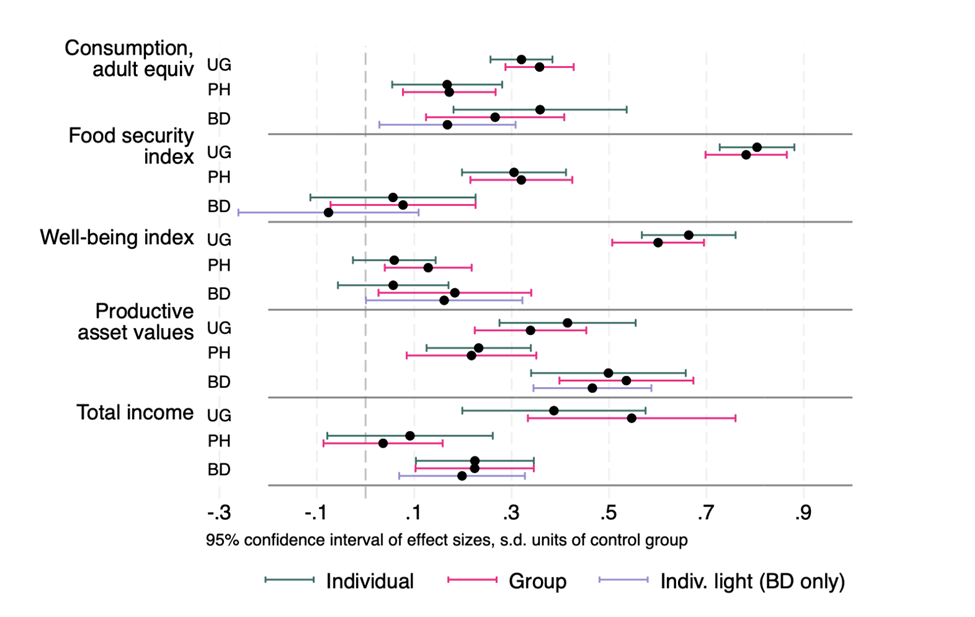
This lack of difference could mislead policymakers if group coaching benefits some groups while harming others. Using machine learning techniques (Chernozhukov et al. 2025), we find no evidence that poorer or more marginalised households were left behind when shifting from individual to group coaching.
We explore reasons why group coaching may be equally effective. We do not find systematic differences in coaching participation or (in Uganda, where we collected data on this) the intensity and nature of this participation. We also hypothesised that group coaching may strengthen networks and trust. However, this evidence is only suggestive: in the Philippines and Bangladesh, group coaching participants report stronger social ties than those in the individual arm, but differences are small and only marginally significant.
The cost-effectiveness advantage of group coaching
While impacts were similar, costs were not. Group coaching versions of the programme were 15–20% cheaper to deliver than the individual coaching versions. In Uganda, PPP-adjusted savings per household were around US$980; in the Philippines and Bangladesh, this was $523 and $665, respectively.
When we compare impact per dollar spent, group coaching consistently outperforms individual coaching. In pooled analysis across countries, group coaching achieves greater improvements in consumption, food security, and well-being per $1,000 invested. Overall, we confirm that group coaching versions of the programme are more cost-effective on our key welfare outcomes – consumption, food security, and well-being – across all three study sites.
Reducing the intensity of individual coaching while keeping the modality the same also cut costs but produced mixed results. Unlike group coaching, lighter-touch individual coaching did not consistently improve cost-effectiveness.
Implications for policy on graduation programmes
Governments and NGOs are expanding graduation programmes rapidly. As of 2021, more than 90 million people have been reached by these programmes in over 75 countries (Andrews et al. 2021). But those programme components that rely on human resources run into diseconomies of scale, i.e. the first good coach is much easier to source than the thousandth. Yet coaching appears to be an essential element of the graduation model, as evidenced by attempts to remove the coaching component that have backfired (Banerjee et al. 2022). Group coaching may help address this challenge by allowing implementers to reduce costs while relaxing the constraints to scaling. Group coaching reduces programme costs without sacrificing impact and eases logistical challenges by requiring fewer coaches to be trained and supervised.
Graduation programmes continue to have powerful impacts on the lives of the poorest households, breaking poverty traps and building resilience (Ghatak 2019, Phadera et al. 2019). But to reach millions more, implementers must find strategies to scale effectively. Our research across three diverse settings – Uganda, the Philippines, and Bangladesh – shows that innovating on how coaching is delivered presents opportunities for reducing costs without sacrificing impact.
For governments and NGOs, this is good news: shifting from individual to group coaching can make graduation programmes both more affordable and scalable, without compromising on the goal of lifting families out of extreme poverty.
References
Abed, S (2025), “Targeting the ultra-poor through the Graduation approach: Insights from BRAC,” VoxDev.
Andrews, C, A de Montesquiou, I Arevalo Sanchez, P V Dutta, B V Paul, S Samaranayake, J Heisey, T Clay, and S Chaudhary (2021), “The state of economic inclusion report 2021: The potential to scale,” World Bank.
Bandiera, O, R Burgess, N Das, S Gulesci, I Rasul, and M Sulaiman (2017), “Labor markets and poverty in village economies,” Quarterly Journal of Economics 132(2): 811–870.
Banerjee, A, E Duflo, N Goldberg, D Karlan, R Osei, W Parienté, J Shapiro, B Thuysbaert, and C Udry (2015), “A multifaceted program causes lasting progress for the very poor: Evidence from six countries,” Science 348(6236): 1260799.
Banerjee, A, E Duflo, and G Sharma (2021), “Long-term effects of the Targeting the Ultra Poor program,” American Economic Review: Insights 3(4): 471–486.
Banerjee, A, D Karlan, R Osei, H Trachtman, and C Udry (2022), “Unpacking a multi-faceted program to build sustainable income for the very poor,” Journal of Development Economics 155: 102781.
Beam, E A, L Brune, N Das, S Dercon, N Goldberg, R Haque, D Karlan, M Khan, D Parkerson, A Pople, Y Sawada, C Udry, and R Zizzamia (2025), “Group versus individual coaching for rural social protection programs: Evidence from Uganda, Philippines, and Bangladesh,” Unpublished manuscript.
Chernozhukov, V, M Demirer, E Duflo, and I Fernández-Val (2025), “Fisher–Schultz lecture: Generic machine-learning inference on heterogeneous treatment effects in randomized experiments, with an application to immunization in India,” Econometrica 93(4): 1121–1164.
Ghatak, M (2019), “Is poverty self-perpetuating?,” VoxDev.
List, J A (2024), “Optimally generate policy-based evidence before scaling,” Nature 626: 491–499.
Phadera, L, H Michelson, A Winter-Nelson, and P Goldsmith (2019), “Do asset transfers build household resilience?,” Journal of Development Economics 138: 205–227.