




Indonesia’s Special Economic Zone programme (known as Integrated Economic Development Zones) had minimal impact on regional growth and welfare, largely because it targeted remote, low-potential areas and relied solely on tax incentives. Effective design requires careful site selection, complemented by infrastructure investment and policies that reduce barriers to formal sector participation.
Throughout the developing world, many countries have created Special Economic Zones (SEZs) to attract investment and spur industrial growth (Abagna et al. 2025, Görg and Mulyukova 2025). In some cases, these zones provide tax incentives and reduced regulatory burdens for firms to promote development in poorer regions. Although SEZ incentives may be costly, the hope is that the zone may attract new firms and benefit existing firms through productivity spillovers. This could create a positive feedback loop, encourage even further entry, and lead to a self-sustaining, virtuous cycle of development with growth dividends that allow the SEZ to ultimately pay for itself.
However, in poorer regions with limited market access and inadequate transport and communications infrastructure, tax cuts alone may not attract firms and investment. Firms that benefit from cheaper labour or capital costs in an SEZ may have intended to locate there even without favourable tax treatment. In such places, even a sizeable tax incentive may not be sufficient to generate the ‘big push’ of investment required to sustain regional growth (Rosenstein-Rodan 1943). Tax cuts may also make it harder for cash-strapped lower- and middle-income countries to provide for public goods.
Studying Indonesia’s Special Economic Zone programme
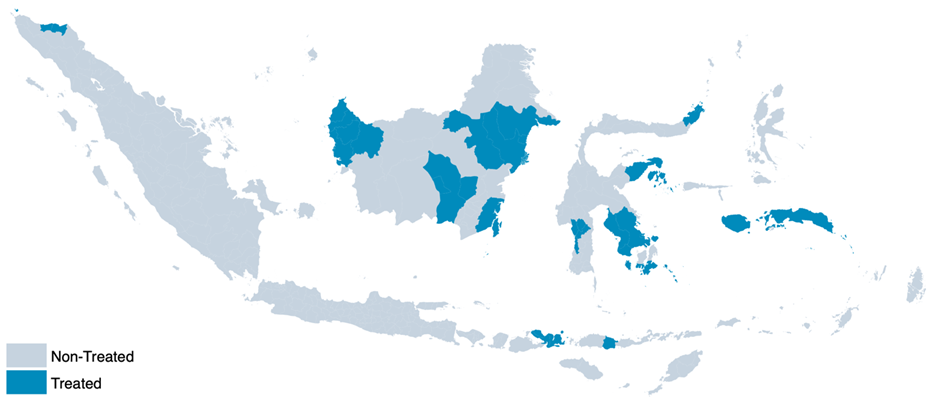
In Rothenberg, Wang and Chari (2025), we study the growth and welfare effects of Indonesia’s Integrated Economic Development Zone programme (Kawasan Pengembangan Ekonomi Terpadu, or KAPET). Beginning in the late 1990s, KAPET provided substantial capital and labour tax breaks for firms locating to certain districts in the Outer Islands of Indonesia, a country with large regional differences in per-capita income and a history of policies to promote inclusive growth (Figure 1).
Figure 1: Map of treated districts
Using household and firm-level data, we find that despite receiving large tax breaks, KAPET districts did not experience better development outcomes after the programme began when compared to similar non-KAPET areas. Firms in KAPET districts reported paying lower taxes, but we find no significant impacts of these tax cuts on wages, employment, population growth, migration, consumption expenditures, or measures of poverty. We also find that the programme was not associated with increased economic growth or night-time light intensity, another commonly used measure of regional output (Henderson et al. 2012, Gibson et al. 2021). Our null findings for the KAPET programme are fairly precise, allowing us to confidently rule out the effect sizes estimated for similar policies in the literature. These empirical results also validate other qualitative analyses of the KAPET programme’s performance (Rahardja et al. 2012, Temenggung 2013).
Why did the KAPET programme fail?
What explains the limited impact of the KAPET programme, and how can it be improved? To shed light on these questions, we develop a quantitative model of Indonesia’s economic geography. The model incorporates several key features, many of which are characteristic of lower-middle income countries. These include: (1) stark variation in economic potential across locations; (2) firms that use labour and capital for production, with inputs subject to taxation; (3) large migration costs between regions (Bryan and Morten 2019); and (4) the prevalence of a large informal sector. We also adapt the model to public finance in Indonesia, allowing for fiscal transfers from the centre to local governments that finance the provision of local public goods.
Using detailed data on the spatial distribution of economic activity, we calibrate and estimate model parameters to quantify the welfare effects of the KAPET programme. We then simulate the impacts of alternative policy designs to generate insights on how regional policies can be more effectively targeted and implemented.
We first use the model to show that it replicates the lack of substantial effects we find for the KAPET programme on multiple outcomes, including total employment, informality, and district output. The model also demonstrates that the current KAPET policy generated only minimal welfare gains, largely because it targeted remote areas with low economic potential. Next, we use the model to evaluate what might have happened if the KAPET programme had been designed differently. This work should be useful for policymakers who are interested in optimising SEZ programmes.
Policy implications: Special Economic Zones
When thinking through how to design effective SEZs, policymakers should consider the following:
- Regional tax incentives may be ineffective when implemented in isolation, particularly when they target poorer areas with limited market access and insufficient human capital. Our simulations suggest that the KAPET programme, as designed, was not effective, but it would have delivered sizeable welfare and growth benefits if it had been paired with complementary local policies that made targeted areas more accessible and economically attractive. Such policies could include infrastructure investments that make SEZs more productive by improving connectivity and reducing commuting costs. This aligns with findings from the broader evidence on place-based policies, which shows that tax incentives alone are often insufficient to stimulate meaningful investment, particularly in areas with poor market access and low-quality infrastructure (Duranton and Venables 2021, Frick et al. 2019).
- The choice of target locations is important and should reflect the underlying policy objectives. There is always an efficiency-equity trade-off. We find that targeting incentives to more populous areas with higher levels of formal employment would generate larger gains for the overall economy. While this targeting may enhance economic efficiency, it may also increase spatial inequality and potentially reduce equity.
- The broader economic context matters. In many developing countries where informal employment dominates, policies that focus solely on the formal sector are less likely to generate broad benefits. Our simulations suggest that reducing barriers to formal entry – by easing start-up regulations or fostering competition – can lead to substantial growth and welfare gains.
- Well-designed fiscal transfer systems are essential. Fiscal transfers are an important part of government policy to finance the provision of local public goods and support less developed regions. Our simulations suggest that while making Indonesia’s transfer system more progressive may encourage activity in less developed places, it also incentivises people to remain in less productive areas. This ultimately reduces aggregate welfare (Henkel et al. 2021).
In summary, a large evidence base evaluating the costs and benefits of various place-based policies finds decidedly mixed results (Neumark and Simpson 2015). Policymakers seeking to use SEZs to promote regional development and economic growth should proceed with caution – exercising discretion in site selection, using SEZs to reduce entry barriers and promote competition, and, if targeting poorer areas, combining tax incentives with connectivity investments.
References
Abagna, M A, C Hornok, and A Mulyukova (2025), “Place-based policies and household wealth in Africa,” Journal of Development Economics, 103482.
Bryan, G and M Morten (2019), “The aggregate productivity effects of internal migration: Evidence from Indonesia,” Journal of Political Economy, 127: 2229–2268.
Duranton, G and A J Venables (2020), “Place-based policies: Principles and developing country applications,” in Handbook of Regional Science: 1–22.
Frick, S A, A Rodríguez-Pose, and M D Wong (2019), “Toward economically dynamic special economic zones in emerging countries,” Economic Geography, 95(1): 30–64.
Gibson, J, S Olivia, G Boe-Gibson, and C Li (2021), “Which night lights data should we use in economics, and where?” Journal of Development Economics, 149: 102602.
Görg, H and A Mulyukova (2024), “Place-based policies and firm performance: Evidence from Special Economic Zones in India,” European Economic Review, 165: 104752.
Henderson, J V, A Storeygard, and D N Weil (2012), “Measuring economic growth from outer space,” American Economic Review, 102: 994–1028.
Henkel, M, T Seidel, and J Suedekum (2021), “Fiscal transfers in the spatial economy,” American Economic Journal: Economic Policy, 13(4): 433–468.
Neumark, D and H Simpson (2015), “Place-based policies,” in Handbook of Regional and Urban Economics, 5: 1197–1287, Elsevier.
Rahardja, S, A Kuncoro, F Fitriani, G Varela, and M A Dipo (2012), "Agglomeration and manufacturing activities in Indonesia," World Bank.
Rosenstein-Rodan, P N (1943), “Problems of industrialisation of Eastern and South-Eastern Europe,” The Economic Journal, 53: 202–211.
Rothenberg, A D, Y Wang, and A Chari (2025), “When regional policies fail: An evaluation of Indonesia’s integrated economic development zones,” Journal of Development Economics, 176: 103503.
Temenggung, D (2013), “Policies to promote development and integration of lagging regions: The Indonesian experience,” in The Internal Geography of Trade: Lagging Regions and Global Markets: 209–227.