






Every year, developing countries spend considerable resources on training teachers—yet these efforts often prove unfruitful. New research from a large-scale, pedagogy-focused teacher coaching programme in rural Peru offers promising results for achieving sustained improvements in students’ educational outcomes, providing valuable insight on evaluating programme impacts in sectors with high turnover.
Teacher quality is an essential determinant of student learning (Das et al. 2007, Chetty et al. 2014), yet many teachers lack the knowledge or skills to teach effectively. This is especially true for teachers in developing countries (World Bank 2018), which spend over US$1 billion on teacher training every year (Loyalka 2019). Standard teacher training programmes—typically conducted in centralised locations where educators from different schools gather—are often found to be ineffective (World Bank 2018).
An alternative to standard teacher training is coaching teachers at their schools. Evans and Popova (2016) find that the most effective teacher training programmes use face-to-face (rather than virtual) training and follow-up visits; these programmes also engage with teachers to obtain their ideas and adapt to the local context. Teacher coaching programmes often include these features, making them a promising alternative to traditional teacher training.
Evaluations of teacher training programmes (including teacher coaching) offered at the school level are complicated by the fact that teachers can, and do, move between schools. The movement of teachers across schools may lead to spillovers (i.e. schools without the programme receiving teachers that were previously in schools with the programme) that introduce biases when comparing programme and non-programme schools, even when a randomised control trial (RCT) is implemented.
This risk of bias would occur in any programme impact estimation if service providers (or programme beneficiaries) move across provider locations. Indeed, high turnover has been documented in various sectors, including among nurses in the US (Kovner et al. 2014) and police officers in India (Banerjee et al. 2021). Despite its frequency, such turnover is often ignored in impact evaluation.
The importance of training teachers in pedagogy in developing countries
Can teacher coaching increase teachers’ skills and, consequently, increase students’ literacy and numeracy skills? In Castro et al. (2025), we estimate the effects of Acompañamiento Pedagógico Multigrado (APM), a coaching programme implemented in remote rural schools in Peru, aimed at improving teachers’ pedagogical skills and student learning. As part of the APM programme, trained coaches visit classrooms and advise teachers on their pedagogical practices, providing customised strategies to improve them. This evaluation draws on a randomised controlled trial of APM conducted during the programme’s expansion in 2016, involving 6,218 schools (3,797 programme schools, 2,421 non-programme schools).
As in many developing countries, Peru’s rural schools have very high rates of teacher turnover; for example, of the teachers in the subsample of 340 schools with teacher skills data, around 43% changed schools between the 2016 and 2017 school years. We also make a methodological contribution by developing a framework that clarifies the assumptions and data needed to obtain unbiased estimates of different types of programme impacts (treatment effects) in RCTs where service providers frequently move to new service provider locations.
Students of teachers who underwent coaching experienced improved educational outcomes
We first estimate ‘intent to treat’ (ITT) effects, which are the effects of offering the programme to teachers, despite some teachers not being fully treated as they moved to schools that do not offer coaching (or moved from a school without coaching to one with coaching). For the teachers who, after turnover occurred, were teaching in the schools assigned to the programme, we find that the ITT effect of two years of coaching is a 0.20 standard deviations (s.d.) increase on their pedagogical skills. We also show that this ITT estimate is, under plausible assumptions, a lower bound of the average treatment effect (ATE), which is the impact on teachers’ pedagogical skills if all teachers were fully treated (all teachers in treated schools had two years of coaching).
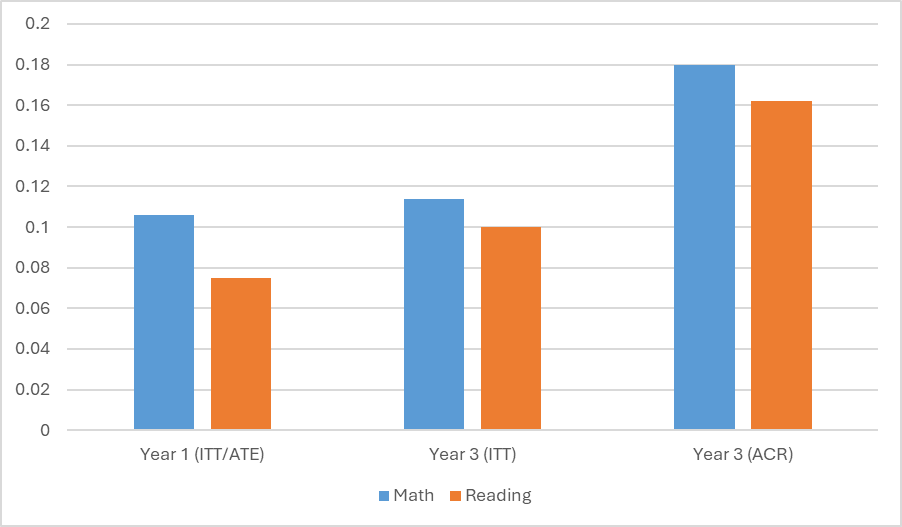
We also estimated the impact of the programme on student learning after one and three years (data were not available for the second year). After one year, the programme increased learning among Grade 2 students by 0.106 and 0.075 s.d. in mathematics and reading comprehension, respectively. These are both ITT and ATE effects, as all teachers followed random assignment (i.e. did not move) within the first school year. After three years, the ITT effect increased only slightly, to 0.114 and 0.100 s.d. for mathematics and reading comprehension, respectively; these estimates, which are lower bounds for ATE (which cannot be estimated in year 3), reflect the fact that many teachers in programme schools in year 3 did not have three full years of coaching, and some teachers who had moved to non-programme schools by year 3 had been coached in previous years. Average causal response (ACR) estimates after three years—which adjust the ITT estimates upward to reflect the impact on student learning from three years of exposure to teachers who received coaching each year—are 0.180 and 0.162 s.d. for mathematics and reading comprehension, respectively (Figure 1).
Figure 1: The impact of Peru’s teacher coaching programme on student learning
While these estimated impacts on student learning may seem small, they are as large or larger than those typically found in developing countries for similar studies. Evans and Yuan (2022) surveyed 224 education studies and found that the median effect on learning outcomes is 0.10 s.d., and that these effect sizes decrease with the size of the study. For large studies (those with over 5,000 students), the median effect is only 0.05 s.d.
Implications for teacher coaching programmes in developing countries
Our study is the first to evaluate the effects on pedagogy and student learning of a large-scale teacher coaching programme in a developing country. Most teacher training programmes evaluated are small-scale pilots or efficacy trials run by researchers or NGOs (Evans and Popova 2016, Cilliers et al. 2020, Albornoz et al. 2020). In contrast, we evaluate a programme implemented by the government in 3,797 public schools in Peru.
The issue of scale is relevant to the effectiveness of coaching programmes due to two features of this type of teacher training. First, the programme’s success depends on the supply of qualified coaches. If these skills are scarce, expanding the programme will likely reduce its quality and thus its effectiveness. Second, classroom observation and personalised feedback require coaches to travel to schools. This can be costly and complicate programme delivery, especially if scaling-up involves schools in very remote areas. This is particularly likely for rural schools in developing countries, where teachers often require additional training.
Finally, our research is the first to address whether coaching can improve general pedagogical skills. Most evaluated coaching programmes focus on pedagogy for a specific topic or course (Albornoz et al. 2020, Cilliers et al. 2020). While some studies measure the effect of coaching on teacher time allocation or the use of specific teaching practices, none prioritise their general teaching skills (Bruns et al. 2018, Kotze et al. 2019). The pedagogical skills of public school teachers in developing countries are generally low, raising a key policy question: can coaching improve a broad set of teaching skills? We show that general teacher skills, as measured by an index of eight more specific skills, can be increased by a large-scale, government-implemented programme.
References
Albornoz, F, M V Anauati, M Furman, M Luzuriaga, M E Podesta, and I Taylor (2020), “Training to teach science: Experimental evidence from Argentina”, The World Bank Economic Review, 34(2): 393–417.
Banerjee, A, R Chattopadhyay, E Duflo, D Keniston, and N Singh (2021), “Improving police performance in Rajasthan, India: Experimental evidence on incentives, managerial autonomy, and training”, American Economic Journal: Economic Policy, 13(1): 36–66.
Bruns, B, L Costa, and N Cunha (2018), “Through the looking glass: Can classroom observation and coaching improve teacher performance in Brazil?”, Economics of Education Review, 64(1): 214–250.
Castro, JF, P Glewwe, A Heredia-Mayo, S Majerowicz, and R Montero (2025), “Can teaching be taught? Improving teachers’ pedagogical skills at scale in rural Peru”, Quantitative Economics, 16(1): 185–233.
Chetty, R, J Friedman, and J Rockoff (2014), “Measuring the impacts of teachers I: Evaluating bias in teacher value-added estimates”, American Economic Review, 104(9): 2593–2632.
Cilliers, J, B Fleisch, C Prinsloo, and S Taylor (2020), “How to improve teaching practice? An experimental comparison of centralized training and in-classroom coaching”, Journal of Human Resources, 55(3): 926–962.
Das, J, S Dercon, J Habyarimana, and P Krishnan (2007), “Teacher shocks and student learning: Evidence from Zambia”, Journal of Human Resources, 42(4): 820–862.
Evans, D and A Popova (2016), “What really works to improve learning in developing countries? An analysis of divergent findings in systematic reviews”, World Bank Research Observer, 31(2): 242–270.
Evans, D and F Yuan (2022), “How big are effect sizes in international education studies?”, Educational Evaluation and Policy Analysis, 44(3): 532–540.
Kotze, J, B Fleisch, and S Taylor (2019), “Alternative forms of early grade instructional coaching: Emerging evidence from field experiments in South Africa”, International Journal of Educational Development, 66: 203–213.
Kovner, C, C Brewer, F Fatehi, and J Jun (2014), “What does nurse turnover rate mean and what is the rate?”, Policy, Politics, & Nursing Practice, 15(3–4): 64–71.
Loyalka, P, A Popova, G Li, C Liu, and H Shi (2019), “Does teacher training actually work? Evidence from a large-scale randomized evaluation of a national teacher training program”, American Economic Journal: Applied Economics, 11(3): 128–154.
World Bank (2018), "World Development Report: Learning to Realize Education's Promise".