



New evidence using geo-referenced data across the African continent suggests that the arrival of multinational enterprises can fuel local conflicts.
Editor’s note: For a broader synthesis of themes covered in this article, check out our VoxDevLit on Foreign Direct Investment.
Multinational enterprises (MNE) are often seen only as engines of growth and development. Yet across Africa, another side of the story is unfolding: foreign investment is increasingly linked to local conflicts over land and livelihoods. Over the past two decades, foreign direct investment inflows have risen sharply, translating into a rapid expansion of MNE operations across the continent, with the number of affiliates growing by nearly 250% since the financial crisis. Governments competed to attract these MNEs through costly public programmes, offering tax holidays and subsidised industrial infrastructure (Owens and James 2018).
While these investments can bring opportunities, such as increasing living standards (Mendez-Chacon and Van Patten 2022), they can also generate new sources of tension. The activities of MNEs often involve the intensive use of scarce local resources, especially land—a vital asset for communities relying on agriculture for food and income (Rulli et al. 2013). To give a sense of the magnitude of this phenomenon, by 2022, public large-scale land acquisition contracts accounted for around 5% of the world’s arable land (Sonno and Zufacchi 2025), often involving MNEs as key actors, which means more than the total arable land in Brazil, the fifth-largest country globally by arable land area.
My research provides causal evidence showing that the arrival of MNEs increases the likelihood of violent conflicts, particularly where land use and community livelihoods are disrupted (Sonno 2025).
A granular view of conflict and MNEs across Africa
My analysis relies on a novel geo-localised dataset of MNEs, identified using Bureau van Dijk’s Historical Ownership and Orbis databases. I mapped a network of more than 6.3 million business groups, with 12.8 million affiliates across more than 200 countries, and geolocated their positions using zip codes. I sourced violent conflict events from the Armed Conflict Location & Event Data Project (ACLED), and extracted land acquisition data from Land Matrix. By geo-referencing MNE affiliates and matching them to conflict occurrences within fine-grained grid cells of approximately 55 × 55 kilometres, my research offers a detailed map of economic and social interactions across Africa.
To address potential endogeneity—notably, the concern that conflict may deter MNE entry—I implemented an instrumental variable strategy. This approach leverages fluctuations in global credit markets and the historical dependence of business groups on external finance to isolate the causal impact of MNE presence on conflict.
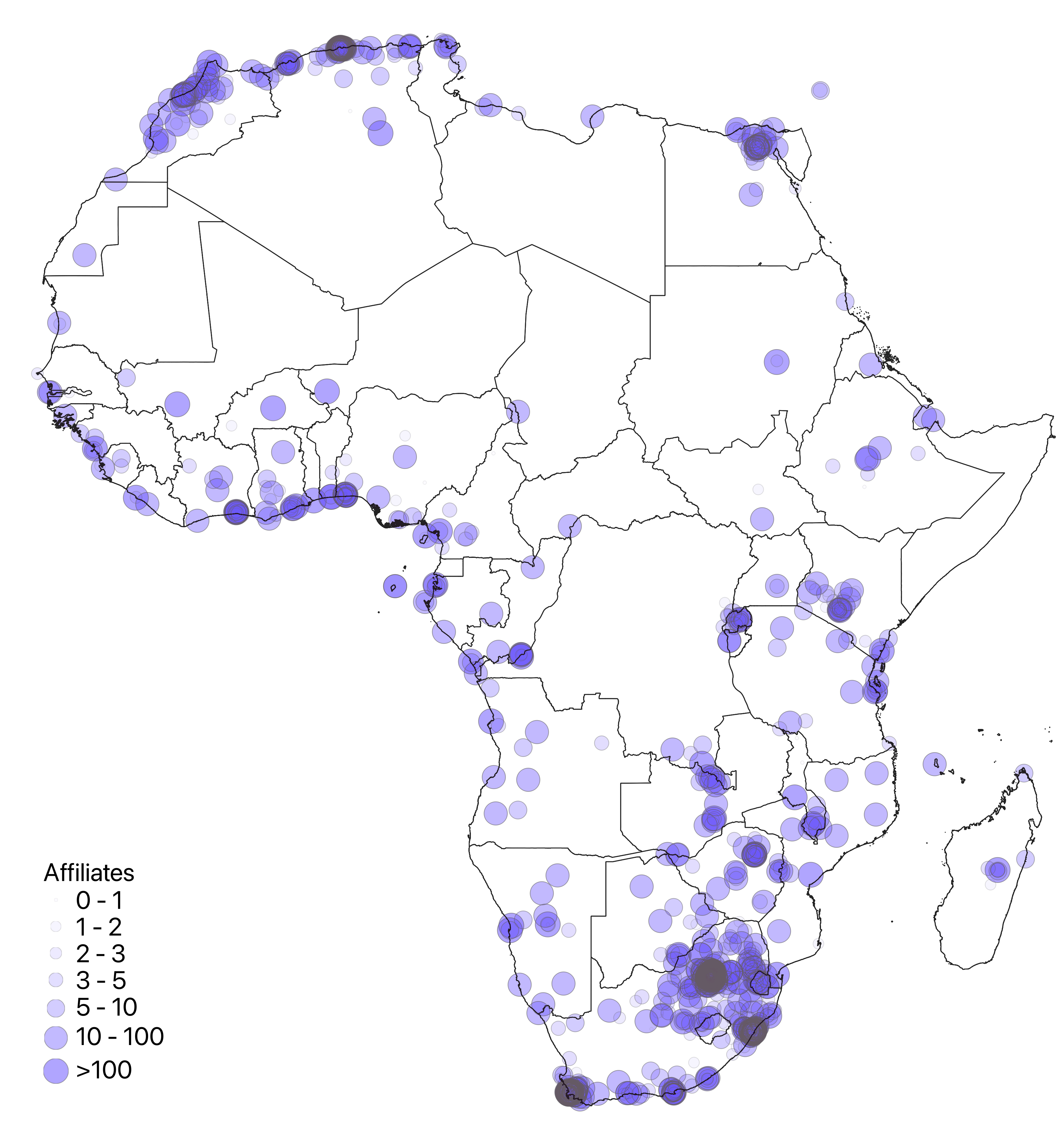
Figure 1 shows that conflict events are widely distributed across Africa, clustering in regions such as the Sahel, the Horn of Africa, and parts of Central Africa. Figure 2 highlights that MNE affiliates are more densely located in urbanised and coastal areas, although they are also present in rural, land-abundant regions. Both figures report averages over the study period from 2007 to 2018, offering a visual overview of the geographical patterns that frame the analysis.
Figure 1: Conflict events
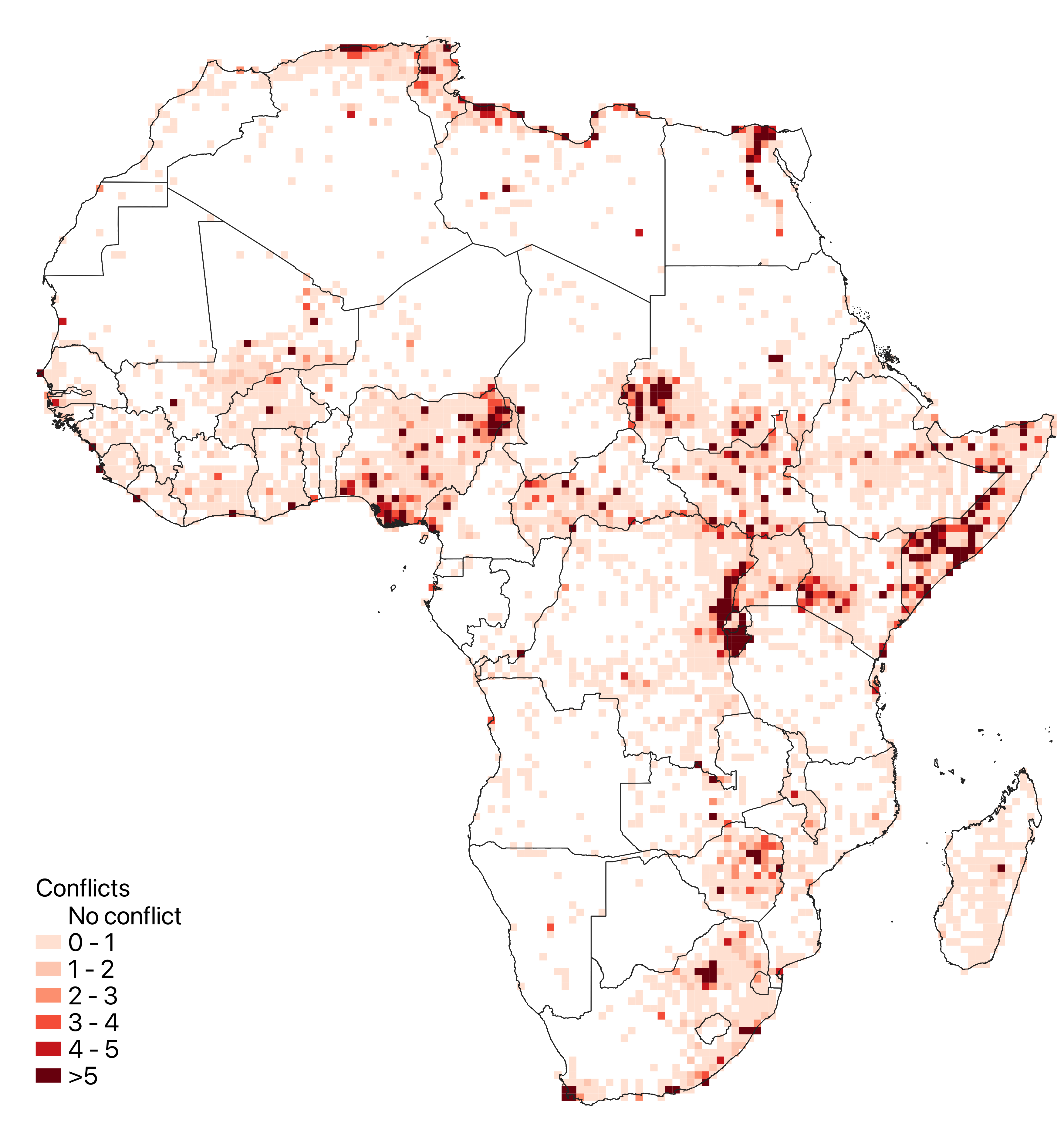
Figure 2: MNE affiliates
The presence of MNEs increases violent conflict
My findings reveal that an increase in the number of MNE affiliates in a given area leads to a significant rise in violent conflict events. Specifically, the arrival of just one additional MNE affiliate increases the number of violent conflicts by 4% in areas with existing MNE activity and by 34% relative to the sample mean. Overall, more than 13% of violent events can be attributed to the presence of MNE. The activities of multinational affiliates headquartered in the UK, France, US, and Germany—the top four non-African home countries of MNEs—account for almost 7% of violent events.
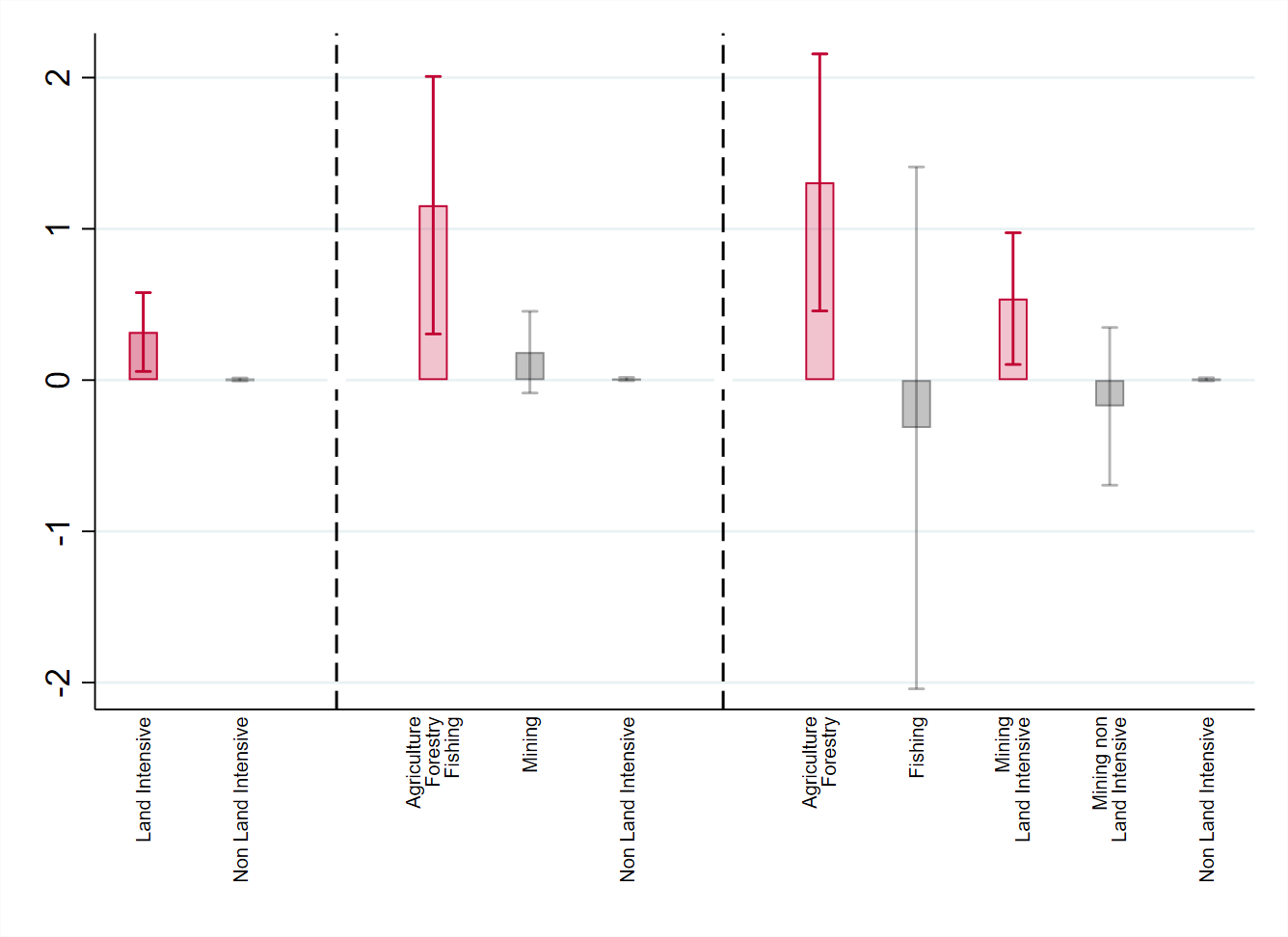
The conflict risk is not uniform. It spikes in land-intensive sectors like agriculture and forestry, particularly where multinational activity disrupts traditional farming systems. Survey data from Afrobarometer confirm that communities living near MNE projects are significantly more likely to cite land management as a major concern. Figure 3 captures this pattern in greater detail, presenting estimated coefficients (and standard errors) from three separate OLS specifications, each separated by vertical dashed lines. The dependent variable on the y-axis is the number of violent conflict events reported in ACLED. In the first specification, industries are broadly classified into land- and non-land-intensive sectors, showing that conflict effects are significantly higher for the former. The second specification focuses specifically on agriculture, forestry, fishing, and mining and quarrying, offering a closer look at sectors directly tied to land exploitation. The third specification further disaggregates these activities, isolating those most closely linked to intensive land use. Across all three panels, the strongest conflict effects are consistently observed in industries where land resources are heavily utilised, highlighting how disruption of land access is a critical mechanism through which MNEs contribute to violence.
Figure 3: Industry heterogeneity
Policy implications: How to prevent instability without discouraging investment
My findings suggest an urgent need for targeted policy interventions. Strengthening land governance frameworks, for example, by adopting international best practices such as the FAO’s guidelines on Responsible Governance of Tenure and Responsible Investment (FAO 2012, FAO et al. 2014), is critical to protecting community land rights. Given that agriculture and forestry investments pose the highest risks, sector-specific regulations are necessary, including mandatory social and environmental impact assessments before land deals are approved. Increasing transparency around land deals, through the public disclosure of large-scale land acquisition contracts, is also crucial to build trust and reduce grievances. These measures would help ensure that investments by MNEs promote sustainable and inclusive development rather than contributing to instability.
Conclusion: Progress without conflict
Foreign investment can bring significant economic opportunities to Africa. But unless local land rights and livelihoods are respected, these investments risk fuelling the very conflicts they seek to overcome. Strengthening governance and building inclusive development strategies are essential to ensure that MNE activity becomes a catalyst for peace rather than instability.
References
Méndez-Chacón, E. and Van Patten, D. (2022). 'Multinationals, monopsony and local development: Evidence from the United Fruit Company', Econometrica, 90(6), 2685–2721.
Owens, J. and James, X.Z. (2018). "Trade, investment and taxation: Policy linkages", Transnational Corporations, 25(2), 1–8.
Rulli, M.C., Saviori, A. and D’Odorico, P. (2013). "Global land and water grabbing", Proceedings of the National Academy of Sciences, 110(3), 892–897.
Sonno, T. (2025). "Globalization and conflicts: The good, the bad, and the ugly of corporations in Africa", The Economic Journal, 135(668), 1108–1140.
Sonno, T., and Zufacchi, D. (2025). "Large-scale land acquisitions: Trees, trade and structural change", Centre for Economic Performance.
FAO. (2012). "Voluntary guidelines on the responsible governance of tenure of land, fisheries and forests in the context of national food security".
FAO, IFAD and WFP. (2014). "Principles for responsible investment in agriculture and food systems".