






The urban share of population in the developing world tends to be lower than that of more developed countries. Can greater access to sewers help catalyse urban migration?
A version of this article appears on the IGC blog.
In many developing countries, rural residents can double or triple their incomes by moving to cities. Those living in the peripheries of cities can also increase their income by working closer to the city centre where formal sector jobs are more prevalent (Scott 2009, Henderson and Turner 2020). Yet, the urban share of population in much of the developing world remains below that of more developed countries. This leaves us with a crucial question: why are cities in developing countries not growing faster?
One possible explanation is that the living standards in these cities are so low that even a doubling of income fails to compensate for the forgone comforts of rural life. According to World Bank (2024), around one-third of those living in these cities lack access to basic sanitation facilities. Given the high population densities typical of cities in developing countries, it is easy to see why individuals would prefer to remain in the countryside.
In McCulloch et al. (2025), we examine whether improved access to residential sanitary sewers enables cities in the developing world to accommodate more people by making higher population densities more feasible. By extension, we assess whether this improved access can also facilitate access to better paying urban jobs. We find that providing sewer access for an additional 1% of neighbourhood households leads to a 6% increase in neighbourhood population density, and that this increase does not trigger an influx of wealthier, better educated migrants.
How do sewer systems affect communities in developing countries?
We investigate the effects of sewer access on neighbourhood population density, literacy, and mean income in a sample of 92 cities in Brazil, Colombia, South Africa, Tanzania, and Jordan. Due to the underlying differences between places with and without sewer services, simply comparing the population density in these places is uninformative. Such a comparison confuses the fact that places that receive sewer service are different from those that don’t, with whatever changes result from sewer construction.
To resolve this issue, we compare neighbourhoods on opposite sides of drainage basin divides. To understand why this comparison is informative, note that a drainage basin is defined as an area in which all rainfall (or sewage) drains to a common point. Figure 1 illustrates the drainage basins around Cascavel, Brazil.
By definition, water and sewage must flow away from the boundary of a drainage basin divide. The basin divide is a local high spot, meaning that sewage outside a drainage basin with sewer service must often travel uphill to cross the divide and reach a central sewer network. This is not easy to achieve, as crossing a drainage basin divide raises the cost of sewer service and reduces its availability. Figure 2 illustrates sewer access in a neighbourhood of Cascavel, Brazil, along with basin divides, demonstrating the decrease in sewer access that occurs when crossing from the drainage basin that contains central Cascavel and its sewer system to an adjacent basin.
Even though drainage basin divides are important for sewer construction, they are usually such minor landscape features that they are almost unnoticeable. Thus, if we see differences in population across basin divides, we can be confident that it is because of differences in sewer access. Hence our strategy of comparing population density and other outcomes for nearby neighbourhoods on opposite sides of a basin divide.
Figure 1: Drainage basins and lights at night around Cascavel, Brazil
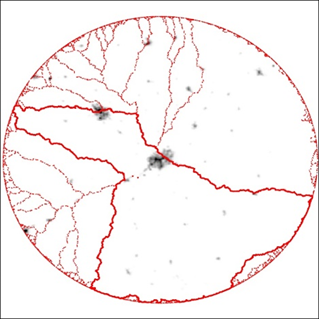
Notes: The dashed red lines indicate drainage basins boundaries around Cascavel, Brazil. Lights at night shows city extent. The disk has a radius of 75km.
Figure 2: Drainage basins and sewer access around Cascavel, Brazil
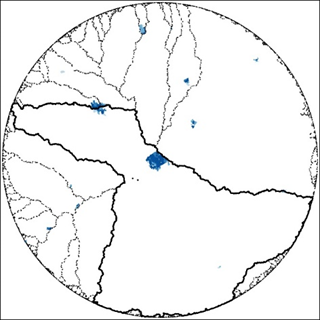
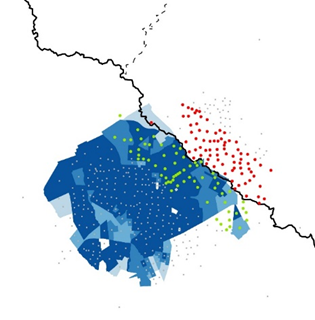
Notes: The left panel describes the same region as in Figure 1. The right panel is a close up, where the darker blue indicates a larger share of households with sewer access and dots indicate the centres of neighbourhoods in our sample.
Sewer systems increase urban density in developing countries
We estimate that providing sewer access to an additional 1% of households in a census tract increase population density in a tract by around 6%. We conduct two exercises to assess how important this effect is.
In the first, we provide sewer access to an additional 1% of households living in the densest parts of a city to understand how much this increases the density around an average resident. This effect is nearly as large as the effect of constructing a single highway through an average US city. In the second, we simulate providing universal sewer access to all neighbourhoods within walking distance (4km) of the city centre. The resulting increase in central population means that, in many cities, about the same share of the city population gains walking access to the central city as gained access to central Bogota following the introduction of the TransMilenio BRT system, one of the most successful BRT systems in the world. Therefore, in many cities in the developing world, providing sewer access to even a small fraction of households can be as significant for urban planning as a major improvement to transportation infrastructure.
Policy implications for improving urban productivity
Alsan and Goldin (2019) find that water and sewer access reduced infant mortality by about 25%, and Bhalotra (2021) finds that chlorination of drinking water reduced infant mortality by 45% or more. Gamper-Rabindram et al. (2010) and Anderson et al. (2018), however, find much smaller effects from similar interventions. In all, there is a good, but not overwhelming, case for expecting dramatic improvements in public health to follow from improved sewer access.
Beyond the public health effects, our findings demonstrate that sewer access increases urban population densities. These higher densities have three implications for the evaluation of improved sewer access:
- By increasing density, sewers increase the number of people who can live in the city and work in urban jobs. If these individuals would have otherwise remained in rural areas, their migration to cities often results in a doubling of income (Scott 2009, Henderson and Turner 2020).
- Cities cause people to be more productive due to density. A central estimate is that labour productivity, i.e. wages, increases by around 0.5% for every 10% increase in population density. This effect extends to existing residents as well.
- Higher-paying, formal sector jobs are typically concentrated in city centres; one argument for improving roads and public transit is to enhance access to these centrally located opportunities. To the extent that central residential areas are not completely sewered, improvements in central sewer access can serve much of the same purpose. By increasing population density within walking distance of the city centre, sewer networks increase access to central jobs.
These results suggest that the benefits of sewer expansion in cities in the developing world will likely extend beyond the public health gains. As a result, the priority of sewer expansion projects should be increased relative to alternative public works projects.
References
Alsan, M and C Goldin (2019), “Watersheds in child mortality: The role of effective water and sewerage infrastructure, 1880–1920”, Journal of Political Economy, 127(2): 586–638.
Anderson, D M, K K Charles, and D I Rees (2018), “Public health efforts and the decline in urban mortality”, Unpublished manuscript.
Bhalotra, S R, A Díaz-Cayeros, G Miller, A Miranda, and A S Venkataramani (2021), “Urban water disinfection and mortality decline in lower-income countries”, American Economic Journal: Economic Policy, 13(4): 490–520.
Gamper-Rabindran, S, S Khan, and C Timmins (2010), “The impact of piped water provision on infant mortality in Brazil: A quantile panel data approach”, Journal of Development Economics, 92(2): 188–200.
Henderson, J V and M A Turner (2020), “Urbanization in the developing world: Too early or too slow?”, Journal of Economic Perspectives, 34(3): 150–173.
McCulloch, S E, M P Schaelling, M Turner, and T Kitagawa (2025), “Sewers and urbanization in the developing world”, Unpublished manuscript.
Scott, A J (2009), "World Development Report 2009: Reshaping Economic Geography", World Bank.
World Bank (2024), “People using safely managed sanitation services, urban (% of urban population)”, World Development Indicators.