

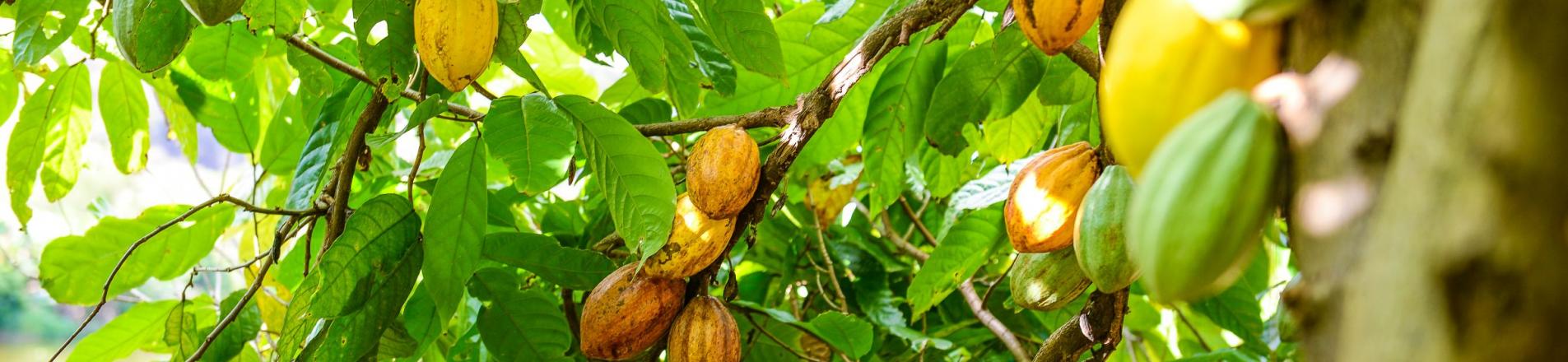


The witches’ broom disease in Brazil decimated cocoa plantations, resulting in disrupted livelihoods, altered labour contracts, and reduced educational and earnings outcomes in the long term.
When a shock doesn’t end: Human capital under permanent disruption
Rural populations in developing countries face constant risks, from climate events and conflicts to crop failures and diseases. How households respond to these shocks depends on their access to credit, savings, or social protection. When shocks are short-lived, families often rely on temporary adjustments. But what happens when the disruption is permanent?
While economists have extensively studied the short-run impacts of temporary shocks on education, income, and child labour, less is known about the long-term effects of persistent or irreversible shocks. A permanent disruption can lower land values, reshape labour contracts, and reduce household income for decades, altering investments in children's education and affecting livelihoods across generations.
In our recent research (Barreto and Oliveira 2025), we examine the long-term consequences of a major agricultural crisis in Brazil: the outbreak of the witches’ broom disease that decimated cocoa plantations in the country’s northeast in the late 1980s. We find that this event led to lasting declines in education and income for children exposed to the shock and triggered deep structural changes in labour relations in affected areas.
Cocoa, inequality, and the witches' broom outbreak
Between the 1960s and 1980s, Brazil was the world’s second-largest cocoa producer, second only to Côte d’Ivoire. The state of Bahia accounted for nearly 90% of the country’s cocoa output. Cocoa farming was dominated by large estates owned by a few wealthy families. These estates operated as monocultures and relied heavily on hired labour, reinforcing the region’s extreme inequality.
This system was upended in 1989, when the witches’ broom fungus, a disease previously limited to the Amazon, suddenly appeared in the heart of Bahia’s cocoa belt. Within months, cocoa trees in multiple municipalities were infected. Investigations concluded that the disease had been deliberately introduced, though its spread was driven by natural vectors like wind and animals.
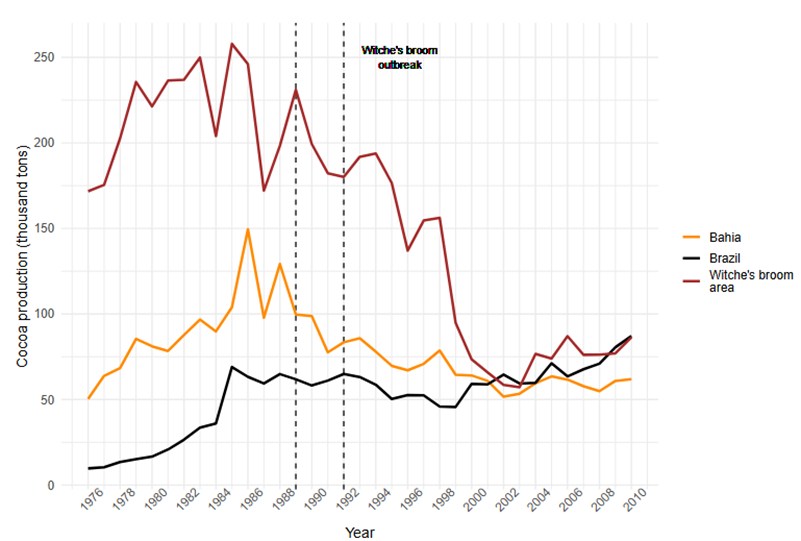
The economic fallout was devastating. Over the next decade, cocoa production in the region fell by 80%, and an estimated 250,000 workers lost their jobs. With few alternatives in a region built on cocoa, the consequences were long-lasting.
Figure 1: Cocoa production in Brazil, 1976-2010
Falling education, lower income, and sectoral shifts
To understand the long-run effects of the witches’ broom outbreak, we compare individuals who were exposed to the disease during childhood with those who were older at the time, across both affected and unaffected areas. We exploit variation in the timing and geographic spread of the disease across municipalities and employ a difference-in-differences design to estimate its causal impacts.
We find that individuals who were under 18 when the outbreak hit were significantly less likely to complete school. Exposure to the disease reduced the probability of finishing elementary school and high school by 3.2 and 2.8 percentage points, respectively. These effects represent declines of around 8% and 10.5%, respectively, relative to the control group average.
These cohorts also earned less as adults. Wages were around 5.1% lower for those exposed to the shock in childhood, with the largest effects for those between ages zero and 12 at the time of the outbreak.
The crisis also appears to have shifted the structure of local labour markets. Younger cohorts in affected municipalities were less likely to work in agriculture and more likely to work in low-skilled service and manufacturing jobs. Many of these workers were self-employed or held informal jobs, suggesting limited economic mobility. Importantly, we find no significant impact on women’s fertility decisions.
Figure 2: Long-run consequences of witches’ broom outbreak on education and earnings
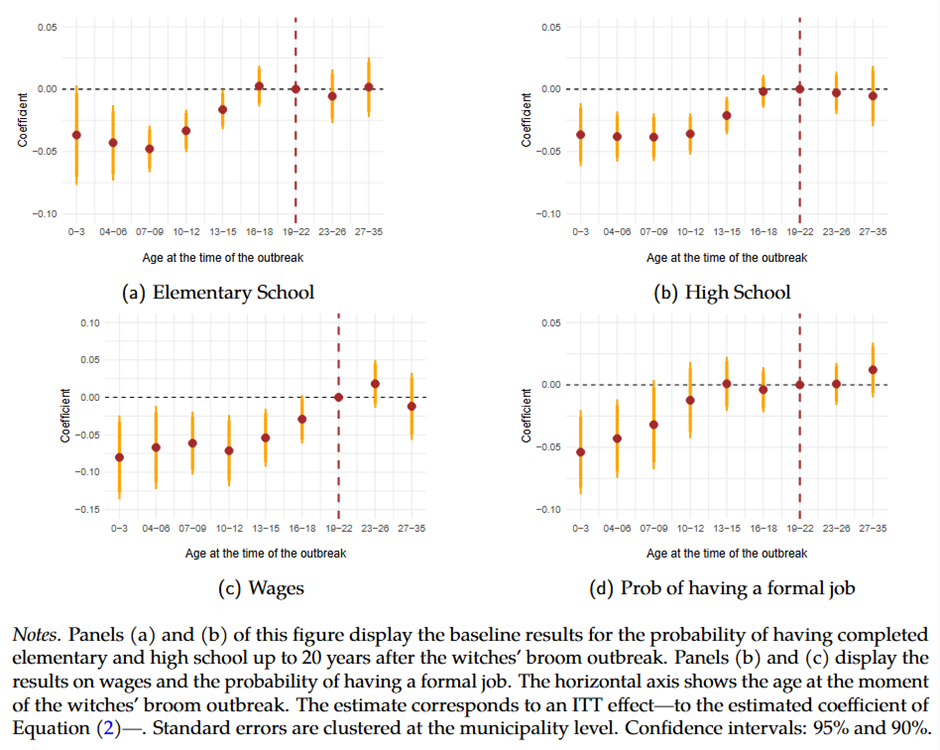
Notes: Panels (a) and (b) of this figure display the baseline results for the probability of having completed elementary and high school up to 20 years after the witches’ broom outbreak. Panels (b) and (c) display the results on wages and the probability of having a formal job. The horizontal axis shows the age at the moment of the witches’ broom outbreak. The estimate corresponds to an ITT effect. Standard errors are clustered at the municipality level. Confidence intervals: 95% and 90%.
A shift in rural labour: The rise of sharecropping and child labour
Beyond human capital outcomes, the witches’ broom outbreak brought profound changes to labour relations in the cocoa sector. With cocoa farms no longer profitable, many landowners could not afford to pay wages. As the risk of workers began occupying idle land grew, landowners increasingly resorted to meiro (sharecropper) contracts, under which workers could farm land in exchange for giving half of their production to the owner.
Sharecropping arrangements, often associated with precarious labour conditions and contexts where modern slavery is more likely to occur, became significantly more common after the crisis. Using data from Brazil’s Agricultural Census, we find that the share of farms operated under sharecropping increased by 4 percentage points in affected municipalities relative to unaffected ones.
Land values also plummeted. Sixteen years after the outbreak, agricultural land in affected areas was worth 48% less than in comparable municipalities. Family labour replaced paid workers, with family-based employment increasing by 10 percentage points five years after the outbreak, and by 20 percentage points by 2017.
Finally, the crisis appears to have increased child labour. Census data from 2000 and 2010 show that child labour was 2.5 percentage points higher in affected areas—underscoring how a persistent shock to adult employment can cascade into negative outcomes for the next generation.
Lessons for policy: When permanent shocks demand structural responses
Our findings highlight how a permanent shock, such as a crop disease, can have effects far beyond the agricultural sector. In the case of Brazil’s cocoa production, the witches’ broom outbreak triggered a long-term decline in educational attainment, earnings, and land values, while pushing more families into precarious work arrangements, including child labour and exploitative sharecropping.
This suggests that policy responses to agricultural crises must go beyond short-term interventions. In regions where livelihoods depend on a single crop, permanent shocks require structural policy interventions, such as education support, land reform, and labour protections, to prevent long-term economic scarring.
References
Barreto, Y, and R C Oliveira (2025), “From Fields to Futures: The Lasting Effects of Crop Diseases on Education and Earnings”, World Bank Economic Review [Forthcoming].