



Humanitarian aid systems are under mounting pressure, with key donors like the US and UK cutting funding despite growing needs. New research in one of the world’s largest refugee camps shows that aid cuts and delays have dramatic impacts on food consumption, food insecurity, and overall welfare, while also straining local food and credit markets.
Humanitarian aid in crisis
In 2025, the United States, historically the largest humanitarian donor, slashed contributions that accounted for nearly half of all public humanitarian funding and over a fifth of the UN’s budget. Rather than stepping in to fill the gap, other donors have instead followed suit.
The timing of these cuts could not have been worse. Humanitarian needs have more than quadrupled since 2015. In 2023, donors were covering only one-third of the $56.7 billion required to meet identified needs, with just 68% of the population in need receiving assistance.
With growing funding gaps, humanitarian organisations are forced to scale down, delay, or suspend critical programmes. Aid cuts and disruptions have, unfortunately, become a recurrent feature of humanitarian operations.
New evidence on the impacts of aid cuts and delays
Yet despite the growing prevalence of aid disruptions, their impacts remain poorly understood. Cuts and delays are typically unanticipated and occur in fragile settings where high-quality data is rarely collected.
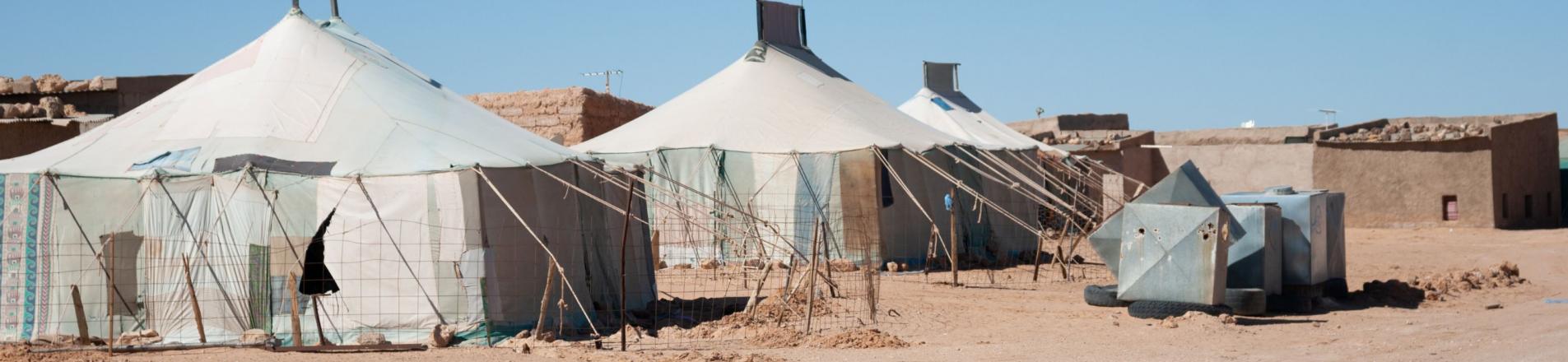
To fill this gap, as part of the Refugee Economies Programme (a research team from the University of Oxford), we launched a project to study how aid volatility affects refugees living in Kakuma, one of the world’s largest refugee camps. Located in a remote and arid region of north-western Kenya, Kakuma is home to over 300,000 refugees, primarily from South Sudan, Somalia, and the Democratic Republic of Congo. Economic opportunities in the area are scarce, and most households depend almost entirely on humanitarian assistance to survive (Betts et al. 2024).
Over the course of a year, we followed 622 refugee households, interviewing them monthly to track how their socio-economic conditions evolved with the timing and amount of aid received. We also collected weekly price data on 70 goods and conducted over 250 qualitative interviews with refugees, shopkeepers, and humanitarian workers.
Our research uses this unique dataset to study the impacts of cuts and delays in humanitarian aid across two papers: one examines the effects of aid cuts (Bruni and Sterck 2025a), the other the impacts of delays (Bruni and Sterck 2025b).
Aid volatility in the refugee camp
Data collection began in October 2022. At the time, all refugees in the camp were receiving monthly food assistance from the World Food Programme (WFP), either as cash or in-kind transfers, amounting to roughly USD 17 per person. This level of support was already limited due to funding constraints, covering only about 80% of the minimum required to meet basic nutritional needs.
More than 90% of refugees were classified as food insecure. Average caloric intake was below 1,900 kcal per person per day—about half the average daily calorie supply available to a US citizen, and well below WFP’s 2,100 kcal target.
In July 2023, assistance was cut by a further 20% after a special US contribution to WFP was discontinued. The cut occurred in the middle of the eighth survey wave.
Because interview dates were randomly assigned, some households were surveyed just before the cut, and others just after. We exploited this variation to assess how consumption and other welfare indicators changed in response to the cut (Bruni and Sterck 2025a). We continued tracking households for three months after the cut, providing a unique window into how refugees coped with the shock over time.
Key finding 1: Hunger got worse
The impacts of the aid cut were immediate and severe. A Somali refugee explained: “After the aid reduction the lives of refugees become hard. That was the money sustaining them. [...] Things are insufficient, and hunger is visible.”
Daily caloric intake per person fell by 145 kcal, a 7% drop relative to the pre-cut average. The value of food consumption declined by about 10%, and the share of households eating two or more meals per day fell by 8 percentage points. Overall household expenditure per capita dropped by 22%.
Households not only ate less but also shifted toward less diverse diets. Food insecurity worsened: before the cut, households needed an average of 1.5 days to consume the World Food Programme’s 2,100-kcal daily target; after the cut, this rose to 1.7 days, a 14% increase.
Our research also finds declines in self-reported well-being and sleep quality following the shock.
Key finding 2: The informal credit system collapsed
In the refugee camp, informal credit plays a vital role in helping refugee households cope with shocks (Siu et al. 2023). Shopkeepers regularly provide food on credit to refugees, using the aid cards on which cash transfers are delivered as de facto collateral. These cards are typically held by shopkeepers until repayment.
This system collapsed when aid was cut. As the value of future transfers fell, shopkeepers reassessed repayment risks, tightened lending conditions, and in many cases refused to extend further credit. Informal borrowing from shopkeepers declined by 9% on average after the cut and continued to decline thereafter. Many refugees reported being denied food on credit or forced to repay existing debts before accessing new goods.
As one Ethiopian shopkeeper explained: “When we give out credit we have a limit; since the aid is reduced, the credit is also reduced.” Another shopkeeper reported: “After the aid cut, we decided to reduce the quantity of food we give on credit or refuse to give out food on credit totally.”
With limited access to informal credit, households began to draw down food stocks and sell off their assets. This shift from debt-based coping to asset depletion may have long-term consequences for economic wellbeing and resilience.
Key finding 3: Food prices fell, partly mitigating the shock
As refugees’ purchasing power dropped, demand for food declined, and so did local prices. We find that food prices fell by about 4% immediately after the aid cut and continued to drop by around 2% per month in the following months (Figure 1). The decline was especially sharp for staple goods. These price reductions helped to cushion some of the negative effects of the aid cut.
Figure 1: Impact of aid cuts on prices over time
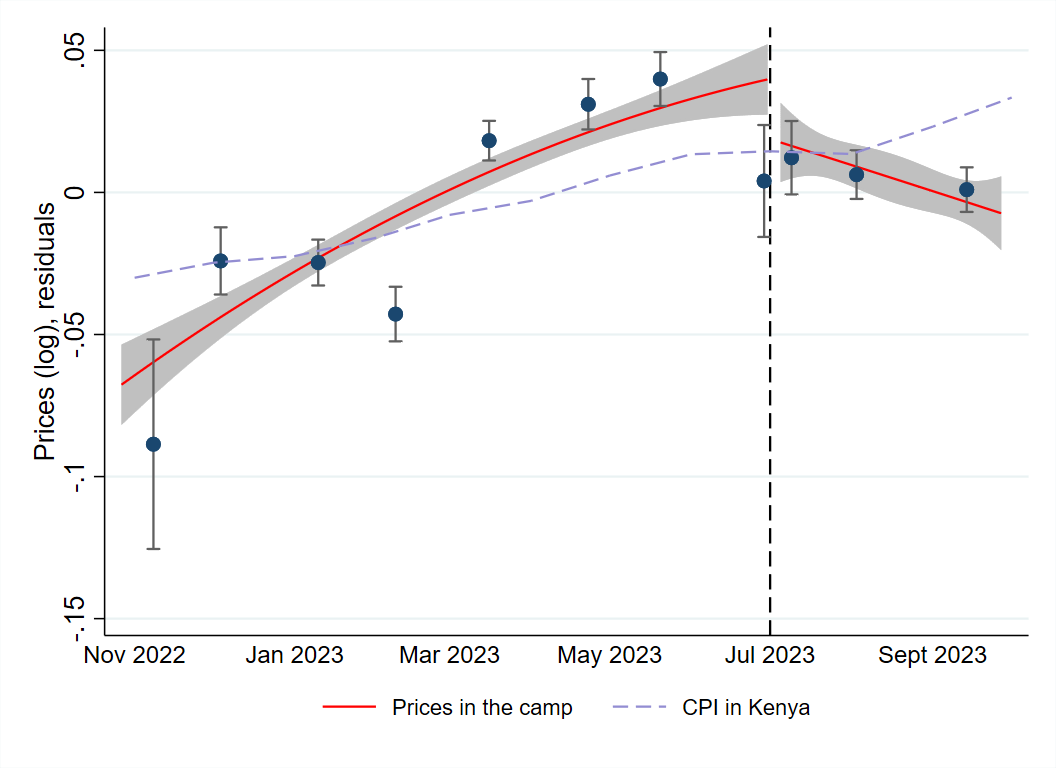
Data sources: Consumer Price Index (CPI) data for Kenya come from the Kenya National Bureau of Statistics. To isolate price changes unrelated to market or product characteristics, prices are regressed on product and market fixed effects and use the residuals. Dots represent average residual prices for each survey wave; the wave during which the aid cut occurred is split in two. The red line shows a quadratic fit of prices before and after the cut. The dashed blue line shows the national CPI trend over the same period.
Key finding 4: Delays in aid delivery also exacerbate hunger
During the one-year study, aid was also frequently delayed. Bureaucratic bottlenecks, logistical hurdles, and security issues often disrupt the timing of transfers in humanitarian settings.
In Kakuma, cash transfers were delayed by an average of 11 days during the study period, with considerable variation across months. In-kind food distributions, which are tied to a weekly calendar, were delivered at irregular intervals—every four to five weeks—due to misalignments between calendar weeks and months.
We used these variations to study how delays affect refugees' ability to manage consumption. While refugees can generally smooth consumption over a normal monthly cycle, their coping capacity breaks down when aid arrives late. Caloric intake drops sharply—by up to 15% for in-kind delays—alongside reductions in meal frequency, dietary diversity, and food security.
To cope with delays, many refugees turn to debt, using their aid cards as collateral to purchase food on credit. This buffers consumption, but at a cost: food bought on credit is 17% more expensive, effectively acting as a hidden interest rate. The stress of delayed aid goes beyond hunger, as refugees report lower happiness and poorer sleep when transfers are late.
As put by one refugee in the camp: “There were many people, families, who were almost to die because of the delay of Aid. They (donors) should release the money at the right time. Many children could die if the money delays.”
Policy implications for humanitarian aid in fragile settings
The 20% aid cut in Kakuma didn’t just reduce what and how much refugees eat; it also triggered a cascade of effects across households and markets. Informal credit markets froze, assets were sold off, and psychological well-being deteriorated. Falling food prices reflect the contraction of demand in an economy where humanitarian aid is the primary income source.
These findings underscore a broader truth: in places like Kakuma, humanitarian aid is not just a safety net—it is the backbone of daily life. In aid-dependent economies, cuts are systemic shocks that disrupt the entire ecosystem of survival.
This has three key policy implications.
First, humanitarian aid should not be treated as optional or discretionary: it is a necessity. Mechanisms are needed to shield core assistance from abrupt donor withdrawals, for instance through pooled funding, contingency reserves, or multi-year commitments.
Second, informal credit is not peripheral: it is central to how refugee economies function. In many camps, shopkeepers double as retailers and lenders, using aid cards as collateral. When transfers are cut, this fragile financial system collapses. Aid programmes must be designed with these dynamics in mind to avoid unintended effects.
Third, when aid arrives also matters. Fixing delays is often less costly than increasing funding, and the welfare gains can be substantial. In Kakuma, most delays stemmed not from insecurity or lack of funds, but from bureaucratic inefficiencies. Streamlining workflows, automating transfers, and simplifying approval processes could make delivery timelier and more predictable.
References
Betts, A, M F Stierna, N Omata and O Sterck (2024), “The economic lives of refugees,” World Development, 182: 106693.
Bruni, V and O Sterck (2025a), “The welfare and general-equilibrium impacts of aid cuts,” Unpublished manuscript.
Bruni, V and O Sterck (2025b), “The welfare and market effects of delays in humanitarian assistance,” Unpublished manuscript.
Siu, J, O Sterck and C Rodgers (2023), “The freedom to choose: Theory and quasi-experimental evidence on cash transfer restrictions,” Journal of Development Economics, 161: 103027.