

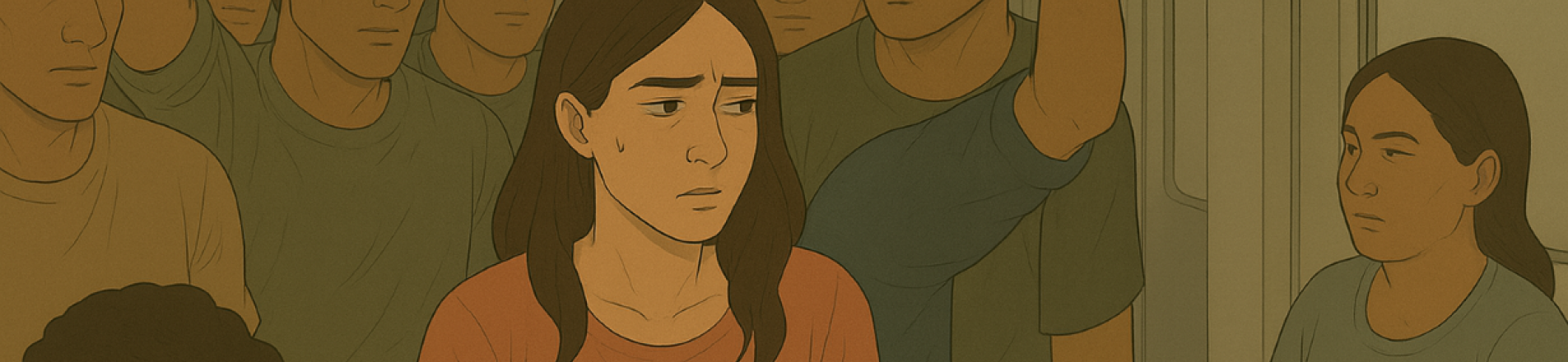





Women-only spaces offer a quick fix for those facing higher risk of harassment but reflect and may reinforce the idea that women are responsible for preventing their own victimisation.
As women travel around cities across the world, sexual harassment remains a daily threat. In response, some governments have introduced ‘safe spaces’—women-only transit cars—intended to offer immediate protection from men. But these interventions may carry unintended consequences. Our research on Rio de Janeiro’s women-reserved train cars reveals that while such policies can reduce harassment, they are clearly second best solutions as they do not address the root of the problem—the behaviour of some men—nor do they address problematic norms that shift the burden of safety onto the victims.
How often are women harassed on public transit?
At the start of our study (Kondylis et al. 2025), we knew that a staggering share of women reported having experienced harassment in public transit over the course of their lives. Yet, we did not have any measure of the frequency at which women face harassment on their daily commute across cities. To bring light to this question, we decided to work with the municipal government in Rio de Janeiro, Brazil. We conducted a high-frequency field study with 363 women commuters using Rio’s suburban rail system, generating data on 22,000 train rides through a smartphone-based crowdsourcing platform.
Our results show that sexual harassment on public transit is pervasive: women assigned to ride in the public space experienced harassment on 18% of all trips, including physical harassment in 2.6%—equivalent to an occurrence once or twice a week.
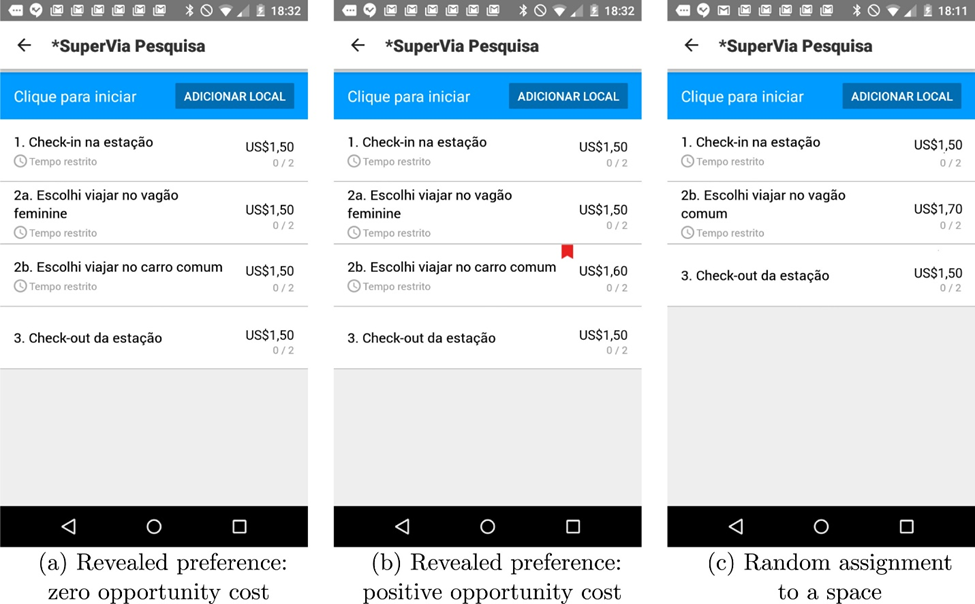
Figure 1: Crowd-sourcing platform interface across the three main phases of the study
How effective is a women-reserved space at addressing harassment?
To capture the impact of riding in a women-reserved space relative to the public space, we used the crowd-sourcing platform to randomly offer female commuters in our sample a paid opportunity to ride in either the public or women-reserved space (Figure 1, Panel C). We ensured the protocol did not place undue burden on participants: 98% of women already used the public space during some of their daily rides, and they could opt out of any ride at any time.
We then asked them to report on their experiences, including incidents of harassment and emotional well-being. Women randomly offered the opportunity to ride in the reserved space are 50% less likely to be physically harassed than those in the public space.
Harassment and demand for safe space are concentrated
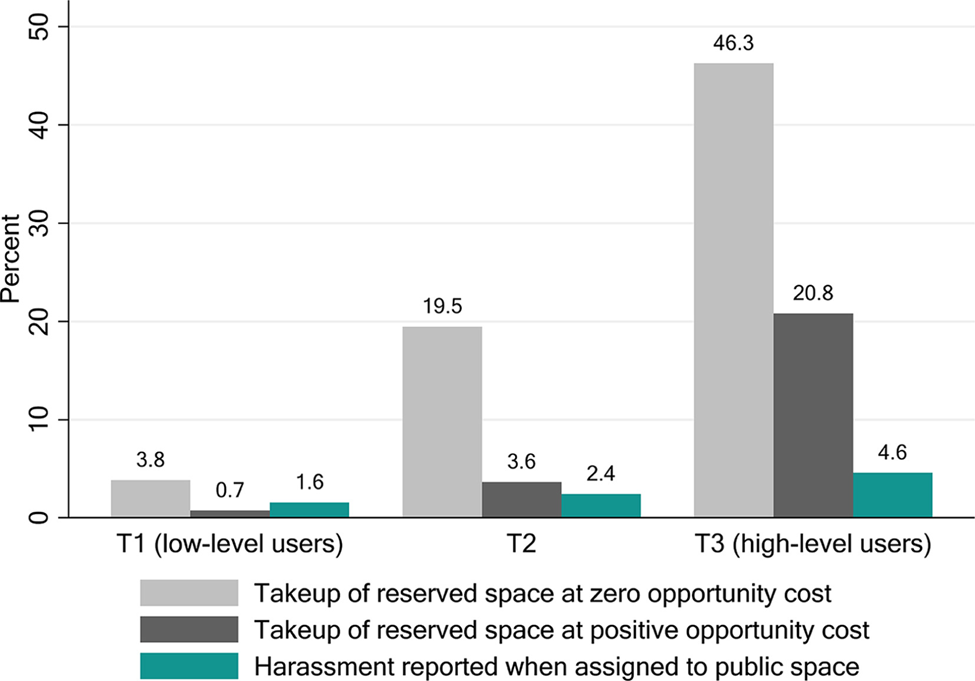
Next, we relate the incidence of harassment and impact of safe space to female commuters’ demand for a safe space. To this end, we used the platform to measure female commuters’ willingness to pay for access to the reserved space under different conditions. Combining results from the random assignment across space and willingness-to-accept elicitation, we show that demand for the women-only space was highly concentrated: the top one-third of riders accounted for 80% of usage and were ten times more willing to pay for access than others. These same women also reported most of the harassment incidents and experienced the greatest benefit from the reserved car’s protection. In other words, a minority of women disproportionately bear the costs of harassment and gain the most from escape routes like the reserved space.
Figure 2: Harassment and demand for the safe space are concentrated
Reinforcing regressive gender norms
Finally, we complemented this data with platform surveys during which we elicited commuters’ stated and implicit attitudes on women in transit and the safe space to document the prevailing norm.
Importantly, our study documents the existence of a social norm that associates the women-only space as the ‘proper’ place for women. The majority of both men and women expressed the view that women who choose to ride in the public space are more sexually open or inviting. Women who believed that others held this view were 79% more likely to use the reserved space, even when it offered no measurable protection due to male crowding.
This suggests that women use the reserved car not only for safety, but also to comply with a social expectation: that they should stay out of public space to avoid judgment or blame. Indeed, the finding that women still chose the reserved space even when harassment risks were similar across cars points to a fixed ‘amenity value’ tied to avoiding social scrutiny.
While our study was not designed to test whether the women-only space increases harassment through this norm effect, we explored this indirectly by examining times when enforcement was weak, and men entered the reserved space. The protective effect of the reserved car vanished when men entered, suggesting that its benefit comes from physical segregation, not symbolic signalling.
While our study does not directly test whether the women-only space reinforces the victim-blaming norms, its existence may implicitly support the idea that women are responsible for avoiding harassment. Survey data reveals that such attitudes are widespread: one in five commuters say a woman is partly to blame if she is harassed while riding in the public space, and one in three believe that women sometimes invite advances and later claim harassment—especially those who ride outside the designated safe space.
Figure 3: Demand for ‘safe space’ varies with the presence of men
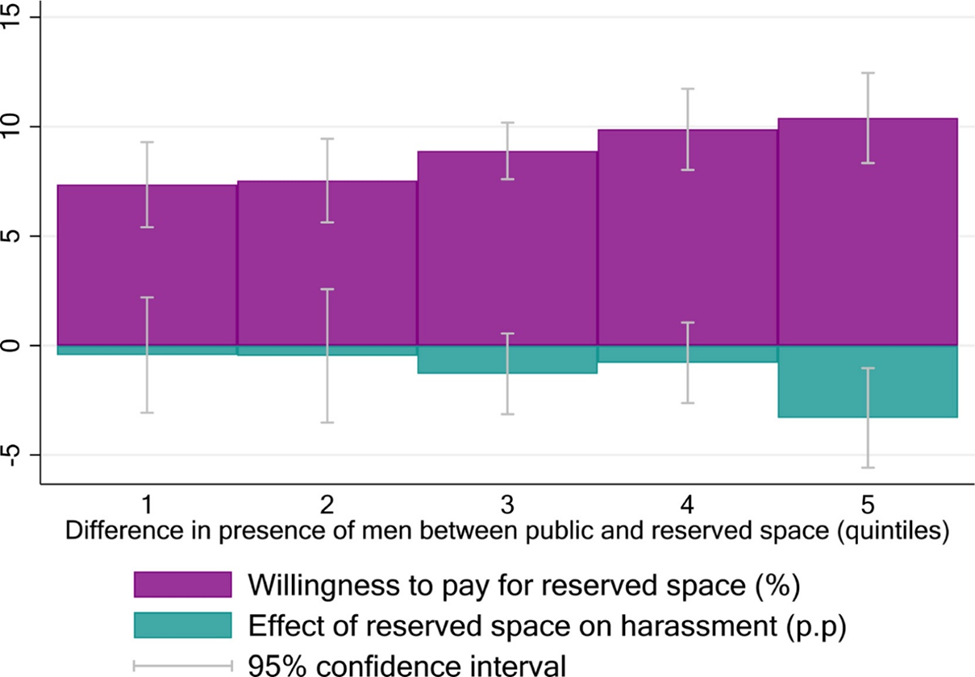
Notes: Demand for the ‘safe space’ decreases but does not go to zero when the presence of men in the reserved space increases, indicating a women commuters place a fixed amenity value on riding in the safe space.
Implications: Beyond ‘safe spaces’
Women-only spaces offer a quick fix for those facing higher risk of harassment, but they may work to legitimise exclusion and reinforce the idea that women are responsible for preventing their own victimisation.
Our results suggest that policymakers should be cautious: protective spaces help women escape harassment in the short term, and in gender-segregated, conservative settings they can even allow women to apply to jobs outside the home (Vyborny 2025, Garlick et al. 2025). However, they do not address the deeper issue: social norms that blame women for harassment when they enter a public space and thus legitimise harassment–they could even reinforce these norms. Policymakers should consider alternative approaches such as more rigorous enforcement against harassment (Amaral et al. 2025), campaigns to shift public attitudes, and investments in urban design that centre inclusive safety.
Ultimately, women should not have to choose between safety and visibility. A truly safe space is one where they are free to be anywhere.
?️ Fictional interview: 'Respect, not restriction'
The authors recorded the following fictional interview to illustrate the variety of perspectives on this policy issue. Listen to it here and follow along with the transcript below. Voice credits: Danilo Castro, Tamille Dias, and Ana Carolina Paci.
Interviewer:
We’re here with a group of women who took part in the protest against the pink cars on Rio’s metro system—vagaõ rosa, exclusivo para mulheres. Some of the protestors took to the streets topless, holding signs that read “Meu corpo, minhas regras” and “Eu não me escondo.”
But not all women feel the same.
Today, we’re also joined by Daniela, who says the women-only car has made her commute bearable.
Daniela (29, call center agent):
Look, I’m not saying the pink car is a solution to everything. But for someone like me, taking the train at rush hour, packed in like sardines—I’ve been groped, whispered at, followed off the platform.
The women’s car? It gave me space to breathe again. I don’t love that we need it… but I use it. Because I’m tired.
Interviewer:
Larissa, you helped organize this protest. How do you respond to Daniela?
Larissa (32, activist):
I hear you. And your fear is real.
But the pink car shifts the problem onto you. It says: if you don’t want to be harassed, remove yourself.
It doesn’t say anything to the men.
Camila (25, university student):
And it changes how people see you.
When I ride the regular car now, I get stares—like I’m doing something wrong just by being there. That’s not safety. That’s shame in disguise.
Daniela:
Maybe. But when I’m tired and just trying to get to work without some guy pressed against me… I’ll take that shame over fear.
I want a better system too. But until then, this is the only break I get.
Luana (39, domestic worker):
It’s true that some of us feel safer in that space. But it shouldn’t come at the cost of freedom.
We’re not against safety. We’re against the idea that women have to disappear to feel safe.
Interviewer:
What do you all want, ultimately?
Larissa:
Respect. Not restriction.
I want a metro where Daniela doesn’t have to choose between safety and dignity.
Where I can stand anywhere—wearing what I want—and not be treated like a target.
Daniela (quietly):
I want that too.
References
Amaral, S., Borker, G., Fiala, N., Kumar, A., Prakash, N., & Sviatschi, M. M. (2025), “Sexual harassment in public spaces and police patrols: Experimental evidence from urban India”, The Quarterly Journal of Economics, qjaf026.
Garlick, R., Field, E., & Vyborny, K. (2025), “Women's mobility and labor supply: Experimental evidence from Pakistan”, Unpublished manuscript.
Kondylis, F., Legovini, A., Vyborny, K., Zwager, A., & Andrade, L. (2025), “Demand for ‘Safe Space’: Avoiding harassment and complying with norms”, Journal of Development Economics, 174: 103392.
Vyborny, K. (2025), “How safe transport could unlock women’s labour force participation in Pakistan”, VoxDev.