






Short, low-cost workshops helped young South African jobseekers to learn about their skills, search for better-matched vacancies, and raise their earnings by 25%.
Editor’s note: For a broader synthesis of themes covered in this article, check out our VoxDevLit on Barriers to Search and Hiring in Urban Labour Markets.
Job search can require difficult choices: jobseekers must choose the types of jobs they target, how many applications to submit, and what strategies to use when applying. These choices can have high stakes for jobseekers’ lives and are often made with limited information about labour market conditions, individual jobs, and the effectiveness of different search methods (Caria et al. 2024). Search choices influence the quality of the skill match between workers and firms, with potentially important implications for aggregate productivity (Lise and Postel-Vinay 2020).
In Kiss, Garlick, Orkin and Hensel (2025), we highlight another important challenge facing jobseekers: limited information about how their own skills fit into the labour market and match with specific jobs. We provide the first direct evidence that jobseekers have limited information about their skill comparative advantage–their strongest skills relative to other jobseekers from similar backgrounds–and that this limited information distorts their job search choices and lowers their earnings.
Introducing job search assistance workshops in a high-unemployment context
High youth unemployment and costly job search are common in many developing economies (ILO 2022), especially in South Africa. At the time of our study, youth unemployment in Johannesburg was roughly 40% and higher among the population we study: young jobseekers from low-income backgrounds, typically with only high school education. Job search in this context is costly: active jobseekers spent on average US$ 23 PPP per week on transport and internet costs, roughly 20% of the full-time minimum wage. Moreover, only 1% of job applications led to offers. This means that any ‘mistakes’ in job search can be very costly.
We worked with the Harambee Youth Employment Accelerator to run day-long job search assistance workshops. During the workshops, jobseekers took established psychometric assessments of multiple skills, including numeracy and communication. We say a jobseeker has a skill comparative advantage in skill S if they rank higher in the S assessment than in any other skill. Only 50% of jobseekers have aligned comparative advantage beliefs, i.e. they believe they are better at the skill in which they actually ranked highest, relative to 12,000 other jobseekers who have taken the assessments. Although these beliefs are often inaccurate, they are important: jobseekers apply more often to jobs that require skills matching their believed comparative advantage than their assessed comparative advantage.
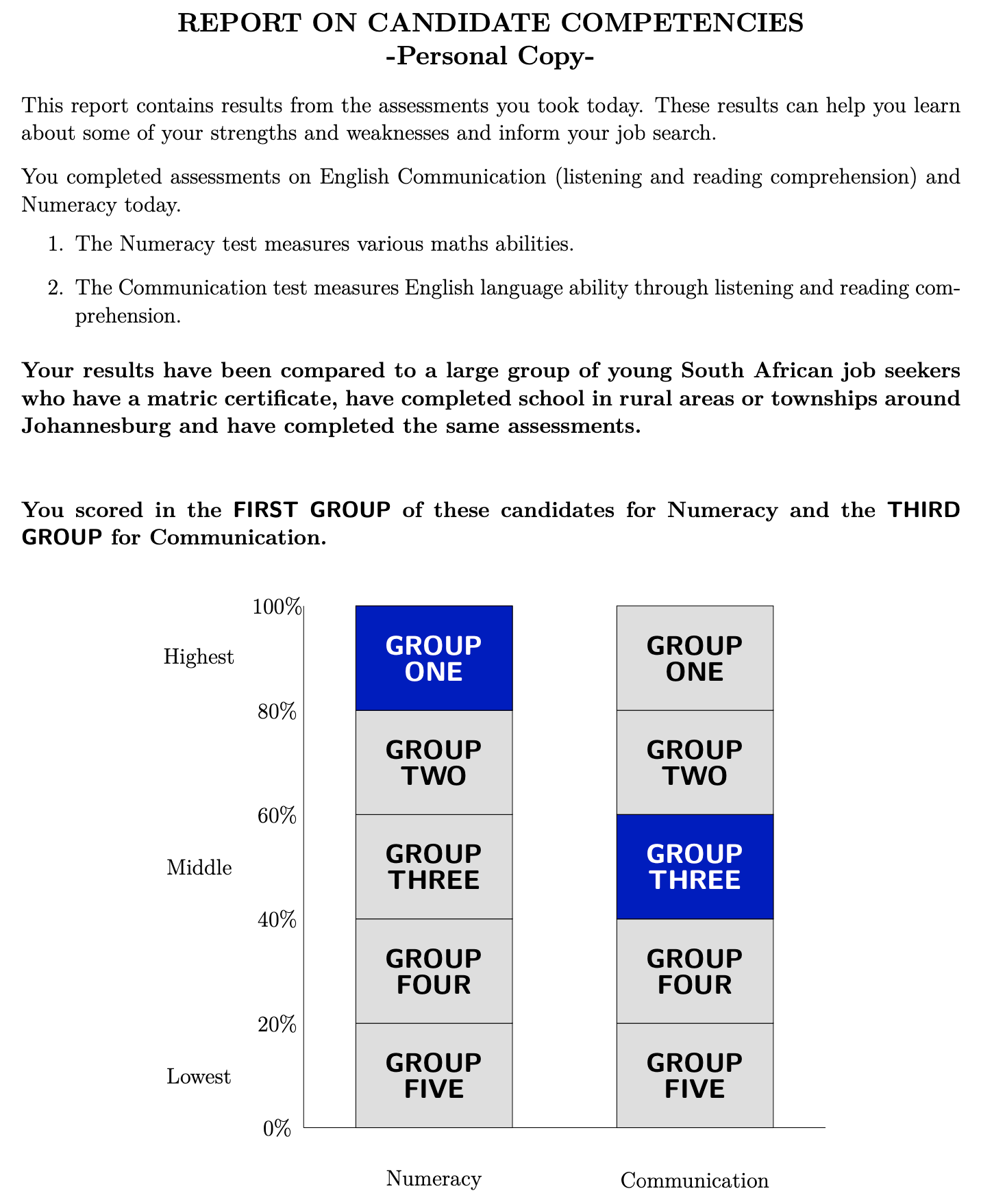
In treated workshops, participants received assessment results (Figure 1) and an explanation about how to interpret them (watch video), which indirectly showed their skill comparative advantage. In control workshops, participants took the assessments without feedback.
Figure 1: Sample participant assessment results
This experiment was run twice, with slightly different approaches, to achieve different goals. One experiment prioritised measuring beliefs and search using unusually rich survey, task, and administrative data. This motivated a tightly controlled experiment with very detailed measurement, a smaller sample (278 participants), and assessments of communication and numeracy skills only. The other experiment prioritised measuring labour market outcomes, which motivated a longer follow-up period (3-4 months), larger sample size 94,389 participants, and assessments of communication, numeracy, and four other cognitive and socioemotional skills. Together, these experiments study the full relationship between changes in beliefs, search, and labour market outcomes.
Job search assistance workshops improved earnings
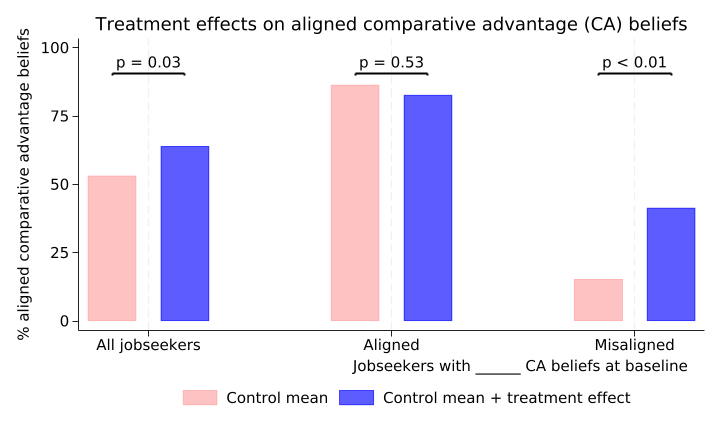
Receiving information about their assessment results moved participants’ beliefs about their skill comparative advantage toward their assessment results. The share of aligned comparative advantage beliefs increased by 13.5 percentage points in the full sample and 20.8 percentage points for participants whose baseline beliefs differ from their assessment results (Figure 2). The latter participants have misaligned comparative advantage beliefs at baseline. This heterogeneity analysis is prespecified and natural–participants with misaligned comparative advantage beliefs at baseline get more information from treatment and so can react more.
Figure 2: Treatment effects on aligned comparative advantage beliefs
These shifts in beliefs translate into shifts in job search. Treated jobseekers are more likely to engage in skill-aligned job search: applying to jobs that demand skills in which they have a comparative advantage. Treatment increased skill-aligned job search by 0.27 standard deviations forthe average participant, 0.6 standard deviations for the average participant with misaligned comparative advantage beliefs at baseline, and almost zero for the other participants (Figure 3). This shows that treatment closes most of the gap in skill-aligned search between participants with aligned and misaligned skill comparative advantage beliefs at baseline.
Figure 3: Treatment effects on skill-aligned search
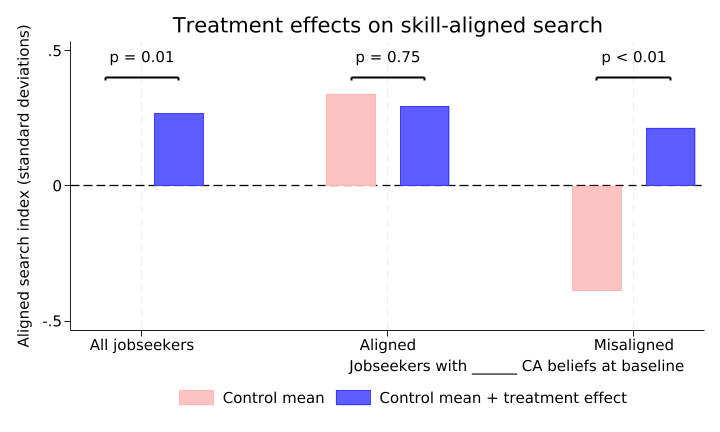
This skill-aligned search measure consists of four components. The key component is a novel job search task during the workshop: participants make 11 incentivised choices between pairs of job adverts that require different skill types but are very similar on wages and other benefits. The other three components are applications on Harambee’s job search platform, applications in response to job adverts received via text message after the workshops, and stated job search plans in a survey.
Treatment increases skill-aligned job search over all four components, though with varying precision. Treatment has no effect on total job search effort on any component, showing that jobseekers respond to new information by changing how they search, not how much they search.
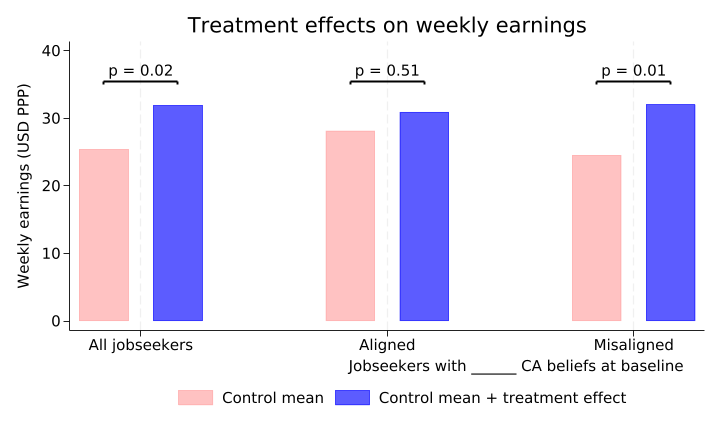
We turn to the second, bigger experiment to show that treatment increases weekly earnings for the average participant by $6.5 PPP, 25% of the control group mean (Figure 4).[1] This effect is almost twice as large for participants with misaligned rather than aligned comparative advantage beliefs at baseline. The effect on earnings is driven entirely by higher hourly wages in new jobs that start after treatment, rather than more employment, self-employment, longer hours, or wage increases in existing jobs. These patterns suggest that more skill-aligned search allowed jobseekers to find jobs that better match their skills and hence pay them more, though we cannot conclusively show this.
Figure 4: Treatment effects on weekly earnings
We find that the treatment did not increase earnings by changing participants’ self-esteem, increasing educational investments, giving prospective employers information about participants’ skills, or, as noted above, increasing job search effort.
Implications for labour policy in settings with high unemployment
Taken together, the results of the two experiments are consistent with many jobseekers having limited information about their skill comparative advantage and, when they get new information, updating their beliefs, aligning their job search with their skill comparative advantage, and getting jobs that pay higher wages.
This suggests that jobseekers have limited information about their skill comparative advantage and hence skill match with different jobs, adding a new dimension to existing work showing that firms have limited information about job applicants’ skills (Bertrand and Caria 2024). Our results suggest that skill mismatch between firms and workers may arise even before firms evaluate applicants.
This illustrates another type of limited information that can challenge jobseekers, adding to the ones reviewed by Caria et al. (2024). This type of limited information about skill match with different jobs may be particularly important in economies where jobseekers navigate unfamiliar labour markets due to migration or structural transformation (Gollin and Kaboski 2024, Hanson 2010, Jia et al. 2023).
Our findings suggest a simple policy response: the assessment workshops we run generate earnings gains larger than their cost under relatively conservative assumptions—and would be substantially cheaper if assessments moved online.[2]
References
Bertrand, M and S Caria (2024), “Helping jobseekers signal their skills: A cost-effective strategy benefitting workers and firms,” VoxDevTalks, 4(50).
Caria, S, K Orkin, A Andrew, R Garlick, R Heath, and N Singh (2024), “Barriers to search and hiring in urban labour markets,” VoxDevLit, 10(1).
Gollin, D and J Kaboski (2024), “New views of structural transformation: Insights from recent literature,” STEG.
Hanson, G (2010), “International migration and the developing world,” in D Rodrik and M Rosenzweig (eds.), Handbook of Development Economics.
ILO (2022), “International Labour Organization’s global employment trends for youth 2022”.
Jia, N, R Molloy, C Smith, and A Wozniak (2023), “The economics of internal migration: Advances and policy questions,” Journal of Economic Literature, 61(1): 144–80.
Kiss, A, R Garlick, K Orkin, and L Hensel (2025), “Jobseekers’ beliefs about comparative advantage and (mis)directed search,” Unpublished manuscript.
Lise, J and F Postel-Vinay (2020), “Multidimensional skills, sorting, and human capital accumulation,” American Economic Review, 110(8): 2328–76.