




Firm productivity rises in privately run Indian SEZs but stagnates in public ones, suggesting that political interference fuels rent-seeking behaviour.
Special Economic Zones: A policy tool under scrutiny
To facilitate firm integration into global value chains, governments in emerging economies often adopt policies designed to enhance their countries’ appeal to foreign investors. Among the most widely utilised industrial policy tools is the creation of Special Economic Zones (SEZs)—designated geographic areas where the state promotes industrial development via targeted infrastructure, fiscal incentives, and special regulatory regimes (Hanson 2024). Today, there are an estimated 4,300 SEZs globally, accounting for at least 20% of world trade (Hachmeier and Mösle 2019).
Policymakers are often inspired by high-profile ‘success stories’ such as China’s famous coastal SEZs (Wang 2013, Lu et al. 2019, Lu et al. 2023). However, the central question remains: Are SEZs actually effective at improving firm performance and delivering sustainable economic development? While academic evidence from developed countries exists (Busso et al. 2013, Kline and Moretti 2014), rigorous evaluations from emerging economies are still limited, largely due to the unavailability of data on which firms are located inside the zones. Research on SEZs in developing contexts has instead focused on other outcomes, such as household wealth effects (Abagna et al. 2025) and female employment (Gallé et al. 2024). In recent research (Görg and Mulyukova 2024), we address this gap by constructing a novel geocoded dataset of firms located inside the zones in India and analyse whether or not the establishment of SEZs promotes firms’ productivity growth.
The history of Special Economic Zones in India
India established Asia’s first Export Processing Zone (EPZ) in Kandla, Gujarat in 1965, but challenges such as inadequate infrastructure, regulatory complexity, and an unstable fiscal regime limited its effectiveness. Inspired by China’s success, the Indian government introduced the SEZ Act in 2005 to promote private-sector-led zones, shifting the focus away from pure export promotion to broader developmental goals and infrastructure improvements.
As of 2025, 370 SEZs have been formally notified, hosting over 6,200 units and providing employment to 3.1 million people (Special Economic Zone of India 2025). Incentives include duty-free imports, income tax exemption on exports, exemption from Central Sales and Service Tax, and a single window clearance for expedited approvals. SEZs can be developed by both public entities (states or public sector enterprises) or private developers and may cover a single factory or large multi-firm industrial parks.
A unique feature of India’s SEZ policy is its ‘bottom-up’ approach: firms can apply for SEZ status, rather than the government designating large tracts of land as SEZs. However, close proximity to policymakers in such settings may incentivise rent-seeking behaviour on the side of the managers. Given that the managerial time and effort is fixed, an increase in effort allocated to non-productive activities in pursuit of higher private returns results in a diversion of effort from productive activities. This shift can adversely affect firm-level productivity.
Studying the impact of SEZs in India
We construct a novel geocoded dataset of firms located inside SEZs by spatially merging a geocoded firm-level dataset with geocoded data on notified SEZs. One of the main challenges in evaluating the impact of SEZs is the endogeneity of their location decisions. Figure 1 shows that SEZs are typically clustered in coastal areas and around big and urbanised cities. To overcome the endogeneity concerns, we employ a time-varying propensity score method in a difference-in-differences framework. For each firm, we calculate the probability of being within an SEZ conditional on observable characteristics, comparing the performance of similar firms located inside and outside an SEZ before and after the SEZ is established.
Figure 1: Distribution of SEZs by district

Ownership matters: Private SEZs outperform public SEZs
Figure 2 shows that, on average, the establishment of SEZs has not led to significant improvements in productivity growth for firms within the zones—a finding robust across multiple measures (e.g. sales, wages) and SEZ sectors. Upon further investigation, however, we find significant heterogeneity based on who develops and operates the zones. While firms located in privately developed SEZs experience positive and statistically significant productivity growth following SEZ establishment, those within public SEZs experience productivity declines.
These unexpected, negative productivity effects may be explained by managerial engagement in non-productive activities, such as lobbying and rent-seeking, particularly within state-owned SEZs where excessive government involvement is prevalent. Government intervention may fail to account for market conditions, infrastructure, and other necessary inputs, limiting SEZs’ productivity gains.
Figure 2: Coefficient estimates of SEZ effect
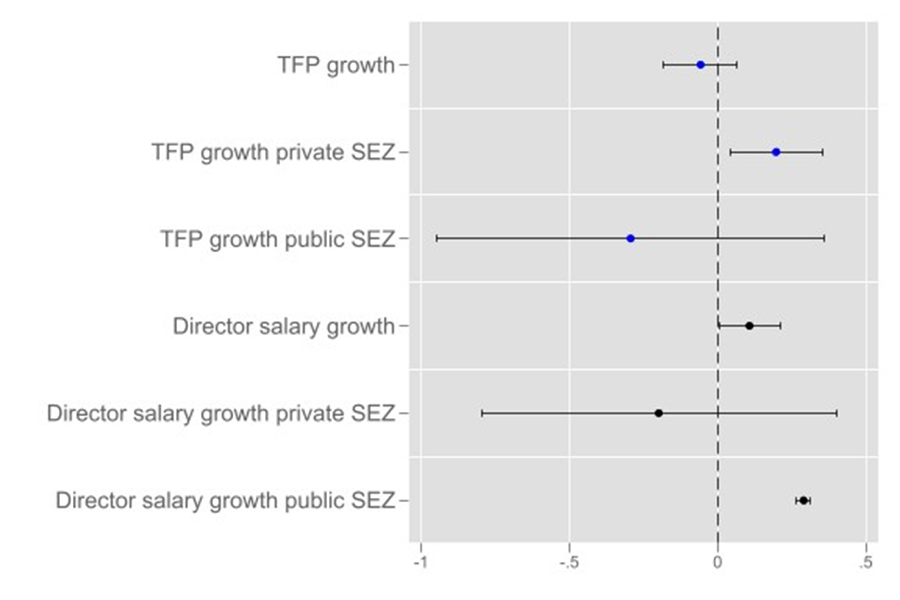
Notes: This graph presents point estimates with 95% confidence intervals. The outcome variable is measured as the log difference of TFP and director salary. TFP is measured using Ackerberg et al. (2015) approach. Controls group are matched firms located further than 40 km away from an SEZ. Time-varying covariates for creating the propensity scores include log of assets, log of sales, and the history of the outcome variable. Time-invariant covariates include age, a foreign ownership dummy, dummies for manufacturing and service industries in 2005 and state dummies. The weights are derived using Covariate Balancing Propensity Score. Standard errors are clustered at the SEZs level.
Managerial rent-seeking: A hidden cost in public SEZs
If non-productive activities are important, it can be hypothesised that managers prioritise income maximisation over firm performance enhancement. Consequently, one would anticipate increases in managerial salaries despite stagnant or declining productivity levels. Indeed, our results show that the director’s salary in public SEZs increases significantly by 10-20% following the establishment of the SEZ, whereas no such salary gains are observed for directors of firms in private SEZs. This supports the idea that in public SEZs, personal gains and political connections can crowd out efficiency gains, in line with previous research in India (Alkon 2018).
Policy implications: Can SEZs promote firm growth?
Our analysis reveals that Indian SEZs did not manage to deliver significant productivity improvements for firms located within the zones. We also show that the ownership of SEZs matters: policies that favour private sector engagement in SEZ development may generate substantial productivity gains compared to public-run SEZs. Empirical evidence indicates that director remuneration increases following SEZ establishment—but only in publicly owned zones—supporting our hypothesis that rent-seeking behaviour among managers may be a key driver of inefficiency. Excessive political involvement may create such opportunities for non-productive behaviour, suggesting the need to re-evaluate SEZ policy design in India with a focus on limiting government interference and promoting private-sector participation.
References
Abagna, M A, C Hornok, and A Mulyukova (2025), “Place-based policies and household wealth in Africa,” Journal of Development Economics, 176: 103482.
Ackerberg, D A, K Caves, and G Frazer (2015), “Identification properties of recent production function estimators,” Econometrica, 83(6): 2411–2451.
Alkon, M (2018), “Do special economic zones induce developmental spillovers? Evidence from India’s states,” World Development, 107: 396–409.
Busso, M, J Gregory, and P Kline (2013), “Assessing the incidence and efficiency of a prominent place based policy,” American Economic Review, 103(2): 897–947.
Gallé, J, et al. (2024), “Place-based policies, structural change and female labor: Evidence from India’s Special Economic Zones,” Journal of Public Economics, 240: 105259.
Görg, H and A Mulyukova (2024), “Place-based policies and firm performance: Evidence from Special Economic Zones in India,” European Economic Review, 165: 104752.
Hachmeier, K U and S Mösle (2019), "Sonderwirtschaftszonen und Industrieparks in Theorie und Praxis – unter besonderer Berücksichtigung Afrikas, Kieler Beiträge zur Wirtschaftspolitik."
Hanson, G (2024), “Place-based policies and development,” VoxDev.
Kline, P and E Moretti (2014), “Local economic development, agglomeration economies, and the big push: 100 years of evidence from the Tennessee Valley Authority,” The Quarterly Journal of Economics, 129(1): 275–331.
Lu, Y, J Wang, and L Zhu (2019), “Place-based policies, creation, and agglomeration economies: Evidence from China’s economic zone program,” American Economic Journal: Economic Policy, 11(3): 325–360.
Lu, F, W Sun, and J Wu (2023), “Special economic zones and human capital investment: 30 years of evidence from China,” American Economic Journal: Economic Policy, 15(3): 35–64.
Special Economic Zone of India (2025), “Fact sheet on Special Economic Zones as on 30.06.2025."
Wang, J (2013), “The economic impact of special economic zones: Evidence from Chinese municipalities,” Journal of Development Economics, 101: 133–147.