





Voting rights alone did not transform political participation or competition in India, but they did shift government priorities in favour of the newly enfranchised voters.
The relationship between democracy and economic development has been debated for centuries—from Aristotle’s Politics to Tocqueville’s Democracy in America and Sen’s Democracy as a Universal Value. A recent body of empirical evidence suggests that democracies tend to achieve better long-run development outcomes (Papaioannou and Siourounis 2008, Acemoglu et al. 2019). Yet democracy is a multifaceted concept, and the mere right to vote—a fundamental democratic institution—does not guarantee meaningful political participation or competition. Some argue that these deeper features of democracy, rather than suffrage alone, are important for curbing corruption and fostering growth.
Unpacking two major suffrage reforms in India’s democratic journey
We focus on two major voting rights expansions in India, the world’s largest democracy, to investigate whether and how formal enfranchisement translates into meaningful changes in political participation and human development (Cassan, Iyer, and Mirza 2025). Direct elections to provincial legislative assemblies were first conducted in 1920, with a very limited electorate. The 1935 Government of India Act, a reform enacted during British colonial rule, significantly lowered property requirements for voting, and also extended suffrage to educated individuals and wives of qualified male voters, increasing the electorate from 2.5% to 11.9% of the population. The 1950 Constitution of post-independence India went further, establishing universal adult suffrage that granted voting rights to all adults aged 21 or older (48% of the population).
These changes in the size of the electorate across districts can be seen in Figure 1, which illustrates the substantial variation in enfranchisement caused by the 1935 and 1950 reforms. Not surprisingly, we see that areas which had the largest increases in enfranchisement in 1935 (darker areas) have smaller increases after the 1950 reform (lighter areas).
Figure 1: Changes in enfranchisement caused by the 1935 and 1950 reforms
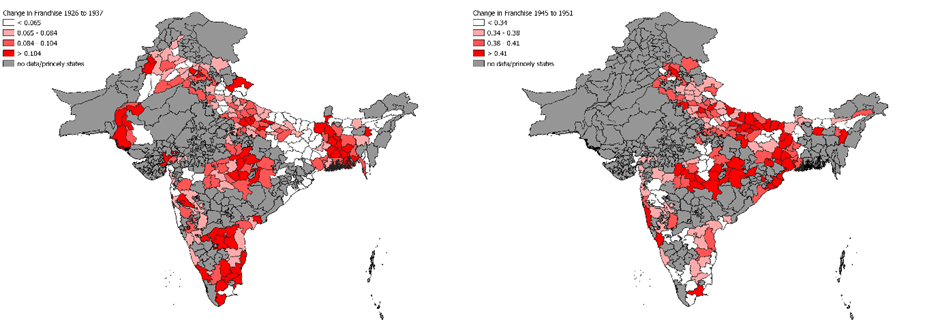
Notes: Reproduced from Cassan, Iyer, and Mirza (2025). Enfranchisement is measured as the number of registered voters divided by the population of the district. Maps show the change in this measure due to the reforms of 1935 and 1950. The underlying data on the number of registered voters comes from ‘Returns Showing the Results of Elections in India’ for the colonial period and ‘Official Election Reports of the Election Commission of India’ for the post-independence period. For district-level population data, we use the censuses of 1921, 1931, and 1951 (the 1941 census quality and coverage were compromised by the constraints of wartime), assigning the previous census-year population to each election year. Grey areas represent princely states that were not under direct British colonial rule and did not experience franchise expansions.
Franchise expansion did not lead to meaningful gains in political participation
Using a novel district-level dataset of electoral outcomes from 1920 to 1957, we find that the effects of franchise expansion on political participation are very small. In both 1935 and 1950, increases in the number of eligible voters led to much smaller increases in the share of people who actually voted. A 10-percentage point rise in enfranchisement raised the voter share of the population by about 4 percentage points after the 1935 reform and just 3 percentage points following the 1950 reform. As a result, overall turnout, measured as the share of registered voters who cast a ballot, declined significantly in districts that experienced the largest expansions in the franchise. Similar declines in turnout following suffrage extensions have been documented in other historical contexts, including the United Kingdom and Italy (Berlinski and Dewan 2011, Larcinese 2024).
In India, several historical factors help explain why many newly enfranchised citizens did not vote. During the colonial period, elections were frequently boycotted by nationalist leaders like Gandhi, who viewed participation as legitimising British rule. After independence, suffrage reforms did little to overcome structural barriers faced by poorer citizens, including limited access to information, weak party outreach, and persistent scepticism about whether elections would lead to tangible change.
Candidacy for electoral office also lagged behind the expansion of voting rights in both reforms. There were no additional eligibility rules for becoming a candidate, beyond those required for voting. However, the number of candidates grew more slowly than the number of registered voters. In districts with the largest gains in enfranchisement, the ratio of candidates to registered voters actually declined. This suggests that while more people were eligible to run for office, the actual level of candidate participation did not keep pace with the expanded electorate.
Political competition also remained stagnant
If expanding the franchise did not significantly increase voter or candidate participation, did it make elections more competitive? The evidence suggests otherwise. Measures such as incumbent re-election rates, the number of candidates per seat, and the share of uncontested races showed little change following either reform. In fact, if anything, the 1950 reform increased the fraction of incumbents who were re-elected. Meanwhile, the dominant Congress Party strengthened its hold on power, winning 74% of seats in the first post-independence election.
This persistence of elite dominance contrasts with experiences in Europe and the US, where franchise or candidacy eligibility expansions disrupted elite control over politics (Berlinski and Dewan 2011, Marcucci et al. 2023, Corvalan et al. 2020). In India, two key factors help explain this difference. First, colonial-era elections lacked strong party systems, with candidates relying on personal networks rather than well-established policy platforms. Second, after independence, the Congress Party positioned itself as the rightful successor to the anti-colonial movement and functioned as a broad-based party of consensusthat absorbed diverse social forces, managed internal dissent, and limited the emergence of a structured opposition (Kothari 1964).
Yet enfranchisement did shift government priorities
The most striking finding is that enfranchisement did influence government policy, even in the absence of dramatic shifts in political participation or competition. Archival evidence uncovered during research shows that newly elected officials in provinces such as Bombay and Bihar launched literacy campaigns, abolished school fees, and funded libraries and reading rooms in the 1930s—modest but meaningful efforts aimed at expanding educational access for poorer voters. Our empirical analysis finds that districts with a 10-percentage point increase in enfranchisement had 0.01 rupees per capita higher education spending, which represents 5% of the pre-1935 mean. Using estimates from Chaudhary (2010), this translates to a 1.3-percentage point increase in literacy rates, which is quite large, considering 1931 literacy in the 5-10 age group was only 5.9% and 2.0% for males and females, respectively.
We find similar results following the 1950 move to universal suffrage. Villages in districts with larger enfranchisement increases were more likely to have a primary school by 1961. Note that this is not simply a continuation of pre-independence trends, as the areas with greater enfranchisement increases after 1950 are the ones that had lower increases in enfranchisement following the 1935 reform. Our post-independence results thus show a shifting of spending priorities across areas based on enfranchisement changes. The observed shift toward primary education aligns with some theories of redistributive politics (Downs 1957, Meltzer and Richard 1981), which predict that when poorer voters gain influence, governments reallocate resources toward their specific priorities—even if political elites remain in power.
Interestingly, these effects were specific to education: we do not see any such relationship between enfranchisement increases and health spending or growth in health facilities. These patterns are consistent with the interests of the newly enfranchised. Primary education is a service with concentrated benefits for poorer and less-educated citizens, offering pathways for upward mobility. In contrast, health spending in this period focused largely on combating infectious diseases, yielding broad public benefits across income groups. Our findings highlight how institutional change can reshape priorities even without substantive change to the political status quo.
References
Acemoglu, D, S Naidu, P Restrepo, and J A Robinson (2019), “Democracy does cause growth,” Journal of Political Economy, 127(1): 47–100.
Berlinski, S and T Dewan (2011), “The political consequences of franchise extension: Evidence from the Second Reform Act,” Quarterly Journal of Political Science, 6: 329–376.
Cassan, G, L Iyer, and R A Mirza (2025), “Enfranchisement, political participation and political competition: Evidence from colonial and independent India,” Journal of Economic History, 85(1): 33–71.
Chaudhary, L (2010), “Taxation and educational development: Evidence from British India,” Explorations in Economic History, 47(3): 279–293.
Corvalan, A, P Querubin, and S Vicente (2020), “The political class and redistributive policies,” Journal of the European Economic Association, 18(1): 1–48.
Downs, A (1957), “An economic theory of political action in a democracy,” Journal of Political Economy, 65(2): 135–150.
Kothari, R (1964), “The Congress ‘system’ in India,” Asian Survey, 4(12): 1161–1173.
Larcinese, V (2014), “Enfranchisement and representation: Evidence from the introduction of ‘quasi universal’ suffrage in Italy,” Journal of Politics, 86(2): 565–581.
Marcucci, A, D Rohner, and A Saia (2023), “Ballot or bullet: The impact of the UK’s Representation of the People Act on peace and prosperity,” The Economic Journal, 133(652): 1510–1536.
Meltzer, A H and S F Richard (1981), “A rational theory of the size of government,” Journal of Political Economy, 89(5): 914–927.
Papaioannou, E and G Siourounis (2008), “Democratisation and growth,” Economic Journal, 118(532): 1520–1551.
Sen, A (1999), “Democracy as a universal value,” Journal of Democracy, 10(3): 3–17.