




In Brazil, labour policy aims to support the most vulnerable workers, yet actual labour practice disproportionately supports the skilled workforce in adjusting to technological change – those workers already poised to benefit from advances in digital technologies.
Technological change is a main driver of the global economy today, enabling businesses to enhance productivity and promoting large-scale economic growth. However, recent advances in digital technologies have ignited widespread fears over the future of work (see Acemoglu and Restrepo 2018). These concerns are supported by a hefty body of research in both developed and developing countries on the coincident rise in digital technologies and decline in lower- and middle-skilled jobs (Acemoglu and Autor 2011, Restrepo 2024).
In Almeida, Corseuil, and Poole (2025), we confirm this idea in the context of a globalising and rapidly digitalising Brazilian economy. We then consider whether Brazilian employment protection legislation is effective at minimising the risk associated with technological change for the most exposed workers.
Which jobs are best poised to succeed in the digital economy?
With the work of Acemoglu and Autor (2011) in mind, we classify the different skills associated with occupations into cognitive or manual skills and the different duties into routine or non-routine duties. A large evidence base proposes that increases in digital technologies will increase the demand for workers with cognitive skills and workers performing non-routine activities (Autor et al. 2003, Brynjolfsson and McAfee 2011).
We investigate this relationship in the context of Brazil’s rapid expansion of internet services during the early 2000s.[1] We use confidential information on over 16 million workers, employed in almost 300,000 establishments spanning all sectors of the economy across the country. Importantly, the data offers rich information on each worker’s occupation, allowing us to make deeper assessments on the duties performed by workers and the skills required by jobs.[2]
The results of our analysis suggest that, while all skills and activities take a negative employment hit as new technologies arrive and perform the same work more efficiently, workers that possess cognitive skills or perform non-routine tasks suffer smaller employment declines and therefore fare far better in the digital economy. Specifically, technology-intensive industries located in cities with earlier access to the internet reduce their relative reliance on manual abilities and routine activities, shifting the composition of the workforce towards more cognitive skills (such as ‘mathematical reasoning’) and non-routine duties (such as ‘interacting with computers’).
Even within the set of routine activities performed by workers, technology adoption expands the use of cognitive relative to manual skills, supporting skill-biased digital technological change among Brazilian firms. Moreover, there is a compositional shift within the set of cognitive skills, following digital technological adoption, as firms make relatively greater use of more interactive, communication-based skills, such as oral expression and speech clarity. Despite the advances made by digital technology, computers have not yet fully mastered human interaction, suggesting that cognitive, interactive, and communications skills are critical individual skills in a technologically advancing world.
To reap the benefits of the digital revolution, governments must prioritise investments in higher-level cognitive skills, especially interactive and communication skills. A workforce equipped with these skills is essential for the country to fully benefit from the higher productivity and welfare gains of digital technology adoption.
Can labour regulations serve to support workers most vulnerable to technology job loss?
Recent research documents the mediating impacts of Brazil’s labour laws in the aftermath of economic shocks on firm size (Almeida and Poole 2017) and worker formalisation (Ponczek and Ulyssea 2022, Almeida et al. 2022), highlighting the potentially counterproductive nature of strict labour policies in countries like Brazil.
We assess the impacts of labour regulations in supporting workers during negative economic shocks with the potential for job displacement, such as technological change. Specifically, we explore the role of labour policy enforcement. Though de jure regulations are uniform throughout the country, there are large differences within the country and over time in de facto regulations, as the Ministry of Labor is centrally designated with ensuring compliance with the laws on the books (see Figure 1).
Figure 1: Labour policy enforcement intensity, by municipality and year
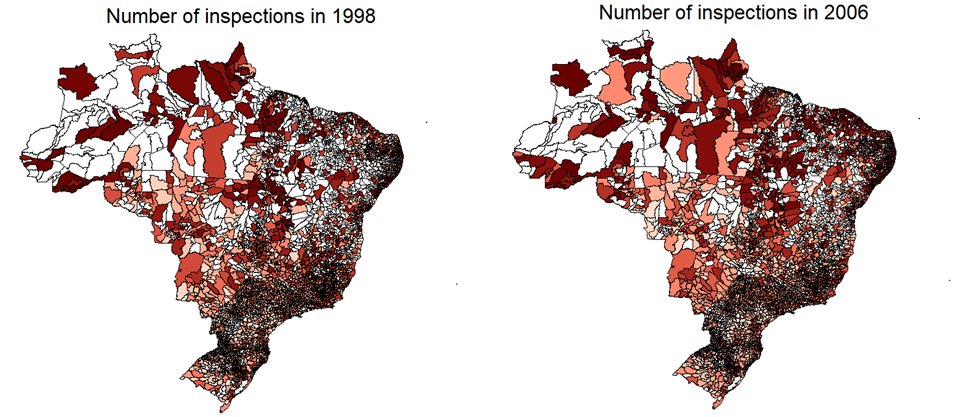
Our estimates find that most of the adjustments towards cognitive skills and non-routine duties occur in cities where the enforcement of labour regulations is stronger, as measured by the number of labour inspections per establishment. That is to say, firms in weak enforcement areas, which are likely to rely more on informal labour contracts, will also likely shed informal workers in the aftermath of a digital technology shock, while firms located in strictly enforced municipalities, with few to no informal workers, are forced to dismiss formal employees. Since skilled workers have a higher cost of adjustment – Brazilian law requires that firms pay fines proportional to worker wages for dismissals without cause – firms disproportionately cut the more vulnerable, lower-skilled workers. Furthermore, the shift towards communication-based cognitive skills is again more pronounced in strong regulatory environments, suggesting that employer-level costs of adjustment for interactive skills are particularly high, possibly due to their scarcity.
Implications for labour policy
In contrast to core labour policy intentions to support workers most at-risk of job loss from the arrival of new digital technologies, de facto labour regulations differentially sustain the skilled workforce in adjusting to technological change – when, in fact, these workers were already poised to benefit from such advancements. We argue that well-intentioned labour policies must not be viewed in a vacuum; rather, coordination and cooperation between government agencies is paramount to ensure policy effectiveness.
Our research, alongside ongoing and future research on best practices in labour policy institutions, offers important implications for governments interested in the effects of labour policy and how it overlaps with other economic policies. These ideas are at the forefront of policy discussions, as Brazil considers new ways to foster industrial productivity and competitiveness, promote inclusive and sustainable growth, and enhance formal economic activity by women and other underrepresented populations (e.g. Santos-Paulino et al. 2024).
References
Acemoglu, D and P Restrepo (2018), “The race between man and machine: Implications of technology for growth, factor shares, and employment,” American Economic Review 108(6): 1488–1542.
Acemoglu, D and D H Autor (2011), “Skills, tasks and technologies: Implications for employment and earnings,” in O Ashenfelter and D Card (eds.), “Handbook of Labor Economics.”
Almeida, R K, C H L Corseuil and J P Poole (2025), “The impact of digital technology on worker tasks: Do labor policies matter?,” Journal of Development Economics 175.
Almeida, R K, L S Paz and J P Poole (2022), “Precarization or protection? The role of trade and labour policies on informality,” Journal of Development Studies 58(7): 1416–1435.
Almeida, R K and J P Poole (2017), “Trade and labor reallocation with heterogeneous enforcement of labor regulations,” Journal of Development Economics 126: 154–166.
Autor, D H, F Levy and R J Murnane (2003), “The skill content of recent technological change: An empirical exploration,” Quarterly Journal of Economics 118(4): 1279–1333.
Brynjolfsson, E and A McAfee (2011), "Race against the machine: How the digital revolution is accelerating innovation, driving productivity, and irreversibly transforming employment and the economy", Digital Frontier Press.
Ponczek, V and G Ulyssea (2022), “Enforcement of labour regulation and the labour market effects of trade: Evidence from Brazil,” Economic Journal 132: 361–390.
Restrepo, P (2024), “Automation: Theory, evidence, and outlook,” Annual Review of Economics 16: 1–25.
Santos-Paulino, A U, Z Olekseyuk, U Panizza, J P Poole, C Trentini and C V Martincus (2024), “Investment facilitation for sustainable development,” T20 Policy Brief.
Tian, L (2025), “How does internet connectivity impact developing economies?,” VoxDev.