




Material scarcity and financial constraints appear to be the main drivers of self-employment for approximately two-thirds of urban own-account workers in Brazil.
Editor’s note: For a broader synthesis of themes covered in this article, check out our VoxDevLit on Barriers to Search and Hiring in Urban Labour Markets.
Three striking regularities stand out when comparing labour markets across the world:
- The self-employed make up a large share of the workforce in poor countries; while wage workers dominate in rich ones (Bandiera et al. 2022, Gindling and Newhouse 2014).
- People who are working by themselves in developing countries are systematically more likely to be among the poorest of all workers (Scarelli 2022).
- Self-employed workers in developing countries are also much more likely to be informal, which means they tend to lack the social protection extended to formal workers (Ulyssea et al. 2025).
Taken together, these patterns suggest that understanding global poverty and vulnerability means, to a large extent, understanding self-employment.
This is no easy task. Self-employment is a broad classification comprising numerous activities, ranging from successful entrepreneurs to individuals working for themselves ‘by necessity’ (Margolis 2014). Still, ‘necessity’ is rarely given a sharp economic definition and can therefore be difficult to quantify. Without a clear distinction between entrepreneurs of necessity versus opportunity, it is difficult to determine whether a large contingent of self-employment is, by itself, something that should worry policymakers.
This is the key motivation behind our recent work (Scarelli and Margolis 2025), in which we suggest that ‘necessity’ self-employment arises when households, facing material scarcity and financial constraints, are driven to prioritise immediate consumption that cannot be met through alternative means. This can occur even when well-paying wage jobs are available but take too long to find, as is often the case in urban centres in developing countries.
Studying self-employment in urban Brazil
Brazil offers an ideal setting to study this problem: it is a large developing country, home to over 200 million people, with a consistently high rate of self-employment (with one self-employed person for every two wage workers). Notably, 85% of the Brazilian population lives in cities—meaning that we cannot dismiss its high self-employment rate as a consequence of widespread employment in small-scale agriculture.[1] Furthermore, Brazil has rich microdata, on both labour market behaviour and various measures of pressing consumption needs, that allow us to empirically quantify the extent to which self-employment is constrained.
Figure 1 breaks down the Brazilian urban labour markets into its three fundamental occupational statuses over the work earnings distribution, highlighting the disparity between the two types of self-employed individuals: those that have employees (the employers) and those that do not (the own-account workers). While the employers represent a very small group that occupy the top of the earnings distribution, the own-account workers are a much more complex case—effectively representing the vast majority of the self-employed that are visibly concentrated at the bottom of the earnings distribution, though they can be found at all earnings levels.
Figure 1: Occupations and labour income
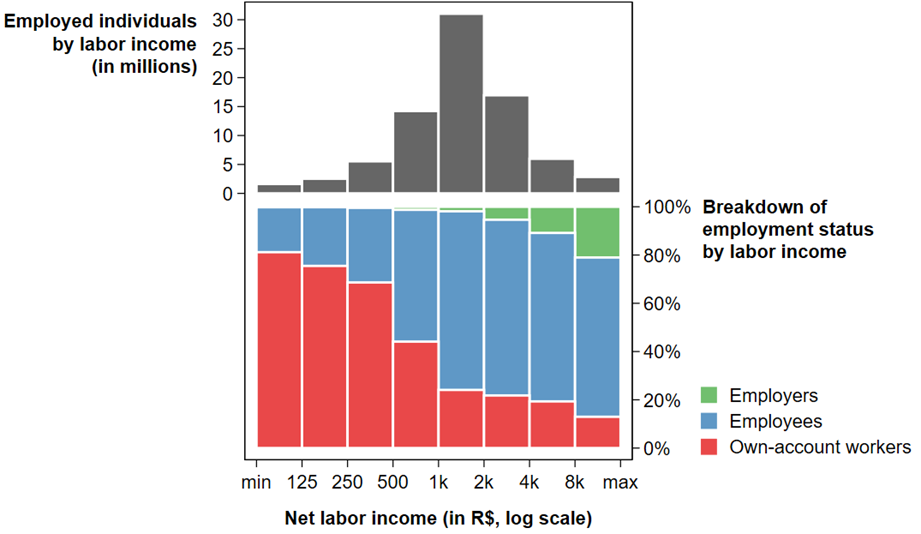
Notes: Plot is based on the income from worker’s primary occupation, net of taxes, for urban, working-age (14–64) individuals. Monetary values in Brazilian reais, at prices of January 2018. Source: Authors' calculations, based on data from IBGE.
In light of these stylised facts, we can reframe the issue of self-employment in developing contexts that are comparable to Brazil as a series of questions about the occupational choice of urban own-account workers. In particular, why do some people work for a firm while others, despite being very similar, work on their own? And, under which conditions can we say that opting for low-pay own-account work is a constrained choice?
Developing a new criterion for financially constrained own-account workers
To address these questions, we note that own-account workers, by definition, do not need to match with a firm to start working. Their occupational choice can be characterised as a decision between taking up an activity that might pay less but starts sooner versus looking for a job that might pay more but will require some time to find. This reflects the observation that the types of own-account work that are most common in settings like Brazil have very low entry barriers and, as such, are more ‘liquid’. That is, people opting for self-employment can substantially reduce the time and resources required to find work, allowing them to effectively transform labour into cash faster.
In this setting, individuals with a stronger consumption urgency would assign a higher value to such liquidity and be more likely to work on their own instead of looking for wage work, even when the second option offers them a relatively higher income in all future periods after a job is found. In practice, such urgent needs often reflect a situation of material scarcity—one that, under well-functioning formal financial markets, could be alleviated through borrowing at reasonable rates to support consumption while searching for a job. However, many households face financial constraints that prevent them from borrowing at a rate below their subjective discount rate. When that happens, it can become optimal to take a low-paying (own-account) job in order to consume now, instead of borrowing at high rates to consume now while looking for a higher-paying (wage) job that would start later.
Own-account workers are driven by urgent consumption needs
This channel thus complements alternative explanations for the prevalence of own-account work that have been proposed in the evidence base, which rely on individual differences in skills, preferences, or some form of market segmentation. We provide a novel explanation for this: individual heterogeneity in consumption urgency is sufficient to motivate sorting into low-productivity own-account work.
An important implication of this is that, if the earnings from self-employment are low and financial constraints are persistent, present consumption needs may continue to push people towards activities that pay less but faster, with the potential to create a form of poverty trap.
How prevalent is financially constrained own-account work in Brazil?
To put a number on how large this effect might be, we applied our model to the data, essentially comparing the reported earnings of own-account workers to their potential earnings in wage employment, and adjusting for how long it would take them to find a wage job, based on the labour market behaviour of similar workers.
This comparison tells us how intense the constraints faced by own-account workers are, as we can use these two earnings measures to recover the lowest level of financial urgency (or discount rate) that can rationalise an individual’s decision to become self-employed, given their observable characteristics. To determine if this rate is too high, we compare it with the interest rates available in the formal credit market.
We thus conclude that only one-third of Brazilian own-account workers appear to be taking their first-best economic choice. By contrast, twice as many seem to favour the immediate gains from own-account work at the expense of larger gains in terms of future wages. Intuitively, for workers facing urgent consumption needs without access to credit, the immediate (though lower) income available through own-account work becomes their only viable option.
Implications for labour policy design
By suggesting that the majority of own-account workers in Brazil appear to be choosing self-employment due to scarcity, our findings challenge prevailing narratives about entrepreneurship in developing countries. While it remains crucial to train entrepreneurs to do better, it is not obvious that such policies are appropriate for all self-employed workers. Indeed, evidence suggests that such policies have mixed results and tend to work best for self-employed workers with somewhat larger firms, above subsistence level (McKenzie et al. 2023).
In contrast, our results suggest policies that smooth consumption during liquidity shocks are likely to support wage employment and lead to long-run income gains by reducing the dependence on readily available (but poorly paid) labour income sources, leading to a more productive occupational structure in the long term.
References
Bandiera, O, A Elsayed, A Heil, and A Smurra (2022), “Economic development and the organisation of labour: Evidence from the Jobs of the World Project,” Journal of the European Economic Association, 20(6): 2226–2270.
Gindling, T H and D Newhouse (2014), “Self-employment in the developing world,” World Development, 56: 313–331.
McKenzie, D, C Woodruff, K Bjorvatn, M Bruhn, J Cai, J Gonzalez-Uribe, S Quinn, T Sonobe, and M Valdivia (2023), “Training entrepreneurs,” VoxDevLit, 1(3).
Margolis, D N (2014), “By choice and by necessity: Entrepreneurship and self-employment in the developing world,” The European Journal of Development Research, 26(4): 419–436.
Scarelli, T (2022), “Occupations and wealth in developing countries,” Revue d’économie du développement, 30(2): 127–135.
Scarelli, T and D N Margolis (2025), “When you can’t afford to wait for a job: The role of time discounting for own-account workers in developing countries,” Economic Development and Cultural Change, 73(4): 1605–1657.
Suri, T, C Udry, J C Aker, C B Barrett, L Falcao Bergquist, M Carter, L Casaburi, R Darko Osei, D Gollin, V Hoffmann, T Jayne, N Karachiwalla, H Kazianga, J Magruder, H Michelson, M Startz, and E Tjernstrom (2024), “Agricultural technology in Africa,” VoxDevLit, 5(2).
Ulyssea, G, M Bobba, L Gadenne, and M Harari (2025), “Informality,” VoxDevLit, 6(2).