



View Chapter:
Downloads:
Chapter 4
Economic Development and Agriculture
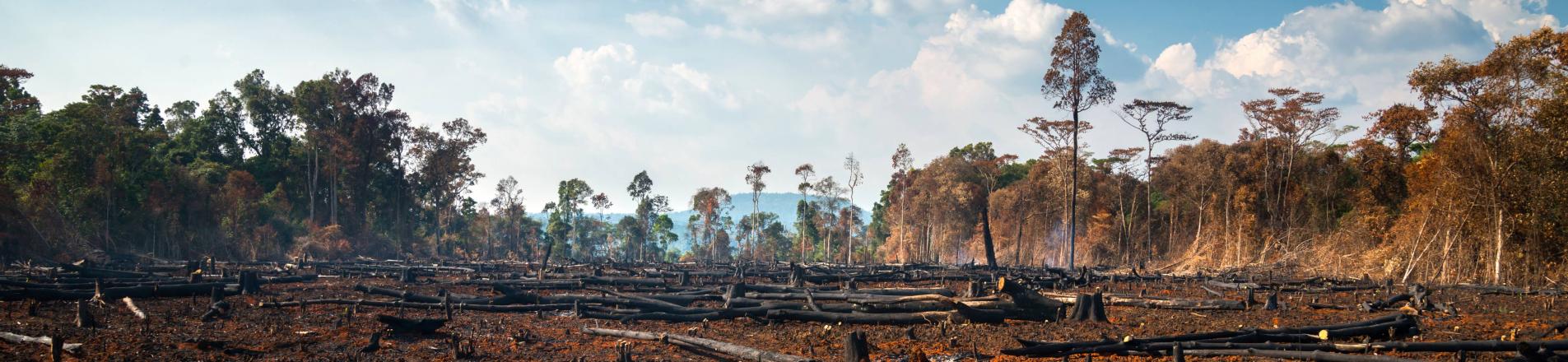
Agricultural expansion is the dominant driver of tropical deforestation worldwide: cattle ranching and soy cultivation in Brazil, oil palm plantations in Indonesia, and subsistence farming across the tropics (Balboni et al. 2023). On one hand, agricultural growth provides food security and rural incomes, often serving as the foundation for structural transformation in developing economies. On the other hand, agricultural expansion imposes significant environmental costs through greenhouse gas emissions and biodiversity loss. Policymakers must navigate this trade-off, as efforts to boost rural productivity and incomes can inadvertently accelerate forest loss unless accompanied by effective conservation measures.
Agricultural Productivity
One of the most contentious debates in the economics of deforestation centres on whether making farmers more productive helps or hurts forests. This debate centres on two competing hypotheses with radically different policy implications.
Theory
The Borlaug Hypothesis, named after Nobel laureate Norman Borlaug, suggests that productivity improvements allow farmers to produce more food on existing land, reducing pressure to clear additional forests. This “land-sparing” view holds that agricultural intensification can satisfy growing food demand without expanding cultivated area. The Jevons Paradox offers the opposite prediction: productivity improvements make agriculture more profitable, raising the opportunity cost of leaving land forested and incentivising farmers to convert more forest to farmland.
Farrokhi et al. (2025) help reconcile these competing views by showing that outcomes depend on the elasticity of demand. When demand is less responsive (i.e. inelastic), productivity gains mainly reduce prices without expanding area, supporting Borlaug. When demand is highly responsive to price changes (i.e. elastic), productivity gains lead to large increases in area cultivated, supporting Jevons.
Evidence
Research has shown that productivity improvements can spare land and reduce deforestation, particularly in smallholder settings. Abman et al. (2020) studied Uganda’s agricultural training programme using spatial discontinuity in village eligibility. The programme reduced deforestation by 14% in the short run by helping farmers intensify production through improved techniques rather than expanding to new areas. Abman and Carney (2020) found that input subsidies for small-scale agriculture in Malawi reduced deforestation in the short run. Assunção et al. (2016) showed that rural electrification in Brazil improved crop farming productivity relative to cattle ranching and reduced forest loss.
On the other hand, research has also found that productivity improvements can accelerate deforestation. Carreira et al. (2024) studied Brazil’s adoption of genetically engineered soy seeds introduced in 2003. Municipalities with greater potential gains from adopting the new technology experienced faster deforestation as farmers expanded soy cultivation into previously forested areas. The key difference is that Brazil’s soy expansion occurred in large-scale commercial agriculture with substantial government-subsidised credit and strong international demand, enabling agricultural frontier expansion into forests.
These seemingly contradictory findings can be reconciled in light of economic conditions and institutional context. Small-scale agriculture with limited access to credit and capital markets tends to support Borlaug, as productivity improvements lead to intensification on existing land. Large-scale agriculture with mobile capital supports Jevons, as improvements attract resources and enable frontier expansion. Crops destined for elastic international markets are more likely to generate expansion, while crops for inelastic local markets promote intensification (Farrokhi et al. 2025).
Policy Interventions
Policymakers have experimented with various interventions to limit agricultural expansion into forests while preserving opportunities for rural development. Most rigorous evidence comes from Brazil’s Action Plan for the Prevention and Control of Deforestation in the Legal Amazon, which implemented multiple policies simultaneously in the 2000s.
Monitoring and Enforcement
Brazil developed sophisticated satellite-based monitoring that revolutionised deforestation detection. The Real-Time System for Detection of Deforestation (DETER) processes satellite imagery to issue alerts and support immediate responses by environmental authorities. Assunção et al. (2023b) exploited cloud coverage blocking satellite visibility as natural variation and found that increasing enforcement by half decreases municipal deforestation by 25%. Ferreira (2023) documented the complete chain from satellite detection to deforestation reduction, finding that real-time alerts increased inspection probability by two percentage points. Gandour et al. (2019) found that this monitoring system, which focused on detecting the clearing of primary forests, also had the unanticipated consequence of increasing forest regeneration.
Financial Restrictions
Brazil pioneered the use of agricultural credit policy as an environmental tool. Through Resolution 3545 in 2008, Brazil made rural credit in the Amazon conditional on environmental compliance and legal land titling. Assunção et al. (2020) found that the policy led to 60% less deforestation than would have occurred otherwise. The mechanism was straightforward: reduced credit disbursements, with 75% of the effect driven by a reduction in loans for cattle ranching – the primary driver of deforestation in the Amazon.
Place-Based Policies
Protected areas are a popular policy tool for preserving forests. A comprehensive review by Reynaert et al. (2024) found that protection had modest impacts on forest cover in most cases, with stronger effects only in areas facing genuine development pressure rather than 'paper parks' with little economic potential. Many protected areas may be established in locations with low economic value, which limits additionality. Furthermore, enforcement capacity and political commitment vary substantially across contexts.
In contrast to traditional protected areas, Brazil developed a more targeted approach through its “Priority List” of municipalities subject to intensified monitoring starting in 2008. Assunção et al. (2023a) found the Priority List reduced deforestation by 43% in targeted municipalities. More importantly, they developed optimisation methods showing that a perfectly targeted list would have achieved 10% lower carbon emissions than the actual policy.
Heterogeneous and Dynamic Policy Effects
Policy effectiveness varies across locations and over time. Harding et al. (2021) documented that different conservation policies implemented in the Amazon had varying effectiveness depending on commodity prices, which influence the underlying deforestation pressure. Burgess et al. (2023) used Brazil’s international borders to track policy effectiveness over time. They documented three periods: 2001 to 2005, when Brazilian deforestation rates were three times higher than across borders; 2006 to 2013, when differences disappeared as Brazil implemented strong policies; and 2014 to 2020, when differences re-emerged as regulations weakened. This reveals that even effective policies can lose impact when political support erodes.
Poverty Reduction
A critical challenge is ensuring that environmental policies do not undermine poverty reduction goals, particularly in tropical forest regions with high poverty and limited non-agricultural opportunities.
Cash Transfers
Programme design critically affects environmental outcomes. Alix-Garcia et al. (2013) studied Mexico’s conditional cash transfer programme and found that additional income increased deforestation through higher consumption of land-intensive goods. In contrast, Brazil’s Bolsa Verde programme demonstrates that transfers can achieve both poverty reduction and forest conservation when designed with explicit environmental goals. The programme targeted poor households in forested areas and made payments based on regional forest cover, creating collective incentives for conservation. Wong et al. (2025) found Bolsa Verde reduced annual deforestation. Evaluating Bolsa Floresta, direct conditional payments in preservation areas, Cisneros et al. (2022) find small conservation effects from the programme. Simonet et al. (2018) estimate significant reductions in deforestation from a pilot project with smallholders in the Brazilian Amazon to Reduce Emissions from Deforestation and forest Degradation (REDD+). Cash transfers can also be administered through employment. Pagel and Sileci (2025) find that a large-scale tree-planting programme in the Philippines achieved poverty reduction through job creation.
Direct compensation for conservation can align incentives effectively (Alix-Garcia and Wolff 2014). Jayachandran et al. (2017) conducted a randomised trial in Uganda offering forest-owning households annual payments for conservation. Tree cover declined by only 4.2% in treatment villages versus 9.1% in controls, with social benefits 2.4 times larger than costs. However, implementation challenges often undermine effectiveness. Jack et al. (2025) found that standard contracts paid after verification did not affect crop residue burning in India. Incorporating partial upfront payment increased compliance by 10 percentage points, highlighting the importance of addressing liquidity constraints and farmer distrust. Jack and Jayachandran (2019) argue that enrolment costs can improve programme effectiveness by deterring participation from those who would have conserved regardless of payment. This suggests that some friction in programme access may be beneficial for targeting.
One challenge of implementing transfers conditional on conservation is that deforestation is already illegal and subject to high penalties in some countries, including Brazil. It may be difficult to design institutions that pay farmers not to do what they are already prohibited from doing.
Alternative Development Pathways
Tourism provides forest-friendly development opportunities. Saavedra (2025) conducted the first randomised trial of ecotourism promotion in Colombia, finding significant decreases in deforestation around ecotourism sites alongside increased tourism and employment. Linsenmeier (2025) used economic modelling to show that tourism in Brazil helped preserve natural land equivalent to the total deforested area over the past 20 years by providing alternative rural employment. McGahan and Pongeluppe (2023) show how private companies can invest in sustainable conservation activities and in protecting natural habitats as a product differentiation strategy, enabling them to signal environmental responsibility and charge premium prices while generating conservation benefits.
Policy Takeaways
We highlight several key insights for balancing economic growth with forest conservation.
- Agricultural productivity. Productivity programmes should explicitly promote intensification over expansion. We note that the impact of these programmes will depend on the context: we would expect higher deforestation in commercial agriculture with mobile capital and elastic international demand, but reduced deforestation in smallholder settings with factor constraints and inelastic local demand.
- Policy Interventions. Satellite monitoring is a breakthrough for enforcement, but it requires sustained political commitment. Financial policy is powerful – making credit conditional on environmental compliance effectively limits agricultural expansion. Data-driven targeting can substantially improve the cost-effectiveness of place-based policy.
- Poverty and Conservation. Cash and asset transfer programmes may increase or decrease deforestation depending on their design. Addressing liquidity constraints and trust issues dramatically improves conservation programme effectiveness. Well-designed programmes can achieve both poverty reduction and environmental protection simultaneously.
- Sustained Commitment. Even highly effective policies lose impact when political support erodes. Building durable coalitions and designing robust institutions are crucial for long-term conservation success.
For full reference list see the end of the conclusion chapter.
Contact VoxDev
If you have questions, feedback, or would like more information about this article, please feel free to reach out to the VoxDev team. We’re here to help with any inquiries and to provide further insights on our research and content.