





In Ghana, a simple, low-cost intervention – helping informal workers set daily goals – significantly improved workers’ and firms’ performance, suggesting that non-binding incentives may be an effective means to foster the growth of small firms in developing contexts.
Editor’s note: For a broader synthesis of themes covered in this article, check out our VoxDevLits on Training Entrepreneurs and Informality. The authors have made slides available to accompany this research here.
Small firms form the economic backbone of many developing economics (Gollin 2008). Academic and policy circles studying these firms tend to focus on three constraints to growth – capital (De Mel et al. 2008, Banerjee and Duflo 2014), technology (Alfaro-Serrano et al. 2021, Suri and Udry 2022, Verhoogen 2023), and managerial practices (McKenzie 2021, McKenzie et al. 2023). However, less is known about how to directly improve workers’ performance, although this lies at the core of firms’ productivity (Bloom and Van Reenen 2011).
Enhancing workers’ performance often hinges on effective motivation strategies. While monetary incentives, like performance-based pay, bonuses, and the threat of job loss are well-understood in developed countries, their implementation and effectiveness in developing countries is less obvious (McKenzie and Woodruff 2017). For example, Davies and Fafchamps (2025) show that identical monetary incentives yield different outcomes in India and UK. In experiments in Ghana, Bandiera and Fischer (2013) find that performance-based pay does not boost effort supply, and Davies and Fafchamps (2021) observe that employers use neither monetary rewards nor punishments to promote effort. Could non-monetary incentives pose an effective means to incentivise worker performance in developing countries?
Inspired by laboratory experiments demonstrating that non-binding production goals can be effective motivators (Locke and Latham 2002), we design a field experiment that tests this concept with cassava processors in rural Ghana. In this experiment, employers and workers are trained to measure production and set daily, non-binding, production goals. The results are striking – non-binding daily goals significantly boosted workers’ output and productivity, suggesting that goal setting may be a low-cost, effective way to raise small-firm productivity in developing contexts.
Figure 1: Goal-setting booklet
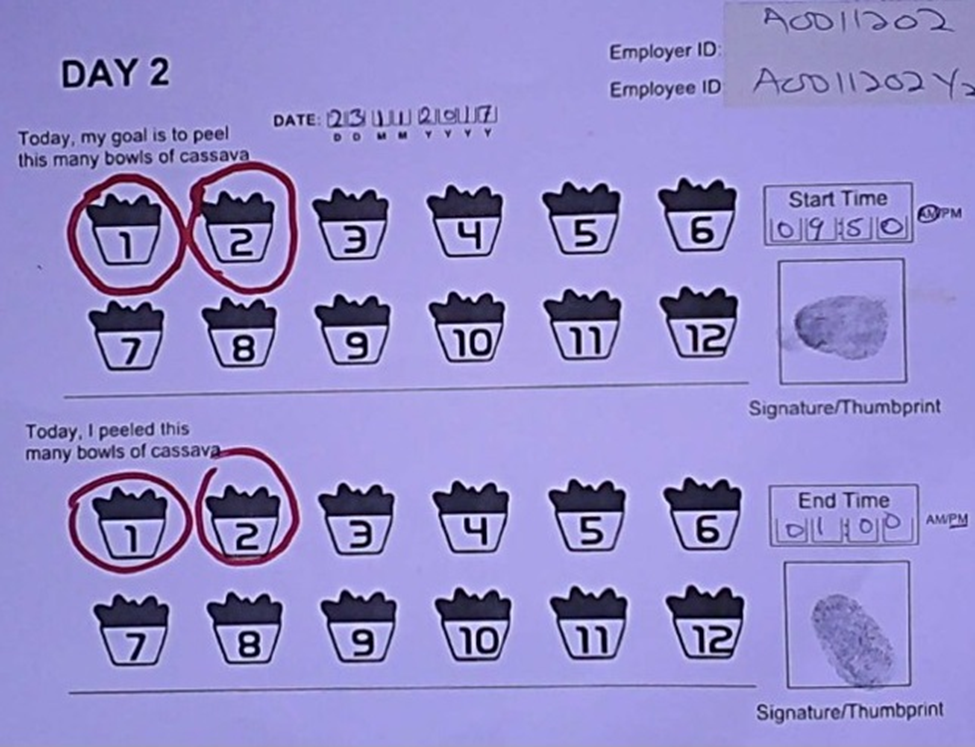
Studying the efficacy of goal setting amongst cassava firms
We worked with 425 firms in rural southeast Ghana, partnering with the National Board for Small Scale Industries (NBSSI) and Innovations for Poverty Action (IPA). The study focused on cassava peeling – the first stage of processing raw cassava for consumption (Cettolin, Cole, and Dalton 2024). Firms were randomly assigned to one of two treatments:
- Production measurement: 105 firm owners and their employees were invited to receive training on how to record the amount of cassava peeled daily by workers.
- Production measurement + goal setting: 210 firm owners and their employees were invited to receive the aforementioned production measurement training, plus additional training after four weeks on setting daily production targets.
Each trained worker received an aluminium bowl in which to place peeled cassava, a booklet with a unique ID code to keep production records, and a camera phone to record each peeled bowl, for an intervention period of 8 weeks. Goal setting was voluntary and non-binding – workers were not paid more for reaching goals, nor penalised for missing them. Employers and workers simply recorded targets and actual production in the provided booklets and corresponding photos. Lastly, and notably, the study sample was primarily female.
Goal setting is a cost-effective way to increase output and productivity
- Workers who set goals peeled more cassava: On average, workers peeled 0.8 additional bowls of cassava per day, an increase of 16%.
- These workers also spent more time peeling: Workers spent an additional 30 minutes per shift peeling, on average, an increase of 8%.
- Workers who set goals were more productive: On average, workers increased their productivity by 0.07 bowls per hour, an increase of about 8%.
- Firms whose workers set goals increased their average product of labour. These firms increased their output by 0.66 bowls per worker per shift, a 13% increase. In other words, both workers and firms benefited economically from goal setting.
Goal setting was particularly effective amongst piece-rate workers, relative to workers who were paid a fixed fee. Piece-rate workers increased their output and productivity by 32% and 24%, respectively, consistent with the idea that existing financial incentives interact positively with goal setting. Importantly, these gains did not come at a cost to workers: 90% of workers did not find goal setting stressful, and the intervention did not impact worker job satisfaction. A heterogeneity analysis based on workers’ characteristics collected in the pre-intervention survey suggests that workers with self-control problems may be those who benefit the most from setting goals.
Finally, this simple intervention proved to be highly cost-effective. While the intervention cost US$45 per firm to implement, a back-of-the-envelope calculation suggests that firms assigned to the goal-setting treatment with piece-rate workers increased their monthly profits by $319, a 33% increase. Moreover, piece-rate workers increased their income by $40 a month by setting goals, a 30% increase. For firms paying flat rates, however, the benefits were negligible. Four months after the intervention, many firms were still using goal setting, and the practice had begun to spread to firms that were not directly trained under the study.
Policy implications: Firms, workers, and agriculture
These findings illustrate that non-monetary incentives like goal setting combined with piece-rate incentives provide an accessible alternative to boost worker and firm productivity in developing contexts. Three policy-relevant takeaways thus emerge from the findings:
- Interventions aimed at worker productivity represent an underexplored but powerful lever for the growth of small, informal firms in developing countries. While much attention has focused on capital, technology, and management, these findings show that low-cost, worker-centred behavioural strategies can also boost incomes for both employees and firms.
- The incentive system in which these interventions are deployed matters. Goal setting worked best for piece-rate workers, where incentives aligned with effort. Policymakers and firms must keep wage structures in mind when designing similar behavioural interventions.
- Similar interventions are scalable across agricultural sectors. Like cassava processing, many agro-processing sectors struggle with low productivity and short working hours. Given its simplicity and minimal cost, goal setting could be rolled out across other agricultural sectors where informal labour dominates.
References
Alfaro-Serrano, D, T Balantrapu, R Chaurey, A Goicoechea, and E Verhoogen (2021), “Interventions to promote technology adoption in firms: A systematic review,” Campbell Systematic Reviews 17(4): e1181.
Bandiera, O, and G Fischer (2013), “Can ‘Good’ HR practices be exported? Evidence from a field experiment in Ghana,” Unpublished manuscript.
Banerjee, A V, and E Duflo (2014), “Do firms want to borrow more? Testing credit constraints using a directed lending program,” Review of Economic Studies 81(2): 572–607.
Bloom, N, and J Van Reenen (2011), “Human resource management and productivity,” in Handbook of Labor Economics, 4: 1697–1767.
Cettolin, E, K Cole, and P Dalton (2024), “Improving workers’ performance in small firms: A randomized experiment on goal setting in Ghana,” Review of Economics and Statistics: 1–45.
Davies, E, and M Fafchamps (2021), “When no bad deed goes punished: Relational contracting in Ghana and the UK,” Journal of Economic Behavior & Organization 191: 714–737.
Davies, E, and M Fafchamps (2025), “Material incentives and effort choice: Evidence from an online experiment across countries,” Games and Economic Behavior 154: 175–199.
De Mel, S, D McKenzie, and C Woodruff (2008), “Returns to capital in microenterprises: Evidence from a field experiment,” Quarterly Journal of Economics 123: 1329–1372.
Gollin, D (2008), “Nobody’s business but my own: Self-employment and small enterprise in economic development,” Journal of Monetary Economics 55: 219–233.
Locke, E A, and G P Latham (2002), “Building a practically useful theory of goal setting and task motivation: A 35-year odyssey,” American Psychologist 57(9): 705–717.
McKenzie, D (2021), “Small business training to improve management practices in developing countries: Re-assessing the evidence for ‘training doesn’t work’,” Oxford Review of Economic Policy 37(2): 276–301.
McKenzie, D, and C Woodruff (2017), “Business practices in small firms in developing countries,” Management Science 63(9): 2967–2981.
McKenzie, D, C Woodruff, K Bjorvatn, M Bruhn, J Cai, J Gonzalez Uribe, S Quinn, T Sonobe, and M Valdivia (2023), “Training entrepreneurs,” VoxDevLit 1(3).
Suri, T, and C Udry (2022), “Agricultural technology in Africa,” Journal of Economic Perspectives 36(1): 33–56.
Verhoogen, E (2023), “Firm-level upgrading in developing countries,” Journal of Economic Literature 61(4): 1410–1464.