




Over a thousand years, China’s political hierarchy reshaped regional prosperity – provincial capitals flourished through bureaucracy and market access, but these benefits faded once they lost administrative status.
Editor's note: The authors have made slides available to accompany this research here.
Across the world, administrative centres tend to enjoy outsized prosperity (De Long and Shleifer 1993, Ades and Glaeser 1995, Davis and Henderson 2003, Glaeser and Puga 2024), and their locations often shape political accountability and stability (Campante and Do 2014). Yet whether these economic advantages endure, and how they are generated, remains an open question. In Bai and Jia (2023), we exploit a thousand years of regime changes in China to trace how shifts in political hierarchy – especially the designation of provincial capitals – reshaped the country’s economic geography.
Using newly constructed data on 261 prefectures from 980 to 2000 CE, we examine how changes in administrative status influenced population density and urbanisation. Our empirical setting is uniquely suited for causal inference: China’s long-standing three-tier administrative system (province-prefecture-county) was repeatedly reorganised by new dynasties, which relocated national and provincial capitals according to political logic rather than economic fundamentals. These regime shifts thus provide a natural experiment to study the long-run impact of political hierarchy on regional development. Our methods include difference-in-differences and instrumental variable strategies, where we predict the relocation of provincial capitals based on the relocation of the national capital and redrawing of provincial boundaries.
Political status reshaped economic fortunes
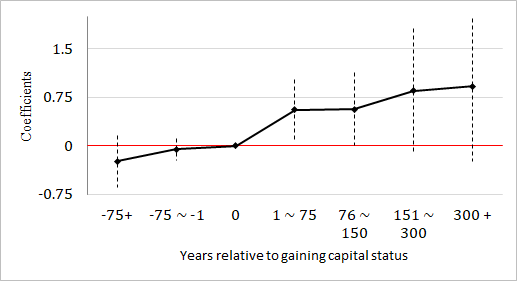
We find that gaining provincial capital status increased a prefecture’s population density by 40–50%, while losing it led to a decline of similar magnitude. Crucially, these effects did not persist once a city lost its administrative role: within 75 years, its population and urbanisation levels converged to those of non-capital peers. Political hierarchy, in short, created and destroyed local advantages with remarkable speed. Figure 1 below illustrates the main dynamic patterns.
These findings contrast with much of the economic history evidence base, which emphasises persistence in spatial development. In imperial China, the central state’s capacity to mobilise resources and redefine administrative landscapes allowed it to overcome the inertia typically observed in city growth.
Figure 1: The impact of capital status on population density
(a) Before and after gaining capital status
(b) Before and after losing capital status
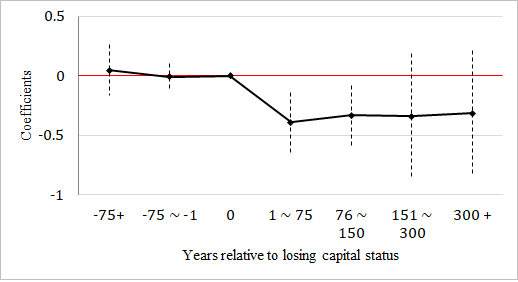
Notes: The figure shows that there are no systematic differences before and after a prefecture gains or loses capital status. The reference group is the period before capital status changes. Due to the low frequency of data, we cannot pin down the exact years it takes for the change to occur, but the patterns tell us that the rise and decline happen within 75 years after status change. A period of 75 years is roughly one-fourth of a regime’s length.
Political hierarchy and economic development
We investigate the mechanisms through which political hierarchy shaped regional development. A long-standing hypothesis, tracing back to twentieth-century sociologist Max Weber, portrays administrative centres in the East as ‘Oriental’ or ‘parasitic’ cities (Weber 1921, Bairoch 1985): places whose prosperity rested primarily on state bureaucracy rather than productive activity. According to this view, public employment moves with administrative status, driving shifts in population and economic activity.
Our findings suggest that Weber was only half right. Public employment did expand with political promotion: provincial capitals hosted larger bureaucracies and attracted service sectors catering to officials. Yet this channel alone cannot account for the magnitude of the observed economic gains.
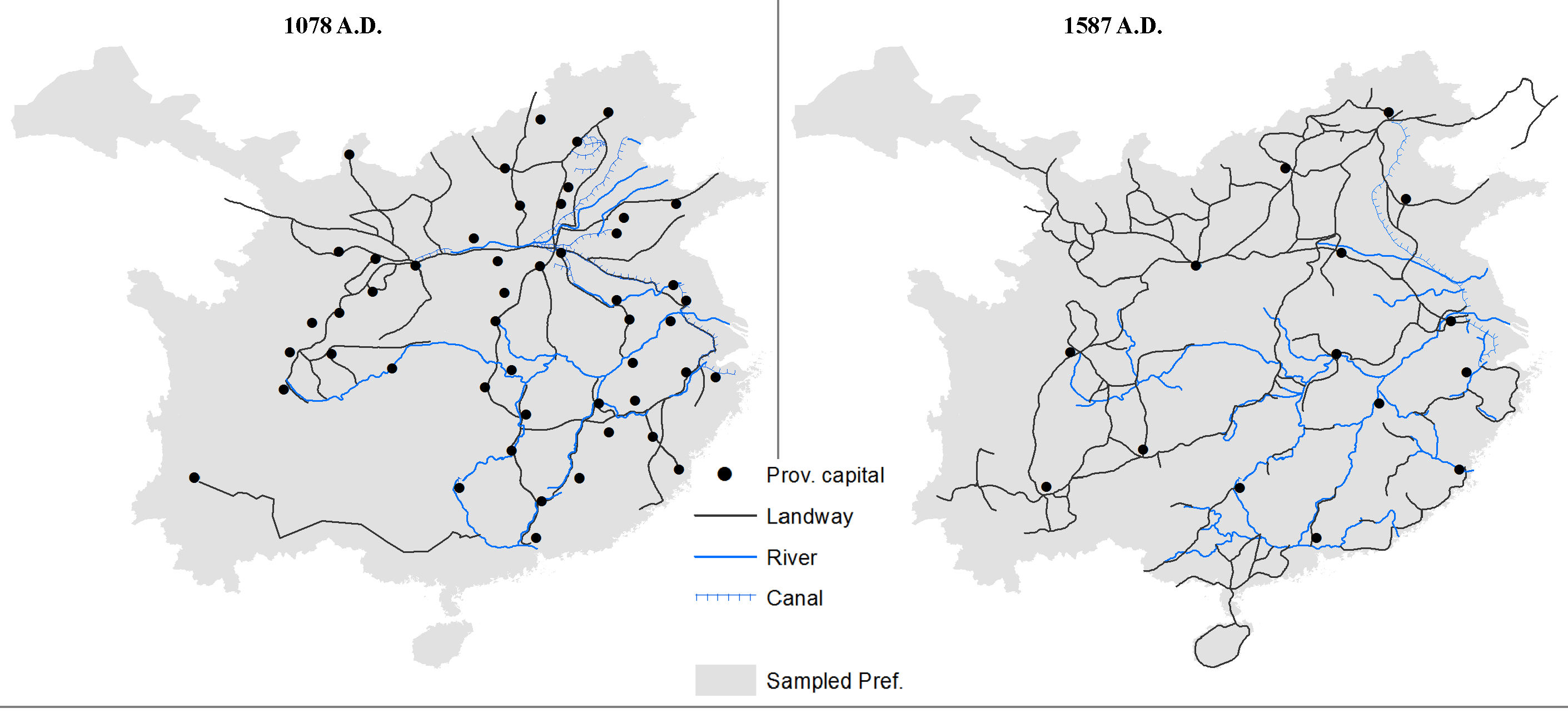
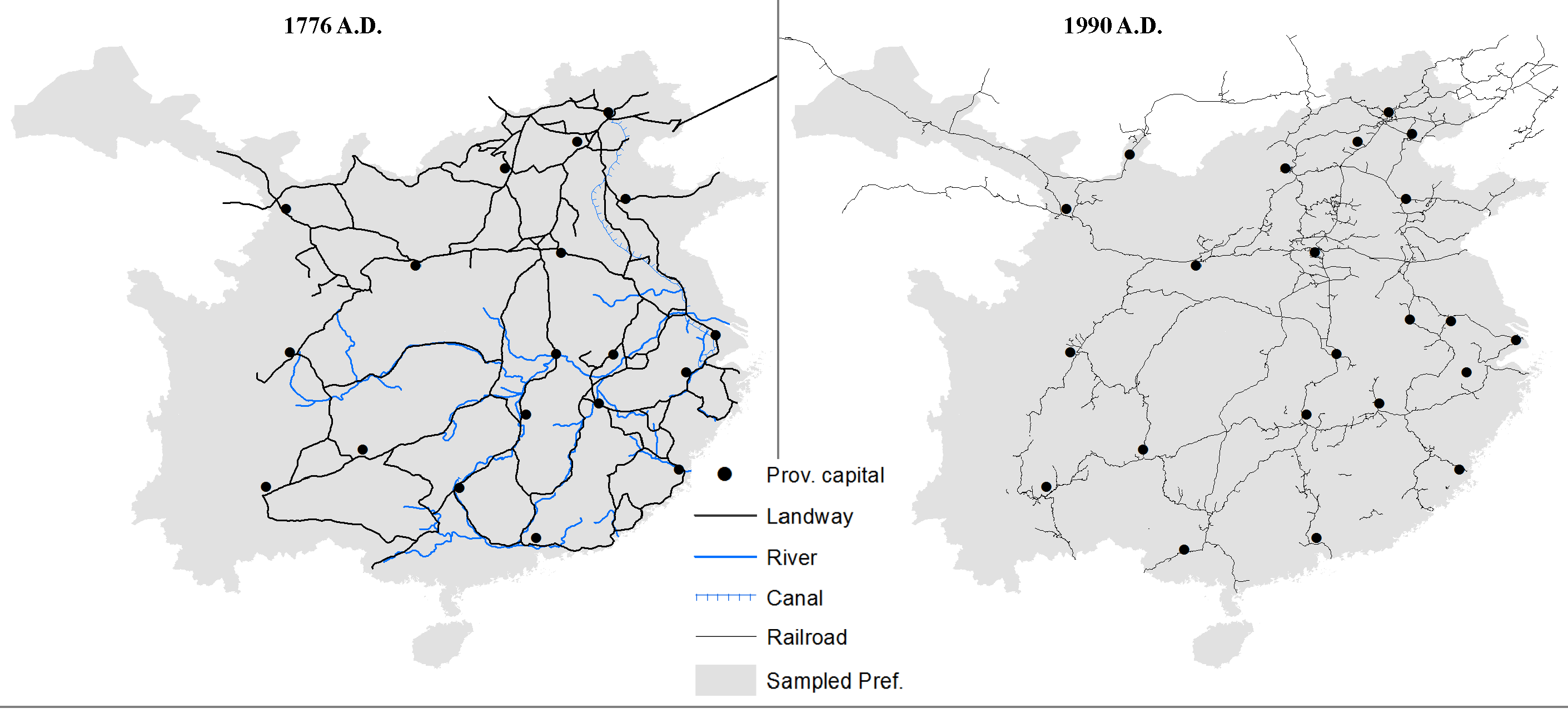
Instead, we show that changes in administrative status also altered market access, as provincial capitals were systematically connected through imperial transport networks such as the Grand Canal and, in modern times, national expressways.
We digitise historical transport maps (Figure 2) and employ the measure of market access used in recent work, pioneered by Donaldson and Hornbeck (2016). Our analysis reveals that provincial capitals consistently occupied more central positions in these networks. This market access effect magnified the economic reach of administrative centres while leaving former capitals stranded once their political relevance faded.
Figure 2: Major transportation networks across regimes
(a) Song and Ming
(b) Qing and 2000
The cost of centralisation
The relocation of infrastructure and resulting shifts in market access reflect the imprint of a highly centralised Chinese state. A simple counterfactual highlights the trade-offs of such centralisation. Had provincial capitals been located purely according to geographic centrality, rather than political logic, aggregate market access across provinces would have been 10.8% higher. In other words, the administrative geography that reinforced central control also imposed a measurable economic cost.
Policy implications for regional development
Our findings highlight the dual role of the state in shaping spatial development. A centralised government can reallocate economic activity by providing infrastructure, but such power also introduces volatility: cities rise and fall with political favour. For today’s policymakers, the lessons are twofold. Administrative promotions may boost local economies in the short run, but their benefits could fade quickly once the political tide turns. And while place-based policies can catalyse development, their design must consider both efficiency and the long-term costs of politically driven geography.
Our results also speak to the broader evidence in urban and economic geography. Earlier research emphasises the persistence of spatial patterns, driven either by locational fundamentals (Davis and Weinstein 2002) or the lasting effects of temporary advantages (Bleakley and Lin 2012). In contrast, our findings highlight how a centralised state can overcome such inertia. Whether spatial advantages endure or dissipate depends not only on geography and history, but also state capacity and incentives to build transformative infrastructure. This perspective offers a useful lens for interpreting persistence and change across diverse historical and institutional settings.
References
Ades, A F, and E L Glaeser (1995), “Trade and circuses: Explaining urban giants,” Quarterly Journal of Economics 110(1): 195–227.
Bai, Y, and R Jia (2023), “The economic consequences of political hierarchy: Evidence from regime changes in China, 1000–2000 CE,” Review of Economics and Statistics 105(3): 626–645.
Bairoch, P (1985), Cities and Economic Development: From the Dawn of History to the Present, University of Chicago Press.
Bleakley, H, and J Lin (2012), “Portage and path dependence,” Quarterly Journal of Economics 127(2): 587–644.
Campante, F, and Q-A Do (2014), “Isolated capital cities, accountability, and corruption: Evidence from US states,” American Economic Review 104(8): 2456–2481.
Davis, D, and D Weinstein (2002), “Bones, bombs, and break points: The geography of economic activity,” American Economic Review 92(5): 1269–1289.
Davis, J, and V Henderson (2003), “Evidence on the political economy of the urbanization process,” Journal of Urban Economics 53(1): 98–125.
De Long, J B, and A Shleifer (1993), “Princes and merchants: European city growth before the Industrial Revolution,” Journal of Law and Economics 36(2): 671–702.
Donaldson, D, and R Hornbeck (2016), “Railroads and American economic growth: A ‘market access’ approach,” Quarterly Journal of Economics 131(2): 799–858.
Glaeser, E, and D Puga (2024), “The role of cities in economic development,” VoxDevTalks.
Weber, M (1921), The City, reprint, New York: Free Press.