




In India, conflict boosts electoral support for incumbents only when leaders and media make it politically salient, turning soldier deaths into narratives of national strength.
Editor’s note: For a broader synthesis of themes covered in this article, check out our VoxDevLit on Political Polarisation. The authors have made slides available to accompany this research here.
The world is currently witnessing multiple ongoing conflicts – from Ukraine and Gaza to Sudan and the Sahel – each reshaping politics and societies in profound ways. The political narratives surrounding them are not merely reflections of events on the ground but can shape public opinion, electoral outcomes, and ultimately the incentives of governments to continue, escalate, or end their engagement in conflict (Cruz et al. 2025). Over time, such narratives can also affect economic development, as politically sustained conflicts often leave enduring social and institutional scars on affected regions (Rohner and Vanden Eynde 2025).
Existing evidence (largely from the US) shows that rising military casualties tend to reduce public support for both the conflict and the incumbent government. Analyses of the Korean and Vietnam wars (Mueller 1973, Jennings 1974), World War II and Gulf War (Larson 1996), Iraq War (Gartner 2008), and the war in Afghanistan (Fetzer et al. 2024) each document this negative relationship, suggesting that visible human costs erode confidence in leadership. Even in countries where conflicts occur domestically – such as Turkey – voters have been found to punish governments for soldier deaths on home soil (Kibris 2011).
Yet despite this consistent pattern, social scientists have theorised that under certain conditions – especially when leaders successfully frame conflict as a matter of national unity and strength – voters may instead rally behind them, producing the so-called ‘rally around the flag’ effect (Edwards and Swenson 1997). However, there isn’t much causal evidence to prove this hypothesis. Our research (Arya and Bhatiya 2025) provides the first causal evidence of this phenomenon in a large democracy. We show that in India exposure to conflict can indeed generate electoral gains for the incumbent – but only when these events are made politically salient.
Measuring conflict exposure: Soldiers’ home constituencies
India offers a rich context to examine how voters respond to conflict. For decades, the country has grappled with multiple insurgencies that differ in geography, intensity, and political framing. The secessionist movements in Jammu and Kashmir and across the Northeast, along with the left-wing extremist insurgency spanning central and eastern India, together create a complex map of unrest. These conflicts are highly visible nationally but unevenly experienced locally.
To study the electoral impact of conflict exposure, we identify parliamentary constituencies that lost at least one soldier in these conflicts between the 2014 and 2019 national elections. Because soldiers are recruited across India and deployed to conflict zones independently of their home constituencies (Jha and Wilkinson 2012, Vanden Eynde 2016), soldier deaths provide an exogenous source of local exposure to conflict. Figure 1 illustrates this spatial distribution, highlighting the home constituencies of soldiers who died between 2014 and 2019 across different conflict regions.
Figure 1: Deaths by conflict
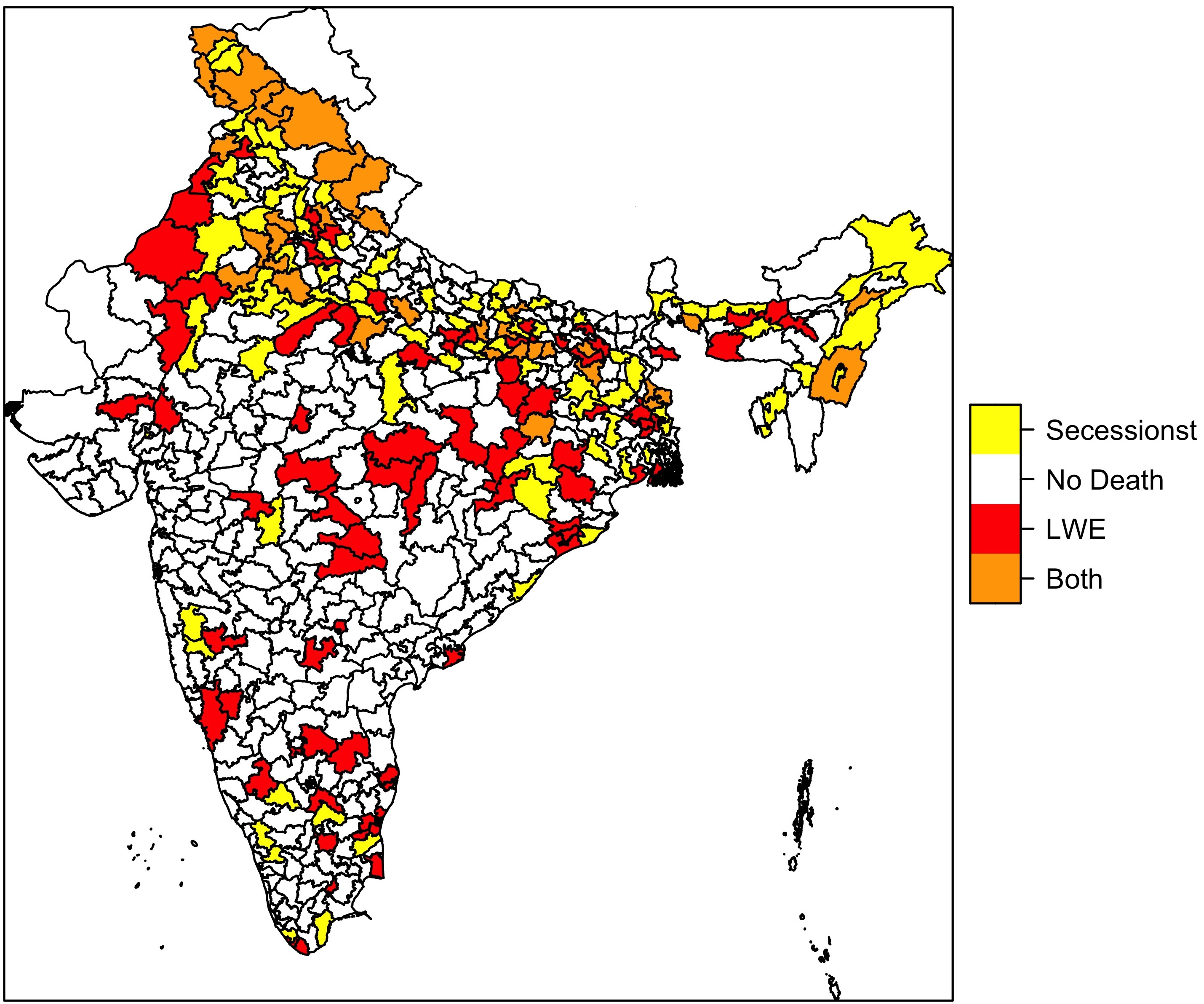
We compare voting behaviour in these constituencies (our treatment group) to others with no such fatalities (control group), using a difference-in-differences framework with constituency fixed effects. This allows us to isolate the causal effect of soldier deaths on incumbent vote share, while accounting for long-standing differences in recruitment patterns or local political preferences.
A clear ‘rally around the flag’ effect: When conflict is salient
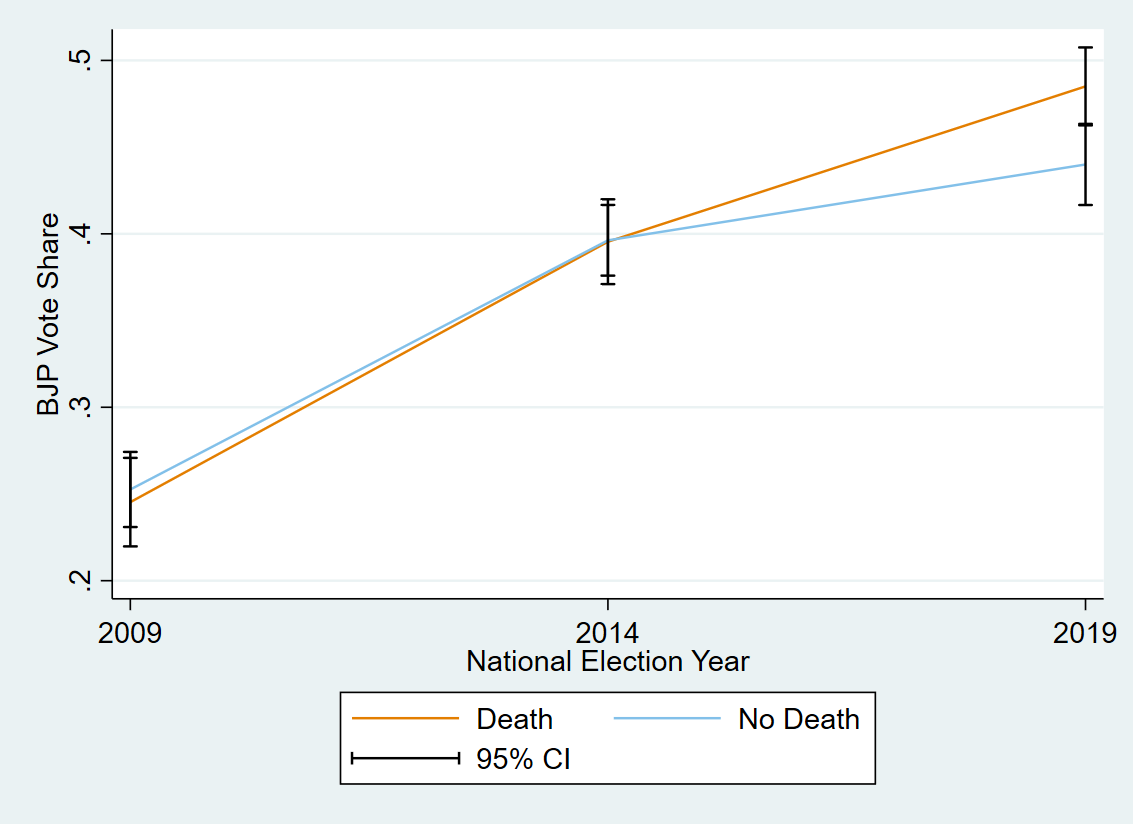
Our findings reveal a significant rally around the flag effect. In constituencies where at least one soldier died, the incumbent Bharatiya Janata Party’s (BJP) vote share in the 2019 national election increased by 4.2 percentage points – an 11% rise relative to the baseline mean. However, not all conflicts produce this effect. When we distinguish between the secessionist and left-wing extremist conflicts, only the former – those in Kashmir and the Northeast – generate electoral gains for the BJP. Constituencies that lost soldiers in secessionist conflicts saw a 5.2-percentage-point increase in BJP vote share, while deaths in left-wing extremist regions had no discernible impact (Figure 2).
Figure 2: Impact of soldier deaths on voting
Two conflicts, two narratives
Why did secessionist conflicts translate into votes while left-wing extremist conflicts did not? The answer lies in the interaction between political messaging and media coverage. During the run-up to the 2019 election, Prime Minister Narendra Modi’s campaign strongly emphasised national security. Following high-profile attacks on Indian soldiers – such as the 2016 Uri and 2019 Pulwama incidents – Modi repeatedly portrayed his government’s military responses (notably the ‘surgical strikes’ and ‘Balakot airstrikes’) as evidence of decisive leadership. By analysing hundreds of Modi’s speeches between 2014 and 2019, we find that the probability of militaristic rhetoric increases by 36% in the immediate aftermath of a soldier’s death in a secessionist conflict, but not after deaths in left-wing extremist regions.
Figure 3: Media coverage of soldier deaths
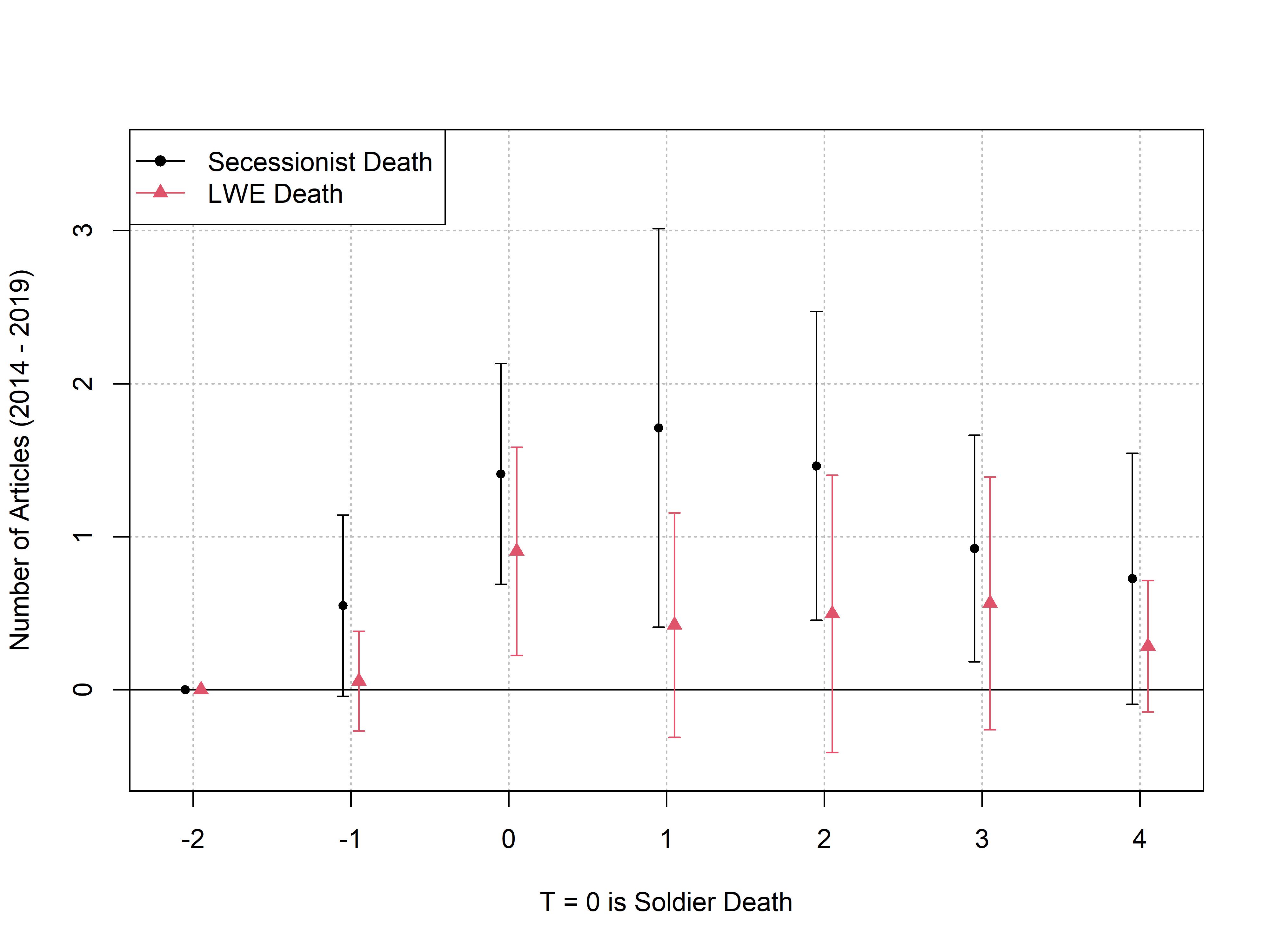
The media followed suit. Using data from the Global Database of Events, Language, and Tone (GDELT), we measure how much attention conflict events received across thousands of online and print outlets. We find that after a soldier’s death in a secessionist conflict, national and regional news coverage jumped by 56% and remained elevated for several days (Figure 3). By contrast, coverage of left-wing extremist deaths spiked only briefly, then disappeared within a day.
Voters respond to what leaders highlight
Using post-poll survey data, we find that voters in the home constituencies of soldiers who died in secessionist conflicts were significantly more likely to identify national security and secessionist issues as top electoral concerns. Interestingly, respondents were not more aware of Modi’s hawkish stance on soldier deaths per se. Rather, they were more likely to credit Prime Minister Modi for his government’s strong response. The effect was particularly strong among households with greater media access, such as through television.
Moreover, soldier deaths that occurred closer to the election date produced larger increases in the BJP vote share, suggesting that the salience of these events decays over time – echoing findings from research on event memory and rational inattention (Tversky and Kahneman 1973, Bordalo et al. 2012).
Political salience, not conflict alone, drives electoral impact
Further underscoring the role of narrative, we can look to the 2014 election. During this election, secessionist soldier deaths received little political or media attention, and there was no effect on any party’s vote share. However, the Congress-led government under Prime Minister Manmohan Singh had focused significant attention on combating left-wing extremism. Consistent with our framework, constituencies exposed to these soldier deaths showed higher support for the incumbent Congress party. This comparative evidence underscores that conflict exposure only translates into electoral gains when it becomes part of the dominant political narrative. Without political or media emphasis, even direct exposure to casualties remains electorally neutral.
Policy implications: The risks of politicising conflict
Our findings have implications for how democracies process information about conflict. On one hand, highlighting fatalities can strengthen collective identity and support for the state. On the other, it can blur accountability if voters reward leaders for conflicts that they themselves helped escalate. In an era of fragmented media and social networks, the ability of political leaders to set the agenda is both powerful and consequential. When governments dominate or steer narratives around conflict, they can blur the line between national unity and political strategy. Ultimately, the challenge for democracies lies in preserving accountability and preventing the politicisation of national security.
References
Arya, Y, and A Y Bhatiya (2025), “When do voters ‘rally around the flag’? The salience of political messages,” Journal of Public Economics, 245: 105356.
Bordalo, P, N Gennaioli, and A Shleifer (2012), “Salience theory of choice under risk,” Quarterly Journal of Economics, 127: 1243–1285.
Cruz, C, H Larreguy, and E Tiburcio (2025), “Political polarisation,” VoxDevLit, 19(1).
Edwards III, G C, and T Swenson (1997), “Who rallies? The anatomy of a rally event,” Journal of Politics, 59: 200–212.
Fetzer, T, P C Souza, O Vanden Eynde, and A L Wright (2024), “Losing on the home front? Battlefield casualties, media, and public support for foreign interventions,” American Journal of Political Science.
Gartner, S S (2008), “The multiple effects of casualties on public support for war: An experimental approach,” American Political Science Review, 102: 95–106.
Jennings, M K (1974), "Review: War, presidents and public opinion," Journal of Politics, 36(3): 813–815.
Jha, S, and S Wilkinson (2012), “Does combat experience foster organizational skill? Evidence from ethnic cleansing during the partition of South Asia,” American Political Science Review, 106: 883–907.
Kibris, A (2011), “Funerals and elections: The effects of terrorism on voting behavior in Turkey,” Journal of Conflict Resolution, 55: 220–247.
Larson, E V (1996), Casualties and consensus: The historical role of casualties in domestic support for US military operations, RAND Corporation.
Mueller, J E (1973), War, Presidents, and Public Opinion, John Wiley & Sons.
Rohner, D, O Vanden Eynde, and E Verhille (2025), “Variants of violence: Classifying conflict types and policies for peace,” Economic Policy, eiaf009.
Tversky, A, and D Kahneman (1973), “Availability: A heuristic for judging frequency and probability,” Cognitive Psychology, 5: 207–232.
Vanden Eynde, O (2016), “Military service and human capital accumulation: Evidence from colonial Punjab,” Journal of Human Resources, 51: 1003–1035.