



We need to reduce deforestation, protect standing forests, and incentivise reforestation at scale. The climate depends on it. Here is a proposal that can achieve all three.
Global greenhouse gas emissions have continued to rise since the Paris Agreement, while policy implementation remains far behind what is needed to limit warming to 1.5°C or even 2°C. Because we are not reducing emissions fast enough, carbon removals have become critically important – not in the future, but now.
In parallel, in the Global Stocktake at COP28, countries called for global efforts to “halt and reverse deforestation and forest degradation by 2030” (UNFCCC 2023). This marks a shift in the global conversation to place tropical forests at the heart of climate action.
Forests can help solve climate change
Strengthening the link between forests and climate creates a dual opportunity. Forests can deliver meaningful carbon removals, while climate finance can support ecosystem restoration and sustainable development for tropical countries. This is especially crucial in a time when tropical forests are at risk of ecological tipping points and losing their integrity.
Tropical forests offer one of the most scalable and immediate carbon removal options available. Assunção et al. (2025a) shows that restoring degraded areas in the Brazilian Amazon could remove billions of tonnes of CO₂ while enhancing biodiversity, water cycles, and local economies. Expanding this work, CPI/PUC-Rio proposes a new mechanism – the Reverse Deforestation Mechanism (RDM) – as a core part of a fit-for-purpose financial architecture that also includes jurisdictional REDD+ (Reducing Emissions from Deforestation and forest Degradation, a UN’s climate mitigation framework) and the Tropical Forest Forever Facility (TFFF) (Assunção et al. 2025b).
The scale of the forest agenda
Tropical forests store vast amounts of carbon, support over half of all terrestrial biodiversity, and regulate regional rainfall. When intact, they act as major carbon sinks; when cleared, they become net emitters. Through evapotranspiration, they also sustain hydropower and agriculture far beyond their borders. They are living climate infrastructure.
Figure 1 illustrates the scale of the forest agenda. Spread across 91 countries and 1.27 billion hectares, tropical forests hold an estimated 593 gigatons of CO₂, around one-third of all historical human emissions. But we are still losing over 10 million hectares each year, undermining one of the planet’s most powerful natural carbon regulators. There is also enormous potential for restoration. Forests cleared since 2001 could reabsorb up to 49 gigatons of CO₂ through natural regrowth and reforestation.
The relative importance of forest protection, deforestation, and the potential for forest restoration, varies widely across countries. Some countries still retain large tracts of intact forests, while others face active deforestation frontiers. At the same time, historical patterns of land use determine the scale and feasibility of restoration, particularly through natural regeneration. Effective forest management therefore requires not just scale, but flexibility to accommodate the distinct ecological and institutional contexts of each of the 91 countries that hold tropical forests.
Figure 1: The scale of the forest agenda

Source: Assunção et al. (2025a).
Success is possible
Many tropical countries have shown that progress is possible. Brazil cut deforestation sharply in the 2000s using enforcement, satellite monitoring, and credit restrictions. Indonesia has also made important progress. Others have piloted community forest management and reforestation programmes.
But these gains are often unstable, vulnerable to political changes and budget cuts. A key barrier is that current forest policies rely too heavily on short-term political cycles (Costa et al. 2025). We need a financial architecture that provides long-term incentives for forest, aligning forest outcomes with national development goals.
A missing piece: Large-scale forest restoration finance
Most forest finance today is geared toward avoiding deforestation. Jurisdictional REDD+, the most established mechanism, provides payments for verified reductions in forest loss. The newly proposed Tropical Forest Forever Facility (TFFF) goes a step further, offering fixed payments per hectare of standing forest, with deductions for deforestation. But there is still a missing piece: a mechanism focused on restoration, which would bring cleared land back into the carbon cycle. Closing this gap is essential to meet the COP28 Global Stocktake call to halt and reverse deforestation by 2030.
The Reverse Deforestation Mechanism (RDM)
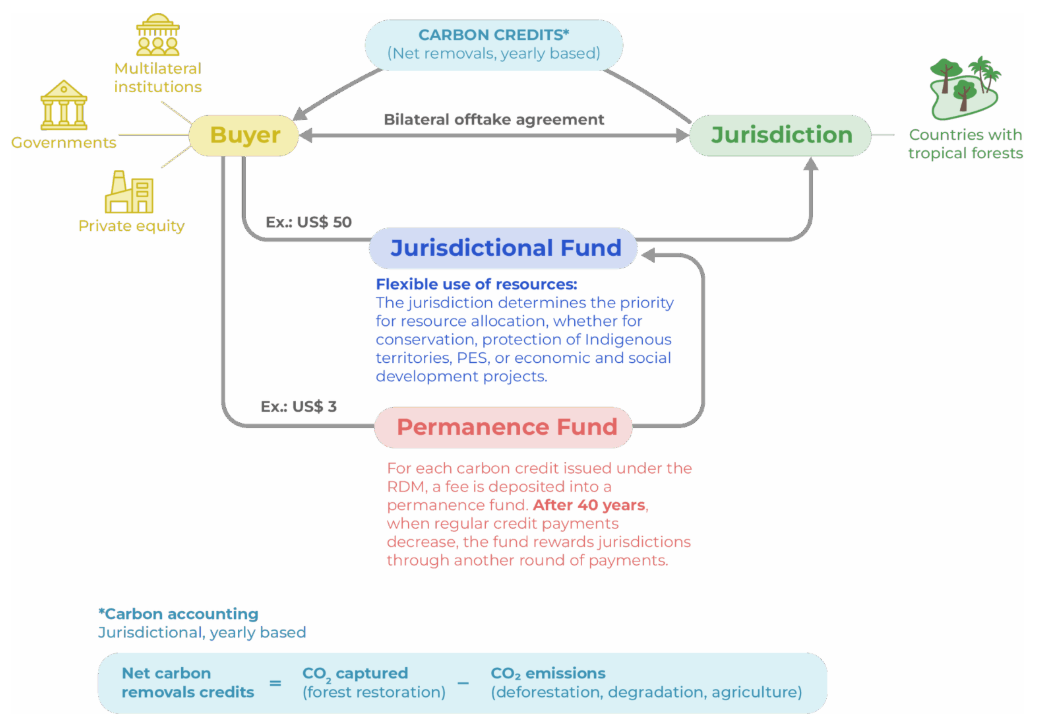
The Reverse Deforestation Mechanism (RDM), developed by CPI/PUC-Rio, is designed to fill the critical gap in forest finance for restoration. It is a results-based payment scheme that rewards tropical countries and subnational jurisdictions for their net carbon removals through forest restoration, drawing on the framework proposed in Assunção et al. (2025a). Figure 2 illustrates the basis structure of the RDM.
Under the RDM, those looking to offset their carbon footprint can buy high-integrity forest restoration carbon credits from tropical countries. The mechanism works through bilateral agreements between buyers – such as governments, corporations, or multilateral institutions – and jurisdictions with tropical forests. Buyers pay for verified carbon removals, while jurisdictions commit to restoring forests to generate those removals.
A key feature of the RDM is that it issues credits based on the net carbon impact: the amount of CO₂ removed through restoration minus emissions from deforestation, degradation, or agriculture. This ensures that only real climate benefits are credited. Since the net impact is comparable to other recognised forms of mitigation, the credits can be priced in line with those in compliance carbon markets, helping attract large-scale finance.
Figure 2: The Reversing Deforestation Mechanism
Source: Assunção et al. (2025a).
Once verified, payments are transferred to a flexible Jurisdictional Fund. These funds give local governments flexibility to allocate resources not only toward restoration and monitoring, but also toward broader development needs. This approach reduces transaction costs and simplifies implementation.
Ensuring permanence is a core challenge in any carbon removal initiative. In the case of tropical forests, as restored forests mature and sequestration slows, credit flows decline – raising deforestation risks, especially after 40 years. Fires and illegal logging add further threats. A Permanence Fund, funded by a small share of payments (e.g. US$3 per tonne), could sustain incentives beyond the crediting period. Simulations suggest this approach can effectively safeguard restored areas.
For jurisdictions committing to long-term restoration, credible, sustained demand for carbon credits is also essential. Anchoring the RDM in international carbon markets provides the scale and certainty needed to unlock lasting climate and development benefits.
The numbers are compelling
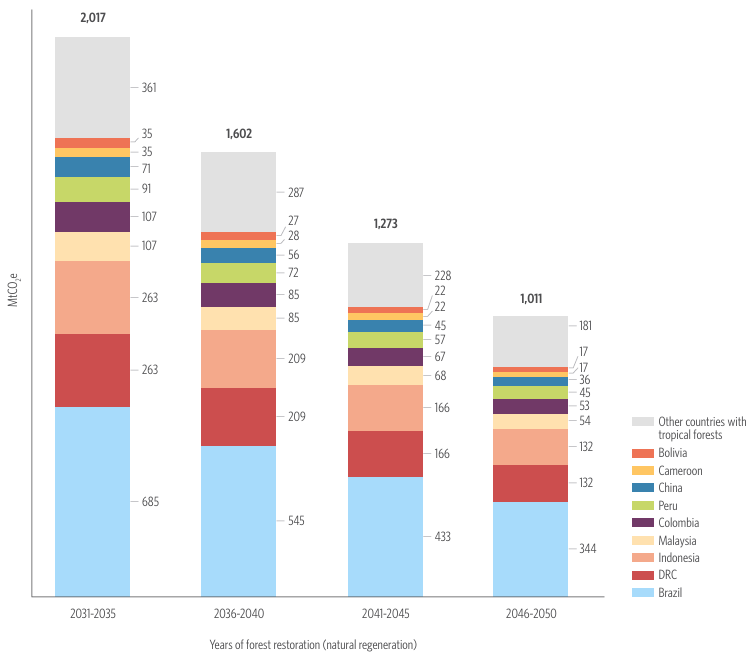
Simulations by CPI/PUC-Rio show that restoring all tropical forest land deforested since 2001 could remove up to 2 GtCO₂ per year in the first five years. At US$50 per tonne of CO₂, a price well below most compliance markets, this could generate up to US$100 billion per year in payments to tropical countries.
Figure 3: Simulating the Reversing Deforestation Mechanism from 2030 onwards (yearly carbon removals in areas deforested between 2001–2023)
Source: Assunção et al. (2025a).
A roadmap to halt and reverse deforestation
The Reverse Deforestation Mechanism (RDM) offers a powerful dual benefit: it supports global climate goals while helping protect and restore tropical forests. But for its potential to be realised, it must be part of a broader shift towards more ambitious climate action. Without large-scale demand from countries and corporations for both emissions reductions and carbon removals, mechanisms like the RDM will remain underused – despite their high impact and cost-effectiveness.
At the close of COP30, the presidency called for a roadmap to halt and reverse deforestation. The key components of this roadmap are already in place: REDD+ offers results-based finance for reducing deforestation, the Tropical Forest Forever Facility (TFFF) proposes payments for protecting standing forests, and the Reverse Deforestation Mechanism (RDM) introduces incentives for large-scale restoration. Together, these instruments can form a fit-for-purpose forest finance framework. Whether the world succeeds in stabilising the climate may depend on how quickly we are able to build and deploy this framework.
References
Assunção, J, J P Arbache, J Chiavari, G de Miranda, and G Zangiski (2025a), “The forest–climate nexus: A fit-for-purpose framework for climate impact,” Climate Policy Initiative.
Assunção, J, L P Hansen, T Munson, and J A Scheinkman (2025b), “Carbon prices and forest preservation over space and time in the Brazilian Amazon,” Becker Friedman Institute.
Costa, F, A Hsiao, H Pellegrina, and E Souza-Rodrigues (2025), “Deforestation,” VoxDevLit, 18(1).