



Pairing an aspirations workshop with a cash transfer helped Kenyan women gain control of household resources and reduced intimate partner violence.
Women across developing countries have poor outcomes: they report limited control of economic resources and experience high rates of intimate partner violence (World Economic Forum 2018, WHO 2021). Household incomes rising through cash transfer programmes, new jobs, or structural transformation can shift intra-household dynamics and bargaining power. Yet evidence shows that economic growth or windfall resources alone do not reliably improve women’s empowerment. In some settings, the increase in resources improves women’s empowerment outcomes (Jensen 2012, Heath 2014), but in others, it does not (Roy et al. 2015, Banerjee et al. 2015, Baranov et al. 2021) and can even provoke backlash (Erten and Keskin 2024). This raises a central policy question: how can women translate new household resources into gains in agency?
In Kenya, we studied this question experimentally by pairing an unconditional cash transfer with an aspirations workshop designed to expose women to successful female role models (Mahmud, Riley, and Orkin 2025). Our results suggest a simple but powerful insight: economic opportunity matters, but timing psychological empowerment with it is key for improving women’s outcomes.
Why role models might shift household dynamics
A large evidence base argues that people form beliefs about what is possible by observing the lives of others (Bandura 1977, La Ferrara 2019). Soap operas featuring empowered women have improved girls’ education and reduced fertility across multiple countries (Chong and Ferrara 2009, La Ferrara et al. 2012, Jensen and Oster 2009, La Ferrara 2016). But these media shifts tend to occur during broader social changes, making it hard to isolate their effects.
We explore whether a short, theoretically targeted exposure to role models can be a pathway for women to envision a different future and take steps to achieve it. And crucially, we test whether this exposure is more effective at the moment the household receives a resource windfall.
Our study setting is in Siaya county in Kenya, where, like many other sub-Saharan African settings, women’s labour participation rates are high, but they report limited joint decision making with their partners and very high rates of intimate partner violence and acceptability of violence. Our sample comprises 3,000 women belonging to poor households, as determined by our partner NGO’s eligibility criteria. All women were monogamously married at baseline and were under the age of 60. The randomised controlled trial was based on village-level randomisation with four groups across 176 villages:
- Cash only: A large unconditional transfer (US$2,237 PPP) delivered via mobile money and a placebo workshop.
- Aspirations workshop only: A brief aspirations workshop lasting on average 80 minutes, including videos of individuals modelling supportive spousal relationships, followed by goal-setting exercises in small groups.
- Combined: Both the cash and the aspirations workshop.
- Placebo workshop: A neutral video followed by placebo exercises. The placebo workshop was the same length and involved the same group interaction as the aspirations workshop.
Workshops were delivered soon after households in the cash arms learned they would receive the transfer, meaning women entered the workshop knowing that resources were on the way. All married women were later interviewed privately using high-quality methods for measuring intimate partner violence.
Aspirations rise in all arms while bargaining changes only with the combined intervention
While the workshop was successful at raising aspirations for household income and assets and children’s education, aspirations rose similarly in the cash arm (Figure 1, Panel A). However, only the combined arm translated these aspirations into meaningful changes in household dynamics (Figure 1, Panel B). Women who received both interventions experienced a marginal improvement in bargaining, driven by making more decisions jointly with their spouse. These behavioural shifts are consistent with the idea that the cash created a ‘bargaining moment’, and the workshop increased women’s willingness to bargain. We did not observe changes in other psychological mechanisms, such as self-beliefs, and in underlying gender attitudes or norms, either their own or their perception of village attitudes.
Figure 1: Impact on mechanisms
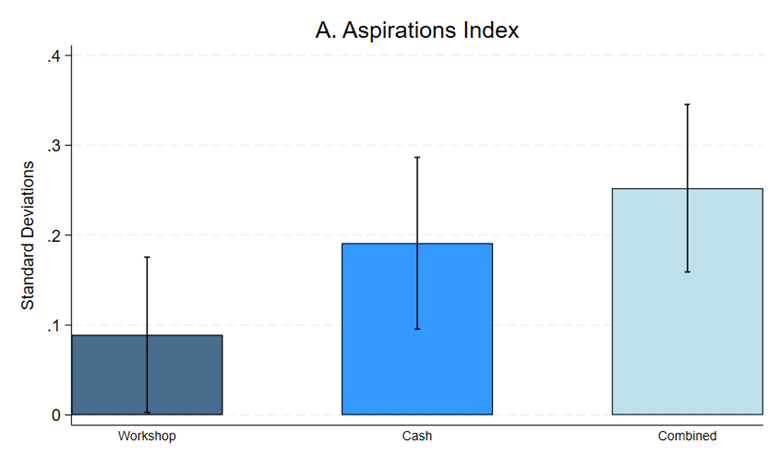
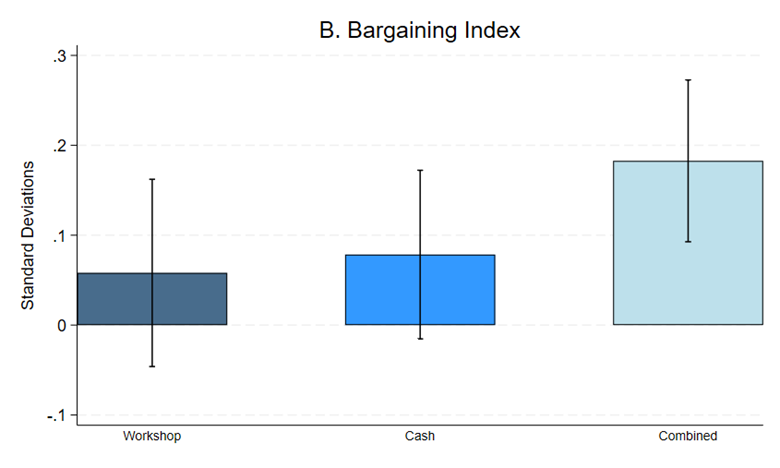
Notes: The aspirations index is a standardised index of aspirations for household income and wealth in ten years and for years of education of a randomly selected child. The bargaining index is constructed as a standardised index of negotiation and joint decision making.
Women in the combined arm gained more control of household assets and experienced reductions in intimate partner violence
The cash transfer increased the value of household assets in both the cash only and combined arms (Orkin et al. 2025). But only in the combined arm did women gain greater ownership and control over these new assets (Figure 2, Panel A). These changes did not appear for either intervention alone. Cash created the opportunity, and the workshop helped women seize it.
In our setting, cash alone had no average effect on IPV (Figure 2, Panel B). However, the combined intervention reduced the frequency of physical and sexual IPV compared to both the workshop alone and the cash alone. Among women identified ex-ante as high-risk, violence rose in the cash group, a rise that was mitigated when cash was combined with the workshop. The workshop appears to have helped women navigate discussions around the windfall income, reducing misunderstandings and lowering the risk of backlash, especially for vulnerable subgroups.
Figure 2: Impact on control of assets and intimate partner violence
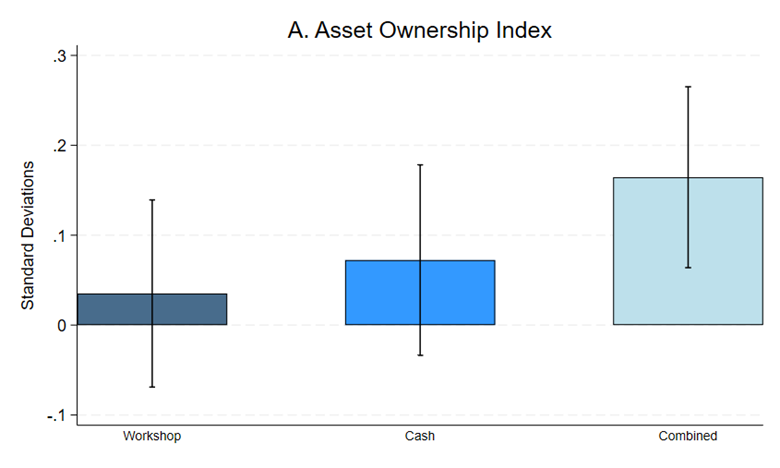
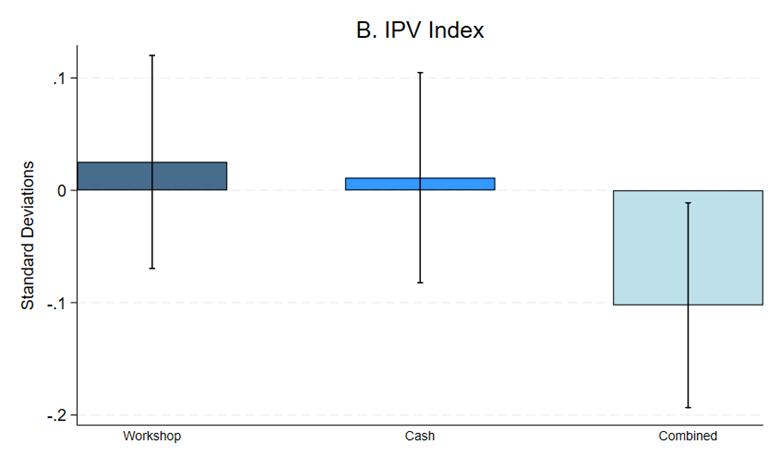
Notes: The Asset Ownership Index is a standardised index of the share of assets owned (proportion of household assets that are owned solely by the woman, or jointly by the woman and family members) and asset ownership (an indicator based on the WEAI measure for any two small or one large asset owned fully or jointly by the woman). The IPV index is a standardised index of the frequency of physical and sexual IPV.
Why timing matters
The workshop alone did little for women’s empowerment, so psychological interventions may not be enough on their own. Instead, effects emerged only in the presence of new resources. Under a bargaining model, a woman’s outside option rises when she controls resources, but her bargaining power can also rise if she is more willing or able to bargain.
New resources create a rare moment to bargain. Short, low-cost psychological support is most powerful when delivered at these pivotal moments. This idea may generalise to other periods of transition: new jobs, land titling reforms, industrialisation, or social protection expansions. Our findings suggest that complementing economic change with exposure to female role models may tilt the balance towards empowerment. When women imagine better futures and have the means to pursue them, support at the right moment can transform their position in the household.
Policy implications for women’s empowerment
- Cash transfers alone are not a guaranteed path to women’s empowerment: They raise aspirations and living standards but may not give women more control of resources or say in decisions, and can even increase violence for some.
- Short, targeted psychological interventions can be powerful when well-timed: Such interventions do not need to be intensive or long-running. A single 80-minute session shifted bargaining dynamics when aligned with a cash infusion.
Our findings complement a growing evidence base experimenting with intensive approaches with multi-week sessions to empower women (Ashraf et al. 2020, Kala and McKelway 2025, Nyqvist et al. 2024). A promising direction is exploring whether such psychologically informed interventions can be scaled through mass media or digital platforms, when aligned with other anti-poverty programmes.
References
Ashraf, N, N Bau, C Low, and K McGinn (2020), “Negotiating a better future: How interpersonal skills facilitate intergenerational investment,” Quarterly Journal of Economics, 135: 1095–1151.
Bandura, A (1977), “Self-efficacy: Toward a unifying theory of behavioural change,” Psychological Review, 84: 191.
Banerjee, A, E Duflo, N Goldberg, D Karlan, R Osei, W Pariente, J Shapiro, B Thuysbaert, and C Udry (2015), “A multifaceted program causes lasting progress for the very poor: Evidence from six countries,” Science, 348: 772.
Baranov, V, L Cameron, D Contreras Suarez, and C Thibout (2021), “Theoretical underpinnings and meta-analysis of the effects of cash transfers on intimate partner violence in low- and middle-income countries,” Journal of Development Studies, 57: 1–25.
Chong, A, and E La Ferrara (2009), “Television and divorce: Evidence from Brazilian novelas,” Journal of the European Economic Association, 7: 458–468.
Erten, B, and P Keskin (2024), “Trade-offs? The impact of WTO accession on intimate partner violence in Cambodia,” Review of Economics and Statistics, 106: 322–333.
Heath, R (2014), “Women’s access to labor market opportunities, control of household resources, and domestic violence: Evidence from Bangladesh,” World Development, 64: 512–528.
Jensen, R (2012), “Do labour market opportunities affect young women’s work and family decisions? Experimental evidence from India,” Quarterly Journal of Economics, 127: 753–792.
Jensen, R, and E Oster (2009), “The power of TV: Cable television and women’s status in India,” Quarterly Journal of Economics, 124: 1057–1094.
Kala, N, and M McKelway (2025), “The power of persuasion: Causal effects of household communication on women’s employment,” Unpublished manuscript.
La Ferrara, E, A Chong, and S Duryea (2012), “Soap operas and fertility: Evidence from Brazil,” American Economic Journal: Applied Economics, 4: 1–31.
La Ferrara, E (2016), “Mass media and social change: Can we use television to fight poverty?” Journal of the European Economic Association, 14: 791–827.
La Ferrara, E (2019), “Presidential address: Aspirations, social norms, and development,” Journal of the European Economic Association, 17: 1687–1722.
Mahmud, M, K Orkin, and E Riley (2025), “Empowering women at a pivotal moment: Evidence from a cash transfer and aspirations workshop in Kenya,” Unpublished manuscript.
Nyqvist, M B, S Jayachandran, and C Zipfel (2024), “A mother’s voice: Impacts of spousal communication training on child health investments,” Journal of Development Economics, 168: 103263.
Orkin, K, R Garlick, M Mahmud, R Sedlmayr, J Haushofer, and S Dercon (2025), “Aspiring to a better future: Can a simple psychological intervention reduce poverty?” Review of Economic Studies, forthcoming.
Roy, S, J Ara, N Das, and A R Quisumbing (2015), “Flypaper effects in transfers targeted to women: Evidence from BRAC’s ‘targeting the ultra poor’ program in Bangladesh,” Journal of Development Economics, 117: 1–19.
World Economic Forum (2018), The global gender gap report, World Economic Forum, Switzerland.
World Health Organization (WHO) (2021), Violence against women prevalence estimates, 2018, World Health Organization.