



In rural India, roads and electricity complement each other, with their joint provision delivering far greater gains in dry-season agricultural productivity, assets, and consumption than either investment alone.
Editor’s note: For a broader synthesis of themes covered in this article, check out our VoxDevLits on Land Transport Infrastructure and Electricity Infrastructure.
Rural infrastructure plays a crucial role in the development strategies of many low- and middle-income countries. Governments frequently implement large-scale infrastructure initiatives together, assuming that these projects will reinforce each other (Sanchez et al. 2007, Moneke 2020). However, concentrating such investments in specific areas can deepen spatial inequalities (Kanbur and Venables 2005). Assessing the extent of these synergies is essential but remains challenging due to the non-random placement of infrastructure, which complicates the identification of combined effects. In particular, the overlap between different programmes often makes it difficult to isolate both individual and joint impacts. In recent research, we attempt to overcome these challenges to assess the importance of complementarities in infrastructure (Vanden Eynde and Wren-Lewis 2025).
Roads and electricity in rural India
We examine the complementary effects of infrastructure programmes in rural India, focusing on two major initiatives rolled out independently between 2005 and 2014: the Pradhan Mantri Gram Sadak Yojana (PMGSY) for road construction and the Rajiv Gandhi Grameen Vidyutikaran Yojana (RGGVY) for electrification. Both were part of India’s ‘Bharat Nirman’ rural infrastructure campaign. Because these programmes were managed separately but covered a large share of India’s 600,000 rural villages, they offer a unique opportunity to analyse potential synergies and provide credible estimates of their separate and combined effects.
Infrastructure development can influence the rural economy in multiple ways, such as reducing the cost of adopting new technologies, enhancing labour mobility, and improving access to input and output markets. To estimate the complementary impacts of infrastructure provision, we study key characteristics of the rural economy that can be measured at the level of project implementation (i.e. the village), using a variety of data sources. These include measures of consumption and assets, employment, crop choice, and agricultural production.
Joint infrastructure provision boosts dry-season cropping
Our first empirical finding focuses on dry-season cropping – a critical and frequently observed indicator of agricultural development in India. Using an event-study design that leverages the staggered implementation of the programmes, we find that villages with both electricity and road access experience a greater increase in dry-season cropping than those with only one type of infrastructure. This suggests that roads and electricity are complementary in fostering rural development.
Figure 1: The impact of road access and electrification on dry-season cropping
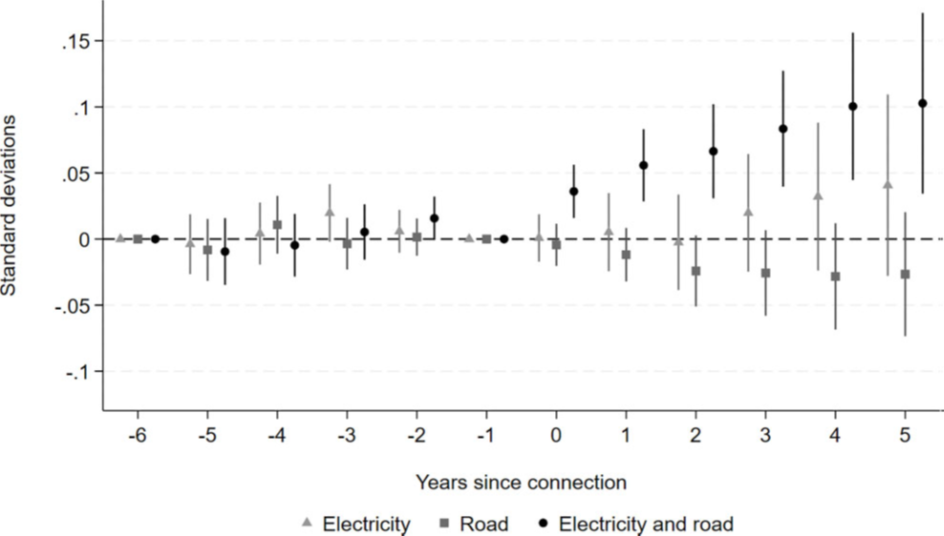
Notes: This figure displays event-study coefficients. The joint coefficient on ‘Electricity and road’ should be interpreted as the additional impact of having both programmes above the estimated individual impacts of each programme. The outcome is the (standardised) inverse-covariance weighted index of dry-season cropping measures, which is constructed as described in the text. Details of the infrastructure programmes are provided in the main text. The sample includes villages that were covered by the road and electrification programmes. The treatment time is the completion date of a specific infrastructure programme. The graphs plot time-to-treatment coefficients and their 95% confidence intervals. The model includes village fixed effects and state-by-year fixed effects. Standard errors are clustered at the subdistrict level.
The observed complementarity between roads and electricity aligns with the idea that both are necessary to make dry-season cropping profitable. Electrification alone may not provide sufficient market access for cash crops, while roads alone may not enable improved water management. Consistent with this mechanism, we observe no such complementarity during the main agricultural season (Kharif), when irrigation is less critical.
Joint infrastructure provision boosts rural welfare
A second analysis uses data from India’s 2011 Census and Socio-Economic Caste Census to explore broader economic impacts. By comparing villages that received infrastructure before and after the census, we find that combined road and electricity access increases irrigated land, market crop production, and asset ownership. While roads alone reduce agricultural employment – consistent with existing research – this effect does not change significantly with electrification.
A third empirical approach, relying on multiple rounds of the National Sample Survey, further examines consumption impacts. Our results show that electrification in villages already connected by roads boosts consumption, particularly during the dry season. This aligns with our main findings, as improved dry-season agricultural productivity likely drives these consumption gains.
Our results provide compelling evidence that roads and electricity complement each other in enhancing dry-season cropping, asset accumulation, and consumption. The pronounced effects during the dry season are natural in the Indian context, as dry-season agriculture relies heavily on water management – facilitated by electric pumps – and market access for inputs and outputs. Road connectivity strengthens market integration, further incentivising dry-season farming. Understanding these dynamics is relevant given India’s stagnating agricultural productivity growth in recent years.
Expanding dry-season cropping, which also supports crop diversification, could help mitigate climate change impacts (Lal 2017, Sambasivam 2020). Of course, an important concern is that the expansion of irrigation could threaten access to water in areas with low water tables, or lead to environmental degradation (Blakeslee et al. 2020). We verify that our results are not driven by regions with low water tables, and we find no evidence that the joint provision of road and electrification increases fires in winter months, which is a measure of crop burning. While we cannot measure all externalities of infrastructure development, overall our results suggest that infrastructure complementarities are likely to produce welfare gains in India and beyond.
Revisiting the impact of electrification and road development in India
Our work contributes to a growing body of research on similar infrastructure programmes. Previous studies have often examined roads or electrification in isolation, with mixed findings. For instance, PMGSY reduced agricultural employment but did not affect investment or output (Asher and Novosad 2020), while RGGVY showed limited economic impacts beyond increased electricity use (Burlig and Preonas 2024). However, neither of these studies explicitly explored complementarities. The present analysis fills this gap, demonstrating that only the joint provision of roads and electricity leads to significant improvements in asset ownership.
Lessons for further research and policy on infrastructure
While recent work has begun to investigate infrastructure complementarities in the African context (Moneke 2020, Abbasi et al. 2022), our work focuses mainly on the industrial sector. We offer an important complementary perspective by focusing on agricultural productivity in India’s rapidly transforming rural economy. Of course, the impacts we document could be specific to Indian agriculture as well as the types of infrastructure focused on. Therefore, there is ample scope for future research to examine complementarities in alternative settings. We are able to leverage the unparalleled scale of India’s rural development efforts, but credible identification of complementarities in other settings may require strictly implemented eligibility rules or deliberate experimentation by policymakers. In spite of these challenges, the careful study of complementarities could have large returns. Infrastructure development is central to the development agenda of any low- or middle-income country. Our results suggest that, when governments plan the implementation of major infrastructure projects, the simultaneous provision of different types of infrastructure could be essential to generate tangible economic benefits.
References
Abbasi, M, M Lebrand, A B Mongoue, R Pongou, and F Zhang (2022), “Roads, electricity, and jobs: Evidence of infrastructure complementarity in Sub-Saharan Africa,” Unpublished manuscript.
Asher, S, and P Novosad (2020), “Rural roads and local economic development,” American Economic Review, 110: 797–823.
Blakeslee, D, R Fishman, and V Srinivasan (2020), “Way down in the hole: Adaptation to long-term water loss in rural India,” American Economic Review, 110: 200–224.
Burlig, F, and L Preonas (2024), “Out of the darkness and into the light? Development effects of rural electrification,” Journal of Political Economy, 132: 2937–2971.
Kanbur, R, and A J Venables (2005), Spatial inequality and development, Oxford University Press.
Lal, B, P Gautam, B B Panda, R Raja, T Singh, R Tripathi, M Shahid, and A K Nayak (2017), “Crop and varietal diversification of rainfed rice-based cropping systems for higher productivity and profitability in eastern India,” PLOS ONE, 12: 1–23.
Moneke, N (2020), “Can big push infrastructure unlock development? Evidence from Ethiopia,” Unpublished manuscript.
Sambasivam, V P, G Thiyagarajan, G Kabir, S M Ali, S A R Khan, and Z Yu (2020), “Selection of winter season crop pattern for environmental-friendly agricultural practices in India,” Sustainability, 12: 4562.
Sanchez, P, C Palm, J Sachs, et al. (2007), “The African Millennium Villages,” Proceedings of the National Academy of Sciences, 104: 16775–16780.
Vanden Eynde, O, and L Wren-Lewis (2025), “Complementarities in infrastructure: Evidence from Indian agriculture,” World Bank Economic Review, lhaf035.