




Reducing oil use is vital, but which barrels we extract matters too: shifting production towards low-carbon deposits could have avoided around 10 billion tonnes of CO2e emissions since 1992.
Aligning oil extraction with planetary limits is not solely about reducing overall oil use, but also about selecting the right sources, i.e. the deposits with a lower carbon footprint per barrel. This supply-side mitigation strategy, combined with measures aimed at reducing aggregate oil demand, can reduce emissions more cost effectively. Smart choices regarding which deposits to exploit can also yield substantial gains even under the assumption that countries keep their oil production unchanged. Yet accurate, transparent data remains essential; without it, carbon-intensity regulations risk being ineffective.
Not all barrels of oil are created equal
Oil barrels differ in their producer extraction costs but also in their carbon footprint. As demonstrated in Figure 1, some sources, like Canadian tar sands, emit on average roughly double the greenhouse gases (GHG) per barrel compared to lighter crude from countries like Saudi Arabia or Norway (Masnadi et al. 2018). These differences arise from oil characteristics, geology, and extraction methods, notably the onsite burning (flaring) or direct release (venting) of the natural gas lifted with oil. This variability across oil deposits, together with the fact that oil is globally abundant when compared to climate-wise aggregate use of oil, makes the selection of deposits to exploit a lever of mitigation for the oil industry.
Figure 1: Carbon intensity by country, 1992–2018
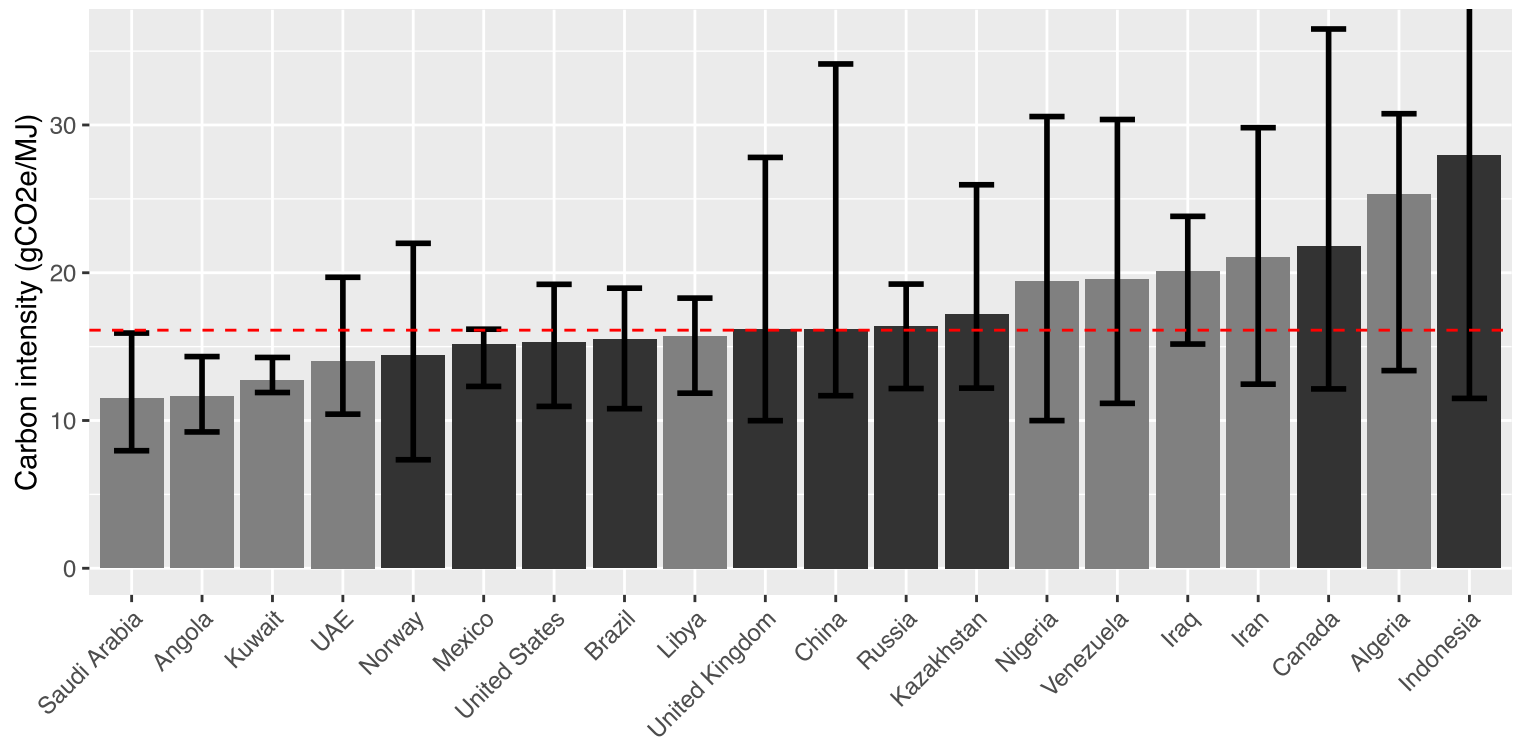
Notes: The figure represents the combined extraction-refining carbon intensity per megajoule (MJ) based on observed production over the 1992–2018 period by producing country. The bar height represents the average (weighted by production), and the line extremities the first and last deciles. The red dashed line corresponds to the world average figure. Only the top 20 oil producers over the period are represented, and OPEC country carbon intensity bars appear in light grey. OPEC, as of 2019, included Algeria, Angola, Congo, Ecuador, Equatorial Guinea, Gabon, Iran, Iraq, Kuwait, Libya, Nigeria, Saudi Arabia, the UAE, Venezuela, and the Neutral Zone shared by Kuwait and Saudi Arabia.
Mitigation opportunities in oil supply
Since the 1992 Earth Summit, oil producers have largely overlooked variations in carbon intensity related to extraction and refining. This isn't surprising, as global GHG emissions from oil production and refining haven't been effectively priced to reflect environmental damage. Our research (Coulomb, Henriet, and Reitzmann 2026) indicates this oversight has significant climate consequences: between 1992 and 2018 alone, if global oil production had been reallocated to minimise total social cost, taking into account both producer extraction costs and GHG emissions, without reducing overall annual production levels, nearly 10 billion tonnes of CO₂-equivalent (CO2e) emissions could have been avoided. At a pollution cost of US$200 per tonne of CO2e, that’s equivalent to $2 trillion in avoided damage (in 2018 dollars).
To contextualise, 10 billion tonnes of CO2e equate to about two years' worth of global life-cycle transport emissions. While global efforts focus on reducing oil consumption overall, our findings underscore that selecting lower-carbon deposits also significantly impacts total emissions. Simply shifting production away from ‘dirtier’ fields towards cleaner alternatives can substantially lower emissions. This supply-focused policy complements essential demand-side measures.
Some countries that are host to high-carbon oil deposits, such as Venezuela or Canada, should have extracted less oil, and countries with cleaner oil deposits, such as Norway or Saudi Arabia, should have increased their production. Supply reductions may be politically difficult to accept, especially in low- and middle-income countries. However, substantial within-country differences in carbon intensities creates scope for reallocating production across fields within a country. Such within-country supply recompositions, holding total national production in each year fixed at historic levels, could have delivered emissions reductions of a magnitude comparable to those reported in earlier estimates.
Even if past mitigation opportunities have been missed, we still have the chance to shape the future of oil supply. Looking ahead, assuming the world embarks on a net-zero trajectory compatible with the International Energy Agency’s projections (IEA 2021), factoring in differences in carbon intensity across deposits into oil supply decisions could save an additional 9 gigatons of CO2e by 2060 – valued at approximately $1.8 trillion – without further demand reductions.
Implications for energy and climate policy
Much of the policy debate centres around demand-side strategies, such as implementing fuel efficiency standards, electric vehicle incentives, and petroleum products taxes to reduce oil consumption. Such measures are critical: major demand reductions are necessary to keep global warming below 2°C. Yet, aligning oil extraction with our planetary boundaries isn’t just about pumping less oil overall, it is also about pumping the right oil if some extraction continues. As oil use won’t vanish immediately, prioritising lower-carbon sources offers additional GHG emission reductions. Combining supply-side reallocation with robust demand-side strategies can help reduce GHG emissions more effectively.
Some existing policies are already moving in this direction. California’s Low Carbon Fuel Standard, for instance, was an early effort to distinguish fuels based on their full life-cycle emissions. The EU’s Fuel Quality Directive (amended by the revised Renewable Energy Directive) aimed to lower the carbon intensity of fuels consumed within the EU by promoting the use of biofuels, but it eventually did not differentiate between crude oil sources. More effective policies could integrate robust carbon pricing that accounts for GHG emissions from oil production through to combustion, supplemented by border adjustments where such pricing is not globally adopted, or even direct bans on high-carbon oil extraction (e.g. extra-heavy oil or fields with very high flaring and venting levels).
The role of data and threats to transparency
Implementing such policies requires accurate, public data on oil carbon intensity. Estimates of extraction-related emissions vary widely; for example, the International Association of Oil and Gas Producers (IOGP) provides a figure for the average carbon intensity for oil extraction 2.7 times lower than estimates from the Oil Production Greenhouse Gas Emissions Estimator used in our research (Stanford Doerr School of Sustainability n.d.). This discrepancy arises partly from differences in upstream activity scope, more limited for IOGP, and from data sources especially concerning flaring and venting.[1]
Without transparent, reliable data, effectively enforcing carbon-intensity regulations becomes nearly impossible. Underestimated emissions from flaring and venting can undermine climate policies by making high-intensity oil appear on paper cleaner than reality, evading stricter regulations. The recent reduction in US administration support for public climate data further exacerbates these transparency challenges, potentially undermining global climate mitigation effectiveness. Indeed, flaring estimates used in our research rely on satellite imagery from the US National Oceanic and Atmospheric Administration and NASA. Investing in rigorous satellite monitoring of GHG emissions and in the maintenance and resilience of public databases, and enforcing strict reporting standards for corporations provide policymakers and the public with the tools necessary to sideline the dirtiest barrels and achieve progress towards net-zero.
Authors’ note: No specific conflicts of interest. The authors do not advise or hold stock shares of oil and gas companies. Research funding from ANR (French National Research Agency), Mines Paris - PSL University, Paris School of Economics, University of Melbourne (Faculty of Business and Economics), The Endowed Chair ENG at Fondation Mines Paris, Dauphine University, Toulouse School of Economics, CentraleSupélec (sponsors: EDF, GRTGaz, TotalEnergies) is acknowledged.
References
Coulomb, R, F Henriet, and L Reitzmann (2026), “‘Bad’ oil, ‘worse’ oil and carbon misallocation,” Review of Economic Studies, 93(1): 404–437.
International Energy Agency (IEA) (2021), “World energy outlook 2021,” Unpublished manuscript.
International Association of Oil & Gas Producers (IOGP) (n.d.), “International Association of Oil & Gas Producers,” Unpublished manuscript.
Masnadi, M S, H M El-Houjeiri, D Schunack, et al. (2018), “Global carbon intensity of crude oil production,” Science, 361: 851–853.
Stanford Doerr School of Sustainability (n.d.), “OPGEE: The oil production greenhouse gas emissions estimator,” Unpublished manuscript.