





Prioritising women in collective bargaining led unions to expand female-friendly workplace amenities, increasing women’s retention and productivity without reducing wages, employment, or firm profits.
Editor’s note: For a broader synthesis of themes covered in this article, check out Issue 2 of our VoxDevLit on Female Labour Force Participation.
Globally, over 30% of working women across 142 countries cite having to balance family and work as their main challenge (Ray et al. 2017). The gender wage gap looms large (20%, ILO 2024), and a substantial share of women (38%, Kleven et al. 2025)[1] drop out of the labour force immediately upon becoming mothers. A broad consensus has emerged among policymakers and scholars alike that the key to reducing gender gaps in the labour market lies in improving workplace conditions, or ‘amenities’, for women (Goldin 2014). For instance, longer maternity leaves could enable women to re-enter the workforce quickly after childbirth, while flexible work schedules could enable mothers to continue working rather than dropping out of the labour force altogether. Yet, despite this broad consensus, we know surprisingly little about how female-focused amenities could actually increase in practice, nor about their resulting impact on workers or firms.
In Corradini, Lagos, and Sharma (2025), we investigate whether unions can improve working conditions for women. Since unions negotiate pay and benefits on behalf of nearly 18% of workers worldwide, they are uniquely positioned to improve workplaces. Our setting is a natural experiment in Brazil, where the country’s largest trade union federation, the Central Única dos Trabalhadores (CUT), representing over 20% of formal workers, adopted a sweeping female-focused bargaining agenda starting in 2015. The CUT began advocating for several female-friendly amenities, including expanding paid maternity leave to six months, flexible work schedules, and universal childcare, and required female representation in union committees and delegations.
The role of unions in improving workplaces for women
How did prioritising women in union bargaining affect female-friendly amenities and their downstream impact on workers and firms? To answer this question, we compare establishments originally negotiating with CUT-affiliated unions (the treated group) to those negotiating with other unions (the control group). We find three key results:
- Union advocacy substantially increased female-friendly amenities both on paper and in practice.
- Women valued these amenities: they remained longer at treated firms and queued for jobs there, indicating that the new female-friendly jobs were more desirable to women.
- Perhaps surprisingly, the improvement in amenities did not come with trade-offs for workers (wages or employment) or employers (profits). Instead, better amenities likely paid for themselves through gains in worker retention and productivity.
Positive effect on female-friendly amenities, larger effect in workplaces with smaller female shares
A central challenge in studying whether unions can improve workplace conditions for women is measuring amenities. We overcome this challenge by constructing establishment-level measures of amenities from the text of Brazilian collective bargaining agreements (CBAs). We then classify which amenities are disproportionately valued by women (‘female-friendly amenities’) using both an intuitive and a data-driven approach. In the intuitive approach, we manually identify 20 amenities associated with women’s workplace needs. In the data-driven approach, we select CBA clauses that correlate with women’s disproportionate desire to work at a given establishment compared to men, as revealed by workers’ job-to-job transitions. Both approaches identify four broad classes of female amenities: maternity and childcare, leaves of absence, harassment and discrimination prevention, and flexibility and part-time work.
One year after the CUT reform, female-friendly amenities in CBAs increased by 19% (Figure 1, Panel A), with leaves and childcare accounting for most of the increase. Female amenities also increased as a share of all clauses, indicating that CBAs became re-oriented towards women’s needs (Figure 1, Panel B).
Figure 1: Changes in amenities
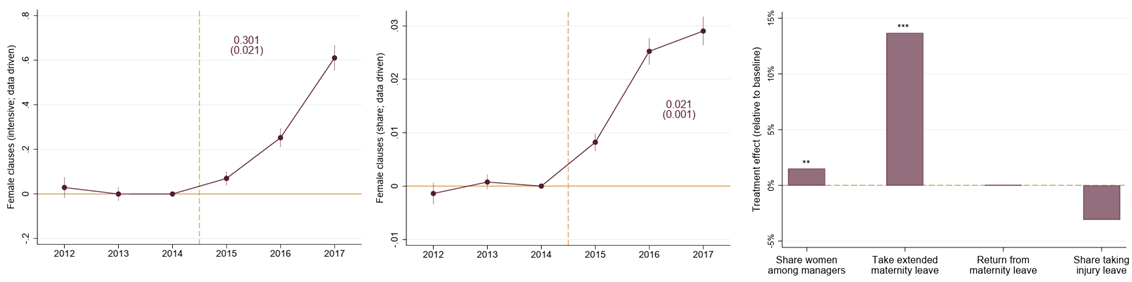
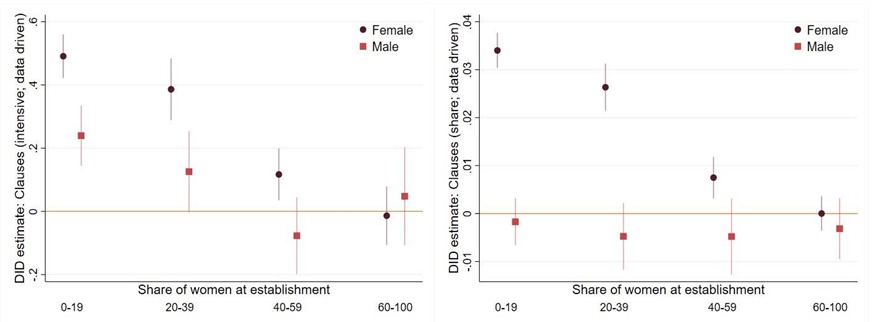
Importantly, amenities increased not merely on paper, but translated into practice. Using administrative data on wages and employment for all formal workers in Brazil, we show that women became 14% more likely to take extended maternity leave while retaining the same job protection upon return, and were 2% more likely to be promoted to managerial positions (Figure 1, Panel C). The largest increase in female-friendly amenities occurred at establishments where women constituted a smaller share of the workforce (Figure 2) or lacked representation in union leadership, suggesting that the top-down shift in unions’ bargaining priorities was particularly effective in giving women voice where they previously lacked representation.
Figure 2: Differences in effects on amenities by share of the female workforce
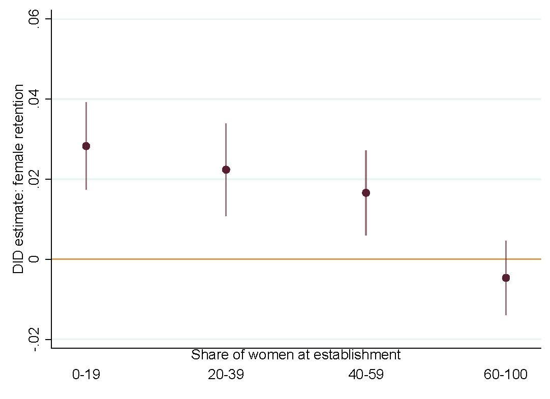
Women valued these changes. Female retention – a measure of employer attractiveness – increased by 1.8 percentage points on average, or 6% relative to baseline. Retention gains were larger in establishments that experienced greater increases in female-friendly amenities (Figure 3), consistent with the interpretation that improved amenities strengthened women’s attachment to their workplace.
Figure 3: Incumbent women’s retention improves
Trade-offs: No effect on wages and employment
Although the reform improved female-friendly amenities in workplaces, an important question is whether this change came at the expense of workers’ wages or employment, or firm profits. We examine three possible ways in which female-friendly amenities were paid for: workers paid through lower wages or employment; employers absorbed the costs through lower profits, or the amenities paid for themselves through gains in worker retention or productivity.
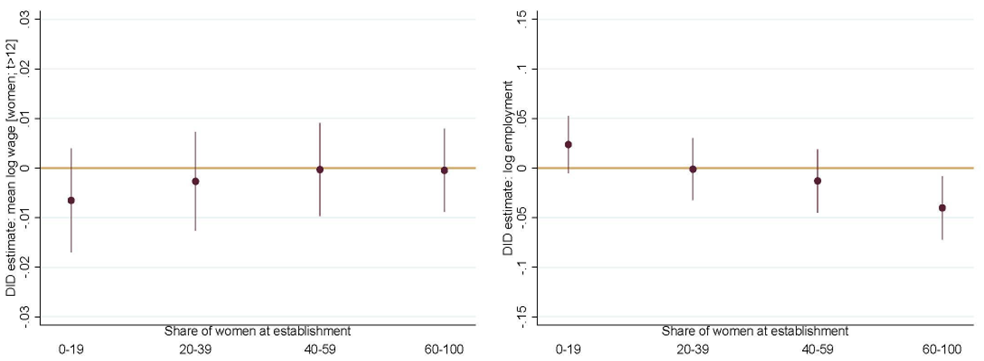
We find no evidence that wages or employment declined following the union reform – even in establishments where amenities improved the most – ruling out compensating differentials (Figure 4). Nor do we find evidence of reductions in employer profits. In theory, profits could fall only if the bargaining power of CUT-affiliated unions increased; however, the reform changed bargaining priorities rather than bargaining power. The data is consistent with this theoretical argument: treated firms are no more likely to exit the market, and for the subset of larger firms for which profit data is available, we find no differential change in profit. Instead, we find that improved amenities increased worker retention and reduced absenteeism, likely raising workers’ productivity. Back-of-the-envelope calculations indicate that these gains are sufficient to pay for the improved amenities: increased worker retention alone could cover the cost of one of the most expensive amenities: a two-month extension of paid maternity leave.
Figure 4: No trade-off in wages or employment
Policy implications for female labour market outcomes
Together, our findings show that prioritising women in collective bargaining increased female-friendly amenities in the workplace without making workers or employers worse off. These results imply that Brazilian firms were initially under-providing female-friendly amenities. Why? Two key policy insights emerge:
First, on the union side, results reveal that prioritising the needs of under-represented workers can benefit both workers and firms. Before the CUT reform, women were the minority in most workplaces and unions, and collective bargaining did not focus on women’s issues. When bargaining reflects the preferences of the median worker – typically male – women’s needs can be overlooked even when meeting those needs is possible and surplus-enhancing. The CUT reform refocused attention on women’s needs that had previously been ignored but which would benefit both workers (through better workplaces) and employers (through higher retention and productivity).
Second, on the firm side, designing programmes to enable experimentation with female-friendly amenities can help firms learn the returns to amenities and expand them voluntarily. We find strong spillovers: firms exposed to the reform through one establishment were substantially more likely to expand female-friendly amenities to other, untreated establishments of the firm, revealing that once firms observed the benefits of amenities, they could scale amenities more broadly. Our findings point to the value of pilot programmes that would (i) direct firms towards promising amenities, and (ii) subsidise experimentation to facilitate learning and expansion.
References
Corradini, V, L Lagos, and G Sharma (2025), “Collective bargaining for women: How unions can create female-friendly jobs,” Quarterly Journal of Economics, qjaf024.
Goldin, C (2014), “A grand gender convergence: Its last chapter,” American Economic Review, 104: 1091–1119.
International Labour Organization (ILO) (2024), “The gender pay gap.”
Kleven, H, C Landais, and G Leite-Mariante (2025), “The child penalty atlas,” Review of Economic Studies, 92: 3174–3207.
Ray, J, N Esipova, A Pugliese, and S Maybud (2017), "Towards a better future for women and work: Voices of women and men," International Labour Organization and Gallup.