




Exposure to less restrictive reproductive health policies via international migration leads to lower fertility in origin communities through the diffusion of new knowledge, preferences, and behaviour.
Editor’s note: For a broader synthesis of themes covered in this article, check out our VoxDevLit on International Migration. The authors have made slides available here.
Globally, fertility has declined rapidly over the last several decades (de Silva and Tenreyro 2017). Even against this backdrop, some countries face fertility rates below replacement while others face continued rapid population growth. Regardless of a country’s direction of desired changes to fertility rates, policymakers seek to understand how to meet population planning goals while respecting women’s autonomy.
Diffusion of reproductive health knowledge and preferences matters for fertility
Family planning norms are relatively persistent, but exposure to new information or ideas can potentially disrupt such norms. Recent research has shown that reproductive health behaviours may diffuse to individuals through messaging campaigns. Edutainment, such as soap operas (La Ferrera et al. 2012), led to declines in fertility in Brazil. In India, access to cable television reduced fertility in rural areas (Jensen and Oster 2009). More recently, mass media messaging in Burkina Faso resulted in declines in fertility, while offering contraceptives for free did not (Glennerster et al. 2021, Dupas et al. 2025). Reproductive health messaging can also increase fertility, such as in Brazil, where fertility increased in response to papal visits (Bassi and Rasul 2017). Our research complements this work by demonstrating another influential channel that causes the diffusion of knowledge and norms about reproductive health behaviour: international migration.
International migration facilitates the transmission of ideas
Many developing countries facilitate international migration as a key pillar of their development strategy (Yang et al. 2026). Much of this stems from the desire for higher incomes abroad and the remittances that follow. Such migrant income has long-run benefits for economic development (Khanna et al. forthcoming). In addition to higher incomes, migrants are also exposed to different cultural practices abroad, which may in turn shape their behaviour and preferences. They may then diffuse this new knowledge back to their origin communities, sending not just financial remittances but also ‘cultural remittances’ (Rapoport et al. 2020). If beliefs or preferences differ across origin and destination countries, then migrants may modify behaviour and transmit this knowledge back to their origin communities.
Previous research has demonstrated that migrant exposure to political systems can lead to changes in voting patterns and political behaviour at home (Tuccio et al. 2019, Barsbai et al. 2017, Chauvet and Mercier 2014, Batista and Vicente 2011, Spilimbergo 2009). Gender norms in the country of origin also respond to exposure to norms abroad (Tuccio and Wahba 2018, Dannecker 2005). Given varied reproductive health behaviours across countries, migration may also influence family planning decisions in the origin country. In recent research (Godlonton and Theoharides 2025), we explore the role of migrant exposure to different reproductive health policies on fertility and other reproductive health decisions.
We examine this question in the context of the Philippines, where facilitating migration has been a key government strategy since 1974. Because Filipinos migrate to many destination countries and these migration patterns are geographically persistent over time, migrant exposure to different preferences and norms surrounding reproductive health behaviour varies substantially by province. Further, the Philippines has historically experienced a slow decline in fertility relative to Southeast Asia, leaving room for a fertility response to new knowledge.
Migrant networks lead to differential exposure to destination country policies
To determine the causal impact of exposure to reproductive health policy abroad on family planning decisions, we combine changes in reproductive health policies over time in destination countries for Filipino migrants with variation across the Philippines in both the intensity and destination composition of migration.
Destination countries vary substantially in their reproductive health policies. We expand a database of country-specific reproductive health policies by Finlay et al. (2012) to create a country-year dataset of reproductive health policies for all destinations of Filipino migrants. We include policies related to condoms, the pill, IUDs, sterilisation, and abortion, which we then aggregate into an overall reproductive health index for each country. Figure 1 illustrates the variation in reproductive health policies over time. We order the countries from those with the most legal restrictions to those with the fewest, with the grey circle indicating the index value in 1990 and the blue cross indicating the index value in 2013. The change in the index between 1990 and 2013 is indicated by the blue line. Many destinations experience reproductive health policy changes, and while most countries remove legal restrictions over time, some add them.
Figure 1: Variation in reproductive health, 1990 to 2013
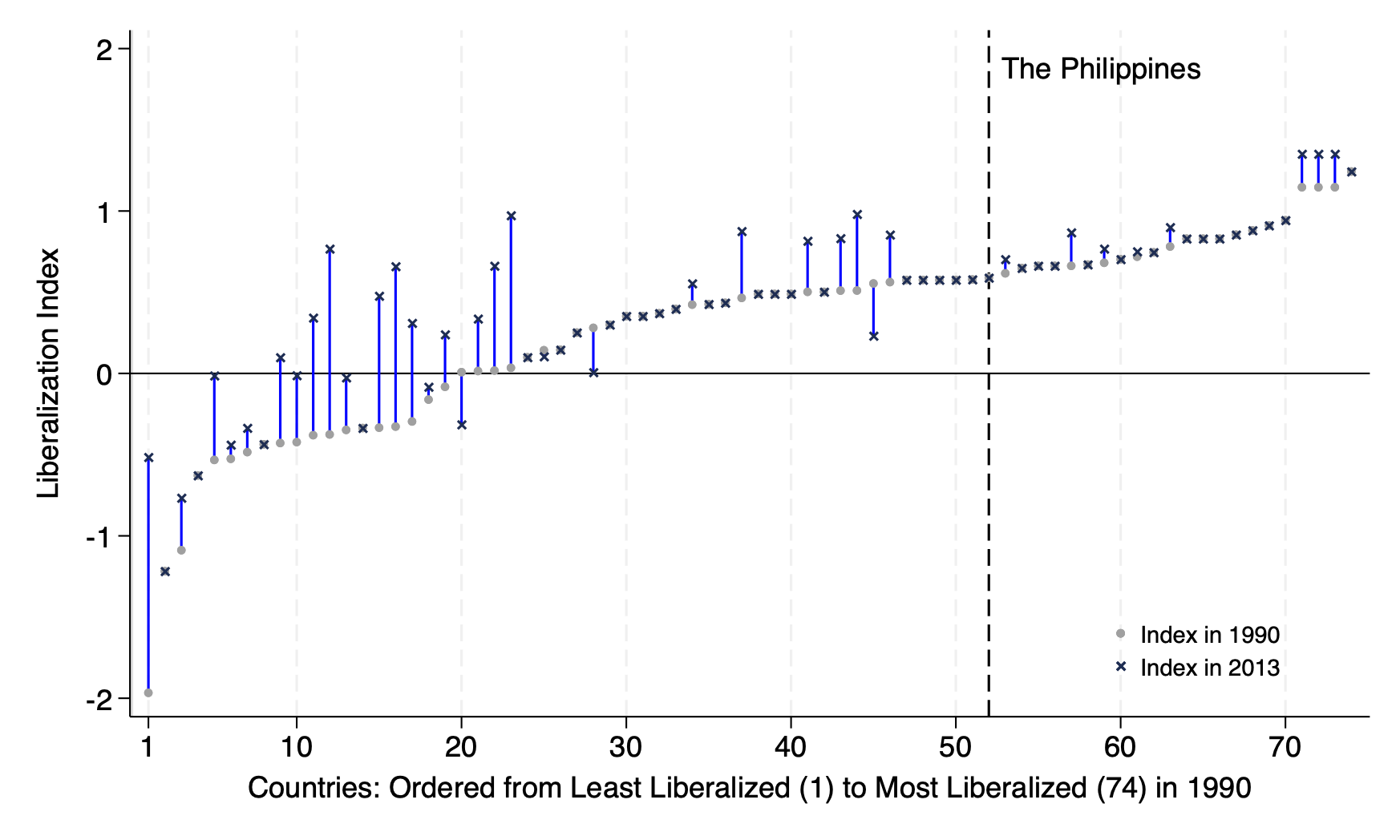
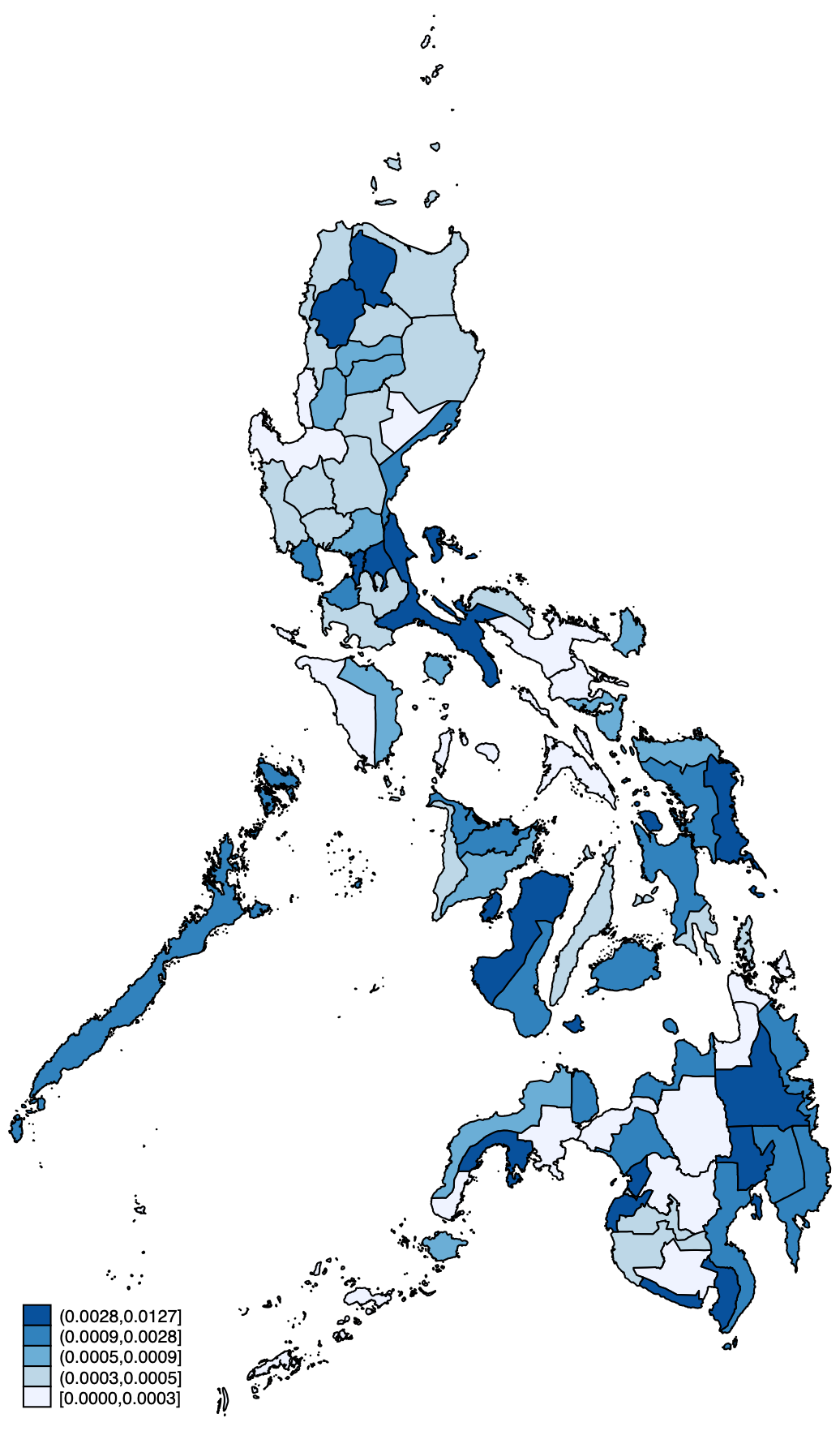
We then map this measure of reproductive health policies to provinces in the Philippines using the historical destination composition of migrants from each province. For example, a province that sends 25% of migrants to Qatar and 75% to Malaysia will have an aggregate reproductive health policy measure based on these weights. Figure 2 shows the change in reproductive health policies between 1994 and 2013 for each Philippine province, weighted by the composition of migrants to each destination. Provinces shaded in darker blue experienced larger reductions in legal restrictions than those in lighter blue.
Figure 2: Change in reproductive health policies, 1994 to 2013
Finally, we combine this weighted policy measure with the province's overall historical migration intensity. Policy exposure will be more salient in origin provinces with a greater share of the population migrating. For example, in 1999, Japan legalised the pill for contraceptive purposes. Two neighbouring Philippine provinces, Zambales and Bataan, have similar shares of their population working overseas. However, 11.6% of all migrants from Zambales work in Japan compared to 3.8% in Bataan. This means that residents of Zambales received more exposure to the Japanese policy change than those in Bataan. Using this type of variation across all provinces in the Philippines and all destination countries for Filipino migrants, we examine the impact of exposure to changes in legal restrictions in reproductive health policy at destination on fertility behaviour in origin provinces.
Less restrictive reproductive health policy abroad reduces fertility at home
We find that fertility falls in response to larger reductions in legal restrictions regarding reproductive health in migrants’ destinations. The magnitude of the reduction in fertility is large enough that it cannot be accounted for solely by migrants, but must also include spillovers to non-migrant households.
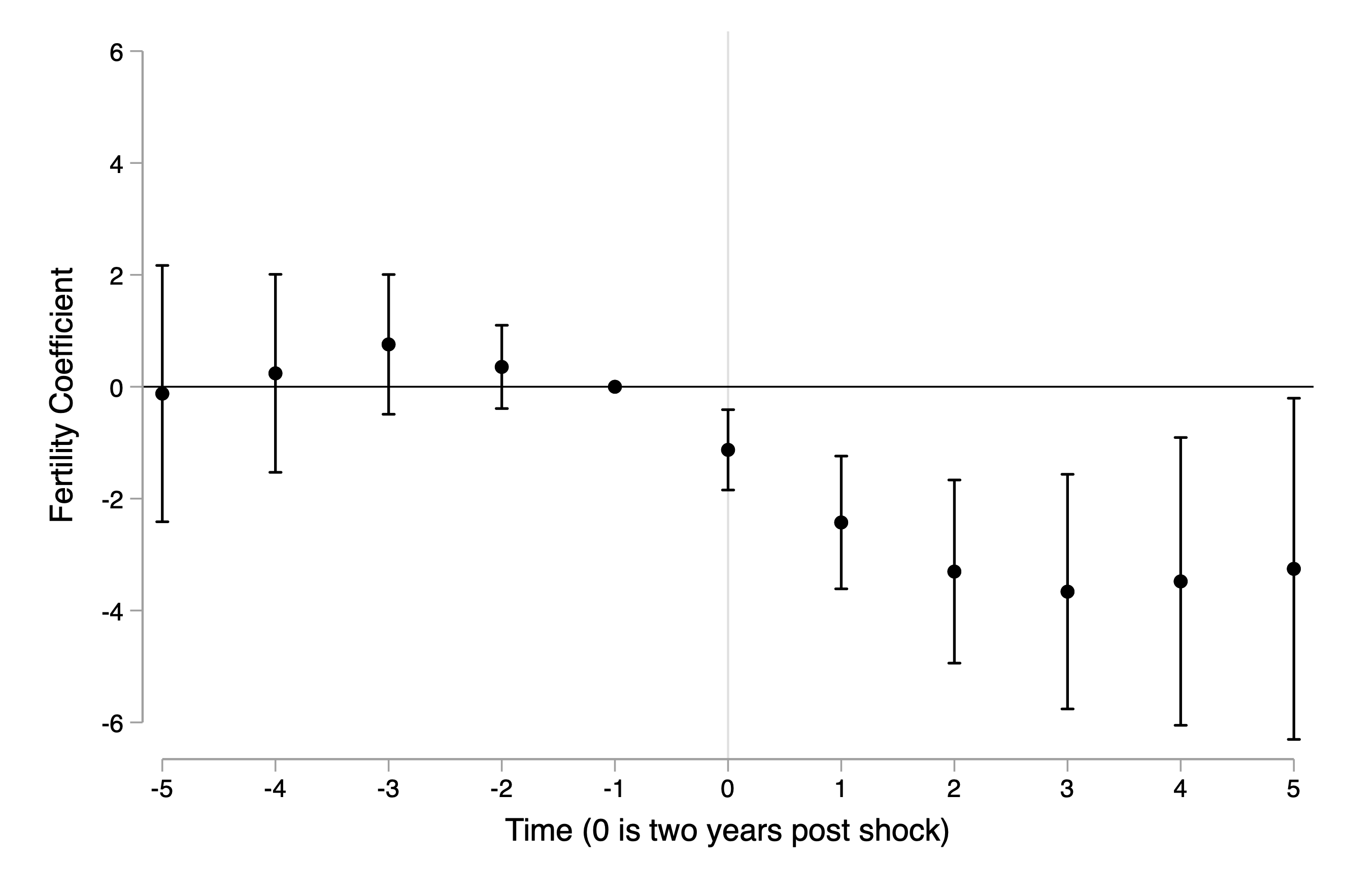
To examine the dynamic effects, we estimate a stacked event study (Figure 3), where the plotted points show the differential impact on fertility for provinces experiencing larger reductions in legal restrictions over time. Fertility initially declines in response to a reduction in legal restrictions abroad and continues to decline over the next two periods, after which it stabilises. To achieve these fertility declines, women increase their use of contraceptive methods, particularly modern methods such as the pill and injectable contraceptives.
Figure 3: Event study
In unpacking which types of reproductive health policies are particularly influential, we find that more visible policy changes at destination, such as less restrictive laws on commercial advertising of contraceptives, are more impactful in reducing fertility. Yet, policy changes that relax restrictions that conflict with firmly established family planning values reduce the fertility response. We further find that the spillover effects are larger for individuals with larger social networks of migrants.
One advantage of our estimation strategy is that it allows us to isolate the effect of exposure to changes in reproductive health policy from other migration-related changes, such as increased migrant income. However, understanding whether the fertility response is greater due to exposure to changes in policy versus in migrant income can help shed light on barriers to reducing fertility in the Philippines. We isolate the effect of changes in migrant income on fertility using a shock to migrant income created by Khanna et al. (2025). We find no effect of increased migrant income on fertility. This is consistent with recent evidence showing no change in contraceptive use when contraceptives were offered free of charge (Dupas et al. 2025), and suggests that knowledge and preferences appear to be significant barriers in reducing fertility rather than income.
Finally, we show that infant and maternal mortality decline in response to exposure to fewer legal restrictions in reproductive health. This is consistent with previous research (Wolpin 1997, Schultz 2007) that shows reduced fertility can lower mortality at birth.
New norms obtained abroad matter for migrant-origin developing countries
Given the potential for fertility to affect long-run economic development, our results suggest another avenue through which international migration may affect development outcomes. As developing countries seek to manage fertility, understanding the role of migration in determining reproductive health decisions will be crucial to their family planning goals. Broadly, our results highlight that migration may influence origin countries not just through financial transfers, but also through the transmission of culture, norms, and behaviour. In a context of high levels of migration globally, understanding the role of such cultural change will matter for eventual development impacts.
References
Barsbai, T, H Rapoport, A Steinmayr, and C Trebesch (2017), “The effect of labor migration on the diffusion of democracy: Evidence from a former Soviet republic,” American Economic Journal: Applied Economics, 9: 36–69.
Bassi, V, and I Rasul (2017), “Persuasion: A case study of papal influences on fertility-related beliefs and behavior,” American Economic Journal: Applied Economics, 9: 250–302.
Batista, C, and P C Vicente (2011), “Do migrants improve governance at home? Evidence from a voting experiment,” World Bank Economic Review, 25: 77–104.
Chauvet, L, and M Mercier (2014), “Do return migrants transfer political norms to their origin country? Evidence from Mali,” Journal of Comparative Economics, 42: 630–651.
Dannecker, P (2005), “Transnational migration and the transformation of gender relations: The case of Bangladeshi labour migrants,” Current Sociology, 53: 655–673.
De Silva, T, and S Tenreyro (2017), “Population policies and fertility convergence,” Journal of Economic Perspectives, 31: 205–228.
Dupas, P, S Jayachandran, A Lleras-Muney, and P Rossi (2025), “The negligible effect of free contraception on fertility: Experimental evidence from Burkina Faso,” American Economic Review, 115: 2659–2688.
Finlay, J E, D Canning, and J Y Po (2012), “Reproductive health laws around the world,” Unpublished manuscript.
Glennerster, R, J Murray, and V Pouliquen (2021), “The media or the message? Experimental evidence on mass media and modern contraception uptake in Burkina Faso,” Unpublished manuscript.
Godlonton, S, and C Theoharides (2025), “Diffusion of reproductive health behavior through international migration: Effects on origin-country fertility,” American Economic Review, 115: 3597–3637.
Jensen, R, and E Oster (2009), “The power of TV: Cable television and women’s status in India,” Quarterly Journal of Economics, 124: 1057–1094.
Khanna, G, E Murathanoglu, C Theoharides, and D Yang (forthcoming), “Abundance from abroad: Migrant income and long-run economic development,” American Economic Review.
La Ferrara, E, A Chong, and S Duryea (2012), “Soap operas and fertility: Evidence from Brazil,” American Economic Journal: Applied Economics, 4: 1–31.
Rapoport, H, S Sardoschau, and A Silve (2020), “Migration and cultural change,” Unpublished manuscript.
Schultz, T P (2007), “Population policies, fertility, women’s human capital, and child quality,” in Handbook of Development Economics, 4: 3249–3303.
Spilimbergo, A (2009), “Democracy and foreign education,” American Economic Review, 99: 528–543.
Tuccio, M, and J Wahba (2018), “Return migration and the transfer of gender norms: Evidence from the Middle East,” Journal of Comparative Economics, 46: 1006–1029.
Tuccio, M, J Wahba, and B Hamdouch (2019), “International migration as a driver of political and social change: Evidence from Morocco,” Journal of Population Economics, 32: 1171–1203.
Wolpin, K I (1997), “Determinants and consequences of the mortality and health of infants and children,” in Handbook of Population and Family Economics, 1A: 483–557.
Yang, D, C Batista, G Khanna, D McKenzie, A M Mobarak, and C Theoharides (2026), “International migration,” VoxDevLit, 21(1).