



Evidence from Senegal shows that teenage girls spend less time on caregiving and complete more years of education after the death of an elderly household member, indicating that the burden of caring for dependent relatives affects girls’ schooling.
The absolute size of sub-Saharan Africa’s over-60s population is increasing rapidly as a result of recent gains in life expectancy and above-replacement fertility rates. From 50 million today, this population is projected to exceed 600 million by 2100 – twice the size of China’s population in the same age group at that time (Duhon et al. forthcoming). Most African countries currently lack the healthcare and pension systems required to meet this transformation.
Throughout the region, old-age care is primarily family-based with large gender disparities in time dedicated to caregiving, a predominantly female activity. In a context where large multigenerational households are common, this implies that teenage girls are increasingly likely to be living with elderly relatives and shoulder some of the burden of caregiving.
Given the extensive evidence showing that informal elderly caregiving is associated with reduced working hours among adult women in both high- and low-income countries (Ettner 1995, Uwakwe et al. 2009, Schmitz and Westphal 2017), more research is needed to understand how a rapidly growing elderly population may impact young women’s lives. A key question is whether caregiving responsibilities may reduce the amount and quality of time dedicated to schooling, thereby increasing the gender gap in education.
Girls’ caregiving role in Senegal
In recent research, I use panel data on 3,556 Senegalese children and teenagers aged 6 to 17 to investigate this question (Thivillon 2025). When they were first surveyed in 2006–07, 21% of girls (and only 5% of boys) reported providing informal care to a household member on a regular basis. The bottom panel of Figure 1 shows that these girls dedicated eight hours per week to their dependent relatives on average, far more than the time spent on any other common household chore. Given that the combined time dedicated to cooking, cleaning, washing, and fuel and water collection also amounts to approximately eight hours per week when considering all girls (Figure 1, top panel), it seems that the burden of household chores doubles for the girls who conduct caregiving work. This extra demand for domestic work might also come with significant stress and cognitive load affecting attention when conducting other tasks such as learning (Mani et al. 2013).
Figure 1: Time dedicated to caregiving and other domestic work by task
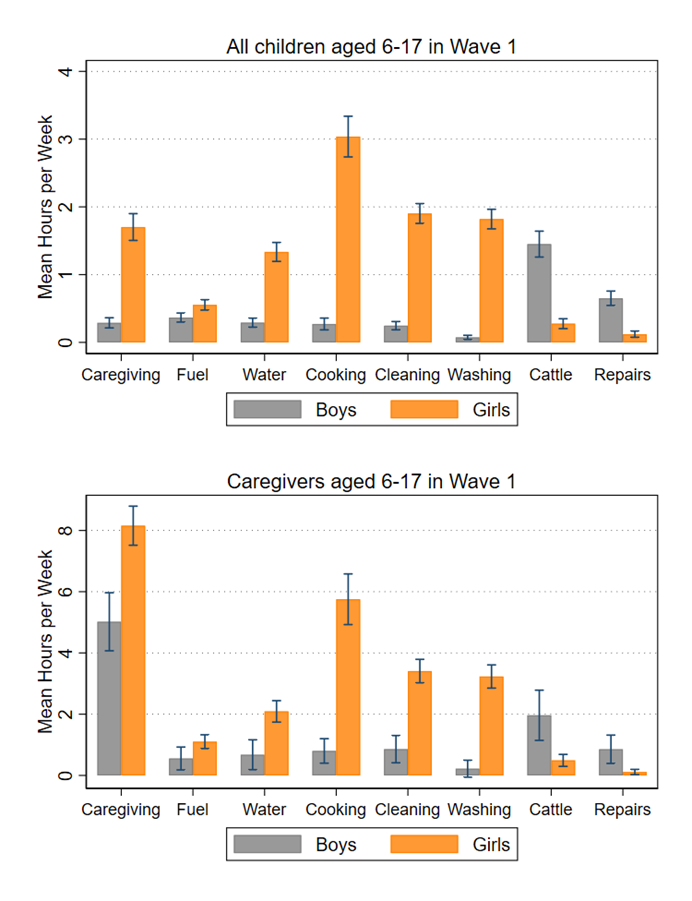
Notes: Sample: All children aged 6–17 at baseline and observed in both waves of the survey. Vertical spikes indicate 95% confidence intervals.
Using elderly deaths to quantify the impacts of caregiving on educational outcomes
To estimate the effect of caregiving burden on girls’ educational outcomes, we cannot simply compare the girls in charge of a dependent relative to those who are not. Indeed, the latter are likely to differ from the former in many ways, even before they start caregiving, and we would end up comparing apples to oranges. We need some source of quasi-random variation in demand for caregiving to ensure that our comparisons are not biased by these pre-existing differences. I use the deaths of elderly household members that occur during the period of approximately four years covered by the data as a natural experiment.
After restricting the sample to the 1,005 children who were enrolled in school and co-residing with an individual aged over 60 at the beginning of the study period, I compare the years of education completed across two groups of girls. The first group consists of girls whose elderly co-resident died during the study period, while the second consists of those who still have an elderly household member at the end of the study. This strategy ensures that the girls we compare initially shared some characteristics associated with a high probability of residing with an elderly person, and that the group which is no longer in this situation at the end of the study is not self-selected.
Nevertheless, there could still be some differences between these two groups as it is likely that the elderly co-residents of bereaved girls had on average a worse health condition at baseline. To address this, I also include boys in the comparison and compute estimates of the impacts of elderly death shocks on girls’ education, which exclude the effect common to both bereaved girls and boys. This removes some of the potential bias due to pre-existing differences between households of deceased and surviving elderly co-residents.
Elderly death shocks increased girls’ educational attainment
Elderly death shocks resulted in bereaved girls completing an extra 0.6 years of education compared to what they would have achieved in the absence of the shock. This is approximately 20% of the baseline education in the reference group (boys at the beginning of the study). Figure 2 demonstrates that this effect is driven by girls aged 12 to 17. In this group, the loss of an elderly household member is associated with 0.8 years of additional education completed (Figure 2, panel b).
Using the same method to analyse the impacts of the death shocks on caregiving work shows that the effect on educational attainment is matched by a large negative shock of demand for caregiving from teenage girls. They are 30 percentage points less likely to be conducting caregiving work at the end of the study and the corresponding decrease in caregiving time is three hours per week. On the other hand, there is no statistically detectable effect on the educational attainment and caregiving time of younger girls.
These results suggest that the school progression of teenage girls was constrained by their caregiving responsibilities and that they were able to progress faster when this constraint was removed. This interpretation of the results is supported by additional analyses showing that the effects of the death shocks are statistically more robust in the sub-sample of girls who were co-residing with less autonomous elderly individuals at the beginning of the study.
Figure 2: Impact of the death shock on girls’ schooling and caregiving work by age group
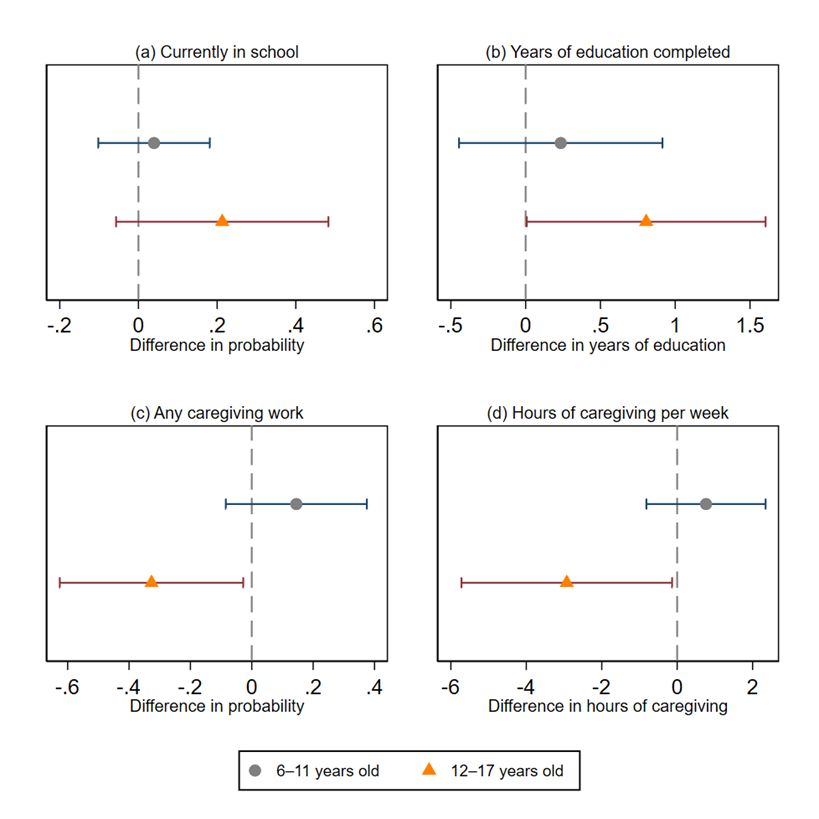
Notes: Sample: Children aged 6–17 who co-resided with an elderly individual and were enrolled in school at the time of survey. Each dot (triangle) represents the estimated effect of the death shock on the outcome of interest for girls aged 6–11 (12–17). Horizontal spikes indicate 95% confidence intervals.
Policy implications: Informal caregiving and girls’ education
My findings on Senegal likely reflect a broader phenomenon across many sub-Saharan African countries, where health and pension systems are underdeveloped, family-based old-age care dominates, and caregiving is heavily gendered. Given this situation, there is a high probability that the rapid ageing of the African population will negatively affect girls’ educational attainment and learning, posing a major threat to the reduction of gender inequalities in the region. This suggests that introducing or extending old-age social protection programmes designed to shift the burden of caring for the elderly away from adolescent girls should represent a policy priority for African governments.
This effort should be matched by interventions aimed at transforming gender norms and the organisation of home production activities within the household so that the caregiving work which cannot be provided by formal care institutions is more evenly shared between male and female household members. In the absence of significant efforts to focus public policies on these two priorities, it is likely that the burden of caregiving and the associated education penalty will only increase for adolescent girls in coming decades.
References
Duhon, M, E Miguel, A Njuguna, D Pinto Veizaga, and M W Walker (forthcoming), “Preparing for an aging Africa: Data-driven priorities for economic research and policy,” Journal of Political Economy: Microeconomics.
Ettner, S L (1995), “The impact of ‘parent care’ on female labor supply decisions,” Demography, 32(1): 63–80.
Mani, A, S Mullainathan, E Shafir, and J Zhao (2013), “Poverty impedes cognitive function,” Science, 341(6149): 976–980.
Schmitz, H, and M Westphal (2017), “Informal care and long-term labor market outcomes,” Journal of Health Economics, 56: 1–18.
Thivillon, T (2025), “Demand for informal caregiving and human capital accumulation: Evidence from elderly deaths in Senegal,” Journal of Health Economics, 104: 103076.
Uwakwe, R, C C Ibeh, A I Modebe, et al. (2009), “The epidemiology of dependence in older people in Nigeria: Prevalence, determinants, informal care, and health service utilization,” Journal of the American Geriatrics Society, 57(9): 1620–1627.