




Theories from research in anthropology, history and African studies, combined with new data on independent political communities in pre-colonial Africa, provide an alternate view of the continent’s history. Africans succeeded in keeping the scale of political society small, but that left Africa vulnerable.
Modern research has argued that a key facet of Africa’s underdevelopment is its apparent inability to build the strong centralised states necessary for public good provision (Michalopoulos and Papaioannou 2013, 2017). Historically, Herbst (2000) argued that this was because low population density removed the incentives to control territory or build such things as fiscal institutions. In the post-colonial period, state weakness has been attributed mostly to the incidence of corruption and clientelism which undermines institutional functionality. In all cases scholars have focused on the absence of factors which are thought to have created effective states in the Western world.
Africans built a vast array of independent political communities
We survey the broader scholarly literature on state formation in Africa, showing that it features mechanisms which have not been studied so far in economics (Henn and Robinson 2026). These findings do not support the hypothesis that the African pattern can be explained by the absence of factors that created Western states. Africa is different (Dincecco et al. 2019).
We also provide for the first time an estimate of the actual number of polities – independent political communities – that existed in Africa at the time of the Scramble for Africa after the Berlin Conference of 1884. Even combining the framework of the Ethnographic Atlas with information from all the volumes of the Ethnographic Survey of Africa, and a large number of additional ethnographic and historical sources, is not sufficient to do this. We have to make some assumptions about how representative the observed information is about the political organisation of societies with scant information. Different reasonable assumptions lead the number of polities to vary from 21,000 to 72,000, but we argue that 45,000 is the most credible estimate. We use various types of ‘reality checks’ to establish this. At the same time there were around 50 polities in Europe. Going back 500 years there were still only 500 in Europe; a whole order of magnitude different even if we assume that the number of polities in Africa was the same 500 years ago as it was in the 1880s.
Nigeria’s varied history of political centralisation
To give a sense of this data, Figure 1 plots it in different ways for Nigeria. Panel A shows the familiar Murdock measure of political centralisation - levels of jurisdictional hierarchy above the local community. The green represents three levels of hierarchy, which are the most centralised states like Benin in the centre at the south, parts of Yorubaland like Oyo to the west, and Bornu in the northeast. The light brown represents two levels of hierarchy, which includes polities in eastern parts of Yorubaland like Ondo, the Nupe state of the middle-belt and the Fulani emirates of the Sokoto caliphate in the north. Next, the medium shade of brown for one level of hierarchy, is prevalent in eastern Nigeria with the Igbo people, or with the Tiv in the middle-belt. Finally, there are also societies with no levels above the village community, represented by the dark brown.
Figure 1: Estimating the Number of Polities in Modern Nigeria
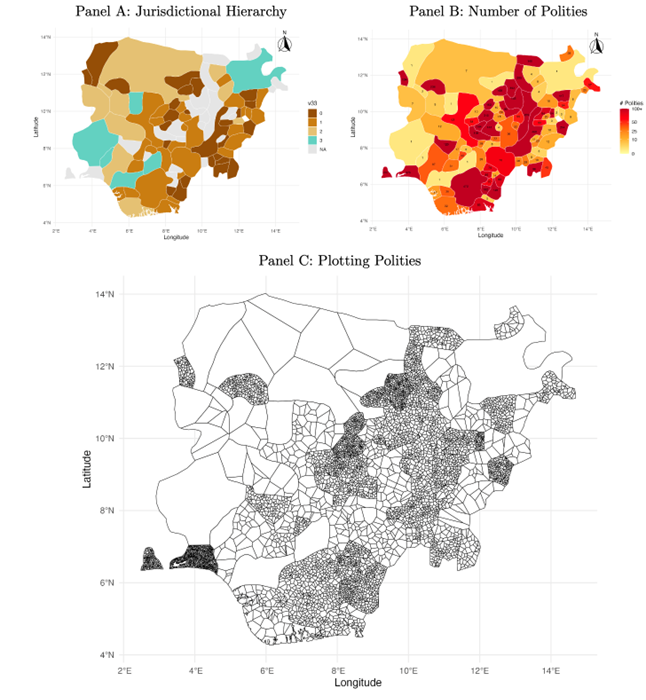
Notes: This figure shows the process of estimating the number of polities in modern Nigeria around 1880. Panel A shows the boundaries of the Ethnographic Atlas groups as collected by Murdock (1967) and digitised by Nunn and Wantchekon (2011) and the levels of jurisdictional hierarchy above the local community. Panel B plots the estimated number of polities per group using the population density and the levels of jurisdictional hierarchy. For visualisation purposes the variable is winsorised at 100 polities. Panel C plots polities across modern Nigeria by splitting the Murdock (1967) groups into equally sized polygons depending on how many polities were estimated for each group.
This not only shows that ethnic groups like the Yoruba were not politically unified and were divided into distinct polities, but also that these polities varied in their level of centralisation. Hence, there is variation in the levels of centralisation within ethnic groups. In Panel B we plot the number of polities by ethnicity and we superimpose our estimate of the number of polities on each group. This is clearly negatively correlated with levels of jurisdictional hierarchy – it is the more decentralised societies like the Igbo that have more polities, around 500 in this case. We make this point clearer in Panel C by dividing the territory of the different ethnic groups by the estimated number of polities. This gives a more visceral feel for the data.
Why was Africa so politically decentralised?
We develop an explanation for this highly decentralised political geography inspired by our reading of the literature in anthropology, history and African studies. The jumping off point is the observation of Vansina (1990, p.119) that Central Africans “refused centralization” in order to safeguard “the internal autonomy of each community”. Indeed, Vansina concludes that:
“the ability to refuse centralisation while maintaining the necessary cohesion among a myriad of autonomous communities has been the most original contribution of western Bantu tradition to the institutional history of the world” (Vansina 1990, p.237).
Vansina’s argument implies that Africans chose to keep the political scale of their societies small. In his hypothesis, however, it is not clear why they cared so much about autonomy. We provide a microfoundation for this based on the idea that African society was highly communal as well as the paramount importance of social relations and the principle of ‘wealth in people’. Africans saw centralisation as threatening to this principle and therefore opposed it. They also created many different mechanisms and institutions that made it very difficult to centralise power and we give examples of this from Igbo, Kikuyu, Somali and Tiv society. Our discussion here illustrates that within a particular level of jurisdictional hierarchy, there was a lot of variation in how African societies were organised.
Africa’s success left it vulnerable
This perspective suggests that Africans achieved what they set out to do – to keep the scale of political society small – and it is radically different from most social science analyses of Africa. Our analysis implies that, thought of in terms of the political organisation of society, Africa was not a failure, it was a success.
Nevertheless, this success turned out to have a large number of unintended consequences and it is these which are primarily responsible for the role Africa played in what Pomeranz (2000) called the “Great Divergence”. First, it exacerbated the negative impact of the slave trade. The small political scale allowed any one polity to believe it could sell its slaves to Europeans and replenish its supply from neighbours. Collectively this created a highly inefficient non-cooperative equilibrium. Second, the political organisation of Africa made it vulnerable to colonial expansion both militarily and via policies of divide and rule. It was larger polities, like China, Japan or Thailand, that were able to avoid colonialism. Within Africa it was the more centralised polities such as Ethiopia or the Zulu kingdom that could inflict military defeats on European powers. Finally, the political geography of Africa made it difficult to build effective post-colonial nation states which led to economic decline (Bates 1981), corruption and patrimonialism (see Heldring and Robinson 2013, for an overview).
There are a number of important features of the African equilibrium based on wealth in people principle. For one, it led to very positive attitudes towards outsiders and ‘strangers’, who after all had value as people. We illustrate this by showing how the words for guest and stranger are the same in many African languages. We also show how the organisation of economic institutions historically was heavily influenced by notions of wealth in people and subservient to the political goal of avoiding centralisation.
References
Bates, R H (1981), Markets and states in tropical Africa, University of California Press.
Dincecco, M, J Fenske, and M G Onorato (2019), “Is Africa different? Historical conflict and state development,” Economic History of Developing Regions, 34(2): 209–250.
Heldring, L, and J A Robinson (2013), “Colonialism and development in Africa,” VoxEU.
Henn, S J, and J A Robinson (2026), “Africa as a success story: Political organization in pre-colonial Africa,” Unpublished manuscript.
Herbst, J I (2000), States and power in Africa, Princeton University Press.
Michalopoulos, S, and E Papaioannou (2013), “Pre-colonial ethnic institutions and contemporary African development,” Econometrica, 81(1): 113–152.
Michalopoulos, S, and E Papaioannou (2017), “The long economic and political shadow of history: Volume II. Africa and Asia,” VoxEU.
Pomeranz, K (2000), The great divergence, Princeton University Press.
Vansina, J (1990), Paths in the rainforest, University of Wisconsin Press.