



Industrial policy, a powerful tool for economic development in the ‘Asian Miracles’, was based on the three key principles: promoting sophisticated export-oriented industries, fostering innovation and competition, and building accountable leading agencies.
Editor’s note: For a broader synthesis of themes covered in this article, check out our VoxDevLit on Industrial Development.
Industrial policy is no longer the policy that shall not be named (Cherif and Hasanov 2019). In the aftermath of the 2008 financial crisis, the Washington Consensus narrative and its focus on ‘structural reforms’ have been called into question (Cherif et al. 2024). The rise of China and the COVID-19 pandemic marked another turning point (Evenett et al. 2025, Amodio et al. 2026). The vulnerabilities of value chains revealed by the pandemic, and more importantly, the roots and consequences of the rise of China’s technological and industrial might have brought the industrial policy debate back to the forefront of economic policymaking, especially in advanced economies (Fasteau and Fletcher 2024). However, industrial policy has yet to be fully accepted as a viable path to achieving economic development in mainstream academic and policy circles.
To successfully implement industrial policy, policymakers in a developing country must overcome three key significant obstacles. The first relates to the debate on the merits of industrial policy at a theoretical and empirical level. By and large, this obstacle was overcome in the 2020s as the discussion moved away from ‘you can’t pick winners’ to ‘industrial policy can potentially work as it did in the past’. The second obstacle involves the view that industrial policy entails substantial risks and developing economies lack the tools to mitigate them. Lastly, after clearing the first two obstacles, an even more formidable hurdle appears: “the world has changed and the economic and political context that made industrial policy possible in the past is gone”. We argue that these obstacles are not insurmountable and suggest pathways to overcome them.
There is now a large body of evidence in support of industrial policy, one which continues to grow.[1] This includes a wide range of theoretical justifications, including from a neoclassical approach, such as the existence of various market failures requiring state intervention (Cherif and Hasanov 2025). It also includes a growing body of empirical research, showing the positive effects of various industrial policy interventions (e.g. Juhász et al. 2023).
Industrial policy and the Asian miracles
In Cherif and Hasanov (2019, 2025), we distil three key principles of successful industrial policy of the Asian Miracles – a group of countries that within a short time reached high-income status (Figure 1): (i) fostering sophisticated sectors, (ii) pushing firms to innovate early, compete domestically, and export, and (iii) ensuring accountability for public support received (Figure 2). A common institutional setup these countries adopted supported policy implementation and continuity (Cherif et al. 2026).
Figure 1: The Asian Miracles vs. other developing countries
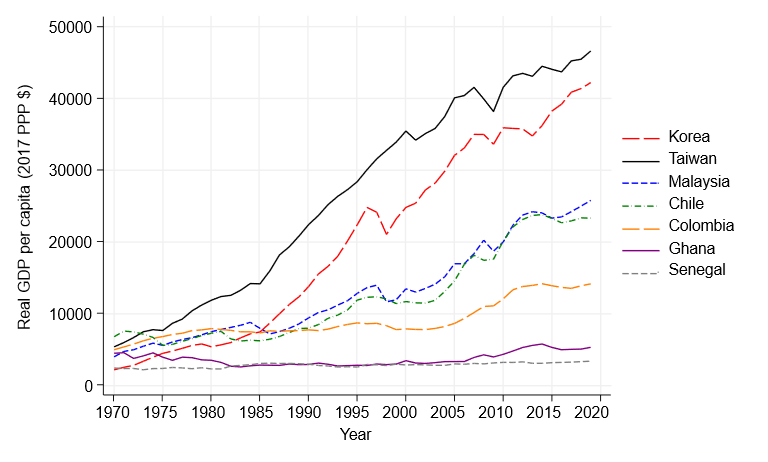
Source: Based on Penn World Tables (PWT) 10.01 (Feenstra et al. 2015).
Figure 2: A push for exports and early innovation
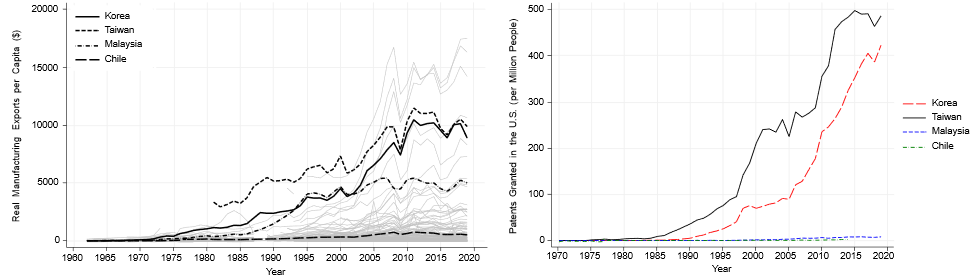
Source: World Development Indicators and US PTO.
Nonetheless, the second obstacle to overcome is the perception that industrial policy entails risks that outweigh its benefits. The argument is that developing economies cannot manage these risks, and consequently, must wait until they ‘grow up’ before they can play with industrial policy. Although policymakers should not discount the risks involved (IMF 2024), mitigation strategies can be used to minimise them.
One key risk cited against use of industrial policy relates to weak institutions – excessive fiscal spending, lack of institutional capabilities or resources and a shortage of technical skills, corruption and ‘white elephant’ projects. This line of argument calls for resolving ‘government failures’ first – providing a conducive business environment, infrastructure, education, and institutions, especially rule of law, property rights, and a well-functioning administration and judiciary. This is a horizontal policy or a structural reform approach that aims to work in an industry-neutral fashion (IMF 2024). Notably, the Asian Miracles scored lower along most institutional metrics than income peers such as Malaysia and Chile in the 1970s and 1980s while growing much faster (Cherif and Hasanov 2025). Fixing these government failures is important but may not be sufficient as market failures are still present (Cherif and Hasanov 2016). Both types of failures need to be resolved in parallel with industrial policy alleviating all types of constraints that preclude the development of a sector.
Rethinking institutions for development
We propose a different notion of ‘good’ institutions relevant for the conduct of industrial policy. The Asian Miracles built a leading agency tasked with tackling both market and government failures, accumulating industry- and context-specific knowledge, coordinating the policies needed, and relying on targeted, purpose-specific investment to develop sophisticated industries. The fact that developing countries lack capabilities does not preclude them from taking the necessary steps to build a well-functioning and autonomous yet accountable and ‘embedded’ leading agency,[2] as the success of central banks globally has shown (Cherif et al. 2026).
The other type of risk facing industrial policy relates to the numerous prerequisites required for its implementation. First, a precise cost-benefit analysis needs to determine the net return on each dollar spent. Although intuitive, this requirement puts the bar unrealistically high when compared with most government programmes, for example, in education or infrastructure, which are rarely precisely appraised in cost-benefit terms. More importantly, cost-benefit analysis is often used to assess marginal changes (e.g. build another lane of highway) as opposed to transformational ones (e.g. build a sophisticated industry), which industrial policy is designed to tackle (Coyle 2023). A holistic view is needed, considering dynamic effects and spillovers, cost of inaction, and risks and opportunities (Mazzucato 2013, Sharpe et al. 2021).
It is also argued that industrial policy puts a heavy burden on public finances. Yet many tools of industrial policy do not imply additional spending. Instead, they reset priorities and reorient fiscal resources, using ‘soft’ tools such as export promotion agencies or industry-specific regulation to foster redirecting of private finance. To further mitigate risks of excessive, poorly targeted spending, a portfolio approach of loans given or equities taken is important. The state acts as a venture capitalist, experimenting before scaling up programmes and promoting competition (Cherif and Hasanov 2019).
Although there is a recognition that intervention is justified in the presence of market failures, the argument goes that the specific market (or government) failure at play needs to be first precisely identified. However, a priori, full identification of failures is unrealistic as each industry has its own specific and wide and changing array of requirements (both market and government failures), most of which are in unknown ex ante (Cherif et al. 2026). In other words, an ‘embedded’ leading agency to successfully implement industrial policy needs to be in close contact with markets and firms to uncover these requirements or impediments by trial and error, experiment and implement solutions, and adapt them over time.
Industrial policy in a changing global economy
The third obstacle stands on the claim that the current global context precludes the successful implementation of an industrial policy ‘Asian Miracle style’. As export-orientation in sophisticated industries has been one of the key ingredients, it is argued that the recent trend in deglobalisation may have closed the door on the next wave of industrialisation for developing countries. While deglobalisation has affected North–South trade, South–South trade – driven by an enhanced regional trade integration (e.g. AfCFTA and Mercosur) – has the potential to compensate. The aggregate share of trade in global GDP has been relatively stable for the last few years (Cevik 2025, Cherif and Hasanov 2024). Both China and India reached record exports in 2025 despite the increase in tariffs they faced, and as they get richer, opportunities emerge for low-income countries as well.
Why manufacturing still matters
For most economies to be export-oriented, producing manufactured goods is vital, yet there is a widespread call against promotion of manufacturing. The decline of the employment potential of manufacturing seems to be accelerating because of automation, while the dominant role of manufacturing economies such as China, Korea, or Germany makes it difficult to imagine that developing economies could have a chance to compete. However, we argue that for mid-size and large developing economies, competing in manufacturing and sophisticated tradable services connected to manufacturing is not only possible but also crucial, supporting spillovers to other sectors, innovation (mostly concentrated in manufacturing), and productivity growth.
The aggregate share of manufacturing value added in global GDP has been strikingly stable (the same applies to the employment share), while the share of services in global trade in goods and services remains relatively small although rising. Beyond their immediate output, skill-intensive tradable industries act as economic engines, creating vast employment and demand multipliers (Moretti 2010, Bivens 2019). This impact is only intensifying as products become more complex as shown by the automotive sector's transition towards software-defined vehicles. It is sophisticated products, including manufacturing-related services, that should be the focus of modern industrial policy (Cherif and Hasanov 2019).
Windows of opportunity are opening for developing economies as wages in manufacturing are increasing rapidly in China. They could attract FDI by alleviating all the existing impediments (whether regulation, energy/land, or technical skills) as did Asian economies during Japan’s yen appreciation period known as endaka. In addition, even if the employment potential of manufacturing declines, generating sufficient exports remains paramount to improving living standards and protecting macroeconomic stability. An industrial policy focused on creating competitive export-oriented sophisticated industries would help finance parallel efforts of technology adoption and innovation to create employment opportunities in other sectors. In other words, creating ‘good jobs’ (Rodrik 2022) in non-tradable services is not a substitute but a by-product of the right type of industrial policy.
Implications for modern industrial policy
While the three obstacles of scepticism, unmitigable risks, and shifting global context present a barrier to modern industrial policy, evidence suggests that these obstacles can be overcome. Opting for a proactive and accountable institutional framework of experimentation, competition, and export-orientation, developing nations can reinterpret structural reforms to implement industrial policy, Asian Miracle style, and achieve their developmental goals.
Authors' note: The views expressed herein are those of the authors and should not be attributed to the IMF, its Executive Board, or its management.
References
Amodio, F, M Poschke, B Caprettini, J Choi, H Huang, Y-H Lei, T Reed, R Rodrigo, L F Sáenz, M Sanfilippo, M Schwartzman, G de Souza, M Sposi, and V Wiedemann (2026), “Industrial development,” VoxDevLit, 22(1).
Amsden, A H (1989), Asia’s next giant: South Korea and late industrialization, Oxford University Press.
Bivens, J (2019), “Updated employment multipliers for the U.S. economy,” Economic Policy Institute.
Cevik, S (2025), “Long live globalization: Geopolitical shocks and international trade,” International Economics and Economic Policy, 22(2): 1–20.
Chang, H-J (1994), The political economy of industrial policy, St. Martin’s Press.
Cherif, R, and F Hasanov (2016), “Soaring of the Gulf falcons: Diversification in GCC oil exporters in seven propositions,” in R Cherif, F Hasanov, and M Zhu (eds), Breaking the oil spell: The Gulf falcons’ path to diversification, IMF Press.
Cherif, R, and F Hasanov (2019), “The return of the policy that shall not be named: Principles of industrial policy,” IMF Working Paper.
Cherif, R, and F Hasanov (2024), “The pitfalls of protectionism: Import substitution vs. export-oriented industrial policy,” Journal of Industry, Competition and Trade, 24(14).
Cherif, R, and F Hasanov (2025), “Industrial policy, Asian miracle style,” Journal of Economic Perspectives, 39(4): 101–126.
Cherif, R, M Engher, and F Hasanov (2024), “Crouching beliefs, hidden biases: The rise and fall of growth narratives,” World Development, 173.
Cherif, R, F Hasanov, and G Xie (2026), “Institutions for industrial policy,” Bennet School of Public Policy.
Coyle, D (2023), Cogs and monsters: What economics is, and what it should be, Princeton University Press.
Evenett, S A, J Jakubik, J Kim, F Martín, S Pienknagura, M Ruta, S Baquie, Y Huang, and R Machado Parente (2025), “Industrial policy since the global financial crisis,” IMF Working Paper.
Fasteau, M, and I Fletcher (eds) (2024), Industrial policy for the United States: Winning the competition for good jobs and high-value industries, Cambridge University Press.
Hamilton, A (1791), Report on the subject of manufactures.
International Monetary Fund (2024), “Industrial policy coverage in IMF surveillance—Broad considerations,” IMF Policy Paper.
Johnson, C (1982), MITI and the Japanese miracle: The growth of industrial policy, 1925–1975, Stanford University Press.
Juhász, R, N Lane, and D Rodrik (2023), “The new economics of industrial policy,” Unpublished manuscript.
Mazzucato, M (2013), The entrepreneurial state: Debunking public vs. private sector myths, Anthem Press.
Moretti, E (2010), “Local multipliers,” American Economic Review, 100(2): 373–377.
Rodrik, D (2022), “An industrial policy for good jobs,” Brookings.
Sharpe, S, J-F Mercure, J Vinuales, M Ives, M Grubb, H Pollitt, F Knobloch, and F J M M Nijsse (2021), “Deciding how to decide: Risk-opportunity analysis as a generalisation of cost-benefit analysis,” UCL Institute for Innovation and Public Purpose.
Wade, R (1990), Governing the market: Economic theory and the role of government in East Asian industrialization, Princeton University Press.
Woo-Cumings, M (1999), The developmental state, Cornell University Press.