






Efficient climate policy disproportionately burdens low- and middle-income countries. Modest transfers can make it fair and feasible.
Editor’s note: For a broader synthesis of themes covered in this article, check out our VoxDevLit on Climate Adaptation.
One of the most contentious issues in global climate negotiations is who should bear the burden of climate action. Carbon policies are costly, and because climate change is a global externality, countries have incentives to free ride on the efforts of others, undermining collective climate action (Farrokhi and Lashkaripour 2025). This tension is compounded by the fact that low- and middle-income countries have contributed far less to the stock of greenhouse gases – as illustrated in Figure 1, which shows cumulative emissions across income groups – yet often face higher costs of mitigation. The principle of Common but Differentiated Responsibilities (CBDR), codified in the 1992 UNFCCC, recognises these asymmetries. Yet translating this principle into concrete financial commitments has proved difficult, leaving climate finance as a central sticking point in international negotiations.
Recent outcomes from the Conference of the Parties (COP) – the annual UN climate negotiations – highlight these challenges. At COP15 in Copenhagen in 2009, advanced economies committed to mobilising US$100 billion per year by 2020 to support climate action in developing countries, but this target was only met in 2022 (Falduto et al. 2024). More recently, at COP29 in Baku, countries agreed to raise this goal to at least $300 billion per year by 2035. While this represents a significant increase, uncertainty about delivery remains high. The persistent gap between pledges, actual transfers, and estimated needs continues to constrain the ambition of global climate policy.
Figure 1: Cumulative CO2 emissions across income groups
Efficient climate policy, unequal burdens
In recent work (Le Moigne, Lepot, Ritel, and Simon 2026), we study how climate policies affect countries differently and quantify the transfers required to compensate those bearing the highest costs – typically low- and middle-income economies. A key feature of our analysis is that it accounts for the global nature of production and trade: by changing relative prices, climate policy reshapes patterns of specialisation, consumption, and supply chains, leading to varying economic impacts.
To assess these effects, we use a benchmark: a uniform global carbon tax that applies the same price to each ton of CO₂ emitted worldwide. While such a policy requires a high degree of coordination, it provides a useful reference point for isolating the distributional consequences of efficient climate action and quantifying what fairness would require in terms of international transfers.
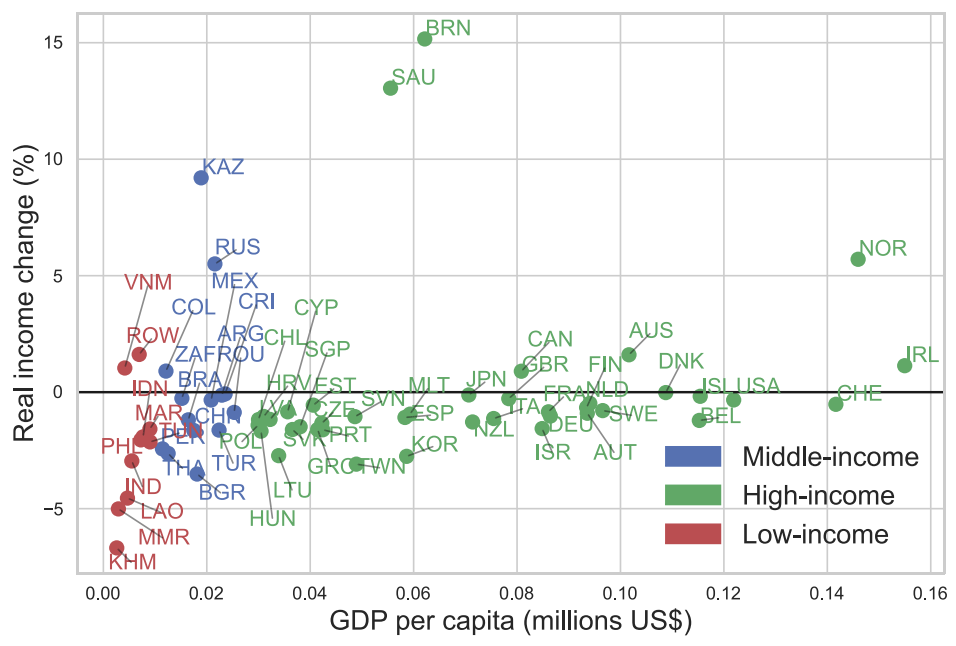
Our findings reveal a stark asymmetry. Even though low- and middle-income countries have contributed relatively little to historical emissions and are expected to suffer the most from climate change, they bear a disproportionate share of the costs of climate action. Using a global trade model covering 64 countries and multiple sectors, we show that a carbon tax of $100 per ton of CO₂ reduces global emissions by about 50%, while the average real income loss remains modest at around 0.5%. However, this average masks large disparities: low- and middle-income economies can experience real income losses of up to 8%, whereas many high-income countries face much smaller losses – or even gains. Figures 2 and 3 illustrate these differences under alternative tax revenue recycling schemes.
These disparities arise because low- and middle-income economies tend to specialise in more carbon-intensive sectors and rely on more emissions-intensive technologies. As a result, policies that are globally efficient can still be highly unequal. Accounting for avoided climate damages makes climate policy more attractive overall – particularly for vulnerable countries – but does not fully offset these effects. Many low-income countries still face net welfare losses even after accounting for avoided damages.
Figure 2: Real income changes under consumer carbon taxes
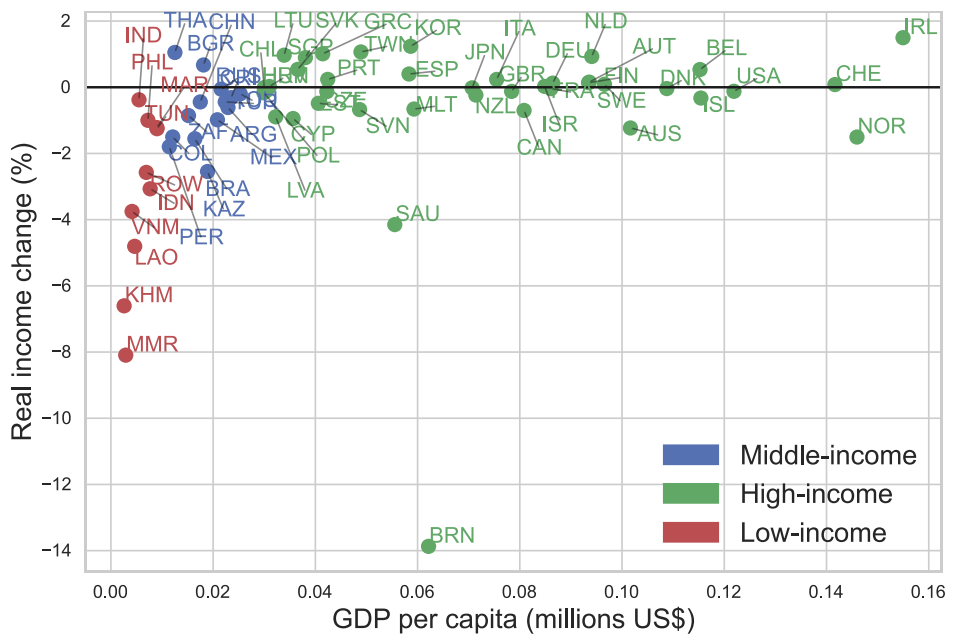
Figure 3: Real income changes under producer carbon taxes
Can transfers reconcile efficiency and fairness?
These findings point to a central role for international transfers. If some countries gain while others lose, redistributing part of these gains can make climate policy both efficient and equitable. We consider two principles for allocating transfers: an equal-cost approach, which equalises the burden of climate action across countries, and a polluter-pays approach, based on historical emissions.
Our results show that realistic transfers are sufficient to eliminate unequal burdens. Under a uniform carbon tax, transfers from the economic North to the economic South of roughly $100–170 billion per year would equalise costs across countries, corresponding to a transfer of about $90–200 per capita in high-income economies.
These magnitudes are striking for two reasons. First, they are comparable to existing climate finance pledges, suggesting that current commitments are not far from what would be required to make global carbon pricing equitable. Second, they are small relative to the size of advanced economies, indicating that such redistribution is economically feasible.
The specific structure of transfers depends on how carbon taxes are implemented. If revenues are rebated to the country of consumption, high-income economies such as the US and Europe are the main contributors. If rebated to the country of production, fossil fuel exporters play a larger role. When transfers are based on historical emissions, however, tax design becomes less consequential, as allocations reflect historical responsibility. In all cases, substantial flows emerge from the Global North to the Global South.
Are alternative proposals more attractive?
Given the political challenges of implementing a uniform global carbon price, policymakers have proposed alternatives such as the IMF’s International Carbon Price Floor (ICPF), which sets different carbon prices by income level. While such differentiated pricing appears more consistent with CBDR, our results suggest otherwise.
Differentiated carbon pricing reduces efficiency, leading to higher global costs for a given level of emissions reduction. It does not necessarily improve equity and, in some cases, requires even larger transfers. For example, an ICPF limited to major emitters – including Canada, China, the EU, Great Britain, India, and the US – requires North–South transfers about 9% higher than under a uniform global carbon tax.
Expanding the scheme further increases transfer needs. Only when applied globally do transfers fall slightly below the benchmark. However, all ICPF variants perform worse in terms of efficiency, with global real-income losses up to six times larger than under uniform pricing.
Policy implications: Rethinking climate cooperation
Our results point to three key policy implications:
- Distributional concerns are central. Climate policies generate substantial and unevenly distributed costs that are closely linked to income levels. As a result, distributional concerns are not peripheral but lie at the core of international climate cooperation.
- Ambition and fairness can go hand in hand. First-best policies can become equitable when combined with international transfers. The scale of redistribution required is in line with existing climate finance commitments, suggesting that countries have the means to pursue more ambitious and effective climate action.
- Differentiated pricing is not necessarily the solution. While politically appealing, it leads to worse economic and distributional outcomes. Combined with the substantial loss of emissions reductions under limited participation (Larch and Wanner 2024), this reinforces the case for uniform pricing with transfers.
Climate finance is often framed as a constraint on climate action. Our results suggest the opposite: it is a key enabler. Efficient climate policies can deliver large emissions reductions at relatively low global cost, but without mechanisms to share the burden fairly, they will remain politically infeasible. Bridging the gap between efficiency and equity through credible international transfers may therefore be the missing piece in global climate cooperation.
References
Falduto, C, J Noels, and R Jachnik (2024), "The new collective quantified goal on climate finance: Options for reflecting the role of different sources, actors, and qualitative considerations," Unpublished manuscript.
Farrokhi, F, and A Lashkaripour (2025), "Can trade policy mitigate climate change?" Econometrica, 93(5): 1561–1599.
Larch, M, and J Wanner (2024), "The consequences of non-participation in the Paris Agreement," European Economic Review, 163: 104699.
Le Moigne, M, S Lepot, D Simon, and M Ritel (2026), "The distributional effects of carbon pricing across countries," Journal of International Economics, 160: 104228.