






Using data on 513 million workers worldwide, we show that location plays a major role in shaping earnings – and that better allocation of workers across cities could raise incomes, especially in developing countries.
Editor's note: The authors have made slides available here.
Why are some places more productive than others? And how much could incomes rise if people moved to better locations? These questions are central to development economics (Clemens et al. 2019). Large differences in earnings exist across countries and cities. But it is difficult to know how much of these differences reflect the places themselves, as opposed to the types of people who choose to live there (de la Roca and Puga 2017, Combes et al. 2008, Card et al. 2025).
In new work (Bhalothia, Engelstad, Khanna, and Mitchell 2025), we provide the first global evidence on this question using detailed job histories for over 513 million workers across 220,000 cities in 191 countries. By tracking individuals as they move between cities, we are able to estimate how much of wage differences are driven by place effects – the causal impact of location – rather than sorting.
A global dataset of worker mobility
Our analysis uses detailed employment histories, including job location, occupation, firm, and the timing of moves. This allows us to compare workers’ earnings before and after they move. This ‘movers’ approach isolates the effect of place: if a worker earns more after moving to a new city, the difference – holding worker ability constant – reflects the value of that location (Finkelstein et al. 2016).
Figure 1: Global variation in average city wages
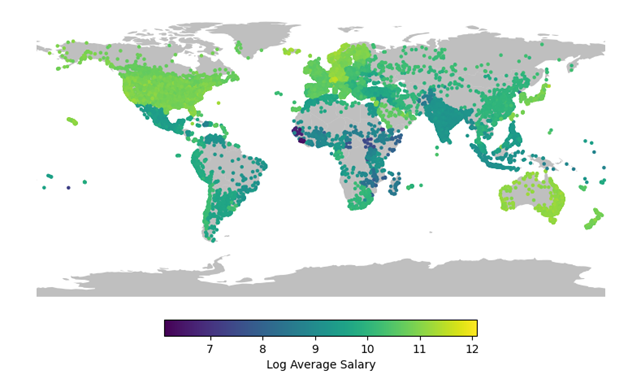
Notes: The map shows the average wages calculated in each city with over 100 users in our data (on a log scale), across the world.
The first key fact is the enormous variation in wages across cities. High-wage cities are concentrated in North America and Europe, while cities in South Asia and sub-Saharan Africa tend to have much lower wages. Even within countries, there are large differences; for example, between coastal and inland cities in the US or between southern and eastern regions in India. These patterns highlight the potential importance of location in shaping economic outcomes.
Place effects are large, especially across countries
We find that location plays a major role in determining earnings. For workers who move across countries, about 93% of the wage difference between origin and destination cities is realised after the move. This implies that most cross-country wage gaps reflect differences in the productivity of places, rather than differences in worker characteristics. Within countries, place still matters, but less so. Around 45–73% of wage differences across cities reflect location, with the remainder due to sorting of workers.
Figure 2: Earnings changes after moving to higher-value cities
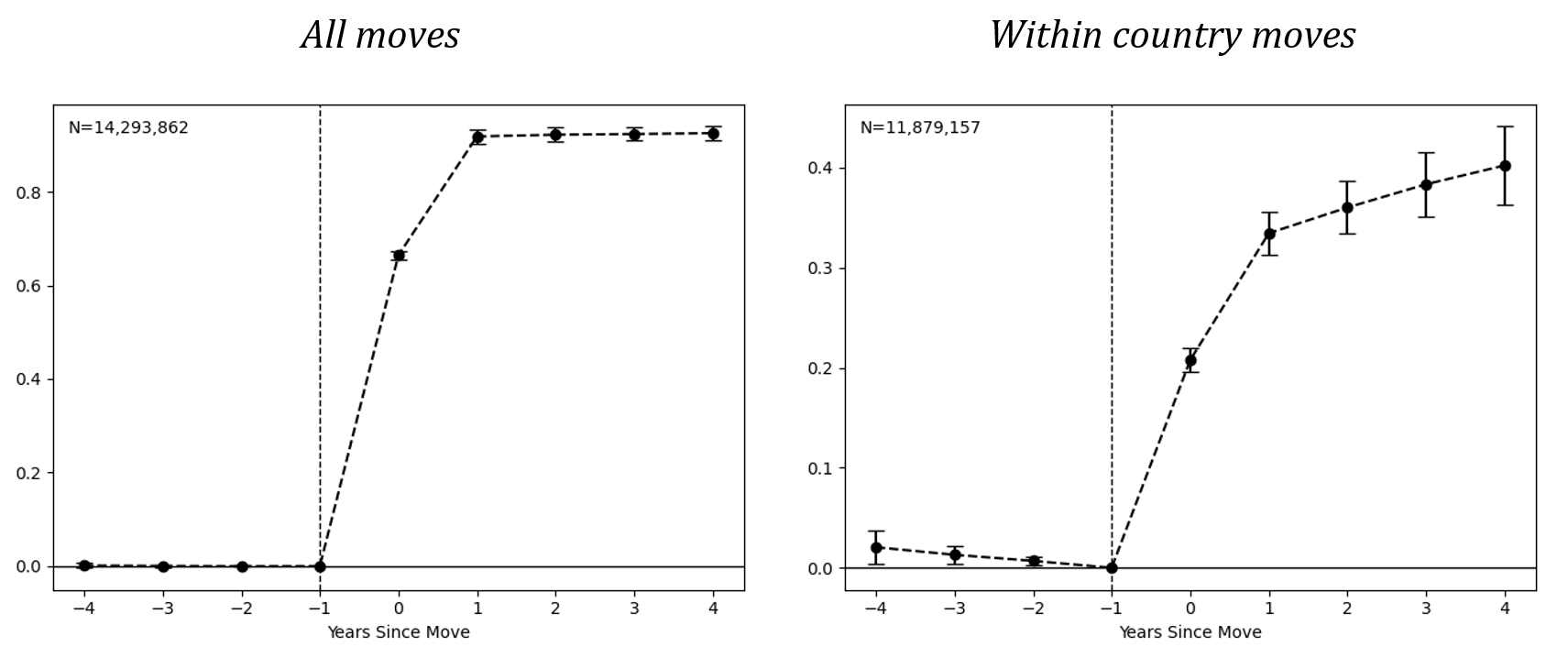
Notes: Plot shows the OLS estimate for the interaction term between the year relative to move and the difference in average log wages between the move origin and destination, which can be interpreted as the fraction of the wage difference movers get. The left panel includes all movers in the sample who go between only 2 cities, and the right panel is restricted to only within-country moves.
Event-study evidence shows that wages increase sharply in the year of a move to a higher-value city, with no evidence of pre-trends. This suggests that the gains are not driven by workers moving after receiving raises, but by the productivity of the destination city itself. In addition to higher wages, workers also move into more senior positions, higher-paying occupations, and more productive industries. Cities thus shape not only pay but also the kinds of opportunities available to workers.
What makes cities more productive?
Why are some cities more productive than others? We highlight two key mechanisms:
- Cities with more diverse industries and larger populations tend to be more productive, consistent with agglomeration economies (Glaeser and Gottlieb 2009).
- The way workers are allocated across firms within a city plays an important role.
Figure 3: Worker allocation across firms within cities
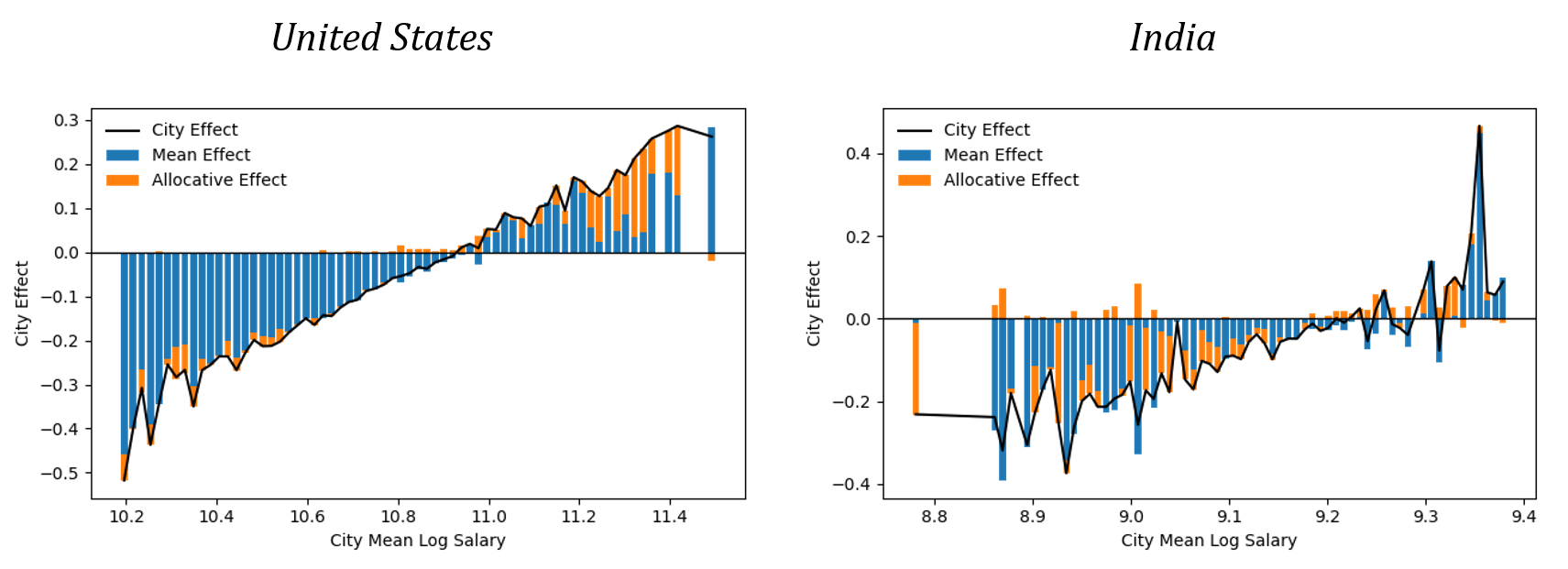
Notes: The city effect is the average firm effect for all firms within a city weighted by the number of worker-years at the firm. The figure decomposes the city effect between the (unweighted) average firm effect and the allocative effect, which comes from having higher weighted high-effect firms. The left panel plots this decomposition for the US, and the right panel plots it for India.
In more productive cities, a larger share of workers is employed in high-productivity firms. In contrast, in many developing countries, even productive cities fail to allocate workers to the most productive firms. Too few workers are employed in the most productive firms, which reduces overall productivity. This suggests that within-city allocation of workers across firms is an important source of income differences across places.
Large unrealised gains from better allocation
These differences in city productivity translate into large potential gains from improving how workers are allocated. In many developing countries, workers are not concentrated in the most productive cities. Even within cities, workers are not efficiently matched to high-productivity firms.
Figure 4: Counterfactual gains from reallocating workers
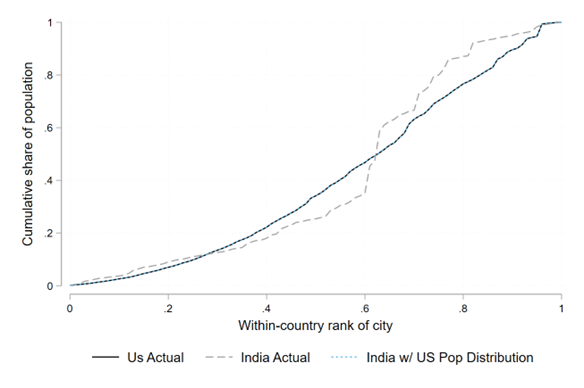
Notes: We reallocate workers between cities in India so the population CDF across cities matches the US CDF.
We quantify the potential gains from improving allocation. Reallocating workers across cities to match the distribution observed in the US raises average incomes by around 2–3% in countries such as India. Improving allocation across firms within cities yields similar gains. Combining both margins leads to even larger increases in income. These gains are largest in low-income countries, where both spatial and within-city frictions are more severe.
Where people live drives what they earn
Our findings highlight the importance of location in shaping economic opportunity. Reducing barriers to migration can help workers access more productive cities. Investments in infrastructure and housing can make productive cities more accessible while reducing congestion. Improving how workers are matched to firms can also raise productivity within cities.
Where people live plays a central role in determining their economic outcomes. While individual skills matter, place itself is a powerful driver of productivity and earnings. At the same time, many countries are far from efficiently allocating workers across cities and firms. Reducing these frictions offers a promising path to raising incomes, particularly in the developing world.
References
Bhalothia, A, G Engelstad, G Khanna, and H Mitchell (2025), "The global value of cities," Unpublished manuscript.
Card, D, J Rothstein, and M Yi (2025), "Location, location, location," American Economic Journal: Applied Economics, 17(1): 297–336.
Clemens, M A, C E Montenegro, and L Pritchett (2019), "The place premium: Wage differences for identical workers across the U.S. border," Review of Economics and Statistics, 101(3): 493–506.
Combes, P-P, G Duranton, and L Gobillon (2008), "Spatial wage disparities: Sorting matters!" Journal of Urban Economics, 63(2): 723–742.
de la Roca, J, and D Puga (2017), "Learning by working in big cities," Review of Economic Studies, 84(1): 106–142.
Finkelstein, A, M Gentzkow, and H Williams (2016), "Sources of geographic variation in health care: Evidence from patient migration," Quarterly Journal of Economics, 131(4): 1681–1726.
Glaeser, E L, and J D Gottlieb (2009), "The wealth of cities: Agglomeration economies and spatial equilibrium in the United States," Journal of Economic Literature, 47(4): 983–1028.