






Rwandan industrial policy, which licensed and supported textile manufacturers to produce high-quality masks during the COVID-19 pandemic, successfully reduced mask prices, increased mask uptake, and slowed the spread of COVID-19. The intervention averted contagion at a cost of just $10 per averted case, suggesting strategic industrial policy has a clear role in pandemic preparedness.
Editor’s note: For a broader synthesis of themes covered in this article, check out our VoxDevLit on Industrial Development.
Global supply chains are increasingly threatened by global crises and geopolitics. Countries may turn to strategic industrial policy to ensure capacity to scale up production of essential inputs during crises. The Pandemic Era raised the stakes: international responses during COVID-19 resulted in an inequitable distribution of essential medical inputs, particularly in developing countries, with consequences for COVID-19 mortality (Sachs et al. 2022).
Industrial policy for pandemic response was an important part of policy toolkits in developing countries to ensure sufficient availability of masks during the COVID-19 pandemic. Masks were essential to help slow the spread of COVID-19 (Abaluck et al. 2020, Howard et al. 2021). Yet this necessity led to rapid increases in global demand for masks following the rapid onset of the COVID-19 pandemic, raising fears over insufficient supply and motivating export restrictions on masks. Many countries responded with industrial policy: support to local manufacturers to produce masks.
Mask manufacturing to the rescue
In recent work (Byrne, Kondylis, Loeser, and Mukama 2026), we ask whether the promotion of mask manufacturing during the COVID-19 pandemic was effective at increasing the availability of masks and slowing the spread of COVID-19 in Rwanda.
Not enough masks. Rwanda detected its first case of COVID-19 in March 2020, and a national lockdown was announced shortly after. By the end of April, a national public mask mandate was introduced and strictly enforced, and lockdowns were partially lifted. Rwanda, like many countries, faced severe constraints for mask availability in the early months of the COVID-19 pandemic: by the end of April, mask prices had increased 197% relative to January. While informal cloth mask producers initially stepped in, these masks were unlikely to be as effective as higher quality masks (Konda et al. 2020).
Industrial policy for pandemic response. On April 17th, the Rwanda Food and Drug Administration issued licences to selected textile manufacturers to produce surgical and barrier masks. The Ministry of Trade and Industry also announced it would facilitate these firms to access machines and raw materials, and the Ministry of Finance and Economic Planning announced a value added tax exemption for domestically manufactured masks. In contrast to informal masks, masks produced by licensed manufacturers were tested for quality and audited.
Measuring mask trade. Studying this required following all these manufactured masks across the country. To track these, we used ‘eInvoices’, digital timestamped receipts that report item-level transactions. eInvoices are used by firms to claim input taxes, so receipts identify both selling firms and buying firms. We identified all licensed mask manufacturers, geolocated all buyers and sellers, and used item descriptions to identify sales of masks or other products. Our data covers 75,000 purchases of nearly 5 million masks at an average price of RWF 680 (US$0.66) per mask.
Figure 1: Example eInvoice
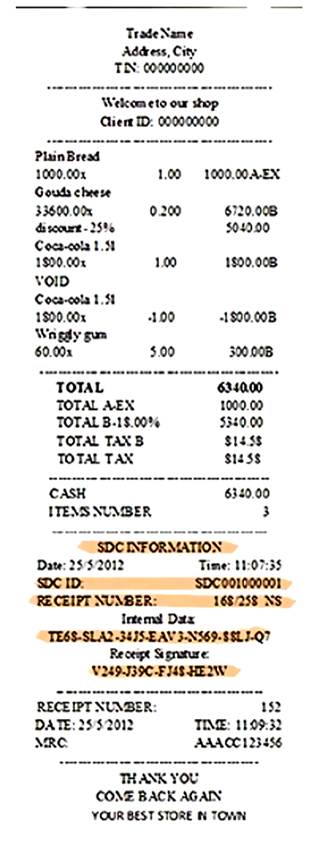
Notes: An illustrative eInvoice. Each line records an item sold, with description, quantity and price.
But the masks didn’t reach everywhere
To estimate the impacts of mask manufacturing, we apply a research design built on the following observation: sub-districts tend to source masks from the same places they previously purchased non-mask textiles, such as clothing. Some sub-districts mostly sourced clothing from places that had no licensed mask manufacturing; these sub-districts had low mask manufacturing exposure. Other sub-districts mostly sourced clothing from places with a lot of licensed mask manufacturing; these sub-districts had high mask manufacturing exposure.
We implement an exposure design and estimate the impacts of licensed mask manufacturing by comparing high and low exposure sub-districts before and after licensing. Crucially, we find that mask manufacturing exposure does not strongly predict sub-district characteristics and does not predict pre-licensing changes in sub-district outcomes. This suggests that post-licensing changes reflect the impact of licensed mask manufacturing.
Figure 2: Mask manufacturing exposure
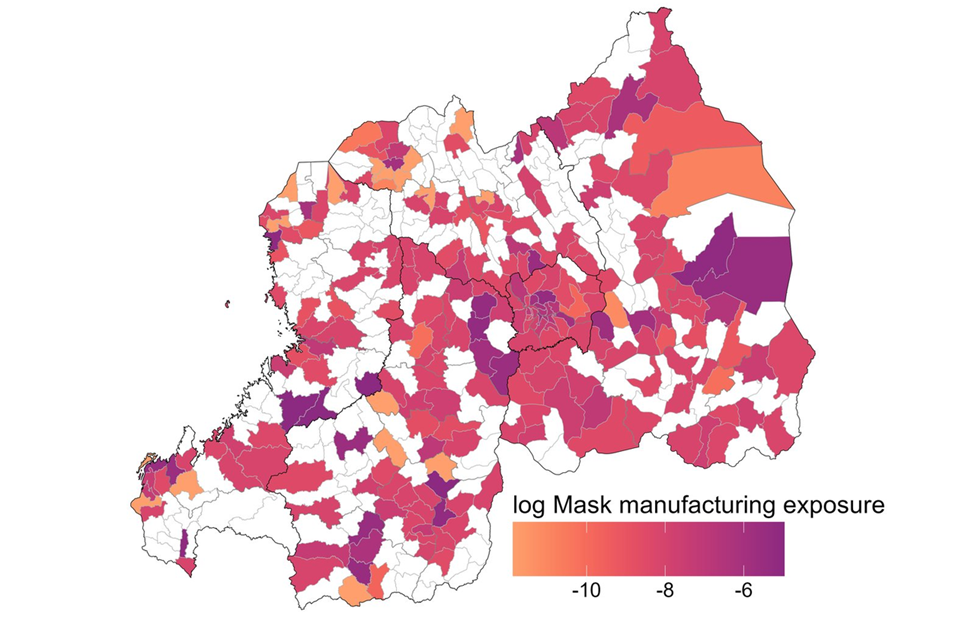
Notes: Mask manufacturing exposure across Rwanda. Darker sub-districts faced higher (log) Mask manufacturing exposure. White sub-districts indicate no data.
Mask prices fell. First, we find a one standard deviation increase in mask manufacturing exposure persistently reduced mask prices by 7.5%. These effects persisted for over year, by which point mask prices had reverted to January 2020 levels. This suggests higher mask manufacturing exposure reflects lower costs of trade with the sources of manufactured masks.
Figure 3: Mask price
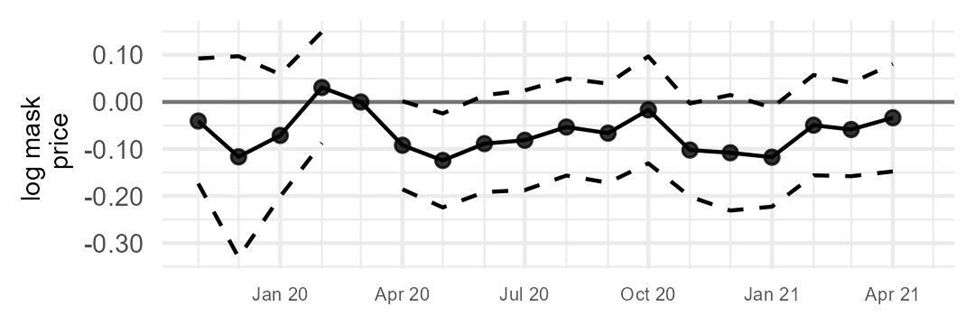
Notes: Effect of mask manufacturing exposure on mask prices, by month, relative to March 2020. Dotted lines are sub-district clustered confidence intervals at 5% significance.
People bought more masks. Second, we find large increases in mask purchases in high mask manufacturing exposure sub-districts, but only from April until June 2020. On June 29, 2020, Rwanda extended by law the quality standards applied to the licensed manufactured masks to all locally sold masks. This meant individuals could no longer choose to buy informal cloth masks to comply with mask mandates, and without this outside option purchases of manufactured masks converged between high and low mask manufacturing exposure sub-districts.
Figure 4: Quantity of masks purchased from manufacturers per adult
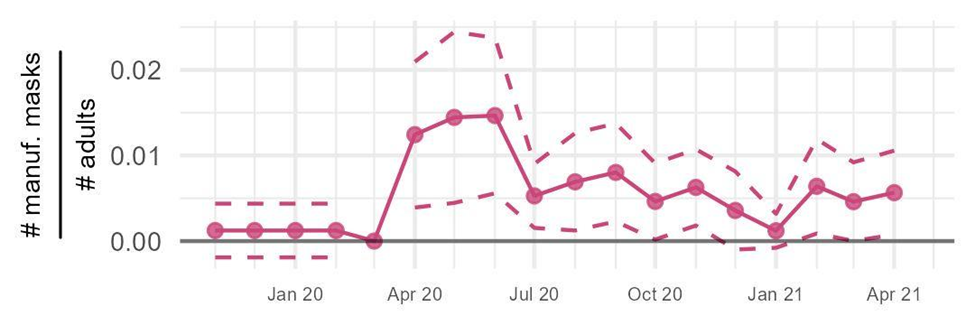
Notes: Effect of mask manufacturing exposure on per-adult purchases of manufactured masks, by month, relative to March 2020. Dotted lines are sub-district clustered confidence intervals at 5% significance.
COVID-19 infections fell while people bought more masks. Third, we find that high quality masks slowed the spread of COVID-19. Measuring this impact was challenging: sub-district-level data on COVID-19 cases is not available; instead, we used purchases of fever medicine as a proxy for COVID-19 infections, which we validated using district-level case data. We find mask manufacturing exposure reduced growth in COVID-19 infections from April until June 2020, resulting in lower levels of COVID-19 infections. That is, COVID-19 infection growth was slowed while impacts on high-quality mask purchases persisted.
Figure 5: Number of paracetamol purchases
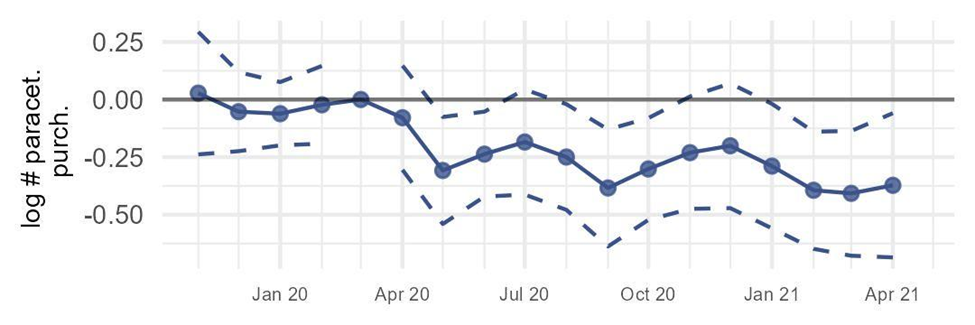
Notes: Effect of mask manufacturing exposure on paracetamol purchases (our proxy for COVID-19 infections), by month, relative to March 2020. Dotted lines are sub-district clustered confidence intervals at 5% significance.
How important were high-quality masks?
Between April and June 2020, mask manufacturing exposure caused individuals to buy more high-quality masks and reduced the rate of COVID-19 infection growth. Scaling impacts on COVID-19 infection growth by impacts on manufactured mask purchases per adult, we calculated universal use of high-quality masks reduces monthly infection growth by 55%. Similar calculations yield estimates of 35% from employee mandates in the US (Chernozhukov et al. 2021) and 19% from promotion of masks in rural villages in Bangladesh (Abaluck et al. 2022). Given our estimate was in the context of strictly enforced mask mandates and yet is not smaller, and if anything larger, suggests that the quality of masks plays an important role in their effectiveness.
Cost-effective industrial policy
A similar calculation suggests that licensed mask manufacturing averted 2,988 COVID-19 cases in Rwanda, a 12% decrease. The cost of the value added tax exemption implies a cost per averted COVID-19 case of approximately $10, an order of magnitude smaller than estimated health care costs. The answer then, to our original question, is yes: promotion of mask manufacturing during the COVID-19 pandemic was effective at increasing the availability of masks and slowing the spread of COVID-19 in Rwanda. In a world where global crises can constrain trade, Rwanda’s experience suggests a clear role for strategic industrial policy as part of pandemic preparedness and response.
References
Abaluck, J, J A Chevalier, N A Christakis, H P Forman, E H Kaplan, A I Ko, and S H Vermund (2020), "The case for universal cloth mask adoption and policies to increase supply of medical masks for health workers," Unpublished manuscript.
Abaluck, J, L H Kwong, A Styczynski, A Haque, M A Kabir, E Bates-Jefferys, and A M Mobarak (2022), "Impact of community masking on COVID-19: a cluster-randomized trial in Bangladesh," Science, 375(6577): eabi9069.
Amodio, F, M Poschke, B Caprettini, J Choi, H Huang, Y-H Lei, T Reed, R Rodrigo, L F Sáenz, M Sanfilippo, M Schwartzman, G de Souza, M Sposi, and V Wiedemann (2026), "Industrial development," VoxDevLit, 22(1).
Byrne, K, F Kondylis, J Loeser, and D Mukama (2026), "A few good masks: mask manufacturing and supply networks in Rwanda during the COVID-19 pandemic," Journal of Development Economics, 181: 103715.
Chernozhukov, V, H Kasahara, and P Schrimpf (2021), "Causal impact of masks, policies, behavior on early COVID-19 pandemic in the US," Journal of Econometrics, 220(1): 23–62.
Howard, J, A Huang, Z Li, Z Tufekci, V Zdimal, H M Van Der Westhuizen, A von Delft, A Price, L Fridman, L Tang, V Tang, G L Watson, C E Bax, R Shaikh, F Questier, D Hernandez, L F Chu, C M Ramirez, and A W Rimoin (2021), "An evidence review of face masks against COVID-19," Proceedings of the National Academy of Sciences, 118(4): e2014564118.
Konda, A, A Prakash, G A Moss, M Schmoldt, G D Grant, and S Guha (2020), "Aerosol filtration efficiency of common fabrics used in respiratory cloth masks," ACS Nano, 14(5): 6339–6347.
Sachs, J D, S S A Karim, L Aknin, J Allen, K Brosbøl, F Colombo, and S Michie (2022), "The Lancet Commission on lessons for the future from the COVID-19 pandemic," The Lancet, 400(10359): 1224–1280.