



When fertiliser prices spike, farmers in countries dependent on fertiliser imports are hit especially hard, and governments must grapple with a range of trade-offs in how they respond.
Editor’s note: For a broader synthesis of themes covered in this article, check out our VoxDevLit on Industrial Development.
After Russia invaded Ukraine, global fertiliser prices tripled, generating the largest increase in fertiliser prices since the 1970s oil crisis. Policymakers reacted quickly. The African Development Bank called for “urgent countercyclical policy such as subsidies” to offset rising food and energy costs (ADB 2022), while former head of the UN World Food Programme David Beasley more apocalyptically warned of “hell on earth” without action (AP 2022). Across Africa, governments expanded existing subsidy programmes (Burundi, Rwanda, Zambia), introduced new ones (Tanzania), or revived old ones (Kenya). Fertiliser subsidies were suddenly back at the centre of policy debates.
Figure 1: Global fertiliser prices for DAP and urea
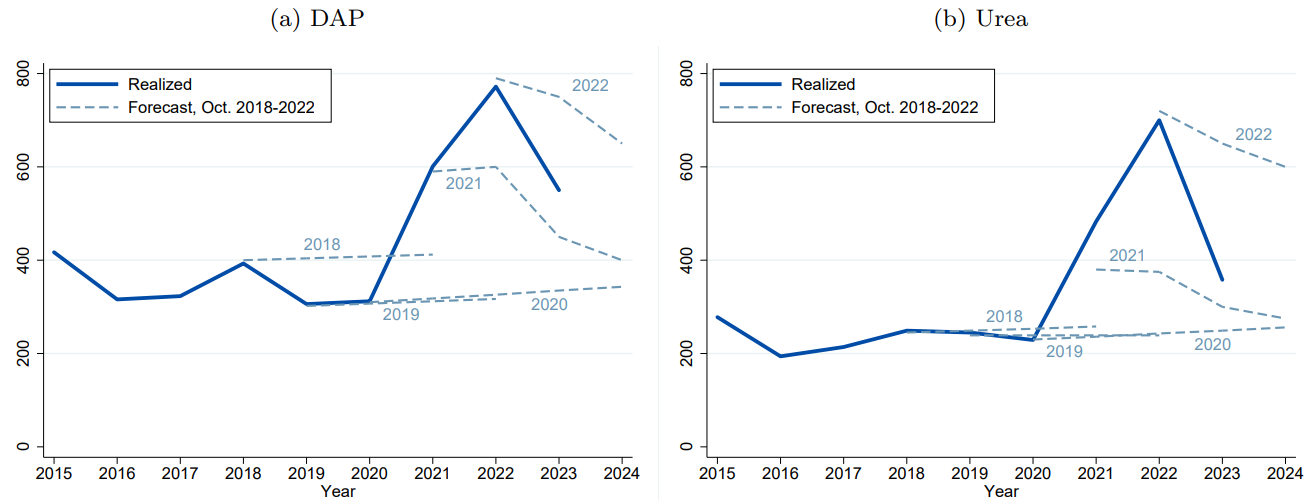
Notes: This plots the nominal international prices for DAP (Panel A) and urea (Panel B) from the World Bank Commodity Price Outlook. The dashed lines are forecasted future prices made at the listed year.
How the spike in fertiliser prices impacted farmers in Rwanda
This shock hit Rwanda, where agriculture accounts for 65% of employment, hard. Like many other countries in Africa, Rwanda imports all of their inorganic fertiliser and the government plays an important role in the market through subsidies. In response to the 2022 shock, they immediately increased their per-unit subsidy from 30% to 45% for most fertilisers, causing the programme’s cost to increase from 4% to 19% of the Agricultural Ministry’s budget (from 5 billion Rwandan francs in 2020 to 13 billion francs in 2022). Taking the global shock and government response in tandem, Rwandan farmers paid 70% more per kilogram of fertiliser in 2022 than they did one season before.
Figure 2: Market price of fertiliser and subsidy rate for three main fertilisers in Rwanda
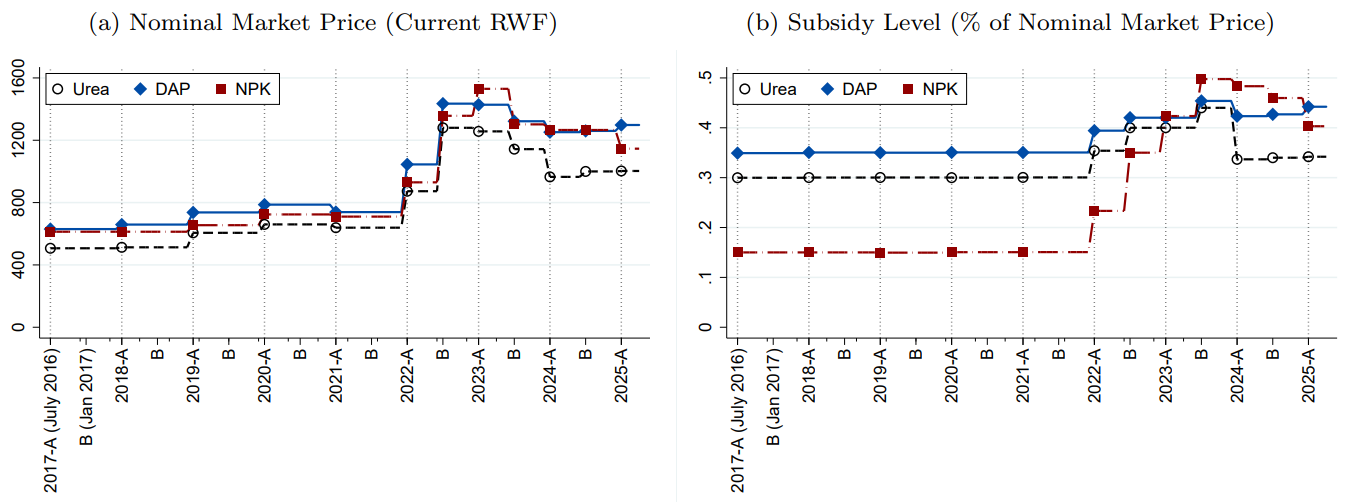
Notes: Panel (a) is the market price for fertiliser, which is set by the Rwandan government but mostly tracks international prices. Panel (b) is the subsidy level. Farmers pay the market price net of subsidy. Each includes the three main fertilisers used in Rwanda. The Rwandan agricultural season includes two main seasons labelled on then horizontal axis.
We collected panel data from about 15,000 households across 444 rural villages between 2020 and 2024. The fertiliser price shock hit midway through data collection, offering a unique opportunity to observe how households responded to such a large, unexpected shock.
One key factor to understand about agriculture is just how important environmental characteristics, things like soil quality, are across villages.
For instance, Figure 3 plots the government-recommended level of fertiliser for potatoes in the western part of Rwanda. You can see that there is substantial variation within even small geographic areas.
Figure 3: Government fertiliser recommendations for potatoes
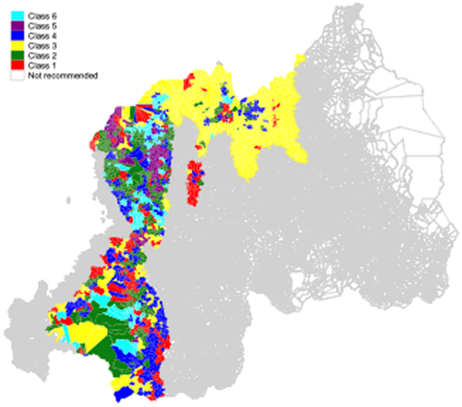
Note: 6 is highest recommendation, 1 is lowest.
We document substantial changes in production, labour intensity, prices and, importantly for our results, large differences in the response across villages. The most fertiliser-intensive villages experience 30% lower fertiliser spending, 21% lower harvests, and 11% higher output prices compared to the least intensive villages. This spatial variation is central to our analysis.
Subsidies are a common response to price shocks
With fertiliser prices closely tied to volatile oil and gas markets in our current geopolitical era, these pressures are unlikely to disappear. Our research (Brooks and Donovan 2026) revisits the role of fertiliser subsidies as optimal policy and asks: how should governments respond when fertiliser prices spike?
There is a seemingly intuitive answer. Farmers in developing countries are often poor and credit constrained, so when fertiliser becomes more expensive, their costs rise and they cannot easily maintain the same level of input use, leading to lower production and income. From this perspective, raising subsidies to protect farmers seems like the natural response.
We use a modern quantitative model combined with granular micro data to show that this intuition is incomplete. While subsidies may need to rise after a price shock, that is not always optimal. And whether it should rise does not depend on the simple intuition described above. The key is how output prices and production adjust across locations when fertiliser costs change. Ignoring these responses can lead to misleading policy conclusions.
We quantify our model for the case of Rwanda. After a shock like the one in 2022, we find that the optimal subsidy remains roughly unchanged, in sharp contrast to the 50% subsidy increase that was implemented in practice. This difference reflects the central trade-off in our model: higher subsidies protect farmers but also distort where production takes place.
Trade-offs: Production, inequality, and policymaker instruments
We consider an economy with three key features. First, returns to fertiliser vary across locations, for example, due to differences in soil quality. Second, households are credit constrained and therefore cannot borrow to finance fertiliser purchases. Third, subsidies must be financed, usually via taxes on consumption like VAT on non-agricultural goods.
Because fertiliser is more productive in some locations than others, higher prices make it efficient to shift production toward areas that rely less on it. In a well-functioning economy, this reallocation would happen through price changes without any policy intervention. But credit constraints limit farmers’ ability to respond: even if output prices rise, they cannot borrow to increase their input use. As a result, production does not adjust enough after a shock.
This creates scope for policy. Lowering the fertiliser subsidy helps reallocate production toward less fertiliser-dependent areas when markets fail to do so.
However, this is only part of the story. Reducing subsidies also harms farmers in areas where fertiliser is most important. An optimal policy would account for this and combine two elements:
- Lower subsidies to improve the allocation of production.
- Targeted, redistributive transfers to compensate the farmers most affected.
For example, after a price shock, the government could reduce subsidies while providing cash transfers to fertiliser-intensive villages. These transfers are financed by those areas that expand production and therefore increase income. Done properly, this makes all villages better off. Other transfers can substitute for cash, like subsidising food purchases, and accomplish the same goal.
There are two important insights here. First, efficient production reallocation pushes the subsidy down after a price shock. This is the part that the intuition at the beginning does not take into account. Second, how fertiliser subsidies should evolve after a shock depends on the set of instruments available to the policymaker.
In practice, however, policymakers make lack the ability to implement these types of targeted transfers. In this case, they face a trade-off. Lowering the subsidy improves the allocation of production but can also increase poverty in those fertiliser dependent areas. Whether the subsidy should rise or fall depends on the balance of these two forces. This is an empirical question that requires understanding where the poorest households are and how their consumption is affected by the shock.
Taking the model to the data in Rwanda
Using the data from our panel survey to estimate our model, we find that the optimal subsidy remains roughly unchanged at 10% before and after the shock (it rises from 10.0% to 10.3%, to be exact). By contrast, the Rwandan government raised their subsidies from about 30% to 45%.
The small adjustment implied by our model reflects two offsetting forces. Efficient production considerations push the subsidy lower, shifting production away from fertiliser-intensive areas. On the other hand, poverty concerns push in the opposite direction. These forces roughly offset given the empirical evolution of production and consumption across Rwandan villages. Put differently, if farmers were rich enough to absorb the shock on their own, our model would imply a decline in the optimal subsidy after a price shock.
Of course, our model also predicts a lower 10% baseline subsidy than the 30% observed in Rwanda before the shock. Interestingly though, if we calibrate the model to resemble Rwanda a decade ago, with lower incomes and lower returns to savings, the optimal subsidy rises from 31% to 46%. This more closely matches observed policy after the 2022 shock.
Figure 4: Optimal Policy
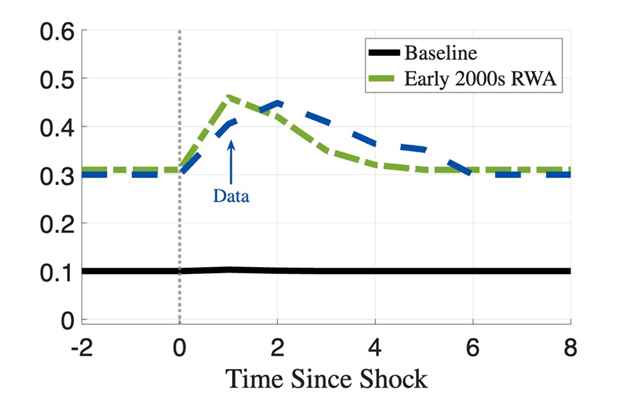
Notes: This figure plots the observed time path of fertiliser subsidies in Rwanda (blue) along with our model-implied optimal subsidy (black). The green dashed line is the optimal subsidy in a counterfactual economy that more closely resembles Rwanda in the early 2000s.
This comparison suggests to us that subsidy policy may be slow to adjust to economic progress. Despite substantial gains in productivity and income, subsidy levels remain high. Recent policy documents have highlighted this over-subsidisation concern and explored reform options (e.g. World Bank 2024). Yet these reports also highlight the difficult political economy issues inherent in doing so. While these political economy forces are not in our model, they are critical to consider in designing policy that can adjust to aggregate economic conditions. Incorporating them into models of optimal policy remains an important direction for future research, and can take advantage of the growing empirical evidence on the topic (see Juhász and Lane 2024, for a terrific recent review).
Economically optimal vs politically feasible
Agriculture is a large and politically important sector of developing countries. Improving its productivity is an important part of medium- and long-term growth. Fertiliser subsidies can support this goal, but with a limited social safety net, they also serve as short-term stabilisation. The past five years show how important it is to get these policies right. In a world in which energy costs are intertwined with an unstable geopolitical environment, developing countries are likely to face this issue more frequently.
A central lesson from our analysis is that fertiliser subsidies cannot be designed in isolation. Even the qualitative statement of whether a subsidy should rise or fall after a fertiliser price shock depends on what other policy tools it interacts with. Ignoring them risks inefficient or unnecessarily costly policy.
We should emphasise that we are not the only ones working on these ideas. There has been an explosion of exciting work studying normative questions of agricultural policy, including Diop (2025), Garg and Saxena (2025), Chakraborty et al. (2026), and Mazur and Tetenyi (2026), among others. These papers highlight how the details of policy implementation shape their effectiveness and distributional consequences. As industrial policy becomes more globally prominent and price volatility continues in the agricultural sector, designing policies that balance efficiency, equity, and political feasibility remains an open, and increasingly urgent, challenge.
References
African Development Bank Group (2022), "African economic outlook 2022: Supporting climate resilience and a just energy transition in Africa."
Associated Press (2022), "UN food chief warns of 'hell on earth' food lows."
Brooks, W, and K Donovan (2026), "Industrial policy with development characteristics: Fertilizer subsidies in a time of crisis," Unpublished manuscript.
Chakraborty, P, A Chopra, and L Contractor (2026), "The equilibrium impact of agricultural support prices and input subsidies," Unpublished manuscript.
Diop, B Z (2025), "Upgrade or migrate: The effects of fertilizer subsidies on rural productivity and migration," Unpublished manuscript.
Garg, S, and S Saxena (2025), "Distributional effects of agricultural interventions in India," Unpublished manuscript.
Juhász, R, and N Lane (2024), "The political economy of industrial policy," Journal of Economic Perspectives, 38(4): 27–54.
Mazur, K, and L Tetenyi (2026), "The macroeconomic impact of agricultural input subsidies," Unpublished manuscript.
World Bank (2025), "Rwanda economic update, April 2025: Modernizing agriculture to accelerate structural transformation in Rwanda."