








A West African TV series in Senegal led to short- and medium-term gains in knowledge and attitudes around violence against women and sexual and reproductive health, though impacts on behaviours were limited, and a podcast version extending content during COVID-19 was ineffective.
"It's through the show that you understand what's going on in the world . . . for teenagers, it's by watching the show that they will understand the problems of a 15-year-old who is married and pregnant. By watching the show . . . they will realise that it's real and they will be careful. Even women like me, will understand how childbirth happens and will take lessons for tomorrow" – Individual interview, married adolescent girl, age 16
Everyone loves a good TV show – one that captivates, elicits emotions, makes you reflect on life and leaves you wanting more. Using the power of media to educate defines the ‘edutainment for development’ approach (Grady et al. 2021, Peterman 2026) – embedding diverse behaviour change messages in drama reaching key audiences via TV, radio, and social media. Researchers have increasingly studied how edutainment can be used to improve gender and health-related outcomes in Africa, including programming to change HIV and risky sex in Nigeria, early and forced marriage in Tanzania, and violence against women in Egypt (Banerjee et al. 2019, Green et al. 2022, Christia et al. 2023). While evidence to date is promising (Peterman 2026), few studies have explored multi-topic series, how impacts can be optimised through complementary activities, and if impacts accumulate or fade over time. Understanding these elements can contribute to broader goals of scaling effective programming, while contributing to viewers’ enjoyment and quality of life.
In new research (Dione, Heckert, Hidrobo, Le Port, Peterman, and Seye 2026), we evaluate the popular West African TV series C’est la Vie!, designed around women’s health and rights themes. The show revolves around everyday life in a maternal health clinic in Senegal, developed and produced by Dakar-based NGO RAES. We investigate whether the series improved adolescent girls’ and young women’s knowledge, attitudes, and behaviours with respect to a wide range of themes across violence against women and girls (VAWG), and sexual and reproductive health (SRH) in Senegal. In addition to exploring impact on key outcomes, we test whether impacts varied by randomised design features, including: i) adding post-viewing discussions and workshops on key themes (‘pedagogical kits’), ii) varying whether the girls and young women selected to participate were encouraged (‘nudged’) to bring a male or female guest, and iii) extending exposure to content via audio podcasts. These variations allow us to test a variety of design features which implementers may consider as they seek to amplify impacts of edutainment.
C’est la Vie! Season 1 trailer
Source: RAES.
Evaluating the impact of edutainment in Senegal
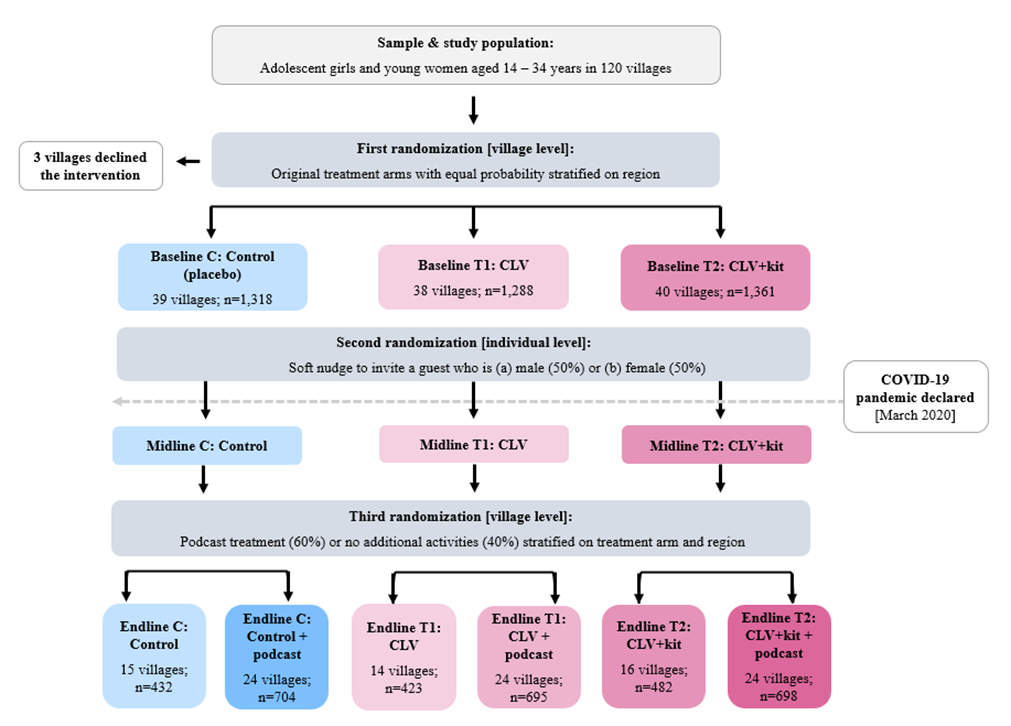
Our research took place in 120 rural villages across Kaolack and Kolda regions, with villages randomised to one of three groups: 1) placebo film (control), 2) C’est la vie! (CLV), and 3) C’est la vie! with additional pedagogical kits (CLV+kit) (Figure 1). The C’est la Vie! series (Season 1) and the placebo film were delivered through bi-weekly film clubs attended by adolescent girls and young women (aged 14–34). The baseline survey was conducted in late 2019, and the film clubs began in December 2019. However, in mid-March, the government of Senegal declared a state of emergency due to COVID-19, forcing the closure of the film clubs halfway through implementation (~4.5 out of nine planned film club sessions had taken place, or ~14 of the 26 episodes in Season 1). We implemented a midline phone survey (three months post-film clubs) to capture short-term impacts. To continue to reach participants with thematic content during periods of social distancing, we shifted delivery of C’est la Vie! to audio podcasts broadcasted via mobile phone. To ensure we could still learn from this shift, we randomised 60% of villages within each treatment arm to receive the podcast (40% of villages received no additional activities, while the placebo group received a placebo podcast). Finally, we implemented an in-person endline survey approximately nine months after the film clubs had ended, or approximately one year after the baseline survey.
Figure 1: C’est la Vie! randomised control trial study design
Successes and lessons learned in Senegal
Film clubs were a huge hit, with high take up and attendance. Overall, nearly 90% of invited adolescent girls and young women participated in film clubs – attending 65% of screenings on average. Participants overwhelmingly reported loving C’est la Vie! and did not want the film clubs to end. They learned new things, were ‘awakened’ to life outside their communities, and discussed what they learned and saw with family and friends. In a complementary process evaluation (Le Port et al. 2022), we assess participants’ responsiveness and engagement, as well as series appropriateness for the target population, with the overall conclusion mirroring the survey results.
“The film club changed women’s outlook on child marriage because I once heard my wife say that the minimum age to give our daughter into marriage is 18 and [now] she goes further by saying that she will not give our daughter in marriage until 20 years and I am in tune with her and ready to support her in her vision” – Male focus group participant
There were promising short- and medium-term impacts on knowledge and attitudes, but no overall impacts on behaviours. In the short term, C’est la vie! increased VAWG and SRH knowledge (Figure 2). Impacts on VAWG knowledge are large (0.28 standard deviations (SDs)), driven by increases of 13–23% in knowledge of adverse consequences of child marriage, female genital mutilation, and intimate partner violence. Impacts on SRH knowledge are smaller but significant at 0.17 SDs, driven by increases of 16–27% in knowledge of modern contraceptives and HIV transmission and prevention methods. In the medium term, these knowledge impacts have faded out. However, we find significant improvements in VAWG attitudes and norms (0.13 SDs), driven by improvements of 4–14% the same themes. Nonetheless, overall aggregate impacts on behaviours across VAWG and SRH at endline are not significant. These findings point to the importance of measuring the evolution of impacts over time, as well as the challenges in changing behaviours.
Figure 2: Impacts on aggregate VAWG and SRH outcomes over time and by study arm
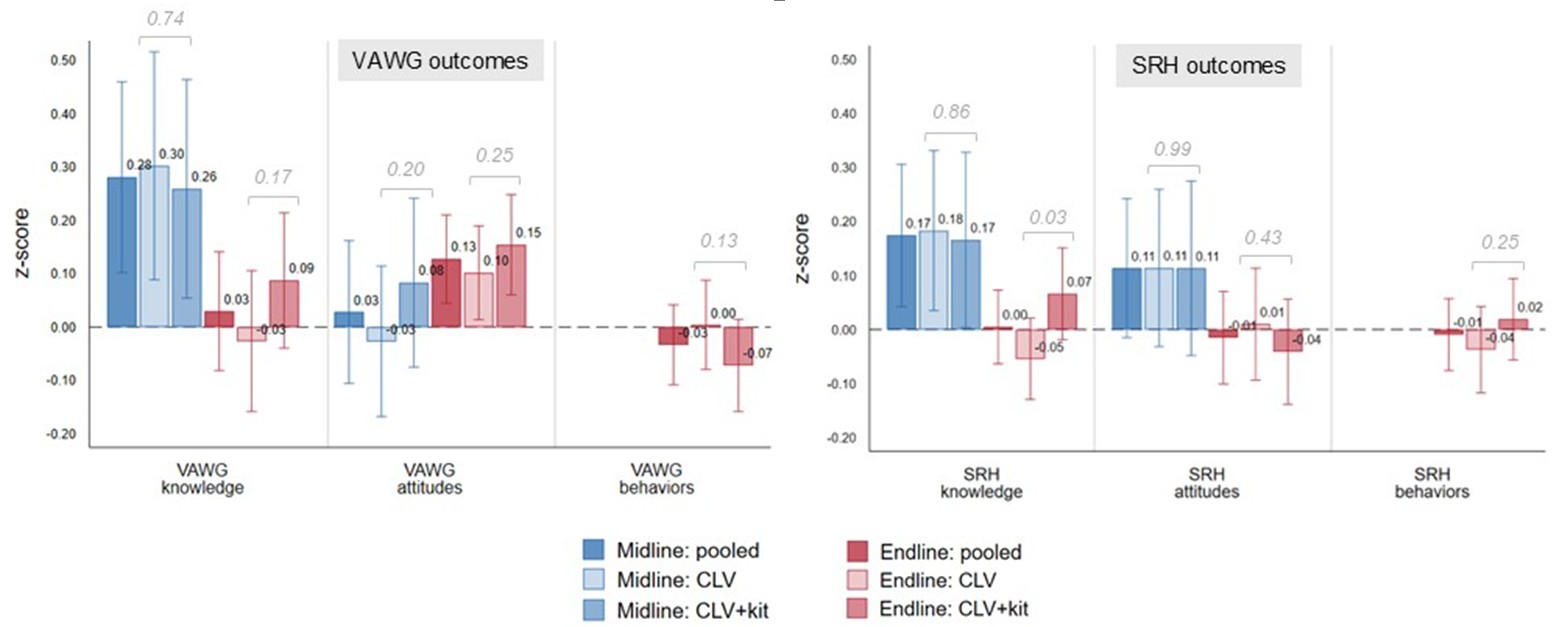
Notes: Estimates are from ANCOVA models using midline (phone survey, n = 3,003) and endline (in-person survey, n = 3,433) samples; behaviour measures were not collected at midline. Coloured bars indicate coefficients with 90% confidence intervals; p-values showing tests of significance between study arms (CLV versus CLV+kit) are shown over the bars in italics.
Adding pedagogical kits resulted in little additional impact. Across outcomes and survey waves, we find minimal differences when pedagogical kits are added to film screenings (Figure 2, p-values reported over study arm bars). This could be because participants were already widely discussing themes and the content of the series outside the film clubs, or because the kits did not introduce significantly more information than was already transmitted in the series. In addition, the content and breadth of the kits were condensed to adapt to implementation realities in rural areas. Thus, it is possible that impacts would have been larger with more intense or in-depth implementation of the kits.
"My family thinks it's good to attend, because it teaches the girls so many things. After each screening, I tell them about everything we saw and each of them gives their opinion.”– Individual interview, unmarried adolescent girl, age 15
Involving men and boys is linked to gains in SRH but not VAWG. We find that SRH knowledge gains were up to twice as large in the ‘male nudge’ group than in the ‘female nudge’ group; however, we find no other differential impacts. Thus, despite the effort to include men and boys through guest invitations, it was not enough to change most outcomes. Monitoring data shows that roughly half of the participants in the group nudged to bring a male guest did so at least once, driving nearly all male participation in sessions. However, even when men and boys attended, they were unlikely to return for future sessions. The process evaluation reveals that participants believed film clubs were ‘for women’ and the series focused on ‘women’s issues’. These results suggest that additional effort and targeted content to engage men and boys may be needed to drive broader behaviour change.
Extending the intervention during COVID-19 via podcasts was ineffective. Despite efforts to pivot implementation during the pandemic, podcasts faced implementation challenges, with lower participation rates than film clubs, possibly because of access and connectivity. In addition, it is possible the podcasts were simply less entertaining than gathering with friends and family to watch the series on a big screen. Unsurprisingly, we found no additional impacts from the podcast extension across knowledge, attitudes or behaviour outcomes – signalling the challenges in remote administration of edutainment, and the role of engagement and community interactions to promote impacts.
An engaging storyline is important. We find that adolescent girls and young women who were more ‘transported’ (emotionally moved) by the series showed significantly larger impacts compared to those who were less transported, suggesting that the power of edutainment lies in its ability to emotionally engage viewers in the storyline. While this analysis is correlational, it highlights the importance of the production phase in generating content that will absorb and captivate viewers.
Implications and future research on edutainment
Our work showed mixed impacts of edutainment in a challenging pandemic environment. Nonetheless, positive shifts demonstrated across numerous themes of knowledge and attitudes provide useful learning, which set the stage for optimising content for broader behaviour change. With increasing visibility, we expect the potential and innovation around edutainment for gender equality and violence to gain momentum in the coming years. We believe there is high potential to leverage diverse platforms and linkages to services to deliver and bolster edutainment impacts and directly target and engage men to move the needle on masculinities and violence. The study team is currently working with RAES to co-develop new edutainment and evidence in Senegal to do exactly this. Stay tuned or get in touch for more details!
Authors' note: This study would not have been possible without the work of many partners. Our thanks go to implementing partners, MobiCiné and RAES for helpful comments and for collaboration on this research. We thank research partners, including the hard-working field teams of ASSMOR Consulting (baseline and endline) and Laboratoire de Recherche sur les Transformations Economiques et Sociales (LARTES) (midline) and the adolescent girls and women who took part in our survey and shared their stories for this analysis. Finally, we are thankful to the CGIAR Research Program on Policies, Institutions, and Markets (PIM) and an anonymous donor for funding this work. A previous version of this blog appeared on the CGIAR website.
References
Banerjee, A, E La Ferrara, and V H Orozco-Olvera (2019), "The entertaining way to behavioral change: Fighting HIV with MTV," Unpublished manuscript.
Christia, F, H Larreguy, E Parker-Magyar, and M Quintero (2023), "Empowering women facing gender-based violence amid COVID-19 through media campaigns," Nature Human Behaviour, 7(10): 1740–1752.
Dione, M, J Heckert, M Hidrobo, A Le Port, A Peterman, and M Seye (2026), "C'est la vie!: Mixed impacts of an edutainment television series in West Africa," Journal of Development Economics, 182: 103748.
Grady, C, A Iannantuoni, and M S Winters (2021), "Influencing the means but not the ends: The role of entertainment-education interventions in development," World Development, 138: 105200.
Green, D P, D W Groves, C Manda, B Montano, and B Rahmani (2022), "A radio drama's effects on attitudes toward early and forced marriage: Results from a field experiment in rural Tanzania," Comparative Political Studies, 56(8): 1115–1155.
Le Port, A, M Seye, J Heckert, A Peterman, A Nganya Tchamwa, M Dione, A S Fall, and M Hidrobo (2022), "A community edutainment intervention for gender-based violence, sexual and reproductive health, and maternal and child health in rural Senegal: A process evaluation," BMC Public Health, 22(1): 1165.
Peterman, A (2026), "Edutainment to prevent violence against women and children," The World Bank Research Observer, 41(1): 78–117.