








A five-year randomised trial across Tanzania finds that entrepreneurship training delivered to young women before family obligations set in produces lasting income gains, but both economic and reproductive-health programmes unexpectedly increased early pregnancy – an effect attenuated when the two are combined.
Adolescence is a turning point. The few years around the end of secondary school shape the rest of young women’s working and family lives (Aizer et al. 2022, Goldin and Katz 2002). In low-income countries, where those transitions are especially sharp, governments, donors, and NGOs invest heavily in empowerment programmes for adolescent girls – economic or reproductive. However, the evidence base is fragmented. Entrepreneurship programmes often raise incomes only briefly (McKenzie 2017), while reproductive-health programmes are usually evaluated on sexual behaviour alone (Dupas 2011, Duflo et al. 2015).
Yet the question of what drives early pregnancy remains unresolved. Is it driven by a lack of information and control over one’s own body – in which case reproductive-health programmes should help – or by a lack of economic alternatives – in which case entrepreneurship should help? Remarkably few studies measure both income and fertility together over the long term (Jensen 2012, Bandiera et al. 2020, Donald et al. 2024). Our recent research (Berge, Bjorvatn, Makene, Sekei, Somville, and Tungodden 2026) brings the two sides of the question together in a single large-scale trial.
A randomised controlled trial of empowerment
We worked with 80 public secondary schools across four regions of central Tanzania. The 3,483 participants were in their final year of lower secondary, at the threshold of a national exam most are likely to fail – a moment when they face immediate decisions about work, relationships, and children. Schools were randomly assigned to one of four arms: a control group, an economic-empowerment programme, a reproductive-health programme, or a combination of the two. We then followed the women for more than five years, reaching almost all of them at least once in three follow-up rounds.
The programmes were delivered in after-school sessions by local teachers, nominated by the women themselves and trained by the NGO Femina HIP. The economic programme ran eight weekly sessions on entrepreneurial mindset, identifying business opportunities, marketing, pricing, and basic financing, illustrated with role models of successful young businesswomen. The reproductive-health programme ran eight parallel sessions on bodily changes, building healthy relationships, contraception, risks of teenage pregnancy, and protection against violence. In the combined arm, the participants received both programmes, across 16 sessions.
Lasting gains in income
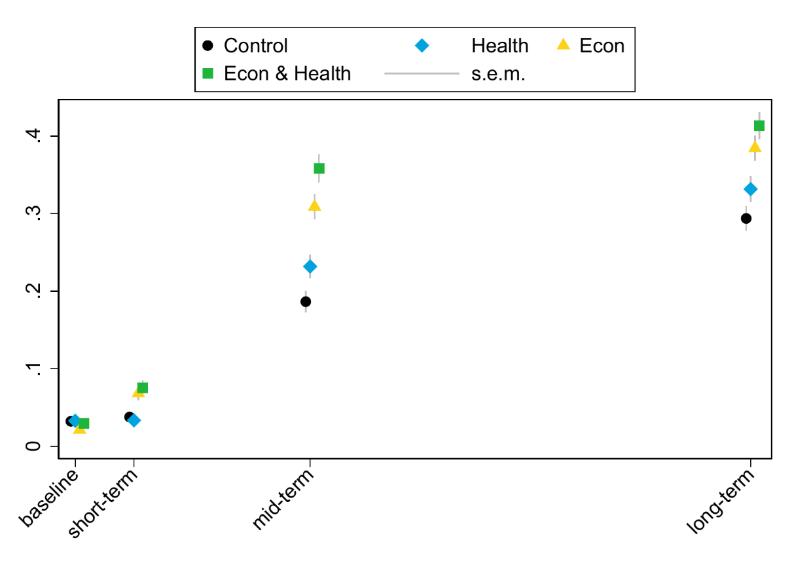
Four years on, the economic programme had delivered a durable income effect. Self-employment was higher in every follow-up round (Figure 1). Weekly incomes were about 27% higher in the long term, and the share of women below the poverty line had fallen by roughly four percentage points. This contrasts with the typically modest and transitory income effects of vocational-training programmes for youth (Blattman and Ralston 2015, Berge et al. 2017, McKenzie 2017). A plausible reason is that we intervened before family obligations and childcare narrowed the women’s economic options, echoing Alfonsi et al. (2020) in Uganda.
Figure 1: Share of women with their own income-generating activity, by treatment arm, over time
Both programmes raised early pregnancy
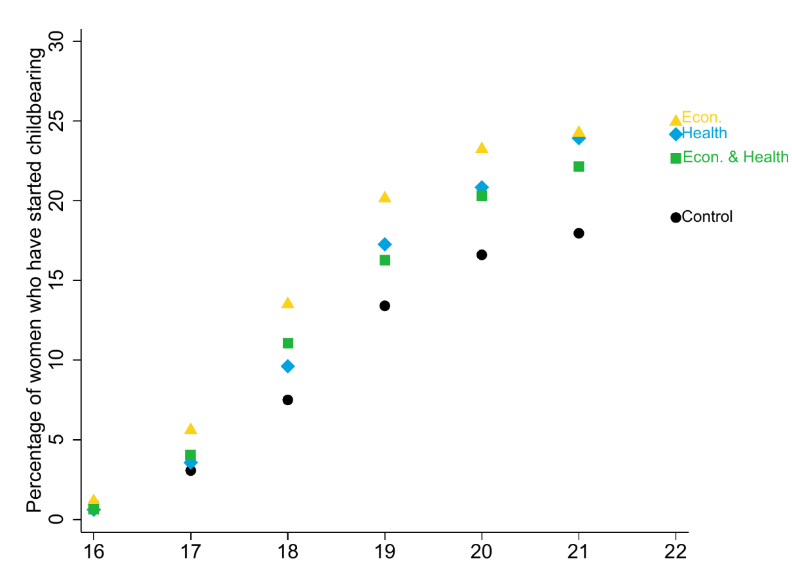
The programmes also affected fertility, with each increasing early pregnancy. The share of women who had a child before age 20 rose from about 10% in the control group to roughly 18% in the economic arm, with smaller but still substantial increases in the reproductive-health and combined arms (Figure 2). Overall childbearing rose by about one fifth in the single-programme arms.
Figure 2: Share of women who have started childbearing, by age and treatment arm
Why did this happen?
The income channel. In high-fertility contexts where most women work in flexible self-employment, higher incomes can translate into more children, not fewer. This is consistent with recent evidence from sub-Saharan Africa (Vogl 2016, Donald et al. 2024, Garcia-Hernandez et al. 2025) and with long-standing patterns in richer countries (Doepke et al. 2022). Self-employment is much more compatible with childcare than salaried work. In our data, self-employment and early pregnancy are strongly associated: self-employed women are about 10 percentage points more likely to have had an early pregnancy, whereas women in salaried employment are not.
The relationship channel. The reproductive-health programme did not change sexual knowledge or the frequency of sexual activity. What it changed was relationships: 25% more women in this arm were in a committed partnership a year after the programme, with partners who provided substantial financial support; 75% of women with a stable partner received regular money from him. The effect is concentrated among the poorest women – for whom, our evidence suggests, forming a committed relationship works as a survival strategy (echoing Duflo et al. 2015).
Decision-making power moderates both channels. Among women with more decision-making power – a composite measure of self-control and gender-equal attitudes – the associations between income, relationships, and early pregnancy are weaker. The combined arm produced fewer pregnancies than the sum of the two stand-alone programmes, a negative complementarity we think reflects the extra decision-making power the combined curriculum delivered. This matters, because the women themselves, both at baseline and shortly after the programmes, self-reported that they preferred to start having children around age 26, not at 18.
Well-being is about more than income
Income alone did not translate into sustained happiness. After the first year, self-reported happiness in the economic arm tracked the control group. The combined arm showed a lasting gain of around nine percentage points, three to four years later, with smaller and less consistent gains in the health-only arm. Relationships and decision-making power, not earnings, seem to do the long-run work on well-being.
Policy implications for women’s empowerment
Four takeaways emerge:
- Targeting the transition matters. Reaching young, unmarried women before family obligations narrow their options can generate durable income gains that look very different from the typical vocational-training study.
- Expect a positive income–fertility link in these settings. In contexts with high baseline fertility, widespread self-employment, and tight household budgets, raising incomes tends to raise childbearing – a pattern that is rarely stated explicitly but is consistent with our data and with the broader evidence base.
- Combine economic with reproductive-health training. Doing both attenuates the fertility response and produces the largest gains in happiness. The two curricula complement each other on the outcomes that likely matter most for the young women themselves.
- Use local resources. Because our programmes were delivered by the women’s own teachers, trained by a local NGO, they are realistic to scale.
A final caveat
Empowerment is not only opportunity – it is also the decision-making power to use those opportunities as one wishes. Even well-intentioned programmes can increase the social pressure on young women to start families earlier than they themselves would choose, through the incomes they unlock and the relationships they help build. Designing interventions that protect women’s own preferences, not just their earnings or their health, is an important question for future research.
References
Aizer, A, P J Devereux, and K G Salvanes (2022), “Grandparents, moms, or dads? Why children of teen mothers do worse in life”, Journal of Human Resources 57(6): 2012–2047.
Alfonsi, L, O Bandiera, V Bassi, R Burgess, I Rasul, M Sulaiman, and A Vitali (2020), “Tackling youth unemployment: Evidence from a labor market experiment in Uganda”, Econometrica 88(6): 2369–2414.
Bandiera, O, N Buehren, R Burgess, M Goldstein, S Gulesci, I Rasul, and M Sulaiman (2020), “Women’s empowerment in action: Evidence from a randomized control trial in Africa”, American Economic Journal: Applied Economics 12(1): 210–259.
Berge, L I O, K Bjorvatn, and B Tungodden (2015), “The role of human and financial capital in microenterprise development: Experimental evidence from Tanzania”, Management Science 61(4): 707–722.
Berge, L I O, K Bjorvatn, F Makene, L Helgesson Sekei, V Somville, and B Tungodden (2026), “On the doorstep of adulthood: Entrepreneurship and fertility of young women in Tanzania”, The Economic Journal, advance article.
Blattman, C, and L Ralston (2015), “Generating employment in poor and fragile states: Evidence from labor market and entrepreneurship programs”, SSRN Working Paper 2622220.
Doepke, M, A Hannusch, F Kindermann, and M Tertilt (2022), “The economics of fertility: A new era”, NBER Working Paper 29948.
Donald, A, M Goldstein, T Koroknay-Palicz, and M Sage (2024), “The fertility impacts of development programs”, World Bank Policy Research Working Paper 10848.
Duflo, E, P Dupas, and M Kremer (2015), “Education, HIV, and early fertility: Experimental evidence from Kenya”, American Economic Review 105(9): 2757–2797.
Dupas, P (2011), “Do teenagers respond to HIV risk information? Evidence from a field experiment in Kenya”, American Economic Journal: Applied Economics 3(1): 1–34.
Garcia-Hernandez, A, N Prakash, and J I Steinert (2025), “Empowerment paradox? The long-run impact of a cycling program for girls in Zambia”, CESifo Working Paper 11889.
Goldin, C, and L F Katz (2002), “The power of the pill: Oral contraceptives and women’s career and marriage decisions”, Journal of Political Economy 110(4): 730–770.
Jensen, R (2012), “Do labor market opportunities affect young women’s work and family decisions? Experimental evidence from India”, Quarterly Journal of Economics 127(2): 753–792.
McKenzie, D (2017), “How effective are active labor market policies in developing countries? A critical review of recent evidence”, World Bank Research Observer 32(2): 127–154.
Vogl, T S (2016), “Differential fertility, human capital, and development”, Review of Economic Studies 83(1): 365–401.