



Conflict disrupting transport routes in Somalia raises food prices and worsens household welfare in distant, peaceful markets, showing that the economic costs of violence travel far beyond the front line through supply chains. Aid strategies focused on areas with active fighting should be complemented by protection of key transport corridors and supply-chain monitoring to reach all affected communities.
Policy responses to conflict are typically geographically targeted, focusing on areas where violence occurs. In Somalia, for example, interventions by organisations such as the World Food Programme concentrate on conflict-affected regions, particularly around Mogadishu (WFP 2021).
This approach implicitly assumes that the welfare effects of conflict are local – a view supported by a large evidence base documenting impacts on health (Tapsoba 2023), education (Foureaux Koppensteiner and Menezes 2021), and livelihoods in conflict zones (Verwimp et al. 2019). However, as the world becomes more interconnected, conflict disrupting logistical networks in one area can have effects somewhere else, as illustrated by recent tensions affecting shipping through the Strait of Hormuz. In recent work (Alfano and Cornelissen forthcoming), we show that conflict can generate substantial spillovers through disrupting transportation networks.
Studying insurgency in Somalia
Our analysis focuses on Somalia during the onset of the al-Shabaab insurgency in the late 2000s, a period marked by escalating violence and persistent food insecurity. We examine the market for maize, a staple consumed across the country.
Using geo-coded data on violent incidents, production areas, and road networks, we identify attacks occurring within 5km of key transport routes but still far away from destination markets. To estimate the effect on maize prices, we regress FAO wholesale maize prices on conflict along transport routes, while controlling for local violence as well as market-by-year and market-by-month fixed effects. We complement this analysis with World Bank household survey data on consumption, health, and education outcomes.
Conflict along transit routes raises food prices
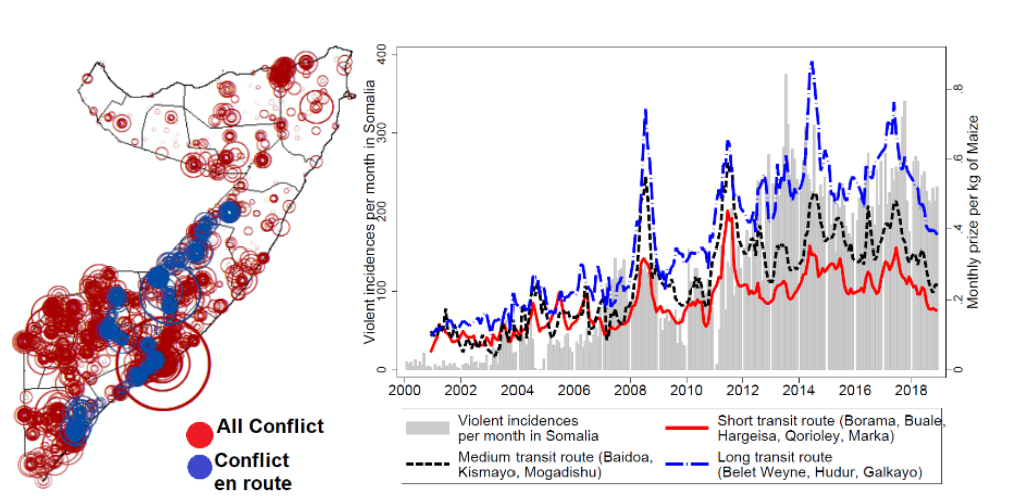
Figure 1 provides suggestive evidence on the role of conflict along transit routes. We compare maize prices across markets at short, medium, and long distances from production areas. Prior to the al-Shabaab insurgency, price trends are similar across groups. Following the increase in violence, however, prices diverge sharply, with the largest increases in markets furthest from production areas, and much smaller changes for closer markets.
Figure 1: Conflict and maize prices
Investigating this link more formally in a regression framework, we find that each additional conflict event along transport routes increases maize prices in destination markets by around 0.4%. In magnitude, these effects correspond to 15–44% of those associated with important price determinants such as production, rainfall, and drought.
The effects of conflict are felt at long distances: price effects are detectable in markets up to 900km away (roughly a 14-hour drive on Somali roads). Consistent with a causal interpretation, prices also respond sharply to sudden, event-driven changes in conflict intensity, such as battles and ceasefires.
We also provide evidence that perceived attack risk is an important mechanism of impact. We construct a forward-looking measure of risk using a kernel density of recent nearby attacks and find that high perceived risk along transport routes increases maize prices by around 6%, even when controlling for realised violence. At the same time, realised attacks retain an independent effect, consistent with both risk and actual disruptions driving price increases.
Household responses and welfare impacts
Price increases translate into substantial welfare losses for families even if they live far from conflict zones. Households substitute away from maize towards cheaper staples such as sorghum, yet we find that food security declines significantly.
We also find worsened health and education outcomes. Children in affected areas face higher incidence of infectious diseases, consistent with worsening nutrition, and primary school enrolment falls – likely reflecting tighter budgets and increased child labour.
Mechanisms: Route choice and market access
To derive policy simulations, we set up a simple model in which maize traders trade off exposure to violent attacks against travel time to find the optimal transportation route in any given month. Given that alternative routes are not realistically feasible (being around 40% longer and exhibiting similar patterns of violence), the model predicts that traders do not use secondary routes in the status quo.
Figure 2 shows several hypothetical policy scenarios and how they would affect the use of alternative routes and how they would impact prices. In the first bar, we simulate a counterfactual in which attacks along the shortest routes are eliminated (1,557 incidents). In this scenario, traders continue to use the shortest routes, but maize prices fall by around 9.8% on average for markets that experienced violence.
Figure 2: Policy simulations
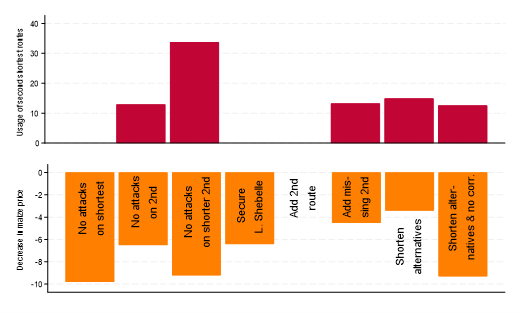
We next simulate removing attacks only from the second-shortest route. This increases their use from zero in the baseline to 12.9%, but generates only modest price reductions, around 6.5% (second bar). This limited price effect arises because alternative routes are substantially longer, so rerouting raises transport costs even as safety improves. In the third bar, when we additionally shorten the second route (reducing its relative travel time from 1.4 to 1.1 times the shortest route), its use rises to 33.7%, and price effects become much closer to those obtained when securing the primary route.
Policymakers facing limited resources may prioritise securing key distribution hubs, such as the Lower Shebelle region, which supplies seven of the eleven markets. As shown in the fourth bar, securing this corridor reduces prices by 6.4% in affected market-years. These effects amount to roughly one-third to two-thirds of those from eliminating all attacks along primary routes yet require preventing only 274 incidents – about 18% of total attacks on shortest paths. This suggests that targeted protection of strategic corridors can deliver large welfare gains at relatively low cost.
Policies that add secondary routes (of the same length or shorter) or shorten existing alternatives (bars five to seven) have only moderate price effects. By contrast, the eighth bar shows large effects when alternative routes are shortened and violence on them is decoupled from conflict on the main route.
Conflict and market access
In a final step, we broaden our analysis and examine how conflict, through its effect on trade cost, alters ‘market access’ – the degree to which markets are connected through the transport network (Donaldson 2018, Chiovelli et al. 2025) – and how these changes affect a broader set of prices.
We find that increased attacks along Somalia’s road network over the past two decades have reduced market access by close to 70%, increasing prices by 6–11% across a broader set of food and non-food goods. The effects of violence along transport routes therefore generalise beyond a single commodity and reflect a more systemic disruption of market integration.
Consistent with this interpretation, we also find that violence in other economically important cities – likely to serve as production or distribution hubs – raises non-food prices elsewhere in the network. This points to multiple channels through which conflict propagates across space.
Policy implications: Spatial targeting
Our results have significant implications for the spatial targeting of interventions. Current approaches, such as food assistance or protection policies, prioritise areas with active violence. However, our evidence shows that even relatively peaceful, far-away regions can experience negative effects through market linkages. This highlights the need to complement place-based targeting with approaches that account for economic connectivity. In practice, this could involve monitoring key supply chains, incorporating price-based indicators into early warning systems, and prioritising the security of critical transport corridors.
Our analysis also highlights the benefits of well-developed transport networks. Policymakers have long stressed Africa’s infrastructure deficit (World Bank 2023) and the transformative potential of better roads. We show that stronger transport networks can enhance economic resilience and help mitigate the adverse effects of violent conflict, a persistent challenge across the continent.
Although set in a very different context, our work also offers insights into disruptions in the Strait of Hormuz. In Somalia, the Lower Shebelle region serves as a critical transport node, and our simulations show that securing this small but strategically located area can generate large price effects across the country. The parallel with the Strait is clear: disruptions at key chokepoints can have far-reaching economic consequences.
References
Alfano, M, and T Cornelissen (forthcoming), “Spatial spillovers of conflict in Somalia”, American Economic Review.
Chiovelli, G, S Michalopoulos, and E Papaioannou (2025), “Landmines and spatial development”, Econometrica 93: 1739–1778.
Donaldson, D (2018), “Railroads of the Raj: Estimating the impact of transportation infrastructure”, American Economic Review 108(4–5): 899–934.
Foureaux Koppensteiner, M, and L Menezes (2021), “Violence and human capital investments”, Journal of Labor Economics 39(3): 787–823.
Tapsoba, A (2023), “The cost of fear: Impact of violence risk on child health during conflict”, Journal of Development Economics 160: 102975.
The World Bank (2023), Africa’s infrastructure: An agenda for transformative action.
Verwimp, P, P Justino, and T Brück (2019), “The microeconomics of violent conflict”, Journal of Development Economics 141: 102297.
World Food Programme (WFP) (2021), “Somalia country brief”, WFP Country Briefs.