





The persistence of patriarchal clan-based orders around the world is a serious hindrance to development not least because they constrain women’s emancipation. Drawing on varied empirical evidence from sub-Saharan Africa, we argue that women’s conversion to new Christian churches may be an attempt to pursue emancipation, subtly undermining clan authority.
Editor's note: The authors have made slides available here.
Women at the centre of religious change: The question and our answer
Of late, there has been a rising interest among economists to better understand the rapid spreading of new Christian churches in developing countries (Aldashev and Platteau 2014, Iyer 2016, Carvalho et al. 2019, Becker et al. 2026, Auriol et al. 2020, Hersey 2024, Costa et al. 2022, Lowes et al. 2025). One question that has been neglected, however, is the specific role of women in the success of these churches. It is striking that, in sub-Saharan Africa, a majority of the members of these churches are women. Figure 1 shows that they are almost 6 percentage points more likely than men to have joined evangelical churches (a 20% increase compared to men's membership rates). Interestingly, this sharp difference does not exist for other religious denominations.
Our research is an attempt to understand women's specific attraction to these churches in sub-Saharan Africa. We provide evidence from a randomised control trial we conducted in Benin and investigate a great variety of survey data for the whole of sub-Saharan Africa (Álvarez-Aragón, Guirkinger, and Platteau 2026).
Our findings are at odds with the conventional view that stresses the higher religiosity of women compared to men. They can be summarised in the following statement: African evangelical churches, which are typically built bottom-up, offer an effective way to escape the control of clan-based communities and, because clans are typically based on patriarchal power, they are more attractive for women than for men. What makes these churches particularly attractive is their perceived effectiveness in fighting and vanquishing the supernatural forces unleashed by any attempt to emancipate from the traditional order, based on traditional religions and the cult of ancestors. In other words, women who become economically successful are often subject to magical threats and find in new evangelical churches a spiritual liberation from these forces.
Figure 1: Women religious affiliation, compared to men
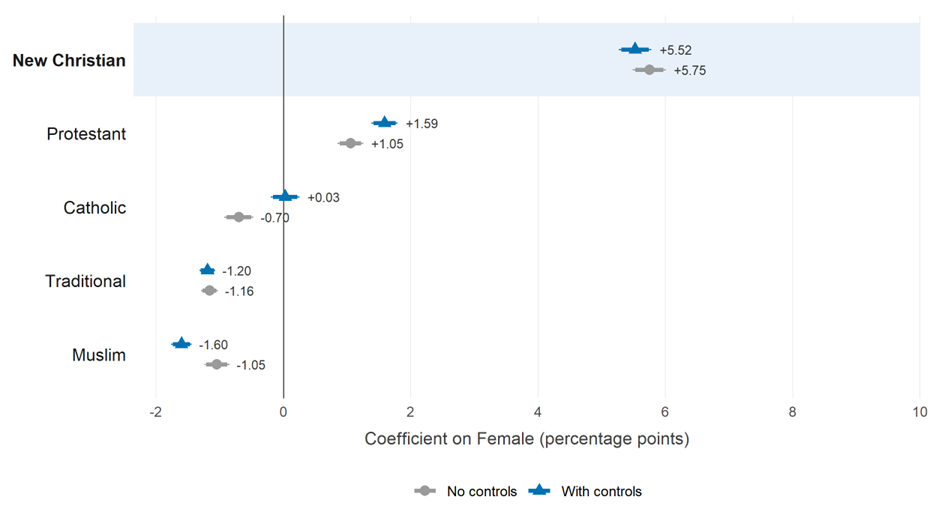
Notes: Thick band = 90% CI; thin band = 95% CI. All specifications include country-round fixed effects. Controls include age, age squared, education, marital status, labour market participation and DHS cluster fixed effects. Source: DHS data.
How a farming subsidy sparked religious conversion among women in Benin
Our experiment consists of a randomised controlled trial carried out within the context of a Belgian development project aimed at encouraging women in southern Benin to participate in the cultivation of a profitable cash crop (pineapple). It turns out that women who were randomly offered such an opportunity are significantly more likely to convert to new Christian churches (Figure 2). However, we find no clear advantage of these churches in terms of economic services as such. Instead, they appear to be particularly valued for their capacity to provide healing and protection against spiritual attacks in a situation where economically successful women are considered especially vulnerable to magical threats (Figure 2).
When entrepreneurial women begin to challenge traditional gender roles, they often encounter household and family resistance, frequently expressed through the stress and psychosomatic disorders inflicted on them by spells or curses alleged to be magical. Religious conversion then supplies a convenient response to these threats since new Christian churches claim to possess effective cures to dispel interpersonal acts of hostility disguised as spiritual attacks.
Figure 2: Intent to treat impact on women of being offered a training and subsidy program to grow pineapple in southern Benin
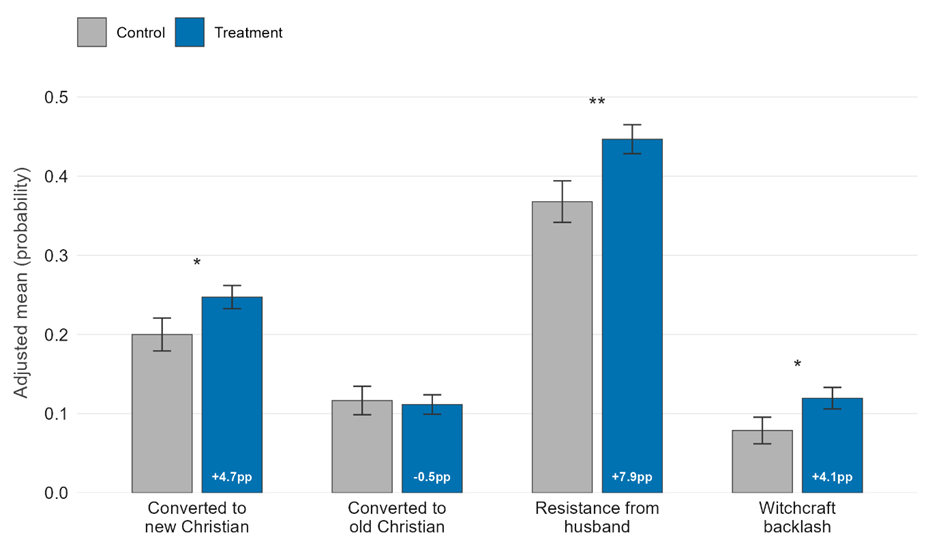
Notes: Bars are adjusted means at covariate means, estimated separately for each outcome from a regression of the outcome on a treatment indicator, age, education, baseline new-Christian status, polygamy, and non-married indicator, with department fixed effects and robust standard errors. Error bars show +/- 1 SE of the adjusted mean. Stars on the Treatment bar mark the significance of the ATE: * p < 0.10, ** p < 0.05, *** p < 0.01. Witchcraft backlash is estimated on the subsample of married women. Source: First-hand data.
In sub-Saharan Africa, positive economic shocks prompt women to join new Christian churches, especially where witchcraft beliefs are strong
These results are not specific to Benin. When we mobilise all available DHS surveys conducted in sub-Saharan Africa, we also find that the occurrence of positive economic shocks to women's incomes trigger their conversion to new Christian churches. We use two measures of positive shocks: the rise in the international price of locally suitable crops and the presence of World Bank-financed development projects that explicitly target women. In both cases, we rely on difference-in-differences estimations, exploiting variations over time in these shock indicators. The analysis leads to the same conclusion: positive shocks increase membership of new Christian churches, for women in particular (Figure 3). Moreover, the effect is stronger in areas where witchcraft beliefs are more prevalent.
Figure 3: Effect of positive economic shock on women's conversion to new Christianity
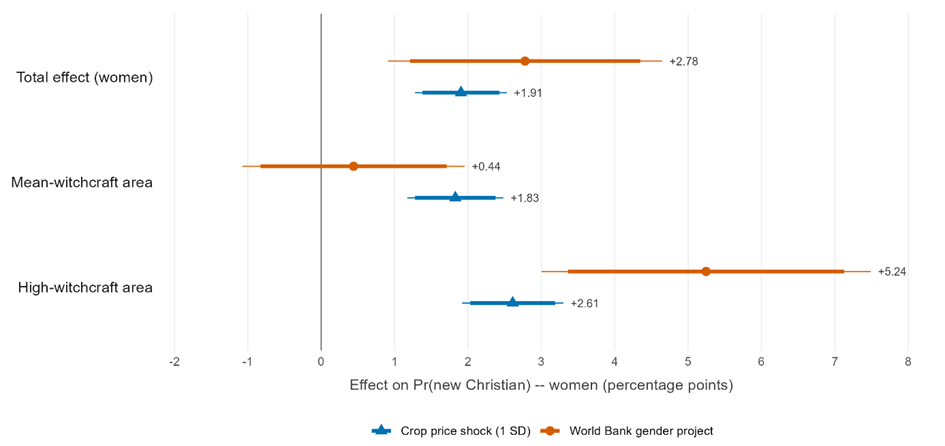
Notes: Thick band = 90% CI; thin band = 95% CI. Crop price shock specifications include grid-cell and year fixed effects, and individual controls (age, age squared, education, employment, marital status, urban/rural); World Bank gender project specifications include grid-cell and year fixed effects and control for the count of any WB projects before the survey wave. Standard errors are clustered at the cell-year level. Source: DHS data.
In addition, systematic data from cross-country surveys support the view that new Christian churches facilitate individual economic emancipation, particularly among women. Female members of these churches thus exhibit higher agency through increased labour force participation, lower fertility, and greater decision-making power. It is also striking that more than other believers or members of other Christian denominations, members of new Christian churches tend to reject traditional supernatural beliefs, rituals, and authority structures. Finally, they report a feeling of security under the protection of the Holy Spirit and embrace a doctrine of God-ordained prosperity (Figure 4).
Figure 4: Women empowerment, beliefs, and new Christianity
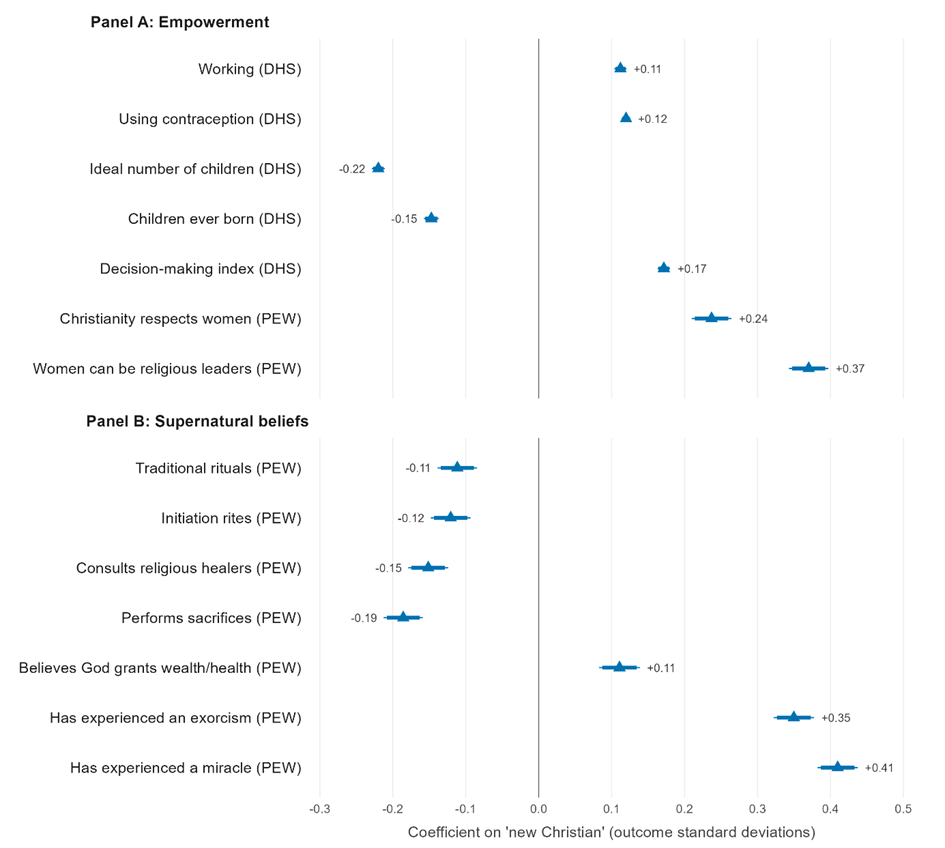
Notes: Thick band = 90% CI; thin band = 95% CI. Panel A (Empowerment): DHS rows are estimated on women (working and children ever born restricted to ages > 29 and > 24 respectively) with country and year fixed effects, controlling for age, age squared and rural/urban residence; standard errors are clustered at the DHS cluster level. Panel B (Supernatural beliefs): all rows are estimated on the pooled adult PEW sample with country fixed effects, robust standard errors, and controls for gender, age, age squared and urban rural residence. Sources: DHS and PEW data.
Conflict as inherent to women's conversion
The interpretation of our results is at odds with the idea, widespread among economists, of a strictly economic calculus in which women decide to convert if the expected economic benefits exceed the costs. This approach presents two basic limitations. First, it ignores the spiritual protection component that is critical in the case of conversion to new Christian churches and, second, it assumes that individuals (women) have full agency in the sense that their decision is unhampered by adversarial forces. In reality, what appears as purely economic decisions by women generates wide repercussions because they disturb the traditional social order. It is therefore not surprising that women's economic initiatives are often regarded as hostile behaviour by their close relatives. Conversion to a new Christian community may be a way to neutralise the latter's resistance, yet there is no guarantee that it will succeed. Indeed, women may choose to abandon plans to convert, or rescind a past conversion decision, not because the economic benefits are insufficient, but because they face such a strong marital opposition that the integrity of the family is at risk.
Women's conversion as an engine of deep change
In the African context, women emerge as central agents of change. As primary beneficiaries of the shift away from patriarchal and spiritual control, they form the majority of new converts and actively participate in religious practices that promise both spiritual empowerment and social liberation. Much like in Europe, where religious reform helped to loosen the grip of kinship structures and enabled female emancipation, the rise of new Christian churches in Africa appears to be fostering a similar transformation – one in which cultural change, rooted in spiritual renewal, may play a pivotal role in broader processes of development.
A fascinating question is whether the bottom-up movement toward women's emancipation observed in SSA today will have more immediate effects than the top-down reforms of the Catholic Church in Western Europe. The effects of these reforms played out over several centuries due to the slow enforcement of new cultural norms. This is attested by the following finding: the significant negative correlation between the spread of Christianity and the presence of clans and lineages can only be observed over a long period (Korotayev 2003).
Two final questions arise: since the argument developed here involves women, how do we account for the fact that men may also join new Christian churches? The answer is that dynamic men, especially younger men, may also want to emancipate because in the patriarchal society the authority belongs to the elders and age-based status is overwhelmingly important. In addition, traditional communities are often heterogeneous and men from marginal ethnic groups, such as immigrants, have an interest in questioning an order that stifles their aspirations for a better life. Second, we have focused on new Christian African churches, which are created bottom-up in origin. The external validity of our findings may not be guaranteed when dealing with other regions in the developing world, typically in Latin America, where evangelical churches may display other characteristics.
References
Aldashev, G, and J-P Platteau (2014), “Religion, culture, and development,” in V A Ginsburgh and D Throsby (eds), Handbook of the Economics of Art and Culture, 2: 587–631.
Álvarez-Aragón, P, C Guirkinger, and J-P Platteau (2026), “Shaking the traditional order: Women's conversion to new Christian churches in sub-Saharan Africa,” Unpublished manuscript.
Auriol, E, J Lassébie, A Panin, E Raiber, and P Seabright (2020), “God insures those who pay? Formal insurance and religious offerings in Ghana,” Quarterly Journal of Economics, 135(4): 1799–1848.
Becker, S O, J Bentzen, and C C Kok (2026), “Gender and religion: A survey,” Journal of Demographic Economics, 1–42.
Carvalho, J, S Iyer, and J Rubin (2019), Advances in the Economics of Religion, Palgrave Macmillan.
Costa, F, A Marcantonio, and R Rocha (2022), “Stop suffering! Economic downturns and pentecostal upsurge,” Journal of the European Economic Association, 21(1): 215–250.
Hersey, T (2024), “Migration, networks, and religious choice,” Unpublished manuscript.
Iyer, S (2016), “The new economics of religion,” Journal of Economic Literature, 54(2): 395–441.
Korotayev, A V (2003), “Unilineal descent organization and deep Christianization: A cross-cultural comparison,” Cross-Cultural Research, 37(1): 133–157.
Lowes, S, B Marx, and E Montero (2025), “Religion in emerging and developing regions,” Unpublished manuscript.