






When women in Saudi Arabia gained the right to drive, not all benefited equally: while some gained employment, others saw little labour market gain and instead faced tighter restrictions on their economic autonomy.
Across much of the world, legal barriers continue to constrain women's mobility, occupational choice, or ability to participate in economic life (World Bank 2022). Female labour force participation is, unsurprisingly, low in such settings (Gonzales et al. 2015, Gurbuz Cuneo et al. 2026). At the same time, it is not clear that removing such legal barriers will necessarily result in women entering the labour force, given the many other constraints to women's economic participation (Jayachandran 2021).
Two challenges make it difficult to assess whether reducing legal barriers improves women’s economic outcomes. First, legal reforms are usually implemented at scale simultaneously and frequently coincide with broader political and social changes, which can make it difficult to establish a clear comparison group, determine the direction of causality, and/or isolate the effects of any single component. Second, social norms strongly shape women's economic opportunities and decisions about work. These norms can influence how legal reforms play out in practice. In some cases, reforms may even trigger backlash if they are seen as threatening existing identities, norms, or interests. Several recent studies document this type of response (Blumenstock et al. 2022, Fouka 2020, Wheaton 2022, Abdelgadir and Fouka 2020, Gottlieb 2016, Mehmood et al. 2022, Bursztyn et al. 2020, Andrew et al. 2022, Brulé 2018, Anukriti et al. 2022).
In recent research (Abou Daher, Field, Swanson, and Vyborny 2025), we confront these challenges and offer new evidence on the impacts on mobility and employment of a major expansion of women's legal rights in Saudi Arabia.
Women's right to drive in Saudi Arabia
Our study takes place in Riyadh, Saudi Arabia, in the wake of the government's decision to lift a 61-year-old ban on women driving. The reform was part of the broader Vision 2030 agenda, which aims to increase female labour force participation and expand women's economic inclusion (Government of Saudi Arabia 2016, Alshuwaikhat and Mohammed 2017). The driving reform went into effect in June 2018 and was widely seen as a milestone for economic inclusion, though sceptics questioned whether it would meaningfully raise female employment given persistent barriers such as social stigma and family disapproval – particularly within the guardianship system – that could continue to limit women's mobility or employment (Alnahda 2019, Ali et al. 2021).

Photograph: Anadolu Agency/Getty Images
Following the reform, women could obtain a driver’s licence after completing a training course and passing a test. However, spaces were severely limited, waitlists stretched for months, and fees were SAR 3,000 (US$800) – more than six times the fee for men. As a result, two years after the ban was lifted, only 2% of women in the country had received a licence (Saudi Arabia General Authority for Statistics 2020).
Studying the impacts of Saudi Arabia’s driving reform
The limited number of training facilities restricted women's de facto access to licences but also created an opportunity to study the causal impacts of the reform. Working with a Riyadh-based nonprofit, Alnahda Society, we identified a sample of Saudi women who expressed interest in driving and offered entry into a training course to a randomly selected group, covering all fees and transportation to the training centre.
Our follow-up survey, conducted approximately two years later, collected detailed information on driving behaviour, labour force status, intrahousehold constraints, as well as participants’ own gender attitudes and their perceived beliefs of the men in their family and people in their community. Our findings highlight how a seemingly straightforward expansion of legal rights can yield complex consequences.
Lifting the driving ban led to gains in mobility and employment, but only for some
Providing access to drivers training led to a significant increase in licensing: 53% of treated women received a licence, compared to just 10% in the control group. These gains also translated into improved independent mobility – treated women were 61% more likely to have driven in the previous month and made 20% more trips without a male chaperone. At follow-up, about half of the women in the control group had not left home unchaperoned a single time the previous week, whereas treatment shifted 19% of women from making all trips with a male chaperone to traveling without one several times a week.
We also find large and significant effects on employment. Women offered access to drivers training were 41% more likely to be employed two years later, most transitioning out of unemployment, and 19% less likely to be unemployed relative to those in the control group. This shift, combined with the significant increase in employment, is consistent with a rise in regular commuting among treated women. In Riyadh, driving is often the most affordable and practical commuting option given limited public transportation and expensive ride-hailing services (Field et al. 2018). Our findings indicate that commuting costs were a binding constraint on women's employment.
Figure 1: Treatment effects on mobility and employment
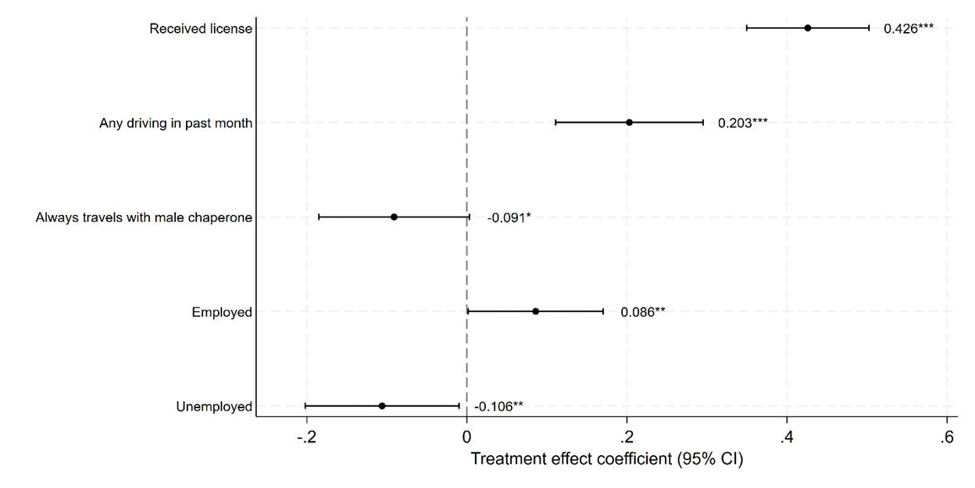
Given these results, we might expect to see similar gains in autonomy over spending and mobility. Instead, we find treated women were 19% less likely to report being able to make a purchase of SAR 1,000 without household permission. Gains in mobility and labour market participation were thus accompanied by reductions in financial autonomy, possibly because family members responded to women's increased independence by shifting towards other means of monitoring and controlling spending.
We then examine whether impacts differ across subgroups, looking specifically at age, education, and marital status, and in particular pose the question of whether household members restrict women’s spending autonomy in response to women’s increased employment or rather as a means of deterring them from seeking a job. The results are striking: younger, never married, and widowed women experience employment gains, while those above the median age, without a high school degree, or ever married conversely experience a reduction in spending autonomy.
What do younger single women have in common with widowed women? While we cannot rule out other unobserved similarities that could help explain these results, an important commonality is that neither group has a husband or co-parent with whom they must make decisions on employment and spending. Every woman has a legal male guardian – typically her father, and then her husband after marriage. In the years following our study, Saudi Arabia has introduced reforms that limit the reach of guardianship (AlOrainan 2025); however, during the period we study, if a woman divorced or was widowed, guardianship usually moved to her father or another male relative. If divorced women had children, ex-husbands also retained substantial leverage over behaviour like employment given custody laws. If husbands and ex-husbands had different views about women's autonomy than fathers or brothers, this could explain the patterns we observe. Research suggests individuals may behave more altruistically towards blood relatives (Doepke and Tertilt 2009, Case 2001), and men may face social stigma when their wives work, which could shape how they respond to women’s employment (Bernhardt et al. 2018).
Indeed, the pattern is even stronger when we compare women with a husband or co-parent to those without (never married, widowed, or divorced without children). Women without a husband or co-parent are more than twice as likely to be employed after gaining access to a licence. Conversely, married women and those divorced with children are 44% more likely to be out of the labour force altogether, and the reduction in spending autonomy is driven solely by this latter group.
Figure 2: Heterogeneous treatment effects across subgroups
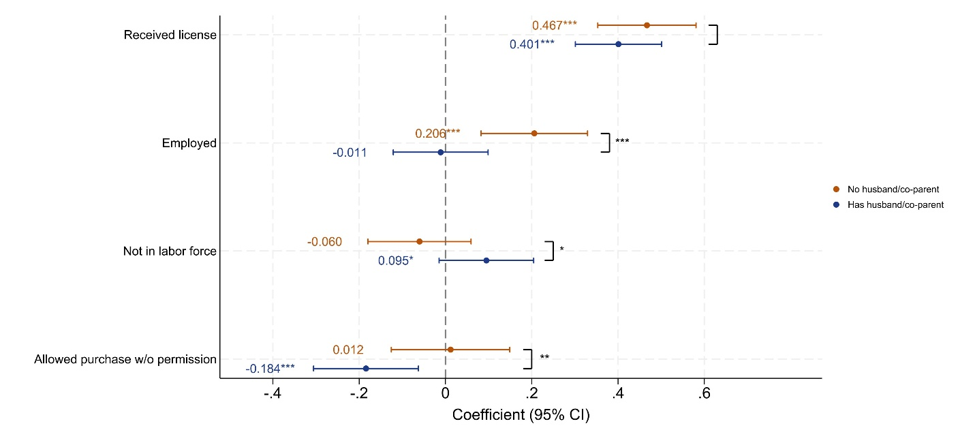
While we cannot rule out all other mechanisms, our results suggest that women who gained access to the right to drive experience backlash from male household members in two ways. For some lower commuting costs induced them to work, but as a result they faced new restrictions that limited their potential gains in financial autonomy. For others, restrictions on spending autonomy deterred them from working at all.
Policy implications: When legal reform contends with intrahousehold responses
Our results highlight how unintended negative consequences accompanied real economic gains for women in response to expanding the legal right to drive. Legal reforms can meaningfully relax binding constraints – in this case, independent mobility – but they do not operate in isolation from intrahousehold responses and social norms. As our results suggest, when women's economic opportunities expand, other forms of control may emerge that partially offset these gains.
For policymakers, removing formal legal barriers is necessary but may not be sufficient to improve women’s economic outcomes. In settings where women's bargaining power within marriage is limited, complementary efforts to shift norms may be required. Our findings underscore the importance of anticipating household responses within the context of local norms to legal change. Legal reform remains a powerful tool for expanding women’s rights, but its ultimate impact depends on the institutional and social environment into which it is introduced.
References
Abdelgadir, A, and V Fouka (2020), "Political secularism and Muslim integration in the West: Assessing the effects of the French headscarf ban," American Political Science Review, 114(3): 707–723.
Abou Daher, C, E Field, K Swanson, and K Vyborny (2025), "Drivers of change: Employment responses to the lifting of the Saudi female driving ban," American Economic Review, 115(9): 3248–3271.
Ali, S, R Alotaibi, E Field, K Swanson, K Vyborny, and C Abou Daher (2021), "Two years, two percent: Why are Saudi women still not driving?" Unpublished manuscript.
Alnahda Society (2019), "Takafu Equal Opportunity Index: Pilot Report," Alnahda Center for Research.
AlOrainan, D (2025), "Expanding women's legal autonomy: New personal status law regulations in Saudi Arabia," LSE Middle East Centre Blog, 27 February.
Alshuwaikhat, H M, and I Mohammed (2017), "Sustainability matters in national development visions: Evidence from Saudi Arabia's Vision for 2030," Sustainability, 9(3): 408.
Andrew, A, S Krutikova, G Smarrelli, and H Verma (2022), "Gender norms, violence and adolescent girls' trajectories: Evidence from a field experiment in India," Institute for Fiscal Studies Working Paper No. 22/41.
Anukriti, S, B Erten, and P Mukherjee (2022), "Women's political representation and intimate partner violence," IZA Discussion Paper No. 15395.
Bernhardt, A, E Field, R Pande, N Rigol, S Schaner, and C Troyer-Moore (2018), "Male social status and women's work," AEA Papers and Proceedings, 108: 363–367.
Blumenstock, J, O Dube, and K Hussain (2022), "Can secular media create religious backlash? Evidence from Pakistan's media liberalization," Unpublished manuscript.
Brulé, R E (2018), "Reform, representation and resistance: The politics of property rights' enforcement," Journal of Politics, 82(4): 1390–1405.
Bursztyn, L, A González, and D Yanagizawa-Drott (2020), "Misperceived social norms: Women working outside the home in Saudi Arabia," American Economic Review, 110(10): 2997–3029.
Case, A (2001), "Election goals and income redistribution: Recent evidence from Albania," European Economic Review, 45(3): 405–423.
Doepke, M, and M Tertilt (2009), "Women's liberation: What's in it for men?" Quarterly Journal of Economics, 124(4): 1541–1591.
Field, E, J Al Sudairy, K Vyborny, N Ali, W Qiu, G Ismail, and C Abou Daher (2018), "Allowing women to drive in Saudi Arabia may reduce cost of travel," Unpublished manuscript.
Fouka, V (2020), "Backlash: The unintended effects of language prohibition in U.S. schools after World War I," Review of Economic Studies, 124(2): 204–239.
Gonzales, C, S Jain-Chandra, K Kochhar, and M Newiak (2015), "Fair play: More equal laws boost female labor force participation," IMF Staff Discussion Note No. 2015/002.
Gottlieb, J (2016), "Why might information exacerbate the gender gap in civic participation? Evidence from Mali," World Development, 86: 95–110.
Government of Saudi Arabia (2016), Vision 2030.
Gurbuz Cuneo, A, A M Tribin Uribe, T Trumbic, and C Perrin (2026), "I want to break free: How laws and social norms open doors for women," World Bank Policy Research Working Paper.
Jayachandran, S (2021), "Social norms as a barrier to women's employment in developing countries," IMF Economic Review, 69(3): 576–595.
Mehmood, S, S Naseer, and D L Chen (2022), "Why are rights revolutions rare?" World Bank Blogs, 24 May.
Saudi Arabia General Authority for Statistics (2020), "Saudi women: The partner of success," GASTAT.
Wheaton, B (2022), "Laws, beliefs and backlash," Unpublished manuscript.
World Bank (2022), Women, Business and the Law 2022, World Bank.