

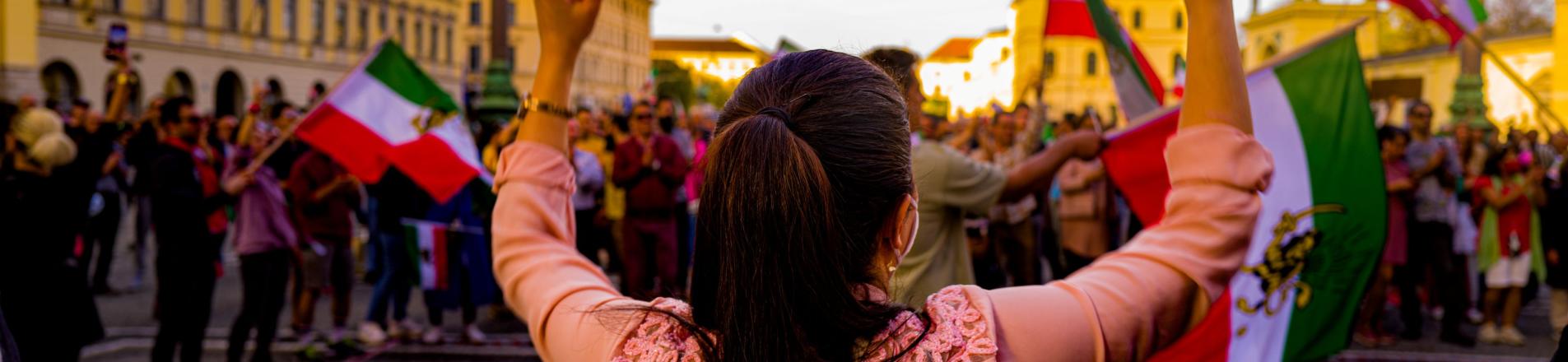

Iran’s 2022 protest movement, ‘Women, Life, Freedom’, revealed the extent of public support for women’s rights. The regime made no legal concessions, yet behaviour changed.
Can mass protest reshape behaviour and norms even when governments refuse to make concessions? The answer may depend not only on whether protest changes policy, but also on whether it changes what people learn about one another. Public signals of opinion can help citizens update their beliefs about what others think and want. In democratic societies, elections often provide such signals (Bursztyn et al. 2020). In less democratic settings, where elections are not credible measures of public sentiment, mass protest may instead make private beliefs publicly visible.
When protest changes society: Iran’s Women, Life, Freedom Movement
On September 16, 2022, Mahsa Jina Amini, a 22-year-old Kurdish-Iranian woman visiting Tehran was pronounced dead while in the custody of Iran’s morality police, where she was detained for allegedly violating the mandatory hijab law. Her death ignited a significant wave of street protests. Over the following four months, more than 800 protest incidents were recorded across 151 of Iran’s 428 counties.
The movement, known as ‘Women, Life, Freedom’ (WLF), centred on Iran’s mandatory hijab law, which requires women and girls above the age of nine to cover their hair and bodies in public, and has been in place since shortly after the Islamic Revolution of 1979. The regime responded to the protests with a brutal crackdown, in which at least 537 people were killed, and tens of thousands were detained (Loft 2023). No legal reforms followed, and the hijab law remains in place to date.
This setting provides an opportunity to examine whether mass protest can shift norms and behaviour even when the laws governing that behaviour remain unchanged. In Ghazarian (2025), I study this question by examining changes in (1) women’s compliance with the hijab law, (2) their bargaining position within the household, and (3) their outcomes in the labour market.
Women’s compliance with the mandatory hijab law
For decades, the mandatory hijab law has functioned as one of the regime’s clearest tools of social control, regulating how women appear in public and, over time, shaping social norms around what is considered an acceptable appearance for women. Compliance, therefore, has reflected not only fear of state punishment, but also concern about the potential social consequences of non-compliance.
In the midst of the WLF movement, women began publicly removing their headscarves as a visible act of protest against the law. While this behaviour could be interpreted as an expression of anger in the heat of the moment, its persistence after the protests subsided, despite the absence of legal change, suggests a shift in social norms regarding acceptable public appearance.
Tracing such shifts, however, poses empirical challenges. Conventional surveys do not measure veiling practices in Iran, and primary data collection on compliance with a law that is actively enforced would likely suffer from severe reporting bias. I address this by constructing a novel dataset from publicly posted images on Instagram, the dominant social media platform in Iran, and developing a machine learning image classifier to detect whether women in images appear veiled or unveiled. The classifier follows explicit labelling criteria. A woman is classified as veiled if she wears a headscarf covering at least part of her head, even when some hair, ears, or neck remain visible. Conversely, women without a headscarf are classified as unveiled.
The classifier, applied to posts specific to Iran collected from 2020 through 2025, reveals that the share of unveiled women in the sample remained low and stable through 2022, then jumped by roughly 23 percentage points immediately after the protest movement subsided in early 2023, and has remained elevated, well above pre-movement levels, ever since.
Figure 1: Trends of women’s unveiled appearances
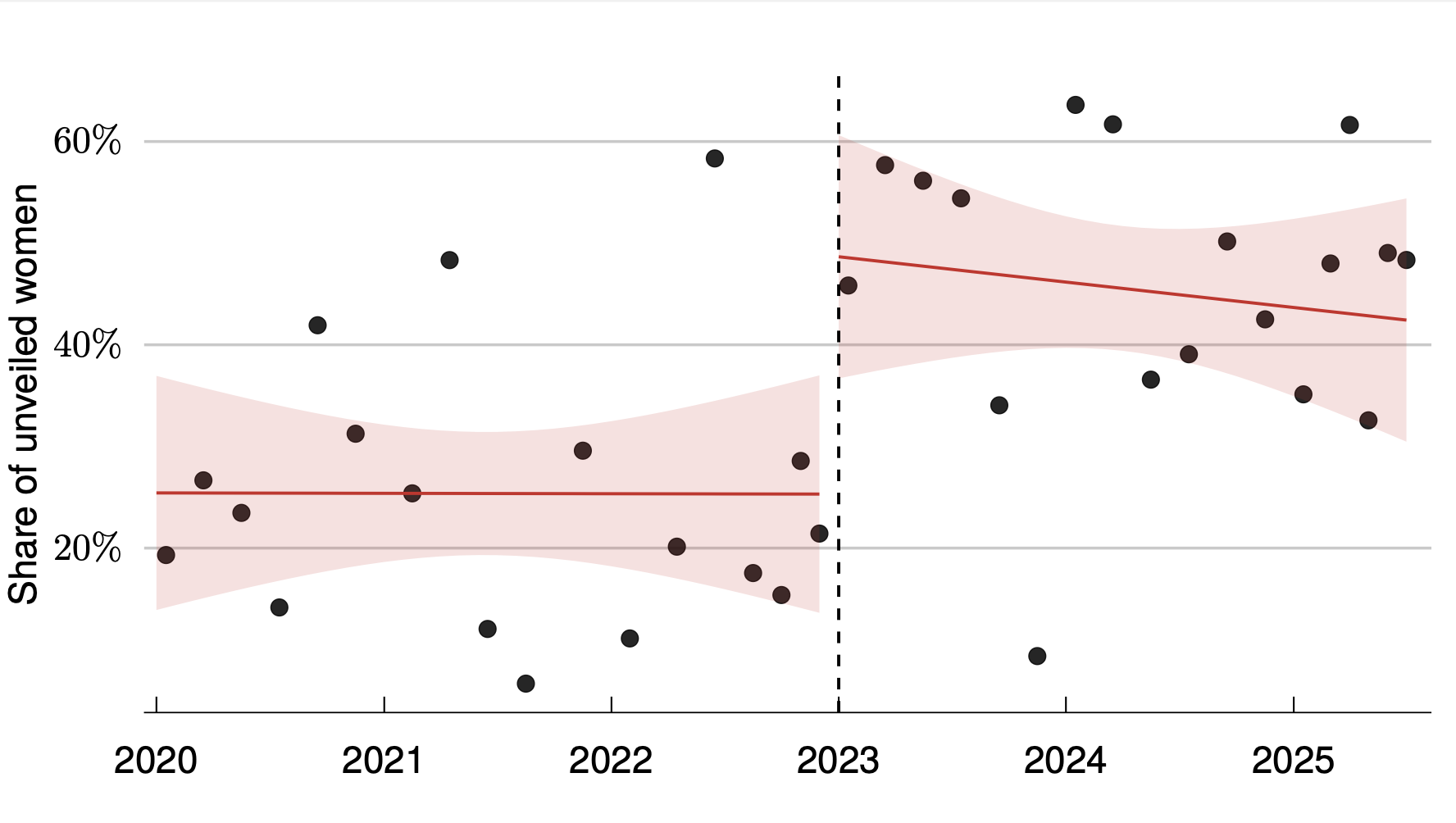
Note: This figure shows the monthly share of women appearing unveiled in Instagram posts from Iran between 2020 and 2025. The fitted lines show estimated trends before and after the protest period. The vertical dashed line marks January 2023, the end of the WLF protest period.
The persistence of this shift, nearly three years on, is notable. The mandatory hijab law did not change, and the regime did not concede on the central demand of the movement. Yet behaviour changed and has not reverted, suggesting that the protests altered the boundaries of what is considered socially acceptable.
Beyond the street: Shifts in bargaining dynamics within households
The public nature of the WLF movement raises a question about whether its effects extended beyond the street. Participation in, or even exposure to, collective action has the potential to shift perceptions of women’s agency and bargaining power within the household. Evidence from the Arab Spring provides one such case (Bargain et al. 2019). The WLF movement is a particularly compelling setting to examine this channel. For the first time in decades, women publicly and collectively rejected a core symbol of state-imposed gender norms. If this visible assertion of rights altered perceptions of women’s position within the household, it may have generated spillovers into the domestic sphere. I therefore examine whether exposure to the protest incidents translated into actual changes in women’s bargaining position within the household.
Since bargaining power is fundamentally unobservable, I focus on the intra-household allocation of resources as a proxy. Specifically, the core outcome of interest is the resource share of each household member, defined as the fraction of total household expenditure allocated to that member. Resource shares are closely tied to bargaining dynamics within the household and have been used in the literature as a measure of relative bargaining power (Browning et al. 2013, Calvi 2020).
Using Iran’s 2020–2024 Household Income and Expenditure Survey (HIES) data, I follow the structural approach proposed by Lechene et al. (2022) to estimate individual resource shares. This allows me to measure how total household spending is allocated across household members. I then compare how these shares evolved before and after the movement in counties that experienced protest activity relative to those that did not.
Figure 2: Event-study of protest exposure and intra-household resource shares

Note: This figure shows estimated changes in women’s and men’s resource shares relative to the quarter of the WLF movement (Quarter 0), using Iranian HIES data from 2020 to 2024. Dots show point estimates and vertical bars show 95% confidence intervals. The right panel restricts the sample to households without young children.
As shown in Figure 2, the findings point to a reallocation of resources within exposed households. In households located in counties with protest activity, women’s share of total household resources increased, while men’s share declined. This pattern is most pronounced in households without young children, where women gain roughly 2% of total household resources, and men lose a similar amount. In households with children, the pattern differs slightly, as men’s shares still fall, but women’s gains are smaller, and children emerge as the main beneficiaries.
What did not change, at least not yet
Labour market outcomes move little in response to protest exposure. This is unsurprising in a context where female labour force participation (FLFP) has remained persistently low. In Iran, the FLFP rate stands at roughly 14%, well below global and regional averages. As in many countries across the MENA region, low FLFP appears to reflect a broader set of constraints than the norms alone (Hendy 2026), and the relatively short time horizon of this study may also limit the ability to detect labour market responses.
Figure 3: Female labour force participation rate over time
Lessons beyond Iran
The broader lesson from the WLF movement is that institutional reform is not necessarily a precondition for social change. Even in the absence of legal concessions, moments of collective action can reveal previously hidden preferences and potentially shift beliefs that may consequently leave a lasting mark on behaviour. Along the same line, the findings highlight the importance of information provision in settings where typical aggregators of private opinion are either unavailable or lack credibility.
References
Bargain, O, D Boutin, and H Champeaux (2019), “Women’s political participation and intrahousehold empowerment: Evidence from the Egyptian Arab Spring,” Journal of Development Economics, 141: 102379.
Browning, M, P A Chiappori, and A Lewbel (2013), “Estimating consumption economies of scale, adult equivalence scales, and household bargaining power,” Review of Economic Studies, 80(4): 1267–1303.
Bursztyn, L, G Egorov, and S Fiorin (2020), “From extreme to mainstream: The erosion of social norms,” American Economic Review, 110(11): 3522–3548.
Calvi, R (2020), “Why are older women missing in India? The age profile of bargaining power and poverty,” Journal of Political Economy, 128(7): 2453–2501.
Ghazarian, A (2025), “Veils of change: The anatomy of social transformation in post-protest Iran,” Unpublished manuscript.
Hendy, R (2026), “Why is female labour force participation still so low in Egypt?” VoxDev.
Lechene, V, K Pendakur, and A Wolf (2022), “Ordinary least squares estimation of the intrahousehold distribution of expenditure,” Journal of Political Economy, 130(3): 681–731.
Loft, P (2023), “Iran protests 2022: Human rights and international response,” House of Commons Research Briefing.