







Local elections have the potential to disrupt the ‘business-as-usual’ culture that often settles in bureaucracies. Evidence from village elections in Indonesia shows that changes in leadership improve information flows between citizens and the state, revitalise bureaucracies, and improve public service delivery.
Editor’s note: For a broader synthesis of themes covered in this article, check out our VoxDevLit on Bureaucracy.
Turnover in governmental organisations involves a fundamental trade-off. Enabling citizens to replace their leaders via democratic elections might weaken institutional memory and disrupt bureaucratic processes (Akhtari et al. 2022). However, it may also create new impetus for reform and break entrenched elite networks (Cruz et al. 2017). Understanding which effect dominates is important in the context of developing countries, many of which have implemented ambitious decentralisation reforms empowering local governments to provide essential public goods, often with limited bureaucratic capacity and accountability (Besley et al. 2022, Finan et al. 2017).
Indonesian villages as ‘laboratories of democracy’
Indonesia’s 75,000 villages provide a rich setting to study the consequences of turnover in local governments.
First, village elections are highly competitive (Aspinall and Rohman 2017, Berenschot et al. 2021), enabling frequent leadership change. Second, village officials work in close proximity to citizens. More than half of village bureaucrats report interacting with citizens daily. Importantly, these interactions may facilitate valuable information exchange between officials and the citizens they serve. In this context, understanding whether policy decisions are aligned with citizens’ priorities is key to evaluate the performance of local governments.
Third, village heads can reshape the bureaucracy. They might do so by appointing new officials, encouraging incumbents to step down, and/or reallocating staff across roles. This discretion creates an opening for nepotistic appointments. In our survey data collected with village officials, one-fifth of serving bureaucrats report having a parent who previously held a position in the village government.
Fourth, village governments manage substantial public resources. Annual budgets average IDR 1.26 billion (approximately US$83,000). These resources are intended to fund investments in public goods, social assistance, and community development programmes.
Dual perspectives of bureaucrats and citizens
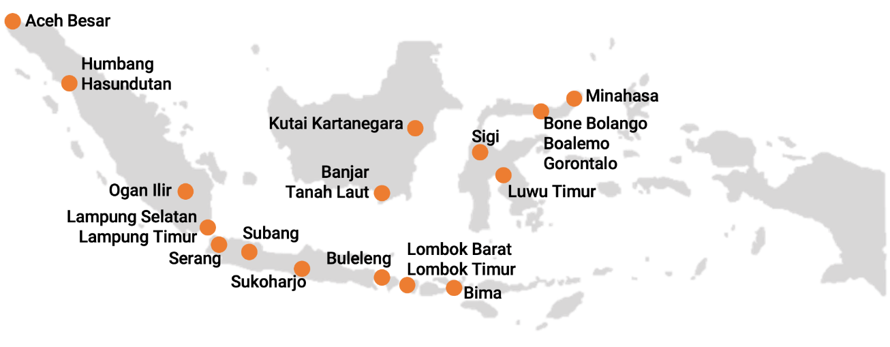
In 2022, we interviewed village heads, bureaucrats, and citizens in 852 villages across the Indonesian archipelago (Figure 1). We collected detailed measures of bureaucrats’ characteristics as well as citizens’ perceptions of local service quality and attitudes towards the village government. We also asked village officials and citizens to identify their top priorities for future development spending. This two-sided approach allowed us to compare the priorities and perceptions of officials with those of citizens. We complemented this survey data with detailed administrative records on village-level public goods, providing an independent measure of service quality.
Figure 1: Survey sample
To isolate the effects of leader turnover, we compare villages where incumbents narrowly lost the most recent village election (resulting in turnover) with villages where they narrowly won (no turnover). Because these races are often decided by very small margins, the resulting comparison approximates a natural experiment.
Electoral turnover drives bureaucratic turnover, and reduces nepotism
In recent research (Bazzi et al. 2026), we find that new village leaders make more appointments, promotions, and demotions than re-elected incumbents. This reshaping of the village bureaucracy reduces the prevalence of nepotistic appointments: the share of bureaucrats reporting that a parent previously served in the village administration falls by roughly 17 percentage points following a change of leadership (Figure 2). This shift is consequential, as our data shows that nepotism is associated with lower service quality.
Bureaucrats in villages that experienced a turnover also report higher morale. While newly appointed bureaucrats exhibit the largest gains, long-serving bureaucrats retained after turnover also report higher – though not statistically significant – levels of enthusiasm and motivation. Finally, long-serving bureaucrats in turnover villages exert higher effort by interacting more regularly with citizens.
Figure 2: Electoral turnover and bureaucrats
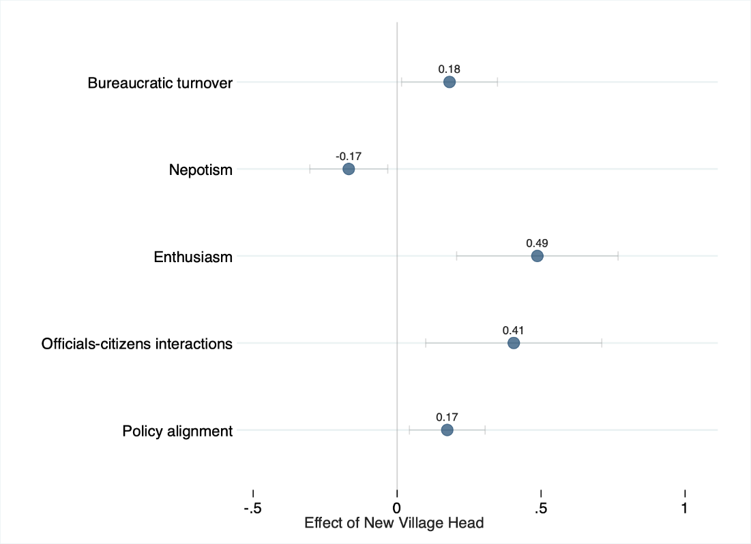
Notes: This figure reports regression discontinuity estimates of the effect of electing a new village head. Points show estimated effects and horizontal bars indicate 95% confidence intervals. Outcomes are bureaucratic turnover (the share of bureaucrats appointed since the last election), an indicator for whether a bureaucrat reports having a parent who served in the village government, standardised indices of self-reported enthusiasm and bureaucrat–citizen interactions, and an indicator for whether a bureaucrat reports receiving complaints about at least one public service that a majority of village residents rank among the three lowest-quality services.
Governments cannot act on what they don’t know
Why do these changes matter? One possibility is that greater engagement between citizens and officials improves the flow of information within the government. Consistent with this, we find that officials and citizens in turnover villages are more closely aligned in their assessments of which public goods and services require attention. For example, they are more likely to share similar views on which public services are of poor quality in the village.
In turn, improved information flows between citizens and officials improve the delivery of essential public goods. Village heads in turnover villages are more likely to take action on the services that have generated complaints from citizens (Figure 3). Citizens independently report improvements in public goods provision, and administrative Village Potential Statistics (PODES) data corroborate these changes.
Importantly, all three sources – official surveys, citizen surveys, and administrative records – identify the same sectors in which these improvements occur, such as road maintenance. One type of service that citizens consistently flag as an investment priority – garbage collection – exhibits marked quality improvements in turnover villages (Figure 3).
Figure 3: Electoral turnover and public goods – three perspectives
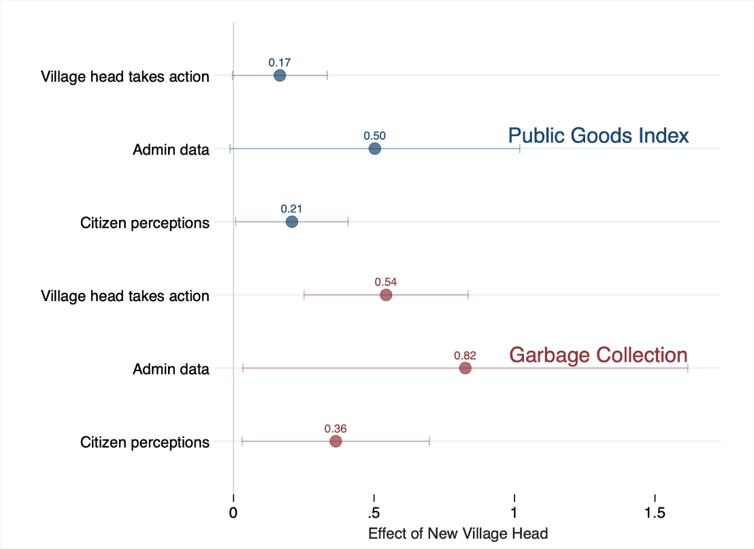
Notes: This figure reports regression discontinuity estimates of the effect of electing a new village head on public goods provision. Points show estimated effects and horizontal bars indicate 95% confidence intervals. Outcomes are measured using three sources: village heads' reports of actions taken to improve services, an administrative index of public service provision, and a standardised index based on citizens' ratings of service quality. The top panel reports effects for a composite public goods index, and the bottom panel reports effects for garbage collection only.
Lessons for policy: Electoral accountability
Our results point to the importance of electoral accountability in shaping how local democracy functions in practice. At a time when democratic institutions face growing scepticism worldwide, our results suggest that regular elections can help improve the quality of local governance by disrupting nepotistic networks, and by making bureaucracies more responsive and service delivery more effective. In that sense, the ability of elections to periodically shift power – even at very local levels – may be one important channel through which democracy delivers tangible benefits to citizens.
References
Akhtari, M, D Moreira, and L Trucco (2022), "Political turnover, bureaucratic turnover, and the quality of public services," American Economic Review, 112(2): 442–493.
Aspinall, E, and N Rohman (2017), "Village head elections in Java: Money politics and brokerage in the remaking of Indonesia's rural elite," Journal of Southeast Asian Studies, 48(1): 31–52.
Bazzi, S, M Hilmy, B Marx, M Shaukat, and A Stegmann (2026), "It takes a village election: Turnover and performance in local bureaucracies," CEPR Discussion Paper No. 19994.
Berenschot, W, W Capri, and D Dhian (2021), "A quiet revolution? Village head elections and the democratization of rural Indonesia," Critical Asian Studies, 53(1): 126–146.
Besley, T, R Burgess, A Khan, and G Xu (2022), "Bureaucracy and development," Annual Review of Economics, 14(1): 397–424.
Cruz, C, J Labonne, and P Querubin (2017), "Politician family networks and electoral outcomes: Evidence from the Philippines," American Economic Review, 107(10): 3006–3037.
Finan, F, B A Olken, and R Pande (2017), "The personnel economics of the developing state," in A V Banerjee and E Duflo (eds), Handbook of Economic Field Experiments, Volume 2, North-Holland: 467–514.
Xu, G, E Deserranno, D Moreira, and E Teso (2023), "Bureaucracy," VoxDevLit, 8(1).