





Can a small pilot project still be effective when scaled up to reach millions? New evidence shows digital advisory can help farmers who experience weather shocks to obtain higher yields.
Smallholder farmers experience persistently low agricultural productivity and face rising risks from climate change, including erratic rainfall and more frequent extreme weather events (Suri 2024). Timely, localised advice could help farmers make informed agricultural decisions and better adapt to these growing risks. With widespread mobile phone ownership, digital advisory services provide governments with a scalable and cost-effective means to support smallholder farmers.
Previous research has demonstrated that a wide range of digital advisory services—delivered via SMS, IVR, video, and smartphone apps—could improve agricultural practices and outcomes across different contexts (Arouna et al. 2020, Baul et al. 2024, Cole and Fernando 2021, Fabregas et al. 2025). A meta-analysis of six studies across five countries shows that these services, on average, boost yields (Fabregas et al. 2019). However, much of the existing evidence comes from targeted programmes focused on specific practices. Less known is whether large-scale, comprehensive digital services—designed to serve diverse farming communities and respond to real-time needs—can deliver meaningful impacts. Our new randomised controlled trial (RCT) from India, conducted in collaboration with the Government of Odisha and Precision Development (PxD), shows that they can (Cole, Goldberg, Harigaya, and Zhu 2025).
Customised digital advisory improves farming practices, yields, and crop protection
We conducted a three-year RCT to evaluate the impact of Ama Krushi, a two-way voice-based advisory service operating in Odisha, a coastal state highly prone to natural calamities. This service delivers weekly agricultural advice to farmers’ phones and allows farmers to call in to ask agricultural questions. Advisory content spans the full crop cycle—from land preparation to harvest and post-harvest processes—and provides real-time alerts and mitigation advice for pests and weather events.
In 2021, we recruited 13,675 rice farmers from five of the thirty districts in Odisha and offered randomly selected farmers access to Ama Krushi. The findings discussed here are based on two rounds of survey data collected from 5,204 farmers following the main agricultural ‘Kharif’ seasons in 2021-2022 (Year 1) and 2022-2023 (Year 2).
Farmers were very interested in receiving digital advice. Nearly all farmers who were offered the service registered, and most (94% in Year 1 and 85% in Year 2) accessed agricultural content during the cultivation season. Each season, farmers listened to the majority of the content in 10 calls on average, approximately one-quarter of the advisory calls they received.
Access to the service led to improvements in agricultural knowledge and practices: treated farmers were more likely to identify correct management practices and report adopting recommended practices. Notably, these changes were accompanied by modest but meaningful gains in outputs, as illustrated in Figure 1—a 1.7% higher yield (kg/ha) and a 4.1% increase in total harvest (kg) across two seasons.[1]
Figure 1: The average impact of treatment on total rice farming
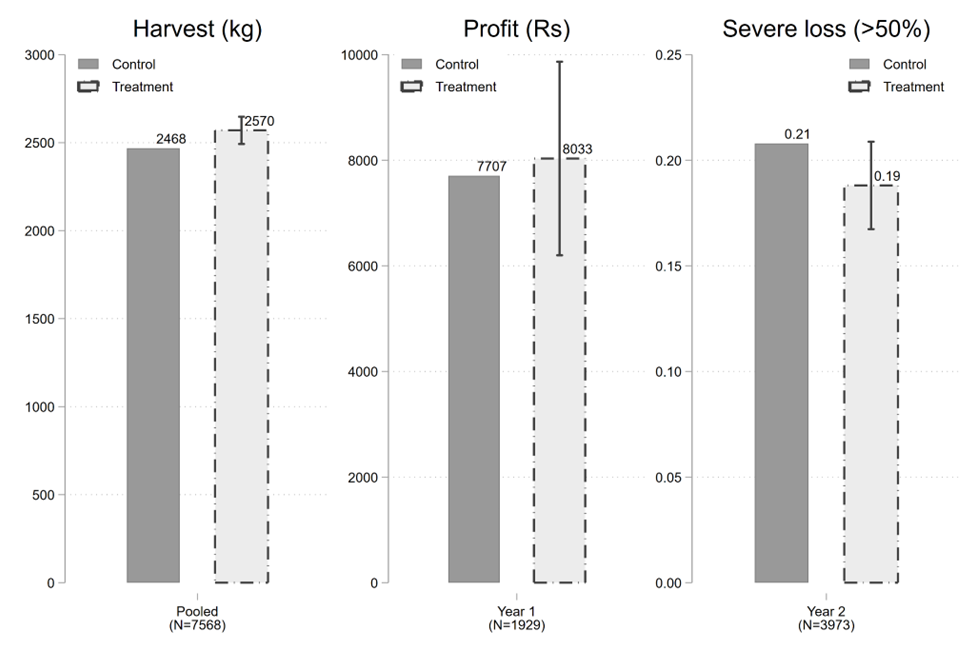
Note: These figures show the average treatment impacts on outcomes (1) total rice harvest (kg) using pooled two-year data, (2) the imputed profit of rice harvest in Year 1, and (3) a dummy variable indicating whether farmers experienced severe rice loss that was greater than 50% of rice crops in Year 2. The bars represent the 95% confidence interval.
While average impacts on profits (measured in Year 1 only) were not statistically significant, the direction of the effects was consistently positive across revenue and profit outcomes. Additionally, we find strong evidence that Ama Krushi helped farmers avoid costly crop losses (measured in Year 2 only). Among control farmers, 61% reported losing some portion of their rice crop, and 21% experienced severe losses of greater than 50%. Access to Ama Krushi reduced the likelihood of severe crop loss by 10%, with particularly large reductions in losses due to pests and diseases (26%) and weather-related events other than floods (24%).
Large impact in areas hit by excess or inadequate rainfall
These large reductions in crop loss among treated farmers suggest that digital advisory services may be particularly effective when farmers experience weather shocks. To explore this further, we use publicly available rainfall data and government reports on natural calamities to identify four major adverse weather events during the evaluation period. The two agricultural seasons were marked by distinctly different weather patterns. In the first year, farmers faced concentrated, extremely heavy rainfall in the early growing season, followed by an unseasonal cyclone during harvest. In contrast, the second year began with intense rainfall shortly after transplanting, causing river flooding in some areas, and was followed by persistently low rainfall across much of the growing season in several districts (Figure 2).
Figure 2: Rainfall patterns during the Kharif growing season in 2021 and 2022
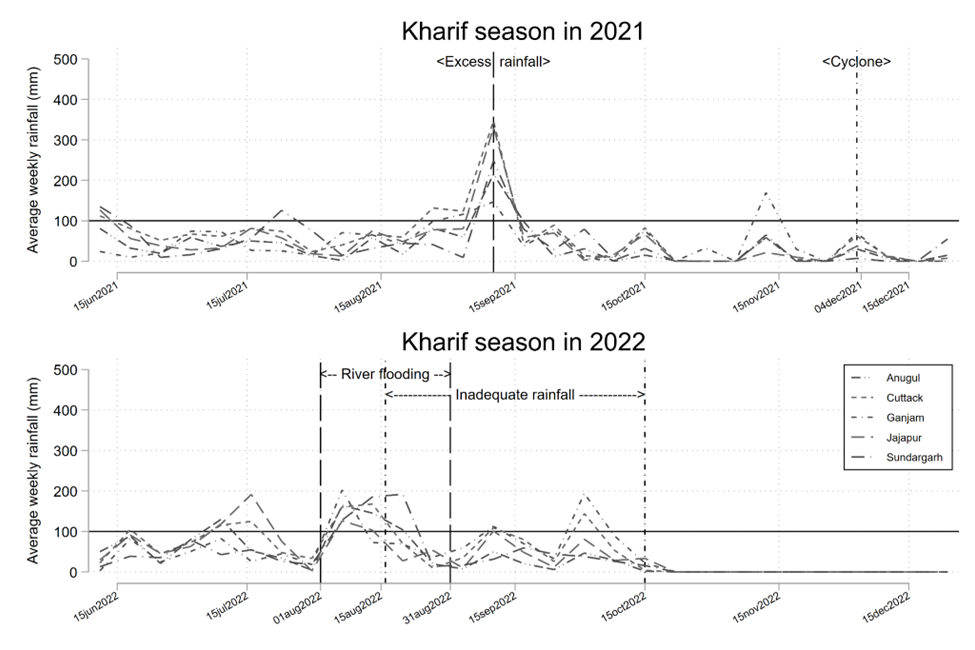
Note: The figures show the mean block-level rainfall during the Kharif season by district. The horizontal line indicates the level of rainfall (100 mm) needed for rice cultivation during the growing stage. In 2021, the spike in the time window from September 1 to 15 indicates the extremely heavy rainfall that submerged a large proportion of rice fields in some study blocks. In 2022, the mean rainfall between August 15 and October 15 dipped below the indicative minimum required rainfall in three out of five districts.
Our analysis suggests that the impact of Ama Krushi is concentrated in areas that experienced excess rainfall in Year 1 and inadequate rainfall in Year 2, generating large gains for farmers exposed to these unanticipated weather shocks.
In areas hit by excess or inadequate rainfall, treated farmers with access to Ama Krushi consistently reported better agricultural outcomes than control farmers, as shown in Figure 3. For instance, treated farmers had a 9.4% and 11.6% higher rice harvest in areas affected by excess rainfall and inadequate rainfall, respectively. Moreover, access to digital advice led to a 14-30% increase in profit in areas with excess rainfall in Year 1, and a 21% reduction in the likelihood of severe crop loss in areas with inadequate rainfall in Year 2.
Figure 3: The heterogeneous treatment impact on total rice farming by weather shocks
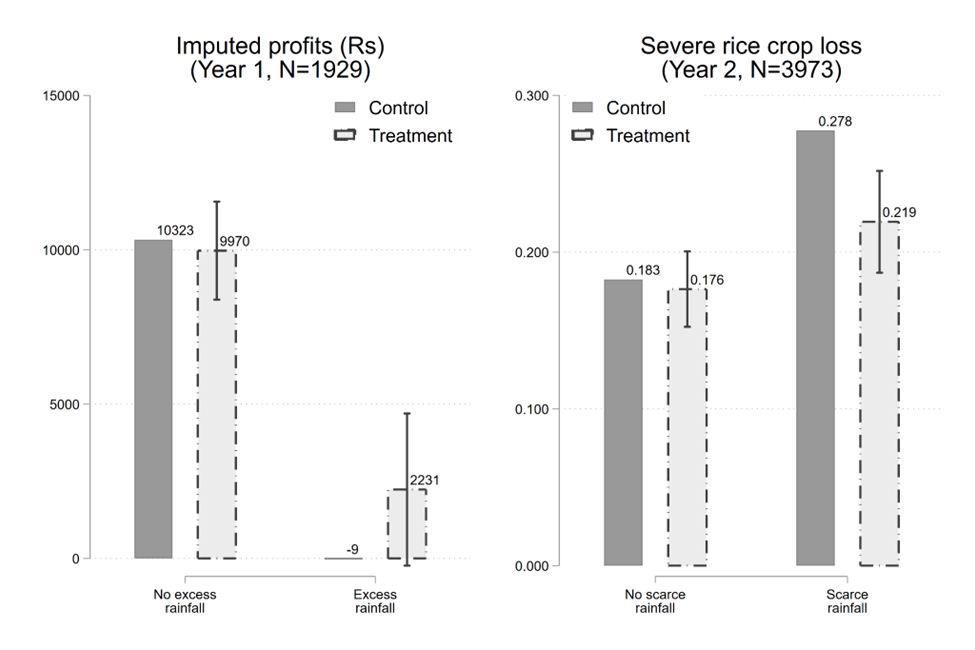
Note: These figures show the average treatment impacts on outcomes (1) the imputed profit of rice harvest in Year 1, and (2) a dummy variable indicating whether farmers experienced severe rice loss that was greater than 50% of rice crops in Year 2, in areas with or without weather shocks. The bars represent the 95% confidence interval.
In contrast, we find no treatment impact in areas affected by river flooding, suggesting that the service did not protect farmers from every weather shock. In the control group, 45% of farmers in affected areas reported losing more than 50% of their crops. For catastrophic events like river flooding, there may be limited real-time advice that could help farmers mitigate the extreme damage.
Our study was not designed to tease out which specific pieces of advice were most valuable to farmers. However, we posit that the gains around weather shock could come from three complementary mechanisms: (1) precautionary advice could boost crops’ resilience, (2) real-time alerts and post-shock advice could help farmers mitigate damage and recover effectively, and (3) general agricultural advice may have higher returns in places where conditions are more variable.
Demonstrated cost-effectiveness at scale in a changing climate
Our study highlights when and how digital advisory tools can deliver meaningful value to farmers.
In a world with constrained resources, it is crucial to consider cost-efficacy. One key advantage of digital advisory services is their ability to scale rapidly at a low marginal cost, increasing returns on investment with scale. Ama Krushi grew its user base from 1.37 million farmers in 2021 to nearly 7 million farmers by the end of 2023. Based on at-scale farmer reach, cost of service delivery, and historical incidence of rainfall shocks, we estimate a long-run benefit-cost ratio ranging from 12:1 to 19:1.
The service also proved especially valuable for farmers exposed to adverse weather conditions. While the average impacts across all farmers who gained access to Ama Krushi were modest, it delivered substantial benefits to those facing excess or inadequate rainfall. Importantly, different groups of farmers benefited from the service in different seasons: the absence of impact in a particular context does not imply limited value—only that benefits may emerge under specific conditions.
As climate change increases weather variability and frequency of extreme weather events, farmers’ need for localised advice and real-time alerts will continue to grow. Future innovation and research may focus on leveraging advanced technologies to expand the scope of localised, real-time information that can help farmers manage evolving climate risks more effectively.
References
Arouna, A, J D Michler, W G Yergo, and K Saito (2020), “One size fits all? Experimental evidence on the digital delivery of personalized extension advice in Nigeria,” American Journal of Agricultural Economics, 103: 596–619.
Baul, T, D Karlan, K Toyama, and K Vasilaky (2024), “Improving smallholder agriculture via video-based group extension,” Journal of Development Economics, 169: 103267.
Cole, S and N Fernando (2021), “‘Mobile’izing agricultural advice: Technology adoption diffusion and sustainability,” The Economic Journal, 131: 192–219.
Cole, S, J Goldberg, T Harigaya, and J Zhu (2025), “The impact of digital agricultural extension service: Experimental evidence from rice farmers in India,” Unpublished manuscript.
Fabregas, R, M Kremer, M Lowes, R On, and G Zane (2025), “Digital information provision and behavior change: Lessons from six experiments in East Africa,” American Economic Journal: Applied Economics, 17: 527–66.
Fabregas, R, M Kremer, and F Schilbach (2019), “Realizing the potential of digital development: The case of agricultural advice,” Science, 366.
Suri, T (2024), “Strengthening climate resilience in agriculture,” VoxDevTalk.